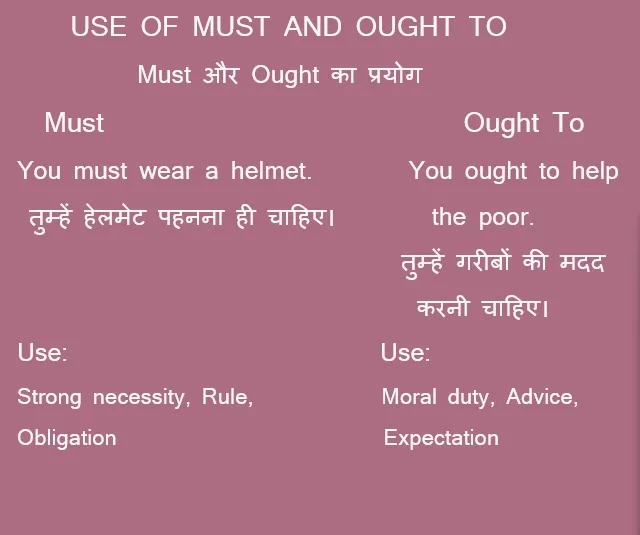
❖ ‘’MUST’’ – Definition
• Must is a Modal verb used to express:
• Strong necessity or obligation (something that is required).
• Prohibition (when used is negative).
• Logical certainty or strong deduction.
• Strong advice or recommendatiom.
• Must एक सहायक क्रिया है जिसका प्रयोग किया जाता है:
• कठोर आवश्यकता या दायित्व (जो करना अनिवार्य हो)।
• मनाही या निषेध (Negative में प्रयोग होने पर)।
• पक्की संभावना या निश्चित अनुमान।
• मजबूत सलाह या सिफारिश देने के लिए।
Must Meaning in Hindi
इसके वाक्य के अंत में, चाहिये, अवश्य चलाएं, जरूर चाहिए, होगा, अवश्य होगा, जरूरी होगा, जैसे शब्द आते हैं।
Read Also
• Use of Can & Could
• may, might
• should,Would
• Shall,will
• need to
• dare
• Use of Used to
• POSITIVE SENTENCE (सकारात्मक वाक्य)
Examples (उदाहरण):
1.You must work hard to succeed.
सफल होने के लिए तो मैं कड़ी मेहनत करनी चाहिए।
2.We must respect our elders.
हमें अपने बड़ों का सम्मान करना चाहिए।
3.He must finish his homework before playing.
उसे खेलने से पहले अपना होमवर्क पूरा करना चाहिए।
4.I must drink enough water everyday.
मुझे रोज़ पर्याप्त पानी पीना चाहिए।
5.They must reach school on time.
उन्हें समय पर स्कूल पहुंचना चाहिए।
6.She must learn English to get a good job.
उसे अच्छी नौकरी पाने के लिए अंग्रेजी सीखनी चाहिए।
7.We must protect the environment.
हमें पर्यावरण की रक्षा करनी चाहिए।
8.You must wear a seat belt while driving.
गाड़ी चलाते समय तुम्हें सीट बेल्ट पहननी चाहिए।
9.Children must listen to their parents.
बच्चों को अपने माता पिता की बात सुननी चाहिए।
10.I must call my friends today.
मुझे आज अपने दोस्त को फ़ोन करना चाहिए।
Read Also
• Model- Auxiliary verb
• Sentence - Types of Sentence
• Parts of Sentence
• Affirmative Sentence
• NEGATIVE SENTENCE (नकारात्मक वाक्य)
Examples (उदाहरण):
1.You must not a lie.
तुम्हें झूठ नहीं बोलना चाहिए।
2.We must not waste water.
हमें पानी बर्बाद नहीं करना चाहिए।
3.He must not fight with others.
उसे दूसरे से झगड़ा नहीं करना चाहिए।
4.Children must not disobey their parents.
बच्चों को अपने माता पिता की अवज्ञा नहीं करनी चाहिए।
5.Students must not use mobile phones in class.
छात्रों को कक्षा में मोबाइल फ़ोन इस्तेमाल नहीं करना चाहिए।
6.We must not forget to lock the door.
हमें जानवरों को नुकसान नहीं पहुंचाना चाहिए।
7.You must not forget to lock the door.
तुम्हें दरवाजा बंद करना भूलना नहीं चाहिए।
8.He must not drive so fast.
उसे इतनी तेज गाड़ी नहीं चलानी चाहिए।
9.They must not make noise in the library.
उन्हें पुस्तकालय में शोर नहीं करना चाहिए।
10.I must not waste my time on useless things.
मुझे बेकार चीजों में अपना समय बर्बाद नहीं करना चाहिए।
Read Also
• Negative Sentence
• Conditional Sentence
• Exclamatory Sentence
• INTERROGATIVE SENTENCE (प्रश्नवाचक वाक्य)
Examples (उदाहरण):
1.Must we obey our teacher?
क्या हमें अपने अध्यापकों की आज्ञा माननी चाहिए?
2.Must I finish this work today?
क्या मुझे यह काम आज ही पूरा करना चाहिए?
3.Must he go there now?
क्या उसे अभी वहाँ जाना चाहिए?
4.Must they reach the station on time?
क्या उन्हें समय पर स्टेशन पहुँचना चाहिए?
5.Must she study hard for the exam?
क्या उसे परीक्षा के लिए कड़ी मेहनत करनी चाहिये?
6.Must you always tell the truth?
क्या तुम्हें हमेशा सच बोलना चाहिए?
7.Must we pay the fees before the due date?
क्या हमें समय से पहले फीस जमा करनी चाहिए?
8.Must I call the doctor immediately?
क्या मुझे तुरंत डॉक्टर को बुलाना चाहिए?
9.Must the children go to bed early?
क्या बच्चों को जल्द ही सो जाना चाहिए?
10.Must we protect the environment?
क्या हमें पर्यावरण की रक्षा करनी चाहिए?
Read Also
• Interrogative Sentence
• Imperative Sentence
• INTERROGATIVE NEGATIVE SENTENCE (प्रश्नवाचक नकारात्मक वाक्य)
Examples (उदाहरण):
1.Must we not respect our parents?
क्या हमें अपने माता पिता का सम्मान नहीं करना चाहिए?
2.Must I not complete this project today?
क्या मुझे यह प्रोजेक्ट आज पूरा नहीं करना चाहिए?
3.Must he not tell the truth?
क्या उसे सच नहीं बोलना चाहिए?
4.Must they not help the poor?
क्या उन्हें गरीबों की मदद नहीं करनी चाहिए?
5.Must she not prepare well for the exam?
क्या उसे परीक्षा की अच्छी तैयारी नहीं करनी चाहिए?
6.Must you not follow the traffic rules?
क्या तुम्हें ट्रैफिक नियमों का पालन नहीं करना चाहिए?
7.Must we not protect our environment?
क्या हम अपने पर्यावरण की रक्षा नहीं करनी चाहिए?
8.Must the children not play outside at this time?
क्या बच्चों को इस समय बाहर नहीं खेलना चाहिए?
9.Must I not call the doctor immediately?
क्या मुझे तुरंत डॉक्टर को नहीं बुलाना चाहिए?
10.Must we not speak politely with elders?
क्या हमें बड़ों से विनम्रता से बात नहीं करनी चाहिए?
Read Also
• Tense
• Present Tense
• Past Tense
• Future tense Tense
• Wh-Word INTERROGATIVE SENTENCE (Wh-Word प्रश्नवाचक वाक्य)
Examples (उदाहरण):
1.What must we do now?
हमें अब क्या करना चाहिए?
2.Where must I go tomorrow?
मुझे कल कहाँ जाना चाहिए?
3.Why must he study hard?
उसे कठिन अध्ययन क्यों करना चाहिए?
4.When must they reach the station?
उन्हें स्टेशन कब पहुंचना चाहिए?
5.Who must help the poor?
गरीबों की मदद किसे करनी चाहिए?
6.Whom must I call first?
मुझे सबसे पहले किसे बुलाना चाहिए?
7.How must we solve this problem?
हमें इस समस्या को कैसे हल करना चाहिए?
8.Which book must she read for the exam?
परीक्षा के लिए उसे कौन सी किताब पढ़नी चाहिए?
9.What must children eat to stay healthy?
स्वस्थ रहने के लिए बच्चों को क्या खाना चाहिए?
10.Why must we protect the environment?
हमें पर्यावरण की रक्षा क्यों करनी चाहिए?
Read Also
• Present Indefinite Tense
• Present Perfect Tense
• Present Continuous Tense
• Present Perfect Continuous Tense
• Wh-Word INTERROGATIVE NEGATIVE SENTENCES (Wh-Word प्रश्नवाचक नकारात्मक वाक्य)
Examples (उदाहरण):
1.Why must we not waste time?
हमें समय क्यों नहीं बर्बाद करना चाहिए?
2.What must children not eat?
बच्चों को क्या नहीं खाना चाहिए?
3.Where must we not park the car?
हमें कार कहाँ नहीं पार्क करनी चाहिए?
4.When must he not use his phone?
उसे अपना फ़ोन कब नहीं इस्तेमाल करना चाहिए?
5.Who must not break the rules?
नियम कौन से नहीं तोड़ना चाहिए?
6.How must we not behave with elders?
हमें बड़ों के साथ कैसे व्यवहार नहीं करना चाहिए?
7.Which books must students not ignore?
छात्रों को कौन सी किताबें नजरअंदाज नहीं करना चाहिए?
8.Why must they not make noise in the library?
उन्हें पुस्तकालय में शोर क्यों नहीं करना चाहिए?
9.Whom must I not tell this secret?
मुझे यह राज़ किसे नहीं बताना चाहिए?
10.What work must we not forget to do?
हमें कौन सा काम करना नहीं भूलना चाहिए?
Read Also
• Active & Passive voice
• Gender
• Use of Has & Have
• Parts of Sentence
❖ USES OF MUST (प्रयोग)
NECESSITY (आवश्यकता / जरूरत)
Must is a modal verb used to express necessity, strong obligation, or something very important to do.
Must एक modal verb है जिसका प्रयोग आवश्यकता, कड़ा दायित्व या बहुत जरुरी कार्य दर्शाने के लिए किया जाता है।
It shows that something is compulsory or absolutely necessary.
यह बताता है कि कोई कार्य अनिवार्य या आवश्यक है।
Examples:
1.you must wear a helmet.
तुम्हें हेलमेट पहनना जरूरी है।
2.I must drink water now.
मुझे अभी पानी पीना जरूरी है।
3.We must obey our parents.
अपने माता पिता की आज्ञा का पालन करना चाहिए।
4.We must take care of our health.
हमें अपने स्वास्थ्य का ध्यान रखना चाहिए।
5.You must wear a mask.
तुम्हें मास्क पहनना जरूरी है।
Read Also
• Past Indefinite Tense
• Past Perfect Tense
• Past Continuous Tense
• Past Perfect Continuous Tense
OBLIGATION/Duty (कर्तव्य / दायित्व)
Must is a modal verb used to express strong obligation, duty or moral responsibility.
Must एक modal verb है जो कठोर कर्तव्य, जिम्मेदारी, या नैतिक दायित्व व्यक्त करने के लिए प्रयोग होता है।
जब कोई काम करना नैतिक, सामाजिक या कानूनी रूप से आवश्यक हो।
Examples:
1.We must respect our elders.
हमें अपने बड़ों का सम्मान करना चाहिए।
2.Citizens must follow the law.
नागरिकों को कानून का पालन करना चाहिए।
3.Employees must follow company rules.
कर्मचारियों को कंपनी के नियमों का पालन करना चाहिए।
4.Doctors must maintain patient confidentiality.
डॉक्टरों को रोगियों की गोपनीयता बनाए रखनी चाहिए।
5.You must stop at a red light.
तुम्हें लाल बत्ती पर रुकना चाहिए।
Read Also
• Use of Had
• Use of These & Those
• Use of This & That
• Use of Was & Were
PROHIBITION (मनाही / निषिद्ध)
Prohibition is the act of forbidding or not allowing someone to do something.
प्रतिबंध का मतलब है कि किसी को किसी काम को करने से रोकना या मना करना।
NEGATIVE Form (must not) का प्रयोग मनाही जताने के लिए होता है।
Examples:
1.You must not smoke here.
तुम्हें यहाँ धूम्रपान नहीं करना।
2.Children must not play on the road.
बच्चों को सड़क पर नहीं खेलना चाहिए।
3.You may not use your phone during the lecture.
व्याख्यान के दौरान तुम्हारा फ़ोन इस्तेमाल करना मना है।
4.Children must not play near the road.
बच्चों को सड़क के पास खेलना मना है।
5.Students must not cheat in exams.
छात्रों को परीक्षा में धोखा देना मना है।
STRONG ADVICE / RECOMMENDATION (मजबूत सलाह)
Strong advice or recommendation is given when someone urgently suggests or urges another person to take a particular action, often for their benefit, safety, or well – being.
कड़ी सलाह या सिफारिश तक दी जाती है जब कोई व्यक्ति दूसरे को किसी कार्य को करने या ना करने के लिए ज़ोर देता है। आम तौर पर उनकी भले सुरक्षा या हित के लिए।
Examples:
1.You must visit the Taj Mahal once.
तुम्हें एक बार ताजमहल जरूर देखना चाहिए।
2.He must see a doctor immediately.
उसे तुरंत डॉक्टर को दिखाना चाहिए।
3.You must wear a helmet while riding a bike.
बाइक चलाते समय हेलमेट पहनना अनिवार्य है।
4.Students must submit their assignments on time.
छात्रों को समय पर अपना असाइनमेंट जमा करना चाहिए।
5.You must see a doctor.
तुम्हें डॉक्टर को दिखाना ही होगा।
Read Also
• Use of Is/am/are
• Singular & Plural
• Use of Can & Could
LOGICAL CERTAINTY/ STRONG DEDUCTION (निश्चित अनुमान)
Logical certainty or strong deduction is when we are sure about something based on evidence, facts, or reasoning.
तार्किक निश्चितता तब होती है जब हम सबूत, तथ्य या तर्क के आधार पर किसी बात के बारे में पूरी तरह निश्चित हो।
Examples:
1.He must be tired after such hard work.
इतना काम करने के बाद वह जरूर थका हुआ होगा।
2.She must be at home now.
वह अब घर पर ही होगी।
3. They must have left already ; the shop is closed.
उन्हें पहले ही जाना चाहिए; दुकान बंद है।
5.The ground is wet. It must have rained last night.
जमीन गीली है। जरूर कल रात बारिश हुई होगी।
6.He must be the new manger.
वह नया मैनेजर होगा ही।
Read Also
• Use of Had
• Use of These & Those
• Use of This & That
• Use of Was & Were
In this post learn about Ought To English and Hindi – Definition, Hindi Meaning, Examples, Uses of Ought to With many examples.Ought to is a modal verb.
इस पोस्ट में आपको Ought के बारे में हिंदी और English में सीखने को मिलेगा – परिभाषा, हिंदी meaning, उदाहरण, Ought To के Uses विस्तार से समझाया गया है ताकि आपको समझने में आसानी हो सकें । आइयें Ought toको समझते तथा सीखतें हैं।
❖ ‘’OUGHT TO’’ – Defination
Ought to is a Modal Verb used to Express:
• Duty / Moral obligation – something that is the right thing to do.
• Advice / Recommedation – giving suggestions in a softer way.
• Probability / Expectation – when something is likely to happen.
• कर्तव्य /नैतिक दायित्व- जो काम करना सही या उचित हो।
• सलाह/ सुझाव- किसी को सुझाव देने के लिए।
• संभावना /उम्मीद- किसी घटना के होने की संभावना बताने के लिए।
Ought meaning in Hindi
इसका प्रयोग करना चाहिए, रखना चाहिए, रूप में होता है।
• POSITIVE SENTENCE (सकारात्मक वाक्य)
EXAMPLES(उदाहरण):
1.We ought to respect our elders.
हमें अपने बड़ों का सम्मान करना चाहिए।
2.You ought to speak the truth.
तुम्हें सच बोलना चाहिए।
3.He ought to help his parents.
उसने अपने माता पिता की मदद करनी चाहिए।
4.She ought to study regularly.
उसे नियमित रूप से पढ़ाई करनी चाहिए।
5.They ought to take care of their health.
उन्हें अपनी सेहत का ध्यान रखना चाहिए।
6.We ought to protect the environment.
हमें पर्यावरण की रक्षा करनी चाहिए।
7.I ought to complete my homework on time.
मुझे समय पर अपना होमवर्क पूरा करना चाहिए।
8.Children ought to listen to their teachers.
बच्चों को अपने अध्यापकों की बात सुननी चाहिए।
9.He ought to return the borrowed money.
उसे उधार लिए हुए पैसे वापस करने चाहिए।
10.We ought to help the poor and needy.
हमें गरीबों और जरूरतमंदों की मदद करनी चाहिए।
Read Also
• Future Indefinite Tense
• Future Perfect Tense
• Future Continuous Tense
• Future Perfect Continuous Tense
• NEGATIVE SENTENCE (नकारात्मक वाक्य)
EXAMPLES (उदाहरण):
1.You ought not to tell a lie.
तुम्हें झूठ नहीं बोलना चाहिए।
2.We ought not to waste our time.
हमें अपना समय बर्बाद नहीं करना चाहिए।
3.He ought not to disobey his parents.
उसे अपने माता पिता की अवज्ञा नहीं करनी चाहिए।
4.She ought not to ignore her health.
उसे अपनी सेहत नजर अंदाज नहीं करनी चाहिए।
5.They ought to make noise in the class.
उन्हें कक्षा में शोर नहीं करना चाहिए।
6.I ought not to forget my responsibilities.
मुझे अपनी जिम्मेदारियां नहीं भूलनी चाहिए।
7.Children ought not to play on the road.
बच्चों को सड़क पर नहीं खेलना चाहिए।
8.We ought not to harm animals.
हमें जानवरों को नुकसान नहीं पहुंचाना चाहिए।
9.He ought not to cheat in the exam.
उसे परीक्षा में नकल नहीं करनी चाहिए।
10.People ought not to waste natural resources.
लोगों को प्राकृतिक संसाधनों को बर्बाद नहीं करना चाहिए।
• INTERROGATIVE SENTENCE (प्रश्नवाचक वाक्य)
EXAMPLES (उदाहरण):
1.Ought we to respect our elders?
क्या हमें अपने बड़ों का सम्मान करना चाहिए?
2.Ought you to speak the truth always?
क्या तुम्हें हमेशा सच बोलना चाहिए?
3.Ought he to help his friends?
क्या उसे अपने दोस्तों की मदद करनी चाहिये?
4.Ought she to studay harder for the exam?
क्या उसे परीक्षा के लिए और मेहनत करनी चाहिए?
5.Ought they to return the borrowed books?
उन्हें उधार ली हुई किताब वापस करनी चाहिए।
6.Ought we to prodect the environment?
क्या हमें पर्यावरण की रक्षा करनी चाहिए?
7.Ought children to listen to their parents?
क्या बच्चों को अपने माता- पिता की बात सुननी चाहिए?
8.Ought he to consult a doctor?
क्या उसे डॉक्टर को दिखाना चाहिए?
9.Ought people to follow traffic rules?
क्या लोगों को ट्रैफिक नियमों का पालन करना चाहिए?
10.Ought I do complete this work today?
क्या मुझे यह काम आज ही पूरा करना चाहिए?
Read Also
• Article-A
• Use of Do&Does
• Use of Dare
• INTERROGATIVE NEGATIVE SENTENCE (प्रश्नवाचक नकारात्मक वाक्य)
EXAMPLES (उदाहरण):
1.Ought we not to respect our elders?
क्या हमें अपने बड़ों का सम्मान नहीं करना चाहिए?
2.Ought you not to help the poor?
क्या तुम्हें गरीबों की मदद नहीं करनी चाहिए?
3.Ought he not obey his parents?
क्या उसे अपने माता पिता की आज्ञा नहीं माननी चाहिए?
4.Ought she not study regularly?
क्या उसे नियमित रूप से पढ़ा ही नहीं करनी चाहिए?
5.Ought they not to return the borrowed money?
क्या उन्हें उधार लिए हुए पैसे वापस नहीं करने चाहिए?
6.Ought we not to protect the environment?
क्या हमें पर्यावरण की रक्षा नहीं करनी चाहिए?
7.Ought children not to listen to their teachers?
क्या बच्चों को अपने अध्यापकों की बात नहीं सुन्नी चाहिये?
8.Ought he not to complete his homework on time?
क्या उसे समय पर अपना होमवर्क पूराकरना चाहिये?
9.Ought people not to follow the traffic rules?
क्या लोगों को ट्रैफिक नियमों का पालन नहीं करना चाहिए?
10.Ought I not to take care of my health?
क्या मुझे अपनी सेहत का ध्यान नहीं रखना चाहिये?
• Wh-Word INTERROGATIVE SENTENCES (Wh-Word प्रश्नवाचक वाक्य)
EXAMPLES (उदाहरण):
1.Why ought we to respect our elders?
हमें अपने बड़ों का सम्मान क्यों करना चाहिए?
2.What ought I do in this situation?
मुझे इस स्थिति में क्या करना चाहिए?
3.Where ought children to play?
बच्चों को कहाँ खेलना चाहिए?
4.When ought students to submit their homework?
विद्यार्थियों को अपना गृहकार्य कब जमा करना चाहिए?
5.Who ought we to help in trounle?
हमें मुसीबत में किसकी मदद करनी चाहिए?
6.How ought people to protect the environment?
लोगों को पर्यावरण की रक्षा कैसे करनी चाहिए?
7.Which book ought I to read for the exam?
मुझे परीक्षा के लिए कौन सी किताब पढ़नी चाहिए?
8.Whom ought she to consult about her health?
उसे अपनी सेहत के बारे में किससे सलाह लेनी चाहिए?
9.Why ought they to obey the rules?
उन्हें नियमों का पालन क्यों करना चाहिए?
10.What ought we to learn from our mistakes?
हमें अपनी गलतियों से क्या सीखना चाहिए?
Read Also
• need to
• dare
• Use of Used to
• Wh-Word INTERROGATIVE NEGATIVE SENTENCES (Wh-Word प्रश्नवाचक नकारात्मक वाक्य)
EXAMPLES (उदाहरण):
1.Why ought we not to respect our elders?
हम अपने बड़ों का सम्मान क्यों नहीं करना चाहिए?
2.What ought I not to say in the meeting?
मुझे मीटिंग में क्या नहीं कहना चाहिए?
3.Where ought children not play?
बच्चों को कहाँ नहीं खेलना चाहिए?
4.When ought students not to waste their time?
विद्यार्थियों को अपना समय कब व्यर्थ नहीं करना चाहिए?
5.Who ought we not to trust blindly?
हमें आंख बंद करके किस पर विश्वास नहीं करना चाहिए?
6.How ought people not to behave in public?
लोगों को सार्वजनिक स्थान पर कैसे व्यवहार नहीं करना चाहिए?
7.Which habits ought we not to follow?
हमें कौन सी आदतें नहीं अपनानी चाहिए?
8.Whom ought she not to ignore in her life?
उसे अपनी जिंदगी में किसे नज़रअन्दाज़ नहीं करना चाहिए?
9.Why ought they not to break the traffic rules?
उन्हें ट्रैफिक नियम क्यों नहीं तोड़ने चाहिए?
10.What lessons ought we not to forget from history?
हमें इतिहास से कौन से सबक नहीं भूलने चाहिए?
❖ USES OF OUGHT TO (मुख्य प्रयोग)
Duty / Moral Obligation (कर्तव्य /नैतिक दायित्व)
Duty or moral obligation is the sense of responsibility to do what is right, ethical, or expected by society.
कर्तव्य या नैतिक दायित्व वह जिम्मेदारी है जो हमें सही नैतिक या समाज की अपेक्षा के अनुसार काम करने की प्रेरणा देती है।
Examples:
1.We ought to respect our elders.
हमें अपने बड़ों का सम्मान करना चाहिए।
2.You ought to obey the law.
तुम्हें कानून का पालन करना चाहिए।
3.We ought to help the needy.
हमें जरूरतमंदों की मदद करनी चाहिए।
4.We ought to speak the truth at all times.
हमें हमेशा सच बोलना चाहिए।
5.We ought to protect the environment.
हमें पर्यावरण की रक्षा करनी चाहिए।
Advice / Recommendation (सलाह /सुझाव)
Ought to is a modal verb used to give advice, suggestion, or recommendation about what is proper, right, or best to do.
Ought to एक modal verb है जिसका प्रयोग किसी को सलाह, सुझाव या सिफारिश देने के लिए किया जाता है कि क्या करना उचित या सही है।
Example:
1.you ought to take some rest.
तुम्हें थोड़ा आराम करना चाहिए।
2.She ought to study harder for the exam.
उसे परीक्षा के लिए और मेहनत करनी चाहिए।
3.You ought to study regularly to get good marks.
अच्छे अंक पाने के लिए तुम्हें नियमित रूप से पढ़ाई करनी चाहिए।
4.She ought to visit a doctor for her health issues.
उसे अपनी सेहत की समस्या के लिए डॉक्टर को दिखाना चाहिए।
5.We ought to save money for the future.
हमें भविष्य के लिये पैसे बचाने चाहिए।
6.You ought to be polite to everyone.
तुम्हे सभी के प्रति विनम्र होना चाहिए।
Probability / Expectation (संभावना/ उम्मीद)
Ought to can be used to express probability or expectation, meaning that something is likely to happen or is expected based on reasoning or evidence.
Ought to का प्रयोग संभावना या प्रत्याश व्यक्त करने के लिए किया जाता है जिसका अर्थ है कि कोई घटना संभावित है या अनुमातिक है।
Examples:
1.He ought to be at the office by now.
वह अब तक दफ्तर में होगा।
2.The train ought to arrive soon.
ट्रेन जल्द ही आने वाली होगी।
3.They ought to have received the parcle by today.
उन्हें आज तक पार्सल मिल जाना चाहिए।
4.This plan ought to work if we follow the instructions.
यदि हम निर्देशों का पालन करें तो यह योजना काम करनी चाहिए।
5.He ought to feel better after taking the medicine.
दवा लेने के बाद उसे बेहतर महसूस होना चाहिए।
Read Also
• Parts of speech
• Noun
• Pronoun
• Verb
• Adverb
• Adjective
• Preposition
• Conjunction
• Interjection