INTERJECTION (विस्मयादिबोधक अव्यय)
Definition:
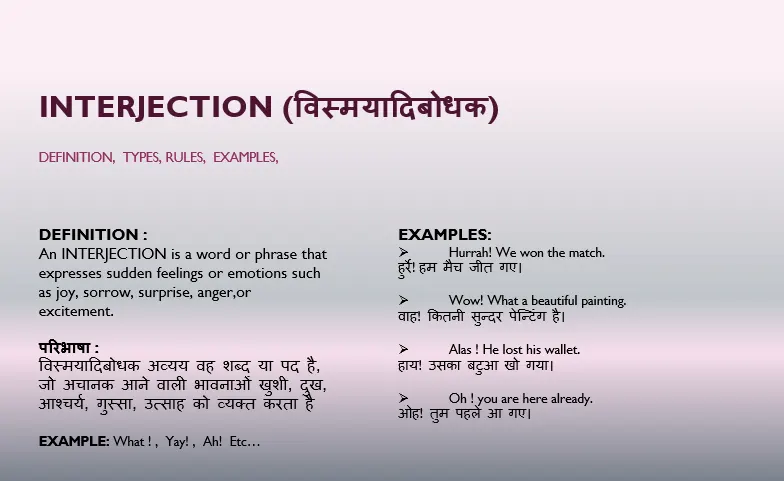
An INTERJECTION is a word or phrase that expresses sudden feelings or emotions such as joy, sorrow, surprise, anger,or excitement.
It is not grammatically related to the rest of the sentences.
It shows the speaker’s mood or reaction and is usually followed by an exclamation mark (!)
परिभाषा:
विस्मयादिबोधक अव्यय वह शब्द या पद है, जो अचानक आने वाली भावनाओं खुशी, दुख, आश्चर्य, गुस्सा, उत्साह को व्यक्त करता है।
यह वाक्य के बाकी हिस्से से व्याकरण की दृष्टि से संबंधित नहीं होता है।
Interjection के बाद सामान्यतः (!) विस्मयादिबोधक चिन्ह लगाया जाता है।
Read Also
• Parts of speech
• Noun
• Pronoun
• Verb
• Adverb
Meaning of Interjection
Interjection का हिंदी अर्थ – विस्मयादिबोधक होता है।
Interjection ऐसे शब्द होते जो भावनाओं को सीधे और तुरंत व्यक्त करते हैं। ये वाक्य में किसी अन्य सब से जुड़े नहीं होते और इनके बाद अक्सर (!) लगाया जाता है। ये भाषा को जीवंत और भावनात्मक बनाते हैं।
Types of Interjection (विस्मयादिबोधक के प्रकार)
1.Joy (खुशी)
खुशी व्यक्त करने वाले शब्द
➢ Hurrah! We won the match.
हुर्रे! हम मैच जीत गए।
➢ Wow! What a beautiful painting.
वाह! कितनी सुन्दर पेन्टिंग है।
➢ Yay! It’s my birthday today.
ये! आज मेरा जन्मदिन है।
Read Also
• Tense
• Present Tense
• Past Tense
• Future tense Tense
2.Sorrow (दुख)
दुख या पीड़ा व्यक्त करने वाले शब्द।
➢ Alas ! He lost his wallet.
हाय! उसका बटुआ खो गया।
➢ Oh ! My phone is broken.
ओ! मेरा फोन टूट गया।
➢ Ah! She faield the exam.
आह! वह परीक्षा में फेल हो गई।
Read Also
• Present Indefinite Tense
• Present Perfect Tense
• Present Continuous Tense
• Present Perfect Continuous Tense
3.Surprise (आश्चर्य)
आश्चर्य व्यक्त करने वाले शब्द।
➢ Oh ! you are here already.
ओह! तुम पहले आ गए।
➢ What ! Did she really say that?
क्या! क्या उसने सच में ऐसा कहा?
➢ Wow! This place is amazing.
वाह! यह जगह अद्भुत है।
Read Also
• Past Indefinite Tense
• Past Perfect Tense
• Past Continuous Tense
• Past Perfect Continuous Tense
4.Approval / Appreciation (प्रशंसा)
स्वीकृति या प्रशंसा व्यक्त करने वाले शब्द।
➢ Bravo! You played very well.
शाबाश! तुमने बहुत अच्छा खेला।
➢ Well done! I am proud of you.
बहुत बढ़िया ! मुझे तुम पर गर्व है।
➢ Good! Keep it up.
अच्छा ! ऐसा ही करते रहो।
Read Also
• Future Indefinite Tense
• Future Perfect Tense
• Future Continuous Tense
• Future Perfect Continuous Tense
5.Greeting (अभिवादन)
अभिवादन व्यक्त करने वाले शब्द।
➢ Hello! How are you?
हैलो ! आप कैसे हो?
➢ Hi ! Nice to meet you.
हाय ! आपसे मिलकर अच्छा लगा।
➢ Good morning ! Have a nice day.
शुभ प्रभात !आपका दिन शुभ हो।
6.Attention (ध्यान आकर्षित करना)
ध्यान आकर्षित करने वाले शब्द।
➢ Look ! The bus is coming.
देखो ! बस आ रही है।
➢ Listen ! I have something to say.
सुनो ! मुझे कुछ कहना है।
➢ Hush ! Don’t make noise.
चुप ! शोर मत करो।
7.Disguest (घृणा)
क्रोध व्यक्त करने वाले शब्द।
➢ Ugh! This food Taste awful.
छी ! यह खाना बहुत खराब है।
➢ Yuck ! What a dirty smell.
छी ! कितनी गन्दी बदबू है।
8.Pain (दर्द)
दर्द या तकलीफ व्यक्त करने वाले शब्द।
➢ Ouch ! it hurts.
आह ! दर्द हो रहा है।
➢ Ouch! My finger hurts.
आह! मेरी उंगली में दर्द है।
9.Fear (भय)
भय व्यक्त करने वाले शब्द।
➢ Ah ! A snake!
आह ! साँप है!
➢ Ah! A Lion!
आह ! शेर है!
Read Also
• Adjective
• Preposition
• Conjunction
Daily Use Interjection (रोज़ बोले जाने वाले विस्मयादिबोधक शब्द)
1.Wow! – Surprise (आश्चर्य)
Wow! You look amazing today.
वाह! तुम आज बहुत अच्छे लग रहे हो।
2.Oh! – Realization (अरे/ ओह)
Oh! I forgot my phone.
अरे! मैं अपना फ़ोन भूल गया।
3.Hey! – Calling attention (अरे/ सुनो)
Hey! Wait for me.
अरे! मेरा इंतज़ार करो।
4.Oops! – By mistake (गलती होने पर)
Oops! I dropped my pen.
ओह! मेरा पेन गिर गया।
5.Ouch! – Pain (दर्द)
Ouch! It hurts!
आह! दर्द हो रहा है।
6.Hurray! – Joy (खुशी)
Hurray! We won the match.
हुर्रे! हमने मैच जीत लिया।
7.Alas! – Sorrow (दुख)
Alas! He failed again.
हाय! वह फिर फेल हो गया।
8.Hmm! – Thinking (सोचते हुए)
Hmm! You might be right.
हूँ ! तुम सही हो सकते हो।
9.Yuck! – Disgust (घृणा)
Yuch! This tastes bed.
छी! इसका स्वाद बहुत खराब है।
10.Eww! – Disgust (नापसंदगी)
Eww! What a smell!
छी! कैसी बदबू है।
11.Aww! – Cute feeling (प्यार या सहानुभूति)
Aww! That baby is so cute.
आह! कितना प्यारा बच्चा है।
12.Oh no! – Disappointment / Shock (निराशा/ दुख)
Oh no! I lost my keys.
अरे नहीं! मेरी चाबी खो गई।
13.Yay! – Excitement / Joy (खुशी)
Yay! It’s my birthday.
ये !आज मेरा जन्मदिन है।
14.Phew! – Relief (राहत)
Phew! That was close.
उफ़! बाल बाल बच गए।
15.Bravo! – Praise (प्रशंसा)
Bravo! You did great.
शाबाश ! तुमने बहुत अच्छा किया।
इन वाक्यों से Interjection को समझ लिया होगा।
Read Also
• Active voice & Passive voice
• Gender in Hindi
• Singular & Plural
🞴 IMPORTANT NOTES (महत्वपूर्ण बातें)
❖ Interjections हमेशा ! (exclamation mark ) के साथ आते हैं।
❖ यह वाक्य में व्याकरण की दृष्टि से स्वतंत्र होते हैं।
❖ यह केवल भावनाओं को व्यक्त करते हैं, कोई गहरा अर्थ या व्याकरणिक भूमिका नहीं निभाते।
❖ Interjection spoken English (बोली जाने वाली अंग्रेजी में बहुत ज्यादा प्रयोग होता है।)
❖ Interjection एक शब्द (word) या छोटा वाक्यांश (phrase) दोनों हो सकता है।
Example:
Word – Oh!, Wow!, Hey!, Alas!
Phrase – Oh my God!, Good heavens!, What a pity!
❖ यह spoken English को natural बनाता है।
Conclusion -निष्कर्ष
इस पोस्ट में आपने विस्मयादिबोधक अव्यय को भली – भाँति समझ लिया होगा। Interjection जो किसी व्यक्ति की अचानक उत्पन्न हुई भावना को
व्यक्त करता है, जैसे - खुशी, आश्चर्य, दुख, गुस्सा, दर्द, घृणा या डर । यह independent word होता है - यानी अकेला ही एक complete
emotional expression देता है। Interjection केवल भावना(emotion) दिखाने के लिए होता है, न कि विचार(idea) बताने के लिए।
Interjection वाक्य के किसी भी हिस्से से व्याकरणिक रूप से नहीं जुड़ा होता। अगर आपको Interjection समझ आ गया तो हमारी पोस्ट
को ज्यादा से ज्यादा शेयर करें।
Thanks For Reading this Article by Edu Tehri.