Degree of Comparison (तुलना की अवस्था) –
Definition
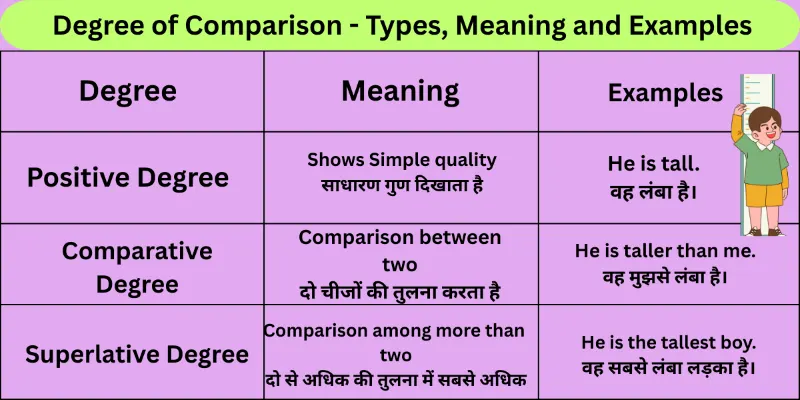
Degree of comparison is a grammar rule that shows the level or amount of a quality in a person, thing, or group. It helps us tell whether a quality is simple, increasing, or at its highest level. By using degrees, we can describe and compare people or things more clearly and effectively.
परिभाषा -
Degree of comparison वह व्याकरणीय नियम है जिसकी मदद से हम किसी व्यक्ति, वस्तु या समूह के गुण की मात्रा या स्तर को बताते हैं। यह दिखाता है कि कोई गुण सामान्य है, बढ़ रहा है या सबसे अधिक स्तर पर है। इस नियम से हम लोगों और चीज़ों की तुलना आसानी और स्पष्टता से कर पाते हैं।
Types of Degree of Comprision
तुलना की अवस्था को तीन भागों में बाँटा गया है:
1. Positive Degree (साधारण अवस्था)
2. Comparative Degree (तुलनात्मक अवस्था)
3. Superlative Degree (श्रेष्ठतम अवस्था)
Read Also
• Parts of speech • Noun
• Pronoun • Preposition
• Verb • Adverb
• Adjective • conjunction
• Interjection • Sentence Parts of Sentence
1. Positive Degree – Definition
Positive degree is the basic form of an adjective that simply describes a quality of a person or thing without making any comparison. It shows the normal level of a quality and tells how someone or something is, but it does not compare it with anyone or anything else.
Positive degree विशेषण का वह साधारण रूप है जिसमें किसी व्यक्ति या वस्तु के गुण को केवल बताया जाता है, लेकिन किसी से तुलना नहीं की जाती. यह किसी गुण के सामान्य स्तर को दर्शाता है और बस यह बताता है कि व्यक्ति या वस्तु कैसी है।
• Positive Degree – Rules
Rule 1: Basic form of adjective is used
Positive degree में adjective का साधारण रूप ही इस्तेमाल होता है.
• tall, big, small, good, bright आदि।
Rule 2: No comparison is made
(किसी भी व्यक्ति या वस्तु से तुलना नहीं की जाती.)
Rule 3: Only describes the quality of one person or thing
(यह सिर्फ एक व्यक्ति या वस्तु के गुण को बताता है.)
Rule 4: Used for simple statements
(साधारण वाक्यों में किसी चीज़ का गुण बताने के लिए इस्तेमाल होता है.)
• Positive Degree Examples
1. She is brave.
वह बहादुर है।
2. The room is clean.
कमरा साफ है।
3. This flower is beautiful.
यह फूल सुंदर है।
4. He is honest.
वह ईमानदार है।
5. The sky is blue.
आसमान नीला है।
6. The tea is hot.
चाय गरम है।
7. My bag is light.
मेरा बैग हल्का है।
8. The water is pure.
पानी शुद्ध है।
9. She is clever.
वह होशियार है।
10. The river is deep.
नदी गहरी है।
2. Comparative Degree – Definition
Comparative degree is used to compare the quality of two persons or two things. It shows which one has more or less of a particular quality. Most comparative forms end with -er or begin with more.
Comparative degree का प्रयोग दो व्यक्तियों या दो वस्तुओं की तुलना करने के लिए किया जाता है। यह बताता है कि किसमें किसी गुण की मात्रा अधिक या कम है। ज्यादातर comparative रूप -er जोड़कर या more लगाकर बनते हैं।
• Rules of Comparative Degree
Rule 1: Add “-er” to short adjectives
(छोटे adjectives में “-er” लगाते हैं.)
• tall → taller
• small → smaller
Rule 2: Use “more” before long adjectives
(लंबे adjectives से पहले “more” लगाते हैं.)
• beautiful → more beautiful
• intelligent → more intelligent
Rule 3: Use “than” to compare two things
(तुलना करने के लिए “than” का प्रयोग होता है.)
• He is taller than me.
Rule 4: Only two persons or things are compared
(सिर्फ दो के बीच तुलना होती है.)
• Comparative Degree Examples
1. She is taller than her sister.
वह अपनी बहन से लंबी है।
2. This road is wider than that one.
यह सड़क उस सड़क से चौड़ी है।
3. The river is deeper than the pond.
नदी तालाब से गहरी है।
4. He is more honest than others.
वह दूसरों से अधिक ईमानदार है।
5. My bag is heavier than your bag.
मेरा बैग तुम्हारे बैग से भारी है।
6. This book is more useful than that book.
यह किताब उस किताब से अधिक उपयोगी है।
7. The box is bigger than the drawer.
डिब्बा दराज से बड़ा है।
8. She is more careful than before.
वह पहले से ज्यादा सावधान है।
9. Your idea is better than mine.
तुम्हारा विचार मेरे विचार से अच्छा है।
10. The train is faster than the bus.
ट्रेन बस से तेज है।
Read Also
• Tense
• Present Tense
• Past tense
• Future tense
3. Superlative Degree – Definition
Superlative degree is used to show the highest or lowest level of a quality among three or more persons or things. Most superlative forms end with -est or begin with most. It tells which person or thing has the greatest amount of a particular quality.
Superlative degree का उपयोग तीन या तीन से अधिक व्यक्तियों या वस्तुओं में से सबसे अधिक या सबसे कम गुण को दिखाने के लिए किया जाता है। इस रूप में सामान्यतः -est लगाया जाता है या most का प्रयोग किया जाता है। यह बताता है कि किसमें वह गुण सबसे ज्यादा होता है।
• Rules of Superlative Degree
Rule 1: Add “-est” to short adjectives
(छोटे adjectives में “-est” लगाते हैं.)
• tall → tallest
• small → smallest
Rule 2: Use “most” before long adjectives
(लंबे adjectives से पहले “most” लगाते हैं.)
• beautiful → most beautiful
• intelligent → most intelligent
Rule 3: Use “the” before the superlative form
(Superlative degree से पहले हमेशा “the” का प्रयोग होता है.)
• He is the tallest.
Rule 4: Used for comparing three or more
(तीन या अधिक लोगों / चीज़ों में तुलना होती है.)
Superlative Degree Examples
1. She is the tallest girl in the class.
वह कक्षा में सबसे लंबी लड़की है।
2. This is the most beautiful flower in the garden.
यह बगीचे का सबसे सुंदर फूल है।
3. He is the strongest player in the team.
वह टीम का सबसे मजबूत खिलाड़ी है।
4. This road is the widest in the city.
यह सड़क शहर की सबसे चौड़ी सड़क है।
5. This book is the most useful of all.
यह किताब सभी में सबसे अधिक उपयोगी है।
6. My house is the oldest in the street.
मेरा घर गली में सबसे पुराना है।
7. She is the most intelligent student in the group.
वह समूह में सबसे बुद्धिमान छात्रा है।
8. This box is the heaviest among all boxes.
यह डिब्बा सभी डिब्बों में सबसे भारी है।
9. The sunrise here is the brightest.
यहाँ का सूर्योदय सबसे उजला है।
10. He is the fastest runner in the competition.
वह प्रतियोगिता में सबसे तेज धावक है।
Read Also
• Use of Used to • Use of Need to
• Active & Passive Voice • Use of Has & Have
• Use of Is / am / are • Number - Singular & Plural
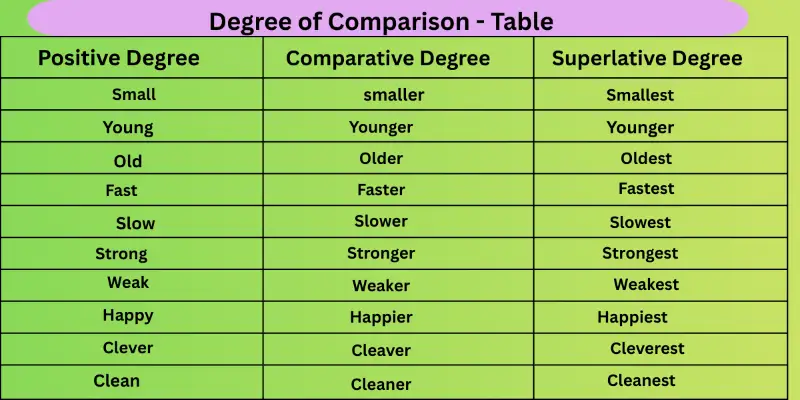
❖ Degree Of Comparison (Positive + Comparative + Superlative ) – TABLE
| Positive Degree |
Comparative Degree |
Superlative Degree |
| Tall |
taller |
tallest |
| Small |
smaller |
smallest |
| Big |
bigger |
biggest |
| Strong |
stronger |
strongest |
| Weak |
weaker |
wealest |
| Bright |
brighter |
brightest |
| Dark |
darker |
darkest |
| Young |
younger |
youngest |
| Old |
older |
oldest |
| Fast |
faster |
fastest |
| Slow |
slower |
slowest |
| Light |
lighter |
lightest |
| साधारण रुप |
तुलनात्मक रुप |
श्रेष्ठतम रुप |
| लंबा |
अधिक लंबा |
सबसे लंबा |
| छोटा |
और छोटा |
सबसे छोटा |
| बड़ा |
और बड़ा |
सबसे बड़ा |
| मजबूत |
और मजबूत |
सबसे मजबूत |
| कमजोर |
और कमजोर |
सबसे कमजोर |
| उजाला |
और उजाला |
सबसे उजाला |
| काला |
और काला |
सबसे काला |
| युवा |
और युवा |
सबसे युवा |
| पुराना |
अधिक पुराना |
सबसे पुराना |
| तेज |
और तेज |
सबसे तेज |
| धीमा |
और धीमा |
सबसे धीमा |
| हल्का |
और हल्का |
सबसे हल्का |
Read Also
• Use of Do & Does • Use of Had
• Use of These & Those • Use of This & That
• Use of Was & Were
❖ Long Adjectives (more / most table)
| Positive |
Compa - rative (more) |
Super - lative (most) |
| Beautiful |
more beautiful |
most beautiful |
| Important |
more important |
most important |
| Intelligent |
more intelligent |
most intelligent |
| Expensive |
more expensive |
most expensive |
| Comfor table |
more comfor table |
most comfor table |
| Useful |
more useful |
most useful |
| Careful |
more careful |
most careful |
| Powerful |
more powerful |
most powerful |
| साधारण |
तुलनात्मक (अधिक) |
श्रेष्ठतम (सबसे) |
| सुंदर |
अधिक सुंदर |
सबसे सुंदर |
| महत्वपूर्ण |
अधिक महत्वपूर्ण |
सबसे महत्वपूर्ण |
| बुद्धिमान |
अधिक बुद्धिमान |
सबसे बुद्धिमान |
| महंगा |
अधिक महंगा |
सबसे महंगा |
| आरामदायक |
अधिक आरामदायक |
सबसे आरामदायक |
| उपयोगी |
अधिक उपयोगी |
सबसे उपयोगी |
| सावधान |
अधिक सावधान |
सबसे सावधान |
| शक्तिशाली |
अधिक शक्तिशाली |
सबसे शक्तिशाली |
| रोचक |
अधिक रोचक |
सबसे रोचक |
❖ Irregular Degrees – TABLE (Special Forms)
| Positive |
Comparative |
Superlative |
| Good (अच्छा) |
better (बेहतर) |
best (सबसे अच्छा) |
| Bad (बुरा) |
worse (और बुरा) |
worst (सबसे बुरा) |
| Little (कम) |
less (और कम) |
least (सबसे कम) |
| Much / many (अधिक) |
more (और अधिक) |
most (सबसे अधिक) |
| far (दूर) |
farther / further (और दूर) |
farthest / furthest (सबसे दूर) |
Read Also
• Tense • Present Tense
• Present indefinite Tense • Present Perfect Tense
• Present continuous Tense • Present perfect continuous Tense
• Past Tense • Past Indefinite Tense
• Past Perfect Tense • Past continuous Tense
• Past Perfect continuous Tense • Future Tense
• Future Perfect Tense • Future Indefinite Tense
• Future continuous Tense • Future Perfect continuous Tense