ADJECTIVE (विशेषण)
Definition (परिभाषा)
An adjective is a word that describes or qualifies a Noun or Pronoun by giving more information about its
quality, quantity, number, size, shape, color, origin, or condition.
वह विशेषण जो संज्ञा व सर्वनाम की विशेषता बताता है, विशेषण कहलाता है।
यह बताता है कि व्यक्ति, वस्तु, या स्थान कैसा, कितना, किस प्रकार का, या कौन सा है?
Examples :
1.He is a handsome boy.
वह एक सुंदर लड़का है।
2.He has four pens.
उसके पास चार पेंन है।
3. Ankit is a tall boy.
अंकित एक लंबा लड़का है।
4.She has three apples.
उसके पास तीन सेब है।
5.This is a beautiful flower.
यह एक सुंदर फूल है।
6.This is a blue car.
यह एक नीली कार है।
उपर्युक्त वाक्यों में Handsome, four, tall, three, beautiful, blue Adjective हैं। ये सभी boy, pens, ankit, apples, flower, car की विशेषता बता रहे हैं।
Adjective Meaning In Hindi:
Adjective का हिंदी अर्थ – विशेषण है।
विशेषता बताने वाला शब्द विशेषण कहलाता है।
Characteristics of Adjectives (विशेषण की विशेषताएँ)
1.They describe or modify noun/pronoun.
यह हमेशा संज्ञा या सर्वनाम को बताते है।
2.They usually answer:
• What kind? (quality)
• How many? (quantity / number)
• Which one? (demonstrative / possessive)
• Whose?
• (possessive)
3.Usually , an adjective comes before a noun.
Example: A red rose, A tall man
But sometimes it comes after a verb like is, am, are was, were.
Example: The sky is blue.
Read Also
• Tense
• Present Tense
• Past Tense
• Future tense Tense
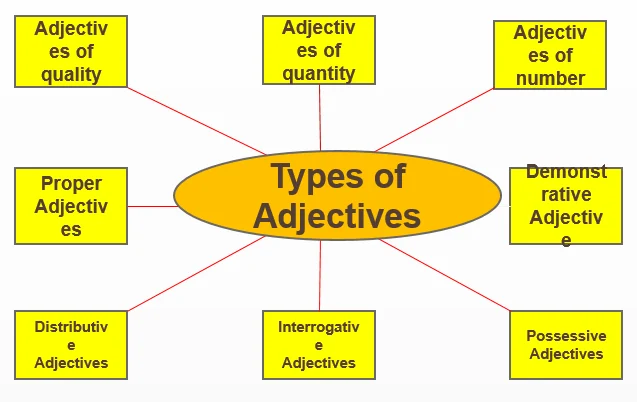
Types of Adjectives (विशेषण के भेद)
विशेषण निम्नलिखित प्रकार के होते हैं –
1.Adjective of Quality (गुणवाचक विशेषण)
2.Adjective of Quantity (परिमाणवाचक विशेषण)
3.Adjective of Number (संख्यावाचक विशेषण)
4.Demonstrative Adjectives (संकेतवाचक विशेषण)
5.Possessive Adjectives (अधिकारी विशेषण)
6.Interrogative Adjectives (प्रश्नवाचक विशेषण)
7.Distributive Adjectives (वितरणवाचक विशेषण)
8.Proper Adjectives (व्यक्तिवाचक विशेषण)
1.Adjective of Quality (Descriptive) in Hindi (गुणवाचक विशेषण)
Definition:
An Adjective of Quality is a word that tells us the quality, nature, color, shape, or appearance of a person, place, or thing.
It answer the question “what kind?”
परिभाषा:
गुण वाचक विशेषण वह शब्द होता है, जो किसी व्यक्ति, वस्तु या स्थान के गुण, रंग, आकार, रूप या स्वभाव को बताता है। यह प्रश्न का उत्तर देता है - कैसा?
संज्ञा या सर्वनाम का गुण या स्वभाव बताता है।
यह प्रश्न का उत्तर देता है - कैसा?
संज्ञा या सर्वनाम का गुण या स्वभाव बताता है।
Examples:
1.Aanchal is a beautiful girl.
आंचल एक सुंदर लड़की है।
2.This is a red rose.
यह एक लाल गुलाब है।
3.The mango is sweet.
आम मीठा है।
4.He is an honest man.
वह एक ईमानदार आदमी है।
5.The sky is blue.
आसमान नीला है।
6.The baby is cute.
बच्चा प्यारा है।
7.It is a cold day.
आज का दिन ठंडा है।
8.She wore a beautiful dress.
उसने एक सुंदर पोशाक पहनी।
9.The sky is clear today.
आज आसमान साफ है।
10.It is a beautiful day.
यह एक सुंदर दिन है।
उपर्युक्त वाक्य में Beautiful, red, sweet, honest, blue, cute, cold, clear गुणवाचक विशेषण (Adjective of Quality) हैं।
अगर Adjective किसी noun या pronoun की गुण या स्वभाव की बात करें,
तो समझो वो Adjective of Qyality (गुणवाचक विशेषण) है।
Example:
A good boy –
कैसा लड़का ? – अच्छा लड़का -
Quality बताता है।
What kind of boy?- An honest boy
कैसा लड़का? – एक ईमानदार लड़का
इसी प्रकार कैसा ? प्रश्न लगाने पर जो प्राप्त होता है वहीं विशेषण होता है।
Read also
• Parts of speech
• Verb & Types of verb
• Adverb & Types of adverb
• Conjunction
• Preposition
2.Adjective of Quantity in Hindi (परिमाणवाचक विशेषण)
Definition:
An Adjective of Quantity tells us how much of a thing is meant.
It describes the amount or quantity of something, especially uncountable nouns (like milk, water, sugar, money, rice,etc.)
➢ It answers the question “How much?”
परिभाषा:
परिणामवाचक विशेषण वह विशेषण होता है जो किसी असंख्य संज्ञा की मात्रा या परिणाम को बताता है। यह बताता है कि कितना पदार्थ, वस्तु या चीज़ है।
यह प्रश्न का उत्तर देता है – “कितना?”।
किसी चीज़ की मात्रा बताता है, परिमाणवाचक विशेषण कहलाता है।
Examples:
1.I have some water.
मेरे पास कुछ पानी है।
2.She has enough money.
उसके पास पर्याप्त पैसा है।
3.He ate little rice.
उसने थोड़ा चावल खाया।
4.There is no milk in the glass.
गिलास से कोई दूध नहीं है।
5.We need some sugar.
हमें कुछ चीनी चाहिए।
6.He spent much time on it.
उसने इस पर बहुत समय लगाया।
7.I have a lot of work.
मेरे पास बहुत सारा काम है।
8.You gave me less water.
तुमने मुझे कम पानी दिया।
9There is no water in the bottle.
बोतल में कोई पानी नहीं है।
10.He spent much time on this work.
उसने इस काम पर बहुत समय लगाया।
उपर्युक्त वाक्यों में some, enough, little, no, much, a lot of, less (Adjective of Quantity) परिमाणवाचक विशेषण हैं।
जब Adejctive बताता है कितना (How much) – तो वह Adjective Of Quantity है।
Example: I have some rice. – (कितना चावल?) – Adjective of Quantity है।
Read Also
• Present Indefinite Tense
• Present Perfect Tense
• Present Continuous Tense
• Present Perfect Continuous Tense
3.Adjective of Number in Hindi (संख्यावाचक विशेषण)
Definition:
An Adjective of Number is a word that tells how many persons or things are meant, or in what order they stand.
It showes the number or position of nouns and pronouns.
Shows number (countable nouns).
➢ It answer the question “How many?” or “in what order?”
परिभाषा:
संख्यावाचक विशेषण वह विशेषण है जो यह बताता है कि कितने व्यक्ति, वस्तुएं या स्थान है या वे किसी क्रम में हैं।
यह प्रश्न का उत्तर देता है - कितने या किस क्रम में।
किसी चीज़ की संख्या का बोध होता है, संख्यावाचक विशेषण कहलाता है।
Examples:
1.I have some water.
मेरे पास कुछ पानीपानी है।
2.She has enough money.
उसके पास पर्याप्त पैसा है।
3.He ate little rice.
उसने थोड़ा चावल खाया।
4.There is milkno milk in the glass.
गिलास से कोई दूध नहीं है।
5.We need some sugar.
हमें कुछ चीनी चाहिए।
6.He spent much much time on it.
उसने इस पर बहुत समय लगाया।
7.I have a lot of work.
मेरे पास बहुत सारा काम है।
8.You gave me less water.
तुमने मुझे कम पानी दिया।
9.There is no water in the bottle.
बोतल में कोई पानी नहीं है।
10.He spent much time on this work.
उसने इस काम पर बहुत समय लगाया।
उपर्युक्त वाक्यों में some, enough, little, no, much, a lot of, less (Adjective of Quantity) परिमाणवाचक विशेषण हैं।
जब Adejctive बताता है कितना (How much) – तो वह Adjective Of Quantity है।
Example: I have some rice. – (कितना चावल?) – Adjective of Quantity है।
Read Also
• Past Indefinite Tense
• Past Perfect Tense
• Past Continuous Tense
• Past Perfect Continuous Tense
Adjectives of Number दो प्रकार के होते हैं-
1.Cardinal Number – one, two, three, four etc.
2.Ordinal Number – First, second, third, fourth etc.
Kinds of Adjective of Number:
(संख्यावाचक विशेषण के प्रकार) –
•Definite (निश्चित): one, two, first, second (एक, दो, पहला, दूसरा)
•Indefinite (अनिश्चित): many, few, several, some (कई, कुछ, अनेक)
•Distributive (वितरणवाचक): each, every, either, neither (प्रत्येक, कोई, दोनों)
Examples:
1.I have three apples.
मेरे पास तीन सेब हैं।
2.There are many students in the class.
कक्षा में बहुत से विद्यार्थी हैं।
3.She got the first prize.
उसने पहला इनाम जीता।
4.Every students was present.
हर विद्यार्थी उपस्थित था।
5.He has several friends.
उसके कई दोस्त हैं।
6.Both girls are intelligent.
दोनों लड़कियां बुद्धिमान हैं।
7.Each child got a gift.
प्रत्येक बच्चे को उपहार मिला।
8.There are few chairs in the hall.
हॉल में थोड़ी कुर्सियां हैं।
9.I have two pens.
मेरे पास दो पेन हैं।
10.I have four dresses.
मेरे पास चार पोशाक हैं।
उपयुक्त वाक्यों में three, many, first, every, several, both, each, few, two, four Adjective of Number (संख्यावाचक विशेषण) है।
जब Adjective बताए कितने , तो वह है - Adjective of Number
Example:
I have two pens. – (कितने पेन) - Adjective Of Number (संख्यावाचक विशेषण) है।
Read also
• Noun
• Pronoun
• Interjection
4.Demonstrative Adjectives in Hindi (संकेतवाचक विशेषण)
Definition:
A Demonstrative Adjective is a word that is used to point out a particular person, place, or thing.
It shows which one or which things we are talking about.
➢ It answer the question “Which one?”
परिभाषा:
संकेतवाचक विशेषण वह विशेषण होता है जो किसी व्यक्ति, वस्तु या स्थान की ओर संकेत करता है। यह बताता है कि कौन सी या कौन सी वस्तु, व्यक्ति, स्थान की बात कही जा रही है।
यह प्रश्न का उत्तर देता है – “कौन - सा”? या “कौन से?”
Common demonstrative Adjectives:
1.This (यह)
2.That (वह)
3.These (ये)
4.Those (वे)
5.Such (ऐसा)
Examples:
1. This book is mine.
यह किताब मेरी है।
2. That car is red.
वह कार लाल है।
3. These apples are sweet.
ये सेब मीठे हैं।
4. Those stars are bright.
वे तारे चमकदार हैं।
5.I have never seen such a man.
मैंने ऐसा आदमी पहले कभी नहीं देखा।
उपर्युक्त वाक्य में this, that, these, those, such Demonstrative Adjectivesसंकेतवाचक विशेषण हैं।
जब कोई शब्द किसी संज्ञा से पहले आकर उसे दिखाएं या बताएं कि कौन – सा, तो वो Demonstrative Adjective कहलाता है।
Example:
This pen is blue. - यह कौन सा पेन? – This – Demonstrative Adjective
Read also
• Use of is/am/are
• Use of has & have
• Article-A
5.Possessive Adjectives in Hindi (अधिकारी विशेषण)
Definition:
A Possessive Adjective is a word that shows possession or ownership of a noun.
It tells us to whom something belong – it shows who owns a person, place, or thing.
➢ It answer the question “Whose?”
परिभाषा:
अधिकारी विशेषण वह होता है जो किसी संज्ञा के स्वामित्व या अधिकार को दर्शाता है। यह बताता है कि वस्तु, व्यक्ति के स्थान किसी का है।
यह प्रश्न का उत्तर देता है - “किसका?”
Common Possessive Adjectives:
1. My(मेरा)
2. Your(तुम्हारा)
3. His(उसका) – लड़के के लिए
4. Her(उसकी) – लड़की के लिए
5. Our(हमारा)
6. Their(उनका)
7. Its(उसका) – जानवर / वस्तु के लिए
Examples:
1. My brother is a doctor.
मेरा भाई डॉक्टर है।
2. Your bag is heavy.
तुम्हारा बैग भारी है।
3. His father is a teacher.
उसका पिता शिक्षक हैं।
4. Her mother is kind.
उसकी माँ दयालु हैं।
5. Our classroom is clean.
हमारा कक्षा कक्ष साफ है।
6. Their car is red.
उनकी कार लाल है।
7.The cat loves its milk.
बिल्ली को अपने दूध से प्यार है।
उपर्युक्त वाक्यों में my, your, his, her, their, its Possessive adjective (अधिकारी विशेषण है।)
जब adjective यह बताता है कि यह चीज किसकी है(Whose?) -
तो वह होता है Possessive Adjective (अधिकारी विशेषण)
Example:
My pen – (किसका पेन?) – मेरा पेन
Their house – (किसका घर?) – उनका घर
Read also
• Use of Do & Does
• Use of Had
6.Interrogative Adjectives in Hindi (प्रश्नवाचक विशेषण)
Definition:
An interrogative Adjective is a word that is used with a noun to ask a question.
It describes the noun by asking something about it, such as which one, what kind, or whose.
➢ It always comes before a noun and is used in interrogative (question) sentences.
परिभाषा:
प्रश्नवाचक विशेषण वह विशेषण होता है जो किसी संज्ञा के साथ मिलकर प्रश्न पूछने के लिए प्रयोग किया जाता है। यह बताता है कि प्रश्न कौन – सा, किसका, या किस प्रकार का है।
यह हमेशा संज्ञा के पहले आता है और प्रश्न वाचक वाक्य में प्रयोग होता है।
वह विशेषण जो प्रश्न पूछने के लिए उपयोग होते है, प्रश्नवाचक विशेषण कहलाता है।
Common Interrogative Adjectives:
1.Which(कौन -सा)
2.What(क्या)
3.whose (किसका)
Examples:
1. Which book do you want?
तुम कौन सी किताब चाहते हो?
2. What color is your bag?
तुम्हारे बैग का रंग क्या है?
3. Whose pen is this?
यह किसका पेन है?
4. Which dress are you wearing?
तुम कौन सी ड्रेस पहन रही हो?
5. What time is it?
अभी क्या समय हुआ है?
6. Whose house is near the park?
पार्क के पास किसका घर हैं?
उपर्युक्त वाक्य में which, what, whose Interrogative Adjective प्रश्नवाचक विशेषण है।
जब “which / what / whose” किसी noun से पहले आए और प्रश्न पूछे,
तो वह कहलाता है Interrogative Adjective (प्रश्नवाचक विशेषण)
Example:
Which pen is yours? – ( कौन – सा पेन?) - Interrogative Adjective
Which is yours? – (कौन – सा?) - Interrogative pronoun
Read also
• Use of Shall & Will
• Active voice & Passive voice
7.Distributive Adjectives in Hindi (वितरणवाचक विशेषण)
Definition:
A Distributive Adjective is a word that refers to each one or every one of a group separately.
It shows that persons or things are taken one at a time and not together.
➢ It is used to describe individual members of a group.
परिभाषा:
वितरणवाचक विशेषण वह विशेषण होता है जो किसी समूह के प्रत्येक सदस्य को अलग -
अलग रूप से दर्शाता है। यह बताता है कि कार्य या बात हर एक व्यक्ति या वस्तु पर अलग अलग लागू होती है, सामूहिक रूप से नहीं।
यह “प्रत्येक, हर, कोई एक, दोनों में से कोई नहीं जैसी” भावना प्रकट करता है।
Common Distributive Adjectives:
1. Each (प्रत्येक)
2. Every (हर एक)
3. Either (कोई एक)
4. Neither (दोनों में से कोई नहीं)
Examples:
1. Each students got a prize. प्रत्येक छात्र को इनाम मिला।
2. Every boy was present. हर लड़का उपस्थित था।
3.You can take either pen. तुम कोई एक पेन ले सकते हो।
4. Neither answer is correct. दोनों में से कोई भी उत्तर सही नहीं है।
5. Each day brings new hope. हर दिन नया आशा लाता है।
उपर्युक्त वाक्यों में each, every, either, neither Distributive Adjective (वितरण वाचक विशेषण) है।
जब कोई विशेषण हर एक व्यक्ति या वस्तु को अलग – अलग दर्शाएँ,
तो वह कहलाता है Distributive Adjective (वितरण वाचक विशेषण)
Example:
Each student got a medal. – (हर एक छात्र)
Read also
• Use of Was & were
• Use of Has & Have
• Models & types
8.Proper Adjectives in Hindi (व्यक्तिवाचक विशेषण)
Definition:
A Proper Adjective is an adjective that is formed from a Proper Noun and describes a specfic person, place, thing, or idea.
It tells us from which country, place, or person something is related.
➢ Proper Adjectives are always capitalized (they begin with a capital letter).
परिभाषा:
व्यक्तिवाचक विशेषण वह होता है जो किसी व्यक्तिवाचक संज्ञा से बनता है और किसी विशेष व्यक्ति, स्थान, देश, भाषा या वस्तु का बोध कराता है। यह बताता है कि कोई वस्तु, व्यक्ति के विचार किस देश, स्थानी या व्यक्ति से संबंधित है।
➢ व्यक्ति वाचक विशेषण हमेशा बड़े अक्षर से शुरू होते हैं।
Examples:
1.I love Indian food.
मुझे भारतीय खाना पसंद है।
2.She likes American movies.
उसे अमेरिकी फ़िल्में पसंद है।
3.We read Shakespearean poems.
हमने शेक्सपियर की कविताएं पढ़ी ।
4.He bought Chinese toys.
उसने चीनी खिलौने खरीदे।
5.They study in a Christian school.
वह एक ईसाई विद्यालय में पढ़ते हैं।
उपर्युक्त वाक्यों में Indian, American, Shakespearean, Chinese, Chirstain Proper Adjective व्यक्तिवाचक विशेषण हैं।
Read Also
• Future Indefinite Tense
• Future Perfect Tense
• Future Continuous Tense
• Future Perfect Continuous Tense
Degrees of Comparison of Adjectives (विशेषण की डिग्री )
1.Positive Degree (साधारण डिग्री )–
simple quality(no comparison).
केवल गुण बताता है।
Example:
He is tall.
वह लंबा है।
2.Comparative Degree (तुलनात्मक डिग्री)
compares two persons/things.
दो व्यक्तियों व वस्तुओं में तुलना करता है।
Example:
He is taller than his sister.
वह अपनी बहन से लंबा है।
3.Superlative Degree (उत्कृष्ट)–
compares more than two; shows the highest degree.
दो से अधिक व्यक्तियों व वस्तुओं में किसी एक का गुण सबसे अधिक दर्शाता है।
Example:
He is the tallest in his class.
वह अपनी कक्षा में सबसे लंबा है।
Formation of Adjectives (विशेषण का निर्माण)
1.From nouns (संज्ञा से विशेषण): boy-boyish, child-childish
2.From verbs (क्रिया से विशेषण): tire-tiresome, talk-talkative
3.From other adjectives (अवयय से विशेषण) : red-reddish, whole-wholesome
Read also
• Use of Can & Could
• Use of May & Might
• Use of Should & Would
• Use of Dare
Position of Adjectives in a Sentence (वाक्य में विशेषण का स्थान)
1.Attributive Position
(संज्ञा से पहले)-before the noun.
•She is a honest girl.
वह एक ईमानदार लड़की है।
2.Predicative Position
( क्रिया के बाद)– after a verb (is, seem, look, become).
•The girl is honest.
लड़की ईमानदार है।
3.Postpositive Position
(संज्ञा के बाद) – immediatelu after the noun (rare, in, poetry/literature).
•Something strange happened.
कुछ अजीब हुआ।
Examples (विशेषण के सभी प्रकारों के उदाहरण)-
1.He is a kind person. (quality)
यह एक दयालु व्यक्ति है। (गुणवाचक)
2.He has six friends. (number)
उसके छह दोस्त है। (संख्यावाचक)
3.I need some water. (quantity)
मुझे थोड़ा पानी चाहिए। (परिमाणवाचक)
4. Those bikes are expensive. (demonstrative)
वे साइकिलें मंहगी है। (संकेतवाचक)
5. My mother is beautiful. (possessive)
मेरी माँ सुंदर है। (अधिकारवाचक)
6. Which book is yours? (interrogative)
तुम्हारी किताब कौन सी है? (प्रश्नवाचक)
7. Each boy was given a prize. (distributive)
प्रत्येक लड़के को एक पुरस्कार दिया जाएगा। (वितरणवाचक)
8.She wore a garhwali dress. (proper)
उसने एक गढ़वाली पोशाक पहनी थी। (व्यक्तिवाचक)