ADVERB(क्रिया विशेषण)
Definition
An Adverb is a word that modifies a verb, an adjective, or another adverb.
It tells how, when, where, how often, or to what extent something happens.
Example:
1. She runs quickly.
(Here, quickly tells how she runs.)
पऱिभाषा
क्रिया विशेषण वह शब्द है जो क्रिया, विशेषण ये किसी अन्य क्रिया विशेषण की विशेषता बताता है ।
यह बताता है कि कार्य कैसे कब कहाँ, कितनी बार यह कितनी मात्रा में हुआ।
Adverb वाक्य को अधिक स्पष्ट, प्रभावशाली और सटीक बनाते हैं।
Example (उदाहरण)-
Modifying Verb :
Ram runs quickly.
राम तेज़ दौड़ता है। ( यह बतता है- कैसे दौड़ता है।)
Modifying Adjective :
She is very tall.
वह बहुत लबीं है। (यह बताता है -कितनी लंबी है।)
Modifying Adverb :
He runs quite fast.
वह बहुत तेज़ दौड़ता है। ( यह बताता है – कितना तेज़ दौड़ता है।)
Examples In Sentences:
1.He runs fast.
वह तेज दौड़ता है।
2.She speaks softly.
वह धीरे बोलती है।
3. I will go tomorrow.
मैं कल जाऊंगा।
4.The child is very cute.
बच्चा बहुत प्यारा है।
5.They never lie.
वह कभी झूठ नहीं बोलते।
6.You came late.
तुम देर से आये।
7.She sings quite well.
वह काफी अच्छा गाती है।
8.Why are you crying?
तुम क्यों रो रहे हो?
उपर्युक्त वाक्यों में fast, softly, tomorrow, cute, lie, late, well, crying Adverbs हैं।
Read also
• Parts of speech
• Active voice & Passive voice
• Sentence and Types
Main Uses Of Adverb (मुख्य उपयोग):
Adverbs are used to give extra information about:
1.Verb – tells how/ when/ where action happens.
He speaks loudly. (How)
2.Adjective – adds intensity.
She is very beautiful.
3.Another adverb – modifies another adverb.
He runs quite fast.
• Adverb meaning in hindi
Adverb का हिंदी अर्थ - क्रिया विशेषण होता है।
क्रिया की विशेषता बताने वाले शब्द क्रिया विशेषण कहलाते हैं।
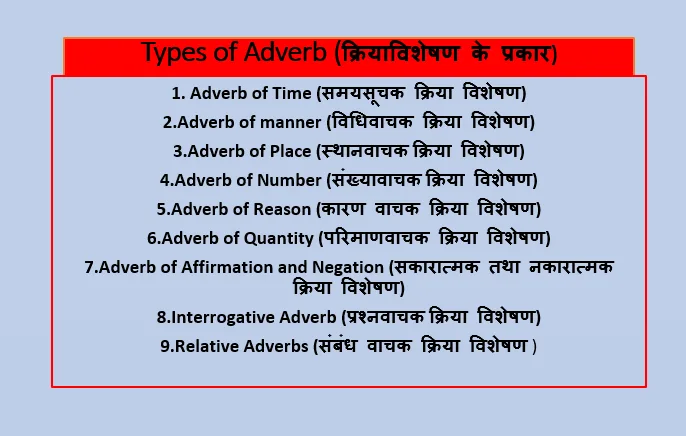
Types of Adverbs in Hindi (क्रिया विशेषण के भेद)
(A) According to Meaning ( अर्थ के अनुसार )
• Adverb of Manner (रीति क्रिया विशेषण)
• Adverb of place (स्थान क्रिया विशेषण)
• Adverb of time (काल क्रिया विशेषण)
• Adverb of Frequency ( आवृत्ति क्रिया विशेषण)
• Adverb of Degree/ Quantity (परिमाण क्रिया विशेषण)
• Adverb of Affirmation and Negation (सकारात्मक और नकारात्मक क्रिया विशेषण)
• Adverb of Doubt (संदेह क्रिया विशेषण)
(B) According to Function (कार्य के अनुसार )
• Interrogative Adverb (प्रश्नवाचक क्रियाविशेषण)
• Relative Adverbs (संबंध सूचक क्रिया विशेषण )
• Formation of Adverbs (क्रिया विशेषण की रचना)
• Degrees of Adverbs (क्रिया विशेषण के रुप)
Read also
• Noun
• Pronoun
• Verb
• Adjective
(A) According to Meaning (अर्थ के अनुसार )
1.Adverb of Manner in Hindi (रीति क्रिया विशेषण)
Definition:
An Adverb of Manner tells how or in what way an action happens or is done.
It describes the manner, style, or method of an action.
➢ It answers the question “How?”
Examples:
slowly, quickly, happily, badly
रीति क्रिया विशेषण
परिभाषा-
रीति विशेषण वह विशेषण होता है जो यह बताता है कि कार्य कैसे हुआ या किस ढंग से किया गया।
यह “कैसे” (How) प्रश्न का उत्तर देता है।
उदाहरण-
धीरे से , तेज़, अच्छे से, सुंदरता से
Position in a Sentence (वाक्य में स्थान)
1. After the verb –
She sings sweetly.
वह मीठा गाती है।
2. After the object (if there is one)-
He speaks English fluently.
वहाँ अंग्रेजी धाराप्रवाह बोलता है।
3. Before the verb (for emphasis) –
She carefully opened the box.
उसने सावधानी से डिब्बा खोला।
Examples of Adverbs Of Manner :
1.She speaks softly.
वह धीरे बोलती है।
2.He walked slowely.
वह धीरे धीरे चला।
3.The dog barked furiously.
कुत्ता गुस्से में भोंका।
4.She smiled happily.
उसने खुशी से मुस्कुराया।
5.The child cried loudly.
बच्चे ने ज़ोर से रोया।
6.He drives carefully.
वह सावधानी से गाड़ी चलाता है।
7.The baby slept peacefully.
बच्चा शांति से सोया।
8.She danced gracefully.
उसने सुंदर ढंग से नृत्य किया।
9.He behaved politely.
उसने विनम्रता से व्यवहार किया।
10.The fought bravely.
उन्होंने बहादुरी से लड़ाई लड़ी।
उपर्युक्त वाक्यों में softly, slowly, furiously, happily, loudly, carefully, peacefully, gracefully, politely, bravely, Adverb Of Manner हैं।
2.Adverb of place in Hindi (स्थान क्रिया विशेषण)
Definition:
An Adverb of place tells where an action happens or takes place.
It shows the location, direction, or position of an action.
➢ It answer the question “where?’’
स्थान क्रिया विशेषण
परिभाषा-
स्थान बताने वाला क्रियाविशेषण वह शब्द होता है जो यह बताता है कि कार्य कहाँ हुआ या कार्य कहाँ होता है।
यह “कहाँ?” (where) प्रश्न का उत्तर देता है।
Common Adverbs of Place:
1. Here (यहाँ)
2. There (वहाँ)
3. Everywhere (हर जगह)
4. Somewhere (कहीं)
5. Nowhere (कहीं नहीं)
6. Inside (अंदर)
7. Outside (बाहर)
8. Above (ऊपर)
9. Below (नीचे)
10. Nearby (पास में)
11. Up, down, away, out, abroad, behind, in, on, under, Etc.
Position in a Sentence (वाक्य में स्थान)
1.Usually placed after the main verb or object:
He is sitting there.
वह वहाँ बैठा है।
2.Can be placed at the beginning for emphasis:
Here comes the teacher.
यहाँ अध्यापक आ रहे हैं।
3. Do not put between verb and object.
✕ He kept there the book.
✓ He kept the book there.
Examples of Adverbs of Place:
1.He is sitting there.
वह वहाँ बैठा है।
2.Come here, please.
कृपया यहाँ आओ।
3.The children are playing outside.
बच्चे बाहर खेल रहे हैं।
4.Birds fly above the tress.
पक्षी पेड़ों के ऊपर उड़ते है।
5.The cat is hidding under the table.
बिल्ली मेज के नीचे छिपी है।
6.She went uptairs.
वह ऊपर गई।
7.Please sit indise.
कृपया अंदर बैठिये।
8.He went abroad last year.
वह पिछले साल विदेश गया था।
9.Don’t go away.
दूर मत जाओ।
10.There is a park behind my house.
मेरे घर के पीछे एक पार्क है।
उपयुक्त वाक्य में there, here, outside, above, under, upstairs, inside, abroad, away, behind Adverb of Place है।
3. Adverb of time in hindi (काल क्रिया विशेषण)
Definition:
An Adverb of Time tells when an action happens, happened, or will happen.
It shows the time, duration or frequency of an action.
➢ It answer the question “When?”
स्थान क्रिया विशेषण
परिभाषा-
काल विशेषण वह क्रिया विशेषणकी वहोता है जो यह बताता है कि कार्य कब हुआ, हो रहा है, या होगा। यह “कब?” प्रश्न का उत्तर देता है।
Common Adverbs of Time:
1. Now (अभी)
2. Then (तब)
3. Today (आज)
4. Yesterday (कल)
5. Tomorrow (आने वाला कल)
6. Soon (जल्द)
7. Already (पहले से)
8. Yet (अभी तक)
9. Just (अभी-अभी)
10. Before (पहले)
11. After (बाद)
12. Lately (हाल में)
13. Recently (हाल ही में)
14. Early (जल्दी)
15. Late (देर से)
16. Always, never, sometimes, often, etc
(frequency type but also time – related)
Position in a Sentence (वाक्य में स्थान)
1.Usually placed at the end of a sentence:
She came yesterday.
वह कल आई।
2.Sometimes placed at the beginning for emphasis:
Yesterday, she came to school.
कल वह स्कूल आई थी।
3.When there are muliple adverbs, the order is: Manner – Palce - Time
He worked hard (manner) in the office (place) yesterday(time).
Examples of Adverbs of Time:
1.He came yesterday.
वह कल आया।
2.I will go tomorrow.
मैं कल जाऊंगा।
3.She is sleeping now.
वह अभी सो रही है।
4.We met recently.
हम हाल ही में मिले।
5.They arrived early.
वे जल्दी पहुँचें।
6.He has already eaten.
वह पहले ही खा चुका है।
7.I have not finished yet.
मैंने अभी तक खत्म नहीं किया है।
8.She left before noon.
वह दोपहर से पहले चली गई।
9.The train will leave soon.
ट्रेन जल्दी ही जाएगी।
10.He called me just now.
उसने मुझे अभी फ़ोन किया।
उपर्युक्त वाक्य में Yesterday, tomorrow, now, recently, early, already, yet, before, soon, just now Adverbs of Time हैँ।
Read also
• Affirmative Sentence
• Negative Sentence
• Exclamatory
• Subject & Predicate
4.Adverb of Frequency in hindi (आवृत्ति क्रिया विशेषण)
Definition:
An Adverb of Frequency tells how often an action happens or is repeated.
It shows the number of times or regularity of an action.
➢ It answers the question “How often?”
आवृत्ति क्रिया विशेषण
परिभाषा-
आवृत्ति बताने वाला क्रियाविशेषण वह शब्द होते हैं जो यह बताता है कि कोई कार्य कितनी बार होता है या कितनी बार दोहराया जाता है ।
यह “कितनी बार” प्रश्न का उत्तर देता है।
Common Adverbs of Frequency:
| Frequency |
Adverb |
Meaning |
| 100% |
always |
हमेशा |
| 90% |
always |
आमतौर पर |
| 80% |
always |
सामान्यतः |
| 70% |
always |
अक्सर |
| 50% |
always |
कभी-कभी |
| 30% |
always |
कभी-कभार |
| 10% |
always |
बहुत कम |
| 5% |
always |
शायद ही कभी |
| 0% |
never |
कभी नहीं |
Position in a Sentence (वाक्य में स्थान)
1. Before the main verb:
He always helps others.
वहाँ हमेशा दूसरों की मदद करता है।
2. After the verb ‘to be’ (is/ am/ are/ was/ were):
She is usually late.
वह आमतौर पर देर से आती है।
3. After the first auxiliary verb (in compound verbs):
They have never seen the sea.
उन्होंने कभी समुद्र नहीं देखा।
4.At the beginning /end (for emphasis):
Sometimes, I read at night.
I read at night sometimes.
Examples of Adverbs of Frequency:
1.She always wakes up early.
वह हमेशा जल्दी उठती हैं।
2.He usually goes to the gym.
वह आमतौर पर जिम जाता है।
3.I often visit my grandparents.
मैं अक्सर अपने दादा दादी से मिलने जाता हूँ।
4.They sometimes eat out.
वह कभी कभी बाहर खाना खाते हैं।
5.We rarely watch TV.
हम बहुत कम टीवी देखते हैं।
6.She never tells lies.
वह कभी झूठ नहीं बोलती।
7.He frequently travels abroad.
वह अक्सर विदेश यात्रा करता है।
8.The teacher is always punctual.
अध्यापक हमेशा समय पर आते हैं।
9.They hardly ever play football.
वह शायद ही कभी फुटबॉल खेलते हैं।
10.I have never been to Delhi.
मैं कभी दिल्ली नहीं गया हूँ।
उपरोक्त वाक्य में always, usually, often, sometimes, rarely, never, frequently, always, Adverbs of Frequency है।
5. Adverb of Degree/ Quantity in hindi (परिमाण क्रिया विशेषण)
Definition:
An Adverb of Degree (also called Adverb of Quantity) tells how much , to what extent, or in what degree an action, adjective, or another adverb is performed.
➢ It answer the question “How much?” or “to what extent?”
परिमाण क्रिया विशेषण
परिभाषा-
मात्रा या परिणाम बताने वाला क्रियाविशेषण वह शब्द होता है जो यह बताता है कि कार्य कितनी बार में या किस हद तक हुआ है।
यह “कितना?” या “किस सीमा तक?” प्रश्न का उत्तर देता है।
Common Adverbs Of Degree/Quantity:
1. Very (बहुत)
2. Too (बहुत ज्यादा /अधिक)
3. Quite (काफी /पूरी तरह)
4. Almost (लगभग)
5. Enough (काफी)
6. So (इतना/ इसलिए)
7. Extremely (अत्यंत /बहुत ज्यादा)
8. Rather (कुछ हद तक/ थोड़ा)
9. Fairly (ठीक – ठाक)
10. Little (थोड़ा)
11. Much (बहुत)
12. Scarcely (मुश्किल से)
13. Totally/ completely (पूरी तरह)
14. Absolutely (पूर्ण रूप से)
15. Nearly (लगभग)
Position in a Sentence (वाक्य में स्थान)
1.Before adjectives or other adverbs:
She is very beautiful.
वह बहुत सुंदर है।
2.Before the main verb:
I almost forgot your name.
मैं लगभग तुम्हारा नाम भूल गया था।
3.After an adjective / adverb (especially with “enough”):
She is tall enough.
वह पर्याप्त लंबी है।
Examples Of Adverbs of Degree / Quantity:
1.She is very intelligent. वह बहुत बुद्धिमान है।
2.The tea is too hot. चाय बहुत ज्यादा गर्म है।
3.He is quite strong. वह काफी मजबूत है।
4.The box is almost full. डिब्बा लगभग भर गया है।
5.She speaks English fluently enough. डिब्बा लगभग भर गया है।
6.He is so tired. वह इतना थका हुआ है।
7.It is extremely cold today. आज अत्यंत ठंड है।
8.The movie was rather boring. फ़िल्म कुछ हद तक उबाऊ थी।
9.The room is fairly clean. कमरा ठीक ठाक साफ है।
10.He works very hard. वह बहुत मेहनत करता है।
उपर्युक्त वाक्यों में very, tea, quite, almost, fluently, so, extremely, rather, fairly, Adverbs Of Degree/Quantity है।
6. Adverb of Affirmation and Negation in hindi (सकारात्मक और नकारात्मक क्रिया विशेषण)
Definition:
An Adverb of Affirmation is used to affirm (agree, approve, or confirm) a statement.
An Adverb of Negation is used to deny (disagree, refuse, or negate ) a statement.
➢ They tell whether somethings is true or not true.
➢ They answer the questions “is it true?”/”yes or No?”
सकारात्मक और नकारात्मक क्रिया विशेषण
परिभाषा-
समर्थन सूचक क्रिया विशेषण वह शब्द होता है जो किसी बात की पुष्टि यह सहमति को दर्शाता है।
निषेध सूचक क्रिया विशेषण वह शब्द होता है जो किसी बात का निषेध या इनकार करता है।
ये यह बताते हैं कि कोई कार्य हुआ है या नहीं हुआ है।
Examples of Questions:
Did he come? – Yes, he came. (Affirmation)
Dis he come? – No, he didn’t come. (Negation)
Common Adverbs of Affirmation:
1. Yes (हाँ)
2. Certainly (निश्चित रुप से)
3. Surely (निश्चय ही)
4. Definitely (निश्चित रुप से)
5. Indeed (वास्तव में)
6. Truly (सचमुच)
7. Undobtedly (निस्संदेह)
8. Obviously (स्पष्ट रुप से)
9. Clearly (स्पष्ट रुप से)
10. Absolutely (पूर्ण रूप से)
Common Adverb of negation:
1. No (नहीं)
2. Not (नहीं)
3. Never (कभी नही)
4. None (कोई नही)
5. Neither (न तो)
6. Hardly (मुश्किल से)
7. Scarcely (मुश्किल से)
8. Rarely (बहुत कम)
Examples Of Adverbs Of Affirmation:
1.Yes, I will go there.
हाँ, मैं वहाँ जाऊँगा।
2.He surely knows the answer.
वह निश्चय ही उत्रर जानता है।
3.She difinitely passed the exam.
उसने निश्चित रूप से परीक्षा पास की।
4.He will certainly help you.
वह निश्चित रूप से आपकी मदद करेंगा।
5. Indeed, she is a kind woman.
वास्तव में वह एक दयालु महिला है।
उपयुक्त वाक्य में yes, surely, difinitely, certainly, indeed Adverbs of Affirmation हैं।
Examples of Adverbs of Negation:
1. No, I don’t want it. नहीं, मुझे यह नहीं चाहिए।
2.She is not coming today. वह आज नहीं आ रही है।
3.He never tells a lie. वह कभी झूठ नहीं बोलता।
4.There is no water in the glass. गिलास में पानी नहीं है।
5.He has hardly any money. उसके पास मुश्किल से कोई पैसे है।
उपर्युक्त वाक्यों में no, not, never, no, hardly Adverb of Negation हैं।
Read also
• Use of is/am/are
• Use of was & were
• Use of Has & Have
• Use of Had
• Use of Do & Does
7. Adverb of Doubt in hindi (संदेह क्रिया विशेषण)
Definition :
An Adverb of Doubt is a word that expresses uncertainly, hesitation, or doubt about an action or statement.
It shows that the speaker is not sure whether something is true or will happen.
➢ It answers the question “Is it certain?”/ “Perhaps?”
संदेह क्रिया विशेषण
परिभाषा :
संदेश सूचक क्रिया विशेषण वे शब्द होते हैं जो संदेह, अनिश्चितता या संकोच को व्यक्त करते हैं। यह बताते हैं कि वक्ता को किसी कार्य के सत्य होने का पूरा भरोसा नहीं है।
यह “शायद”, “संभवतः” “हो सकता है” जैसे भाव प्रकट करते हैं।
Common Adverb of Doubt:
1.Perhaps (शायद)
2.Maybe (हो सकता है)
3.Probably (संभवतः)
4.Apparently (प्रतीत होता है।)
5.Likely (संभवतः)
6.Seemingly (प्रतीत होता है।)
7.Probably not (शायद नहीं)
8.uncertainly (अनिश्चित रुप से)
Position in a Sentence (वाक्य में स्थान)
1.Usually comes before the main verb or at the beginning of the sentence.
•Perhaps she is right.
2.It modifies the whole sentence or the main verb.
Examples of Sentences:
1.Perhaps she will come tomorrow.
शायद वह कल आएगी।
2.Maybe he is tired.
हो सकता है वह थका हुआ हो।
3.He will probably arrive late.
संभवतः वह देर से आएगा।
4.She is possibly at home.
संभवतः वह अभी घर पर है।
5.Apparently, they don’t know the truth.
प्रतीत होता है कि वे सच्चाई नहीं जानते।
6.He likely to win the race.
संभवतः वह दौड़ जीत जाएगा।
7. Seemingly, everything is fine.
प्रतीत होता है कि सब कुछ ठीक है।
8.She will probably not come today.
शायद वह आज नहीं आएगी।
उपर्युक्त वाक्यों में perhaps, maybe, probably, possibly, apparently, likely, seemingly, probably Adverb of Doubt हैं।
How to identify Adverb of Doubt:
If the sentence shows “uncertainty”, “guess”, or “possibility”, then it contains an Adverb of Doubt.
Examples:
Perhaps he is right. – Doubt
Surely he is right. – Affirmation (not doubt)
Never he is right. – Negation
Read Also
• Tense
• Present Tense
• Past Tense
• Future tense Tense
(B) According to Function (कार्य के अनुसार )
1.Interrogative Adverb in Hindi (प्रश्नवाचक क्रियाविशेषण)
Definition
An Interrogative Adverb is a word that is used to ask question about time, place, reason, manner, or quantity of an action.
➢ They are used to form question and modify the verb in a sentence.
➢ They usually begin wh -: when, where, why, how, howmuch, how often Etc.
It answers questions like:
When? Where? Why? How? How much? How often?
प्रश्नवाचक क्रियाविशेषण
परिभाषा :
प्रश्नवाचक क्रियाविशेषण वे यह शब्द होते हैं जो किसी कार्य के समय, स्थान, कारण, ढंग या मात्रा के बारे में प्रश्न पूछने के लिए प्रयोग किए जाते हैं।
ये “कब? कहाँ? क्यों? कैसे? कितना? कितनी बार?” जैसे प्रश्न पूछते हैं।
Common Interrogative Adverbs:
1.When (कब)
2.Where (कहाँ)
3.Why (क्यों)
4.How (कैसे)
5.How much (कितना)
6.How many times/how often (कितनी बार)
7.How far (कितनी दूर)
8.How long (कितने समय तक)
Examples:
1.When will you come?
तुम कब आओगे?
2.Where are you going?
तुम कहाँ जा रहे हो?
3.Why are you late?
तुम देर से क्यों आये?
4.How did you do this?
तुमने यह कैसे किया?
5.How much money do you need?
तुम्हें कितने पैसे चाहिए?
6.How often do you go to school?
तुम कितनी बार स्कूल जाते हो?
7.How far is your school from here?
तुम्हारा स्कूल यहाँ से कितनी दूर है?
8.How long will you stay here?
तुम यहाँ कितने समय तक रहोगे?
9.When did he arrive?
वह कब पहुंचा?
10.Where did you put my book?
तुमने मेरी किताब कहाँ रखी?
उपर्युक्त वाक्यों में when, where, why, how, howmuch, how often, how far, how long Interrogative Adverb है।
Read Also
• Present Indefinite Tense
• Present Perfect Tense
• Present Continuous Tense
• Present Perfect Continuous Tense
2. Relative Adverbs in hindi (संबंध सूचक क्रिया विशेषण)
Definition:
A Relative Adverb is a word that joins two clauses amd at the same time modifies a verb in the main clause.
It acts both as a connector (joining word) and as an adverb.
➢ They main Relative Adverbs are – where, when, why.
They intriduce Adverb Clauses and relate them to the main clause.
संबंध सूचक क्रिया विशेषण
परिभाषा :
go- goes, eat- eats, run- ran, write- wrote.
परिभाषा:
सम्बन्धसूचक क्रिया विशेषण वे शब्द होते हैं जो दो वाक्यों या उपवाक्यों को जोड़ते हैं और साथ ही साथ क्रिया को विशेषित करते हैं।
➢ मुख्य संबंधसूचक क्रिया विशेषण हैं – जहाँ, जब, क्यों
Main Relative Adverbs :
| Relative Adverb |
Hindi |
Used for |
| Where |
जहाँ |
Place (स्थान) |
| When |
जब |
Time (समय) |
| Why |
क्यों |
Reason (कारण) |
Position and Use Rules:
1.“Where” – used to refer to a place.
This is the school where I studied.
2.“When” – used to refer to a time.
I remember the day when we met.
3. “Why” – used to refer to a reson.
I don’t know the reason why he left.
Examples:
1.This is the place Where I was born. यह वह जगह है जहाँ मेरा जन्म हुआ था।
2.Do you remember the day When we met first? क्या तुम्हें वह दिन याद है जब हम पहली बार मिले थे?
3.Tell me the resone why you were absent. मुझे वह कारण बताओ क्यों तुम अनुपस्थित थे?
4.That was the time When I was very happy. वह समय था जब मैं बहुत खुश था।
5.This is the village where my uncle lives. यह वह गांव है जहाँ मेरे चाचा रहते हैं।
6.I know the reasonwhy he left early. मैं कारण जानता हूँ क्यों वह जल्दी चला गया।
7.Do you remember the house where we stayed? क्या तुम्हें वह घर याद है जहाँ हम ठहरे थे?
8.The day When we met was Sunday. वह दिन जब हम मिले थे रविवार था।
उपर्युक्त वाक्यों में where, when, why Main relative adverb है।
Read also
• Use of This & That
• Use of These & Those
• Gender
• Singular & Plural
3.Formation of Adverbs (क्रिया विशेषण की रचना )
• Some adverbs have the same form as adjectives.
कुछ शब्द विशेषण और क्रिया विशेषण दोनों के रुप में एक तरह दिखते है।
Example :
fast, hard, late, early
उदाहरण –
तेजी से, कठिन , देर से, जल्दी
Read Also
• Past Indefinite Tense
• Past Perfect Tense
• Past Continuous Tense
• Past Perfect Continuous Tense
4.Degrees of Adverbs (क्रिया विशेषण के रुप)
Like adjectives, adverbs also have three degrees:
1.Positive Degree (सामान्य रुप) –
fast -तेज़ (She runs fast.-वह तेज़ दौड़ती है।)
2.Comparative Degree (तुलनात्मक रुप)-
faster -और तेज़ (She runs faster than me. वह मुझसे तेज़ दौड़ती है।)
3.Superlative Degree (उत्कृष्ट रुप) –
fastest -सबसे तेज़ (She runs fastest of all. वह सबसे तेज़ दौड़ती है।)
Examples Table:
| Positive |
Comparative |
Superlative |
| Fast |
faster |
fastest |
| Early |
earlier |
earliest |
| Hard |
harder |
hardest |
| Soon |
sooner |
soonest |
| Well |
better |
best |
| Badly |
worse |
worst |
| Little |
less |
least |
| Much |
more |
most |
Read Also
• Future Indefinite Tense
• Future Perfect Tense
• Future Continuous Tense
• Future Perfect Continuous Tense