25th Day Learning English – 25th day Challenge
Today is the 25th day of our English learning journey.
In the previous chapter, we learned about positive and negative sentences, and we also learned how they are used in conversations.
Today, we will study interrogative sentences and learn what interrogative sentences are and how they are formed.
If someone asks you a question, how to answer it properly will also be taught today.
आज हमारा अंग्रेज़ी सीखने का 25वाँ दिन है।
पिछले चैप्टर में हमने Positive और Negative sentences के बारे में पढ़ा था और यह भी सीखा था कि बातचीत (conversation) में इनका प्रयोग कैसे किया जाता है।
आज हम Interrogative sentences के बारे में पढ़ेंगे और सीखेंगे कि Interrogative sentence किसे कहते हैं और ऐसे वाक्य कैसे बनाए जाते हैं।
यदि कोई आपसे प्रश्न करता है, तो उसका उत्तर कैसे देना है, यह सब आज आपको सिखाया जाएगा।
Interrogative Sentences (प्रश्नवाचक वाक्य)
An Interrogative Sentence is a sentence that is used to ask a question.
It always seeks information, ends with a question mark ( ? ), and usually begins with a helping verb or a question word (Wh-word) such as what, where, when, why, who, how, which, etc.
Or
An interrogative sentence is used to ask questions and to get answers.
Interrogative Sentence (प्रश्नवाचक वाक्य) वह वाक्य होता है
जिसका प्रयोग किसी से प्रश्न पूछने या जानकारी प्राप्त करने के लिए किया जाता है।
ऐसे वाक्य हमेशा प्रश्नवाचक चिन्ह ( ? ) से समाप्त होते हैं
और अक्सर helping verb या question word (Wh-word) से शुरू होते हैं।
Examples:
1. Are you ready for the test?
क्या तुम परीक्षा के लिए तैयार हो?
The first example says, "Are you ready for the test?" This is a question, meaning one person is asking another, "Are you ready for the test?" This is called an interrogative sentence.
पहले उदाहरण में बताया गया है आर यू रेडी फॉर द टेस्ट। क्या तुम टेस्ट के लिए तैयार हो? इसमें क्वेश्चन किया गया है, एक व्यक्ति के प्रश्न पूछ रहा है क्या तुम टेस्ट के लिए तैयार हो? इसे प्रश्नवाचक वाक्य कहते हैं।
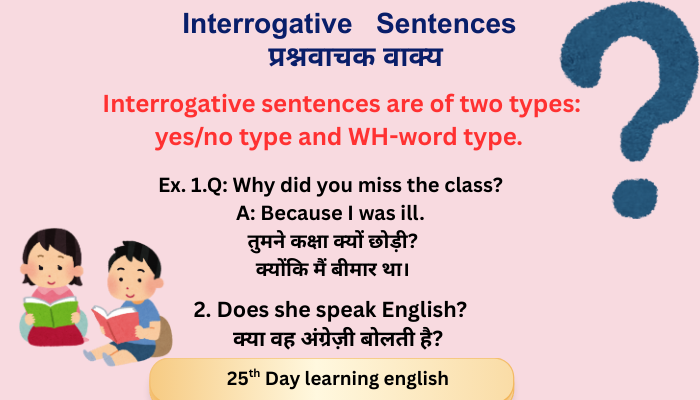
2. Does she speak English?
क्या वह अंग्रेज़ी बोलती है?
Read Also
• Sentences
• Parts of Sentence
• Affirmative Sentences
• Negative Sentences
• Interrogative Sentences
Interrogative sentences are of two types: yes/no type and WH-word type. These two examples are of the yes/no type, and all the examples below are of the WH-word type.
We use interrogative sentences in our daily life.
For example – What happened? Why did it happen? How did it happen? Where did he go? How many are there? Where are you? When did you go?
We speak such questions every day.
Today, we will learn how to make sentences of all these types of questions.
हम रोज़मर्रा की ज़िंदगी में interrogative sentences का उपयोग करते हैं।
जैसे – क्या हुआ? क्यों हुआ? कैसे हुआ? कहाँ गया? कितने हैं? कहाँ हो? कब गए?
इस तरह के प्रश्न हम रोज़ बोलते हैं।
आज हम इन्हीं सभी प्रकार के प्रश्नों के वाक्य बनाना सीखेंगे।
EXAMPLES:
1. What happened? (क्या हुआ?)
1. Q: What happened outside?
A: A dog was barking loudly.
बाहर क्या हुआ?
एक कुत्ता ज़ोर से भौंक रहा था।
2. Q: What happened to your phone?
A: It stopped working.
तुम्हारे फोन को क्या हुआ?
वह काम करना बंद हो गया।
3. Q: What happened in class today?
A: We had a test.
आज कक्षा में क्या हुआ?
हमारा टेस्ट हुआ।
4. Q: What happened last night?
A: It rained heavily.
कल रात क्या हुआ?
बहुत तेज़ बारिश हुई।
5. Q: What happened to him?
A: He fell down.
उसे क्या हुआ?
वह गिर गया।
Read Also
• Imperative Sentence
• Exlamatory Sentences
• Conditional Sentences
2. Why did it happen? (क्यों हुआ?)
1. Q: Why did you miss the class?
A: Because I was ill.
तुमने कक्षा क्यों छोड़ी?
क्योंकि मैं बीमार था।
2. Q: Why did she cry?
A: She lost her book.
वह क्यों रोई?
उसकी किताब खो गई।
3. Q: Why did the bus stop?
A: There was traffic.
बस क्यों रुकी?
ट्रैफिक था।
4. Q: Why did you come early?
A: I had free time.
तुम जल्दी क्यों आए?
मेरे पास समय था।
5. Q: Why did he fail?
A: He did not study well.
वह फेल क्यों हुआ?
उसने अच्छे से पढ़ाई नहीं की।
3. How did it happen? (कैसे हुआ?)
1. Q: How did you solve this problem?
A: With the teacher’s help.
तुमने यह सवाल कैसे हल किया?
शिक्षक की मदद से।
2. Q: How did the glass break?
A: It fell from the table.
गिलास कैसे टूटा?
वह मेज़ से गिर गया।
3. Q: How did you reach here?
A: By bus.
तुम यहाँ कैसे पहुँचे?
बस से।
4. Q: How did she learn cooking?
A: From her mother.
उसने खाना बनाना कैसे सीखा?
अपनी माँ से।
5. Q: How did the child get hurt?
A: While playing.
बच्चे को चोट कैसे लगी?
खेलते समय।
4. Where did you go? (कहाँ गए?)
1. Q: Where did you go in the morning?
A: I went to the temple.
तुम सुबह कहाँ गए थे?
मैं मंदिर गया था।
2. Q: Where did she go yesterday?
A: She went to school.
वह कल कहाँ गई थी?
वह स्कूल गई थी।
3. Q: Where did they go for picnic?
A: To the park.
वे पिकनिक के लिए कहाँ गए?
पार्क में।
4. Q: Where did your father go?
A: He went to the office.
तुम्हारे पापा कहाँ गए?
वे ऑफिस गए।
5. Q: Where did you go last night?
A: I went to my friend’s house.
तुम कल रात कहाँ गए थे?
मैं दोस्त के घर गया था।
5. How many are there? (कितने हैं?)
1. Q: How many books are there?
A: There are five books.
वहाँ कितनी किताबें हैं?
वहाँ पाँच किताबें हैं।
2. Q: How many students are present?
A: Twenty students are present.
कितने छात्र मौजूद हैं?
बीस छात्र मौजूद हैं।
3. Q: How many days are in a week?
A: There are seven days.
हफ्ते में कितने दिन होते हैं?
सात दिन होते हैं।
4. Q: How many apples do you have?
A: I have three apples.
तुम्हारे पास कितने सेब हैं?
मेरे पास तीन सेब हैं।
5. Q: How many classes do you take?
A: I take two classes daily.
तुम कितनी कक्षाएँ लेते हो?
मैं रोज़ दो कक्षाएँ लेता हूँ।
6. Where are you? (कहाँ हो?)
1. Q: Where are you now?
A: I am at home.
तुम अभी कहाँ हो?
मैं घर पर हूँ।
2. Q: Where are you sitting?
A: I am sitting in the room.
तुम कहाँ बैठे हो?
मैं कमरे में बैठा हूँ।
3. Q: Where is your brother?
A: He is in school.
तुम्हारा भाई कहाँ है?
वह स्कूल में है।
4. Q: Where are they?
A: They are in the garden.
वे कहाँ हैं?
वे बगीचे में हैं।
5. Q: Where is your bag?
A: It is on the table.
तुम्हारा बैग कहाँ है?
वह मेज़ पर है।
7. When did you go? (कब गए?)
1. Q: When did you wake up?
A: I woke up at 6 am.
तुम कब उठे?
मैं 6 बजे उठा।
2. Q: When did the class start?
A: It started at 10 am.
कक्षा कब शुरू हुई?
10 बजे।
3. Q: When did you meet him?
A: Yesterday evening.
तुम उससे कब मिले?
कल शाम।
4. Q: When did she come back?
A: She came back today.
वह कब लौटी?
आज।
5. Q: When did the train arrive?
A: The train arrived late.
ट्रेन कब आई?
ट्रेन देर से आई।
8. Who are you? (तुम कौन हो?)
1. Q: Who are you?
A: I am a student.
तुम कौन हो?
मैं एक छात्र हूँ।
2. Q: Who are you talking to?
A: I am talking to my friend.
तुम किससे बात कर रहे हो?
मैं अपने दोस्त से बात कर रहा हूँ।
3. Q: Who are you waiting for?
A: I am waiting for my teacher.
तुम किसका इंतज़ार कर रहे हो?
मैं अपने शिक्षक का इंतज़ार कर रहा हूँ।
4. Q: Who are you helping?
A: I am helping my brother.
तुम किसकी मदद कर रहे हो?
मैं अपने भाई की मदद कर रहा हूँ।
5. Q: Who are you calling?
A: I am calling my mother.
तुम किसे कॉल कर रहे हो?
मैं अपनी माँ को कॉल कर रहा हूँ।
9. Who is he / she? (वह कौन है?)
1. Q: Who is he?
A: He is my neighbour.
वह कौन है?
वह मेरा पड़ोसी है।
2. Q: Who is she?
A: She is my English teacher.
वह कौन है?
वह मेरी अंग्रेज़ी की शिक्षिका हैं।
3. Q: Who is standing outside?
A: My friend is standing outside.
बाहर कौन खड़ा है?
मेरा दोस्त बाहर खड़ा है।
4. Q: Who is calling you?
A: My father is calling me.
तुम्हें कौन फोन कर रहा है?
मेरे पापा फोन कर रहे हैं।
5. Q: Who is your best friend?
A: My best friend is Rahul.
तुम्हारा सबसे अच्छा दोस्त कौन है?
मेरा सबसे अच्छा दोस्त राहुल है।
10. Who was / were? (कौन था / थे?)
1. Q: Who was at the door?
A: The postman was at the door.
दरवाज़े पर कौन था?
दरवाज़े पर पोस्टमैन था।
2. Q: Who was your teacher last year?
A: Mr. Sharma was my teacher.
पिछले साल तुम्हारे शिक्षक कौन थे?
श्री शर्मा मेरे शिक्षक थे।
3. Q: Who were in the room?
A: Two students were in the room.
कमरे में कौन थे?
कमरे में दो छात्र थे।
4. Q: Who was late today?
A: I was late today.
आज कौन देर से आया?
मैं आज देर से आया।
5. Q: Who were absent yesterday?
A: Three students were absent.
कल कौन अनुपस्थित थे?
तीन छात्र अनुपस्थित थे।
11. Who did? (किसने किया?)
1. Q: Who did this work?
A: I did this work.
यह काम किसने किया?
यह काम मैंने किया।
2. Q: Who did you meet?
A: I met my cousin.
तुम किससे मिले?
मैं अपने कज़िन से मिला।
3. Q: Who did she call?
A: She called her friend.
उसने किसे फोन किया?
उसने अपने दोस्त को फोन किया।
4. Q: Who did they help?
A: They helped the old man.
उन्होंने किसकी मदद की?
उन्होंने बूढ़े आदमी की मदद की।
5. Q: Who did he ask?
A: He asked the teacher.
उसने किससे पूछा?
उसने शिक्षक से पूछा।
12. Who will? (कौन करेगा?)
1. Q: Who will teach us today?
A: Our English teacher will teach us.
आज हमें कौन पढ़ाएगा?
आज हमें हमारी अंग्रेज़ी की शिक्षिका पढ़ाएँगी।
2. Q: Who will help me?
A: I will help you.
मेरी मदद कौन करेगा?
मैं तुम्हारी मदद करूँगा।
3. Q: Who will go with you?
A: My brother will go with me.
तुम्हारे साथ कौन जाएगा?
मेरा भाई मेरे साथ जाएगा।
4. Q: Who will win the match?
A: Our team will win.
मैच कौन जीतेगा?
हमारी टीम जीतेगी।
5. Q: Who will call him?
A: I will call him.
उसे कौन कॉल करेगा?
मैं उसे कॉल करूँगा।
Exercise-1
Make Questions / Choose Correct Answer
A. Fill in the blanks (खाली जगह भरो)
1. __ happened in the class today?
2. __ did you come late?
3. __ did you learn English?
4. __ did she go yesterday?
5. __ are you sitting now?
6. __ did the train arrive?
7. __ is calling you?
8. __ many students are present?
9. __ did he meet at the market?
10. __ will help you with this work?
(What / Why / How / Where / When / Who / How many)
B. Make Questions (प्रश्न बनाइए)
11. You are studying English.
→ __________ ?
12. She went to school.
→ __________ ?
13. I woke up at 6 am.
→ __________ ?
14. Rahul is my best friend.
→ __________ ?
15. There are five books on the table.
→ __________ ?
C. Choose the correct option (सही विकल्प चुनिए)
16. _ did you go yesterday?
a) Who
b) Where
c) Why
17. _ is standing outside?
a) How
b) When
c) Who
18. _ many days are in a week?
a) What
b) How
c) How many
19. _ did it happen?
a) How
b) Where
c) Who
20. _ will teach us today?
a) Why
b) Who
c) When
D. Short Answer (छोटा उत्तर दीजिए)
21. Where are you now?
22. Who is your teacher?
23. When did you wake up today?
24. Why are you learning English?
25. How did you come here?
ANSWER KEY
A.
1. What
2. Why
3. How
4. Where
5. Where
6. When
7. Who
8. How
9. Who
10. Who
B. (Possible answers)
11. What are you studying?
12. Where did she go?
13. When did you wake up?
14. Who is your best friend?
15. How many books are on the table?
C.
16. b) Where
17. c) Who
18. c) How many
19. a) How
20. b) Who
D.
21. I am at home.
22. My teacher is Mrs. Sharma.
23. I woke up at 6 am.
24. Because I want to speak English.
25. I came here by bus.