Definition
A Conditional Sentence expresses that something will happen (or would have happened) only if a particular condition is fulfilled.
It usually begins with the word “if” and connects a condition with its possible result.
परिभाषा
Conditional Sentence वह वाक्य होता है जिसमें यह बताया जाता है कि कोई कार्य तभी होगा (या हुआ होता) जब कोई विशेष शर्त पूरी होगी।
ऐसे वाक्य आमतौर पर “if” (यदि) शब्द से शुरू होते हैं, जो शर्त और परिणाम को जोड़ते हैं।इन वाक्यों में यदि या अगर से प्रारंभ होते हैं और वाक्यों के बीच दो या तब शब्द आता है।
नीचे दिए गए वाक्य में आप को उदाहरण सहित के बारे में समझाया गया है। इन उदाहरणों को हिंदी से अंग्रेजी अनुवाद में ध्यानपूर्वक पढ़ें और समझें।
Examples:
1. it rains, we will stay at home.
अगर बारिश होगी, तो हम घर पर रहेंगे।
2. If you study hard, you will pass the exam.
यदि तुम मेहनत से पढ़ोगे, तो परीक्षा पास कर लोगे।
3. If I were rich, I would help the poor.
अगर मैं अमीर होता, तो गरीबों की मदद करता।
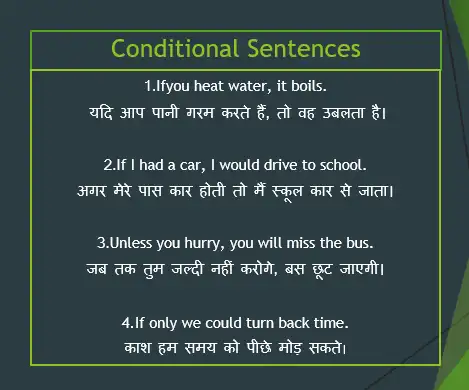
4. If you heat water, it boils.
यदि आप पानी गरम करते हैं, तो वह उबलता है।
5. If I had studied, I would have got good marks.
अगर मैंने पढ़ाई की होती, तो मुझे अच्छे अंक मिलते।
6. If you don’t eat, you will feel weak.
अगर तुम नहीं खाओगे, तो कमज़ोर महसूस करोगे।
7. If I see him, I will tell him the truth.
अगर मैं उसे देखूंगा, तो उसे सच्चाई बता दूंगा।
8. If they had left early, they would have caught the train.
अगर वे जल्दी निकलते, तो ट्रेन पकड़ लेते।
9. If I had wings, I would fly in the sky.
अगर मेरे पास पंख होते, तो मैं आसमान में उड़ता।
10. If you help others, God will help you.
अगर तुम दूसरों की मदद करोगे, तो भगवान तुम्हारी मदद करेंगे।
Read Also
• Affirmative Sentence
• Negative Sentence
• Interrogative Sentence
❖ Types of Conditional Sentences
शर्त वाचक वाक्य के प्रकार
Conditional Sentences 4 प्रकार के होते हैं- नीचे आपको सभी उदाहरणों के बारे में विस्तार पूर्ण बताया गया है, सभी उदाहरणों को ध्यान से सीखें।
1. Zero Conditional (Universal truth / general Fact)
2. First Conditional (Real or Possible Future)
3. Second Conditional (Imaginary or Unreal Present / Future)
4. Third Conditional (Unreal Past)
1. Zero Conditional Sentences
Definition
Zero Conditional Sentence is used to express universal truths, general facts, scientific laws, or things that are always true.
It tells us what always happens when a particular condition is fulfilled.
It shows: Fact → Result (Always True)
परिभाषा
Zero Conditional Sentence वे वाक्य होते हैं जो सामान्य सत्य, वैज्ञानिक तथ्य या हमेशा सच होने वाली घटनाएँ बताते हैं।
इन वाक्यों में शर्त और परिणाम दोनों हमेशा सत्य (सदैव सत्य) होते हैं।
Examples:
1. If you heat water, it boils.
यदि आप पानी गरम करते हैं, तो यह उबलता है।
2. If you touch fire, it burns.
यदि आप आग को छूते हैं, तो यह जलाती है।
3. If it rains, the ground gets wet.
यदि बारिश होती है, तो ज़मीन गीली हो जाती है।
4. If you mix red and yellow, you get orange.
यदि आप लाल और पीला रंग मिलाते हैं, तो नारंगी बनता है।
5. If the sun sets, it becomes dark.
जब सूरज डूबता है, तो अंधेरा हो जाता है।
6. If babies are hungry, they cry.
यदि बच्चे भूखे होते हैं, तो वे रोते हैं।
7. If you don’t water plants, they die.
यदि आप पौधों को पानी नहीं देते, तो वे मर जाते हैं।
8. If students study regularly, they learn better.
यदि छात्र नियमित पढ़ाई करते हैं, तो वे बेहतर सीखते हैं।
9. If you freeze water, it turns into ice.
यदि आप पानी को जमाते हैं, तो यह बर्फ बन जाता है।
10. If the temperature falls below zero, water freezes.
यदि तापमान शून्य से नीचे जाता है, तो पानी जम जाता है।
Read Also
• Parts of speech
• Gender
• Singular & Plural
2. First Conditional Sentences
Definition
A First Conditional Sentence is used to talk about a real or possible situation in the future — something that might actually happen if a certain condition is met.
It expresses a cause and effect relationship between the condition and its result.
It talks about real possibilities — not imaginary ones.
परिभाषा
First Conditional Sentences वे वाक्य होते हैं जो भविष्य में किसी वास्तविक या संभावित स्थिति को दर्शाते हैं।
इनमें बताया जाता है कि यदि कोई शर्त पूरी होती है, तो उसका परिणाम भविष्य में हो सकता है।
यानी — “अगर यह होगा, तो वह होगा।”
Examples:
1. If it rains, we will stay at home.
अगर बारिश होगी, तो हम घर पर रहेंगे।
2. If you study hard, you will pass the exam.
यदि तुम मेहनत से पढ़ोगे, तो परीक्षा पास कर लोगे।
3. If I see her, I will tell her the truth.
अगर मैं उसे देखूंगा, तो उसे सच्चाई बता दूंगा।
4. If you eat too much, you will get fat.
अगर तुम ज़्यादा खाओगे, तो मोटे हो जाओगे।
5. If we leave now, we will catch the bus.
अगर हम अभी निकलेंगे, तो बस पकड़ लेंगे।
6. If he works hard, he will succeed.
अगर वह मेहनत करेगा, तो सफल होगा।
7. If you don’t hurry, you will miss the train.
अगर तुम जल्दी नहीं करोगे, तो ट्रेन छूट जाएगी।
8. If they invite me, I will go to the party.
अगर वे मुझे बुलाएँगे, तो मैं पार्टी में जाऊँगा।
9. If you help others, they will help you.
अगर तुम दूसरों की मदद करोगे, तो वे भी तुम्हारी मदद करेंगे।
10. If she studies regularly, she will improve her marks.
अगर वह नियमित रूप से पढ़ाई करेगी, तो उसके अंक बढ़ेंगे।
Read Also
• Tense
• Present Tense
• Past Tense
• Future tense Tense
3. Second Conditional Sentences
Definition
A Second Conditional Sentence is used to talk about imaginary, unreal, or unlikely situations in the present or future.
It expresses something that is not true now or probably won’t happen in reality.
परिभाषा
Second Conditional Sentences वे वाक्य होते हैं जो काल्पनिक (imaginary) या अवास्तविक (unreal) स्थितियों को वर्तमान या भविष्य में दर्शाते हैं।
इनका प्रयोग तब किया जाता है जब कोई स्थिति वास्तव में नहीं होती, लेकिन कल्पना की जाती है।
Examples:
1. If were rich, I would buy a big house.
अगर मैं अमीर होता, तो बड़ा घर खरीदता।
2. If I had a car, I would drive to school.
अगर मेरे पास कार होती, तो मैं स्कूल कार से जाता।
3. If it rained tomorrow, we would stay at home.
अगर कल बारिश होती, तो हम घर पर रहते।
4. If I knew his address, I would visit him.
अगर मुझे उसका पता पता होता, तो मैं उससे मिलने जाता।
5. If I were a bird, I would fly in the sky.
अगर मैं पक्षी होता, तो आसमान में उड़ता।
6. If she studied more, she would get better marks.
अगर वह ज़्यादा पढ़ती, तो उसे बेहतर अंक मिलते।
7. If you helped me, I would finish this work.
अगर तुम मेरी मदद करते, तो मैं यह काम पूरा कर लेता।
8. If they lived near us, we would visit them often.
अगर वे हमारे पास रहते, तो हम उनसे अक्सर मिलते।
9. If I were you, I would apologize.
अगर मैं तुम्हारी जगह होता, तो माफ़ी मांगता।
10. If we had more time, we would play another game.
अगर हमारे पास और समय होता, तो हम एक और खेल खेलते।
Read Also
• Present Indefinite Tense
• Present Perfect Tense
• Present Continuous Tense
• Present Perfect Continuous Tense
4. Third Conditional Sentences
Definition
Third Conditional Sentence is used to talk about imaginary or unreal situations in the past
something that did not actually happen, but we imagine what would have happened if the condition were different.
It expresses regret, past imagination, or missed opportunity.
परिभाषा
Third Conditional Sentence उन स्थितियों को दर्शाता है जो भूतकाल (past) में हुई नहीं,
लेकिन हम कल्पना करते हैं कि अगर ऐसा हुआ होता, तो क्या होता।
इसका प्रयोग पश्चाताप (regret) या कल्पना (imagination) जताने के लिए किया जाता है।
Examples:
1. If I had studied harder, I would have passed the exam.
अगर मैंने ज़्यादा मेहनत की होती, तो मैं परीक्षा पास कर लेता।
2. If it had rained yesterday, we would have stayed at home.
अगर कल बारिश हुई होती, तो हम घर पर रहते।
3. If I had seen you, I would have called you.
अगर मैंने तुम्हें देखा होता, तो मैंने तुम्हें बुलाया होता।
4. If they had left early, they would have caught the bus.
अगर वे जल्दी निकलते, तो बस पकड़ लेते।
5. If I had known the truth, I would have told you.
अगर मुझे सच्चाई पता होती, तो मैं तुम्हें बता देता।
6. If she had worked harder, she would have succeeded.
अगर उसने ज़्यादा मेहनत की होती, तो वह सफल हो जाती।
7. If I had woken up on time, I wouldn’t have missed the train.
अगर मैं समय पर जागा होता, तो ट्रेन नहीं छूटती।
8. If we had met before, we would have been good friends.
अगर हम पहले मिले होते, तो अच्छे दोस्त बन जाते।
9. If he had driven carefully, he wouldn’t have had an accident.
अगर उसने ध्यान से गाड़ी चलाई होती, तो एक्सीडेंट नहीं होता।
10. If the teacher had explained it, we would have understood.
अगर अध्यापक ने समझाया होता, तो हम समझ जाते।
Read Also
• Imperative Sentence
• Exclamatory Sentence
❖ Other Conditional Forms
1. Unless = if not (अगर नहीं / जब तक नहीं)
Definition
Unless” means “if not” — it is used in conditional sentences to show a negative condition.
It expresses that something will not happen except if a certain condition is true.
परिभाषा
“Unless” का अर्थ होता है “यदि नहीं” (अगर नहीं)।
इसका प्रयोग तब किया जाता है जब किसी कार्य के होने की शर्त बताई जाती है कि —
अगर वह शर्त पूरी नहीं हुई, तो परिणाम नहीं होगा।
Examples:
1. You will fail unless you study.
अगर तुम पढ़ाई नहीं करते हो, तो तुम फेल हो जाओगे।
2. I won’t go unless you come with me.
मैं नहीं जाऊँगा अगर तुम मेरे साथ नहीं चलोगे।
3. She won’t pass the exam unless she works hard.
वह परीक्षा पास नहीं करेगी अगर वह मेहनत नहीं करेगी।
4. We can’t start the meeting unless the manager arrives.
जब तक मैनेजर नहीं आता, हम मीटिंग शुरू नहीं कर सकते।
5. The plants will die unless you water them.
अगर तुम पौधों को पानी नहीं दोगे, तो वे मर जाएँगे।
6. Unless you hurry, you’ll miss your train.
अगर तुम जल्दी नहीं करते, तो तुम्हारी ट्रेन छूट जाएगी।
7. They won’t let you in unless you have a ticket.
अगर तुम्हारे पास टिकट नहीं है, तो वे तुम्हें अंदर नहीं जाने देंगे।
8. You can’t be successful unless you work hard.
जब तक तुम मेहनत नहीं करते, तुम सफल नहीं हो सकते।
9. Unless it rains, we will go for a picnic.
अगर बारिश नहीं होती, तो हम पिकनिक पर जाएँगे।
10. I can’t help you unless you tell me the truth.
मैं तुम्हारी मदद नहीं कर सकता अगर तुम सच नहीं बताते।
Read Also
• Active & Passive voice
• Article-A
2. Even if (भले ही / चाहे कुछ भी हो)
Definition
Even if” is used in conditional sentences to show that the result will be the same,no matter what happens or whatever the condition is.
It expresses determination, contrast, or unexpected condition.
It means — “even though the condition happens, the result will not change.”
It makes the condition stronger than “if”.
परिभाषा
“Even if” का अर्थ होता है “भले ही”, “चाहे कुछ भी हो”, या “फिर भी”।
इसका प्रयोग तब किया जाता है जब कोई परिणाम स्थिति के बावजूद नहीं बदलता।
मतलब: “कुछ भी हो जाए, परिणाम वही रहेगा।”
Examples:
1. Even if it rains, we will go to school.
भले ही बारिश हो, हम स्कूल जाएंगे।
2. Even if you ask me, I won’t help you.
चाहे तुम मुझसे पूछो भी, मैं तुम्हारी मदद नहीं करूँगा।
3. Even if I am tired, I will finish my work.
भले ही मैं थका हूँ, फिर भी मैं अपना काम पूरा करूँगा।
4. Even if she studies hard, she may not pass.
चाहे वह बहुत पढ़े, फिर भी शायद पास न हो।
5. Even if I had money, I wouldn’t buy that car.
अगर मेरे पास पैसे भी होते, तो भी मैं वह कार नहीं खरीदता।
6. Even if he apologized, she wouldn’t forgive him.
भले ही वह माफी मांग ले, वह उसे माफ नहीं करेगी।
7. Even if they invite me, I won’t go.
चाहे वे मुझे बुलाएँ भी, मैं नहीं जाऊँगा।
8. Even if I tried again, I couldn’t do it.
अगर मैं फिर कोशिश भी करूँ, तो भी मैं नहीं कर पाऊँगा।
9. Even if we start now, we will be late.
चाहे हम अभी शुरू करें, फिर भी हम देर से पहुँचेंगे।
10. Even if it snows, we’ll still play outside.
भले ही बर्फ़ पड़े, हम बाहर खेलेंगे।
Read Also
• Past Indefinite Tense
• Past Perfect Tense
• Past Continuous Tense
• Past Perfect Continuous Tense
3. If Only (काश / केवल अगर)
Definition
If only” is used to express a strong wish, regret, or desire about a situation that is not real or did not happen.
It is similar to conditional sentences, because it talks about imaginary or unreal situations —
in the present, future, or past.
It means: “I wish that…” or “I really hope that…”
परिभाषा
“If only” का अर्थ होता है “काश”, “अगर ऐसा होता तो…”, या “मैं चाहता हूँ कि…”
इसका प्रयोग किसी इच्छा, पछतावे या अफसोस को व्यक्त करने के लिए किया जाता है —
ऐसी स्थितियाँ जो वास्तव में नहीं हुईं, पर हम चाहते हैं कि होतीं।
Examples:
1. If only I could see you again!
काश मैं तुम्हें फिर से देख पाता!
2. If only I had not lost my wallet.
काश मेरा बटुआ न खोया होता।
3. If only I were taller.
काश मैं थोड़ा लंबा होता।
4. If only we could turn back time.
काश हम समय को पीछे मोड़ सकते।
5. If only she had listened to me.
काश उसने मेरी बात सुनी होती।
6. If only they would stop fighting.
काश वे झगड़ना बंद कर दें।
Read Also
• Future Indefinite Tense
• Future Perfect Tense
• Future Continuous Tense
• Future Perfect Continuous Tense
Conditional Sentences Examples English to Hindi –
1. If you mix blue and yellow, you get green.
अगर आप नीला और पीला मिलाते हैं, तो हरा रंग बनता है।
2. If you don’t water plants, they die.
अगर आप पौधों को पानी नहीं देते, तो वे मर जाते हैं।
3. If I finish my work early, I will call you.
अगर मैंने अपना काम जल्दी खत्म कर लिया, तो मैं तुम्हें फोन करूंगा।
4. If it doesn’t rain, we will go for a picnic.
अगर बारिश नहीं हुई, तो हम पिकनिक पर जाएंगे।
5. If I were a teacher, I would make learning fun.
अगर मैं शिक्षक होता, तो पढ़ाई को मजेदार बनाता।
6. If she lived in Delhi, she would visit us often.
अगर वह दिल्ली में रहती, तो अक्सर हमसे मिलने आती।
7. If they had worked harder, they would have succeeded.
अगर उन्होंने और मेहनत की होती, तो वे सफल हो जाते।
8. If I had known about the meeting, I would have attended it.
अगर मुझे बैठक के बारे में पता होता, तो मैं शामिल होता।
9. Unless you hurry, you will miss the bus.
जब तक तुम जल्दी नहीं करोगे, बस छूट जाएगी।
10. Unless he studies, he will fail the test.
अगर वह पढ़ाई नहीं करेगा, तो परीक्षा में फेल हो जाएगा।
11. Even if it snows, the match will continue.
भले ही बर्फ गिरे, मैच जारी रहेगा।
12. Even if you beg him, he won’t change his mind.
भले ही तुम उससे विनती करो, वह अपना मन नहीं बदलेगा।
13. If only I could meet my childhood friends again.
काश मैं अपने बचपन के दोस्तों से फिर मिल पाता।
14. If only I had listened to my parents.
काश मैंने अपने माता-पिता की बात सुनी होती।
15. If you heat metal, it expands.
अगर आप धातु को गरम करते हैं, तो यह फैलती है।
16. If you see him, tell him I’m looking for him.
अगर तुम उसे देखो, तो कहना मैं उसे ढूंढ रहा हूँ।
17. If she had left on time, she wouldn’t have been late.
अगर वह समय पर निकली होती, तो देर नहीं होती।
18. If I were in your place, I would accept the offer.
अगर मैं तुम्हारी जगह होता, तो प्रस्ताव स्वीकार कर लेता।
19. Unless you work hard, you can’t achieve success.
जब तक तुम मेहनत नहीं करोगे, सफलता नहीं मिलेगी।
20. Even if I win the lottery, I’ll keep working.
भले ही मैं लॉटरी जीत जाऊं, मैं काम करना नहीं छोड़ूंगा।
Read Also
• Modal Auxiliary Verb
• Use of Can & Could
• Use of May & Might
• Use of Should & Would