9th Day Learning English – 9th day Challenge
Today is a nine day for learning English. On this ninth day, we will learn about etiquette in English. Along with speaking English, we should also understand how important etiquette is. Through good manners, we show respect to others and receive respect in return. It's very important to pay attention to how we should behave and use proper etiquette when speaking English. Today, we will explain how to practice good manners.
आज हमारा अंग्रेजी सीखने का नवां दिन है नौवें दिन में हम अंग्रेजी में शिष्टाचार सीखेंगे अंग्रेजी बोलने के साथ-साथ हमें यह भी पता होना चाहिए की शिष्टाचार हमारे लिए कितने महत्वपूर्ण है शिष्टाचार से ही हमें दूसरों को सम्मान देते हैं तथा हमें स्वयं भी सम्मान मिलता है अंग्रेजी बात और व्यवहार से बहुत ही ध्यान देने वाली बात यह है कि शिष्टाचार हमें कैसे-कैसे करना चाहिए आज हम आपको शिष्टाचार किस प्रकार किया जाता है यह बताएंगे-
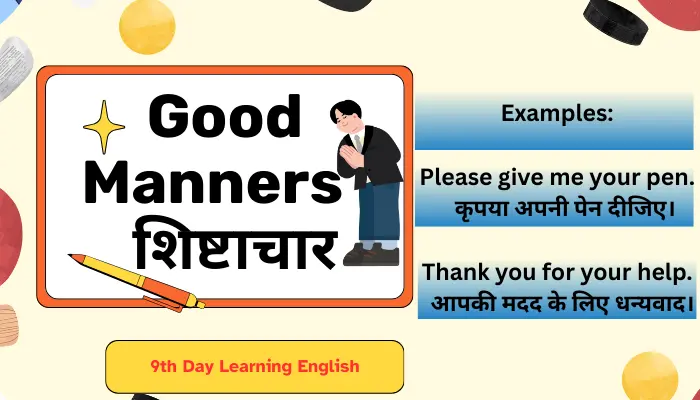
Good Manners (शिष्टाचार)
1.Using “Please” (कृपया का प्रयोग)
We use please while requesting or asking for something politely.
जब हम किसी से विनम्रता से कुछ माँगते हैं, तब please (कृपया) का प्रयोग करते हैं।
Examples:
• Please give me your pen.
कृपया अपनी पेन दीजिए।
• A glass of water, please.
एक गिलास पानी दीजिए।
2. Saying “Thank You” (धन्यवाद कहना)
We say thank you when someone helps us or gives us something.
जब कोई हमारी मदद करता है या हमें कुछ देता है, तब हम thank you (धन्यवाद) कहते हैं।
Examples:
• Thank you for your help.
आपकी मदद के लिए धन्यवाद।
• Thanks a lot.
बहुत-बहुत धन्यवाद।
3. Reply to “Thank You” (धन्यवाद का उत्तर)
We reply politely when someone says thank you.
जब कोई हमें धन्यवाद कहे, तो हम शिष्ट उत्तर देते हैं।
Replies:
• You’re welcome. – आपका स्वागत है।
• It’s my pleasure. – मुझे खुशी हुई।
• That’s all right. – कोई बात नहीं।
4. Saying “Sorry” (माफ़ी माँगना)
We say sorry when we make a mistake or arrive late.
गलती होने या देर हो जाने पर sorry (माफ़ कीजिए) कहते हैं।
Examples:
• Sorry, I am late.
माफ़ कीजिए, मुझे देर हो गई।
• I’m very sorry.
मुझे बहुत अफ़सोस है।
5. Using “Excuse Me” (क्षमा करें का प्रयोग)
We use excuse me to get attention, pass by someone, or ask permission.
किसी का ध्यान खींचने, रास्ता माँगने या अनुमति लेने के लिए excuse me कहते हैं।
Examples:
• Excuse me, please.
क्षमा करें।
• Excuse me, may I come in?
क्षमा करें, क्या मैं अंदर आ सकता/सकती हूँ?
Read Also
• Tenses
• Future - tense
• Future - indefinite - tense
• Future - Continuous - tense
• Future Perfect Tense
• Future Perfect Continuous Tense
6. Using “Pardon” (दोबारा कहने के लिए)
We use pardon when we cannot hear or understand something.
जब बात ठीक से सुनाई न दे, तब pardon कहते हैं।
Examples:
• Pardon?
क्या कहा?
• I beg your pardon.
कृपया दोबारा कहिए।
7. Offering Help (मदद की पेशकश)
We politely offer help to others.
हम दूसरों की मदद विनम्रता से ऑफ़र करते हैं।
Examples:
• May I help you?
क्या मैं आपकी मदद कर सकता/सकती हूँ?
• Allow me.
मुझे करने दीजिए।
8. Letting Someone Go First (पहले आप कहना)
We say after you to show respect.
सम्मान दिखाने के लिए after you (पहले आप) कहते हैं।
Examples:
• After you, please.
पहले आप।
9. Polite Requests (विनम्र निवेदन)
We use polite sentences while requesting.
निवेदन करते समय शिष्ट भाषा का प्रयोग करते हैं।
Examples:
• May I have your attention, please?
कृपया ध्यान दीजिए।
• Will you please speak slowly?
कृपया धीरे बोलिए।
10.Polite Expressions
• Glad to meet you
आपसे मिलकर खुशी हुई
• That’s very kind of you
आप बहुत दयालु हैं
• Please make yourself comfortable
आराम से बैठिए
• I will try my best
मैं पूरी कोशिश करूँगा/करूँगी
• Hope you are enjoying
आशा है आप आनंद ले रहे हैं
11. Asking Permission (अनुमति माँगना)
• May I sit here?
क्या मैं यहाँ बैठ सकता/सकती हूँ?
• May I use your phone, please?
क्या मैं आपका फोन इस्तेमाल कर सकता/सकती हूँ?
• Is it okay if I leave early?
क्या मैं जल्दी जा सकता/सकती हूँ?
12. Requesting Politely (विनम्र निवेदन)
• Could you help me, please?
क्या आप मेरी मदद कर सकते हैं?
• Would you mind opening the window?
क्या आप खिड़की खोल देंगे?
• Can you explain it again, please?
कृपया इसे फिर से समझाइए।
Read Also
• Present - tense
• Present - indefinite - tense
• Present - Continuous - tense
• Present Perfect Tense
• Present Perfect Continuous Tense
13. Saying No Politely (सभ्य तरीके से मना करना)
• Sorry, I can’t.
माफ़ कीजिए, मैं नहीं कर सकता/सकती।
• I’m afraid I can’t help.
मुझे खेद है, मैं मदद नहीं कर पाऊँगा/पाऊँगी।
• Maybe next time.
शायद अगली बार।
14. Appreciating Others (तारीफ़ करना)
• Well done!
बहुत अच्छा किया!
• That’s a great idea.
यह बहुत अच्छा विचार है।
• I really appreciate your help.
मैं आपकी मदद की सच में कद्र करता/करती हूँ।
15. Apologizing Politely (विनम्र माफ़ी)
• Please forgive me.
कृपया मुझे माफ़ कर दीजिए।
• It won’t happen again.
आगे ऐसा नहीं होगा।
• I didn’t mean to hurt you.
मेरा आपको दुख पहुँचाने का इरादा नहीं था।
16. Attracting Attention (ध्यान आकर्षित करना)
• Excuse me, sir/madam.
क्षमा करें, सर/मैडम।
• May I have a word with you?
क्या मैं आपसे कुछ बात कर सकता/सकती हूँ?
17. Showing Respect (सम्मान दिखाना)
• With due respect…
पूरे सम्मान के साथ कहना चाहता/चाहती हूँ…
• I respect your opinion.
मैं आपकी राय का सम्मान करता/करती हूँ।
18. Making Offers (पेशकश करना)
• Would you like some tea?
क्या आप चाय लेंगे?
• Can I get you something?
क्या मैं आपके लिए कुछ ला दूँ?
Read Also
• Past - tense
• Past - indefinite - tense
• Past - Continuous - tense
• Past Perfect Tense
• Past Perfect Continuous Tense
19. Asking for Clarification (फिर से समझने के लिए)
• Could you please repeat that?
क्या आप कृपया दोबारा कहेंगे?
• I didn’t quite understand.
मैं ठीक से समझ नहीं पाया/पाई।
20. Telephone Manners (फोन पर शिष्टाचार)
• May I speak to Mr. Sharma, please?
क्या मैं श्री शर्मा से बात कर सकता/सकती हूँ?
• Could you hold on, please?
कृपया लाइन पर रहें।
• Thank you for calling.
कॉल करने के लिए धन्यवाद।
21. Classroom Manners (कक्षा में)
• May I come in, please?
क्या मैं अंदर आ सकता/सकती हूँ?
• May I ask a question?
क्या मैं एक सवाल पूछ सकता/सकती हूँ?
• Sorry for being late.
देर होने के लिए माफ़ कीजिए।
22. Public Place Manners (सार्वजनिक स्थान)
• Please stand in a queue.
कृपया लाइन में खड़े रहें।
• Don’t litter here, please.
कृपया यहाँ गंदगी न फैलाएँ।
• Please keep silence.
कृपया शांति बनाए रखें।
We have taught you all the different ways to use polite language. Now you need to use these polite expressions in your everyday conversations so that you can properly learn the rules of polite communication. We are providing some exercises below, along with an answer key. Solve all of them and see if your answers are correct or incorrect.
हमने आपको सभी प्रकार के शिष्टाचार बोलने का तरीका सिखा दिया है अब आपको अपने रोजमर्रा के बोल-चाल में प्रयोग करना है ताकि आप अच्छे से नियम सीख सके अब हम आपको नीचे दे रहे हैं तथा उसके साथ एक आंसर की भी जोड़ रहे हैं उन सभी के सॉल्व करें और देखें कि आपके आंसर सही है कि गलत-
Exercise -1
Part A: Fill in the blanks
1. We say ____ when we ask politely.
2. ____ you for your kind help.
3. We say ____ when we make a mistake.
4. ____ me, may I come in?
5. We reply ____ welcome after “thank you”.
6. “After you” shows ____.
7. We use ____ when we cannot hear clearly.
8. Please ____ in a queue.
9. We say ____ me to get attention.
10. Good manners make a person ____.
Part B: Translate into English
11. कृपया मेरी मदद करें।
12. आपका स्वागत है।
13. मुझे माफ़ कर दीजिए।
14. क्या मैं अंदर आ सकता/सकती हूँ?
15. कृपया लाइन में खड़े रहें।
16. क्या आप दोबारा कहेंगे?
17. ध्यान दीजिए, कृपया।
18. देर होने के लिए माफ़ी।
19. पहले आप।
20. आपकी मदद के लिए धन्यवाद।
Part C: Choose the correct option
21. Which word is used to make a request polite?
(a) Sorry
(b) Please
(c) Pardon
22. When someone says “Thank you”, we reply –
(a) Sorry
(b) You’re welcome
(c) Excuse me
23. Which sentence is polite?
(a) Give me water
(b) Water
(c) A glass of water, please
24. “Excuse me” is used to –
(a) show anger
(b) get attention
(c) scold
25. “Sorry” is used when –
(a) we are happy
(b) we make a mistake
(c) we give order
26. “After you” means –
(a) go fast
(b) first you
(c) stop here
27. Which word is used when we don’t hear properly?
(a) Please
(b) Pardon
(c) Thanks
28. “Stand in a queue” shows –
(a) bad habit
(b) good manners
(c) anger
29. “Thank you very much” is used to show –
(a) respect
(b) anger
(c) fear
30. Good manners help us to become –
(a) rude
(b) polite
(c) lazy
Answer Key
Part A: Fill in the blanks
1. please
2. thank
3. sorry
4. Excuse
5. You’re
6. respect
7. pardon
8. stand
9. excuse
10. polite
Part B: Translate into English
11. Please help me.
12. You’re welcome.
13. Please forgive me. / Sorry.
14. May I come in?
15. Please stand in a queue.
16. Pardon, please? / Could you repeat, please?
17. Pay attention, please.
18. Sorry for being late.
19. After you.
20. Thank you for your help.
Part C: Choose the correct option
21. (b) Please
22. (b) You’re welcome
23. (c) A glass of water, please
24. (b) get attention
25. (b) we make a mistake
26. (b) first you
27. (b) Pardon
28. (b) good manners
29. (a) respect
30. (b) polite