Future Indefinite Tense (भविष्य अनिश्चित काल)
Definition -
Future Indefinite Tense is used to talk about any action that will happen later, not now.
If the action is planned, unplanned, imagined, predicted, promised, or simply expected in the future, we use will + base verb.
This tense does not show the exact time of the action — it only shows that the action will happen in the future.
It shows:
• future actions
• decisions taken at the moment
• promises
• offers
• predictions
• hopes and expectations
परिभाषा -
Future Indefinite Tense किसी भी ऐसे काम को बताने के लिए होता है जो भविष्य में होगा, यानी अभी नहीं, बाद में।
जब हम कोई
• योजना बनाते हैं,
• वादा करते हैं,
• उम्मीद जताते हैं,
• भविष्य बताने की कोशिश करते हैं,
• या अचानक कोई फैसला लेते हैं,
तो हम will + क्रिया का मूल रूप का प्रयोग करते हैं।
यह काल यह नहीं बताता कि भविष्य में कब होगा—बस इतना बताता है कि होगा जरूर।
इन वाक्यों के अंत में गा, गी, गें आदि शब्द आते हैं।
Examples :
1. I will start my studies tomorrow.
मैं कल अपनी पढ़ाई शुरू करूँगा।
2. She will visit her grandparents next week.
वह अगले हफ्ते अपने दादा-दादी से मिलने जाएगी।
3. We will help you in your project.
हम तुम्हारी प्रोजेक्ट में मदद करेंगे।
4. They will play Kho- Kho in the evening.
वे शाम को खो -खो खेलेंगे।
5. He will buy a new phone soon.
वह जल्दी ही एक नया फ़ोन खरीदेगा।
6. The teacher will check our notebooks later.
शिक्षक हमारी कॉपियाँ बाद में चेक करेंगे।
7. I will call you after the meeting.
मैं मीटिंग के बाद तुम्हें कॉल करूँगा।
8. She will cook dinner tonight.
वह आज रात खाना बनाएगी।
9. We will travel to Dehradun next month.
हम अगले महीने देहरादून की यात्रा करेंगे।
10. The weather will improve in a few hours.
कुछ घंटों में मौसम बेहतर होगा।
उपरोक्त सभी उदाहरणों के अंत में गा, गे, गी आदि शब्द आ रहे हैं, सभी उदाहरण Future Indefinite Tense के है।
Read Also
• Future Tense
• Future Indefinite Tense
• future continuous tense
• Future Perfect Tense
• Future Perfect Continuous Tense
• Rules of Future Indefinite Tense (अनिश्चित भविष्यकाल के नियम) :
Rule 1: Use will + base verb (V¹) in all future actions.
सभी भविष्य के वाक्यों में will + क्रिया का मूल रूप (V¹) का प्रयोग होता है।
Rule 2: In affirmative sentences, only “will” is used as helping verb.
Affirmative वाक्यों में केवल “will” helping verb लगता है।
Rule 3 : For negative sentences, use will not / won’t + base verb.
Negative वाक्यों में will not / won’t + क्रिया का मूल रूप लगता है।
Rule 4 : Interrogative sentences start with “Will”.
Interrogative वाक्य “Will” से शुरू होते हैं।
Rule 5 : Structure of interrogative: Will + subject + V¹ + object?
Interrogative संरचना: Will + subject + क्रिया का मूल रूप + object?
Rule 6: WH-questions use: Wh-word + will + subject + V¹?
WH-questions में क्रम होता है: Wh-word + will + subject + क्रिया का मूल रूप?
Rule 7 : No “s/es/ing/ed” is added to the main verb in this tense.
इस tense में मुख्य क्रिया के साथ s/es/ing/ed नहीं लगता।
Rule 8 : “Will” is used with all subjects (I, You, He, She, They, We, Name).
Will का प्रयोग सभी subjects के साथ होता है।
Rule 9 : Time words like tomorrow, next week, soon, later etc. can be used.
Tomorrow, next week, soon, later आदि time words का उपयोग किया जा सकता है।
Rule 10 : Sentence structure remains same for all subjects — no change in verb.
सभी subjects के लिए वाक्य संरचना एक जैसी रहती है — क्रिया नहीं बदलती।
Future Indefinite Tense – Table
| Topic |
Explanation |
| Definition |
Future Indefinite Tense expresses An action that will happen in the Future using will + base verb. |
| Identification |
Sentences show future time with “will” |
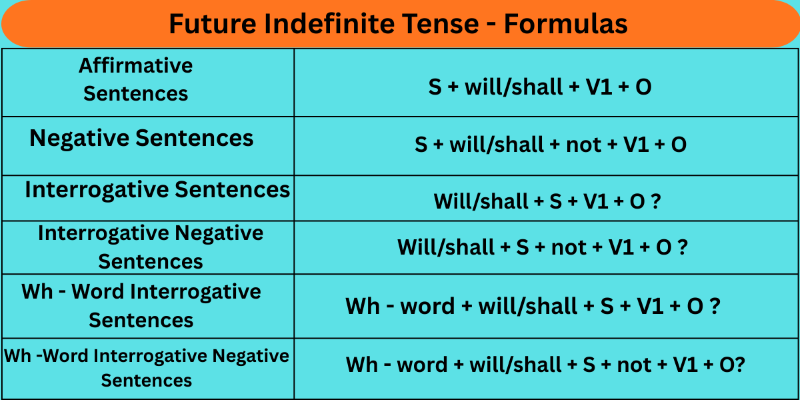
| Affirmative |
Subject + will + V1 + object |
| Negative |
Subject + will not / won’t + v1 + Object |
| Interrogative |
Will + subject + V1 + object + ? |
| Interrogative Negative |
Will + subject + not + V1 + object? |
| Wh – word question |
Wh -word + will + subject + V1 + Object + ? |
| Wh – Word Negative |
Wh- word + will + subject + not + V1 + object + ? |
| Helping verb |
Will is used with all subjects. |
| Main verb rules |
Always use base form (V1), no s/es/ing/ed added |
| Time words used |
Tomorrow, next week, later, soon, Today night, etc. |
Read Also
• Use of Shall & Will • Use of Should & Would
• Use of Used to • Use of Need to
1. Affirmative Sentences (सकारात्मक वाक्य) of Future Indefinite Tense
Affirmative sentences of Future Indefinite Tense are those sentences in which we express an action that will happen in the future, using will + base verb.
Future Indefinite Tense के Affirmative वाक्य वे होते हैं जिनमें हम बताते हैं कि कोई कार्य भविष्य में होगा, और इसके लिए will + क्रिया का मूल रूप का प्रयोग किया जाता है।
• Rules of Affirmative Sentences
RULE 1 — Subject Comes First (Formula का पहला हिस्सा)
Sentence की शुरुआत हमेशा Subject से होगी।
वाक्य की शुरुआत Subject से ही होगी।
Example:
I will study.
मैं पढ़ाई करूँगा।
RULE 2 — “Will” Always Comes After Subject (Formula का दूसरा हिस्सा)
Subject के बाद हमेशा will लगेगा।
Subject के तुरंत बाद will लगाया जाता है।
Example:
I will help you.
मैं तुम्हारी मदद करूँगा।
RULE 3 — Verb Must Be in Base Form V¹ (Formula का तीसरा हिस्सा)
Will के बाद आने वाली verb हमेशा मूल रूप (V¹) में होगी।
Verb में s/es/ed/ing नहीं लगेगा।
Will के बाद क्रिया हमेशा मूल रूप में रहेगी।
Example:
He will go.
वह जाएगा।
RULE 4 — Object Comes at the End (Formula का आखिरी हिस्सा)
Verb के बाद object या sentence का बाकी भाग आता है।
क्रिया के बाद object या वाक्य का शेष भाग आएगा।
Example:
They will play cricket.
वे क्रिकेट खेलेंगे।
RULE 5 — NO “NOT” in Affirmative (Formula में नहीं होता)
Affirmative sentence में not नहीं आता, इसलिए formula में नहीं है।
Affirmative वाक्य positive होते हैं, इसलिए not का प्रयोग नहीं किया जाता।
Example:
She will sing a song.
वह एक गाना गाएगी।
RULE 6 — Same Formula for All Subjects
Formula सभी subjects के लिए same रहता है।
Verb नहीं बदलती।
सभी subject के साथ यही formula लागू होता है।
Verb में कोई बदलाव नहीं होता।
Example:
I will read. / They will read.
मैं पढ़ूँगा / वे पढ़ेंगे।
RULE 7 — Sentence Must Show a Future Action (Formula का उद्देश्य)
br
Formula “will + V¹” भविष्य दर्शाता है, इसलिए action future होना चाहिए।
Formula भविष्य बताता है, इसलिए वाक्य भविष्य से संबंधित होना चाहिए।
Example:
We will travel tomorrow.
हम कल यात्रा करेंगे।
Examples:
1. I will finish my homework tonight.
मैं आज रात अपना होमवर्क पूरा करूँगा।
2. She will bring the documents.
वह दस्तावेज़ लाएगी।
3. They will meet us at the station.
वे हमसे स्टेशन पर मिलेंगे।
4. He will clean his room later.
वह बाद में अपना कमरा साफ करेगा।
5. We will start the project tomorrow.
हम प्रोजेक्ट कल शुरू करेंगे।
6. I will visit the museum next week.
मैं अगले हफ्ते संग्रहालय जाऊँगा।
7. She will call her friend in the evening.
वह शाम को अपनी दोस्त को कॉल करेगी।
8. They will plant trees in the garden.
वे बगीचे में पेड़ लगाएंगे।
9. He will buy some fruits.
वह कुछ फल खरीदेगा।
10. We will watch a movie tonight.
हम आज रात फिल्म देखेंगे।
11. I will join the class on Monday.
मैं सोमवार को क्लास जॉइन करूँगा।
12. She will write a poem for the event.
वह कार्यक्रम के लिए एक कविता लिखेगी।
13. They will celebrate his birthday.
वे उसका जन्मदिन मनाएंगे।
14. He will visit his uncle soon.
वह जल्दी अपने चाचा से मिलने जाएगा।
15. We will shift to a new house.
हम एक नए घर में शिफ्ट होंगे।
16. I will drink tea after work.
मैं काम के बाद चाय पीऊँगा।
17. She will decorate the room.
वह कमरे को सजाएगी।
18. They will play cricket tomorrow.
वे कल क्रिकेट खेलेंगे।
19. He will complete the assignment.
वह असाइनमेंट पूरा करेगा।
20. We will arrange the meeting.
हम मीटिंग की व्यवस्था करेंगे।
21. I will repair my bicycle.
मैं अपनी साइकिल ठीक करूँगा।
22. She will guide her younger sister.
वह अपनी छोटी बहन को मार्गदर्शन देगी।
23. They will support your idea.
वे तुम्हारे विचार का समर्थन करेंगे।
24. He will bring snacks for everyone.
वह सभी के लिए नाश्ता लाएगा।
25. We will learn something new.
हम कुछ नया सीखेंगे।
26. I will send the report today.
मैं आज रिपोर्ट भेजूँगा।
27. She will answer the questions.
वह सवालों का जवाब देगी।
28. They will reach early in the morning.
वे सुबह जल्दी पहुँचेंगे।
29. He will take part in the competition.
वह प्रतियोगिता में भाग लेगा।
30. We will enjoy the holiday.
हम छुट्टी का आनंद लेंगे।
Read Also
• Affirmative Sentence • Conditional Sentence
• Use of Can & Could • Use of Dare
• Use of May & Might • Use of Must & Ought
2. Negative Sentences (नकारात्मक वाक्य) of Future Indefinite Tense
Negative sentences of the Future Indefinite Tense are the sentences that express an action that will not happen in the future.
In these sentences, we use “will not” or “won’t” before the base form of the verb to show denial, refusal, or the absence of an action in the future.
Future Indefinite Tense के Negative वाक्य वे होते हैं जिनमें हम बताते हैं कि कोई कार्य भविष्य में नहीं होगा।
इन वाक्यों में “will not” या “won’t” का प्रयोग क्रिया के मूल रूप से पहले किया जाता है, ताकि यह बताया जा सके कि काम न होने वाला है या इंकार व्यक्त किया जा रहा है।
• Rules of Negative Sentences
Rule 1: Use “will not / won’t” to show denial
Before the main verb, add will not or its short form won’t to show that the action will not happen in the future.
मुख्य क्रिया से पहले will not या won’t लगाकर बताया जाता है कि काम भविष्य में नहीं होगा।
Rule 2: Main verb always stays in base form (V¹)
Example verbs: go, eat, write, play, come
Hindi:
Verb हमेशा मूल रूप में रहता है—इसमें s/es/ing/ed नहीं लगता।
Rule 3: “Will” does not change with any subject
I, you, he, she, it, they — all use will not.
Hindi: किसी भी subject के साथ will not ही लगता है (सबके लिए एक जैसा)।
Rule 4: Sentence structure should be straight and clear
Always follow the formula:
Subject → will not → V¹ → object
Hindi:
हमेशा यही क्रम रहेगा—Subject के बाद will not, फिर verb का मूल रूप।
Rule 5: No extra helping verbs are used
Only will not is used.
No “do”, “does”, “did”, etc.
Hindi:
सिर्फ will not ही लगता है। कोई दूसरी helping verb नहीं लगती।
Example:
1. I will not go to school tomorrow.
मैं कल स्कूल नहीं जाऊँगा/जाऊँगी।
2. She will not eat junk food now.
वह अब जंक फूड नहीं खाएगी।
3. They will not attend the meeting.
वे मीटिंग में शामिल नहीं होंगे।
4. He will not buy a new phone.
वह नया फोन नहीं खरीदेगा।
5. We will not start the work today.
हम आज काम शुरू नहीं करेंगे।
6. You will not forget this lesson.
तुम यह पाठ नहीं भूलोगे।
7. The teacher will not accept late homework.
अध्यापक देर से दिया हुआ होमवर्क स्वीकार नहीं करेंगे।
8. I will not watch TV at night.
मैं रात में टीवी नहीं देखूँगा/देखूँगी।
9. She will not trust him again.
वह उस पर दोबारा भरोसा नहीं करेगी।
10. They will not travel this weekend.
वे इस सप्ताहांत यात्रा नहीं करेंगे।
11. He will not come to the party.
वह पार्टी में नहीं आएगा।
12. I will not waste my time now.
मैं अब अपना समय बर्बाद नहीं करूँगा/करूँगी।
13. You will not open the gate.
तुम गेट नहीं खोलोगे।
14. She will not call you tonight.
वह आज रात तुम्हें फोन नहीं करेगी।
15. We will not shift to another city.
हम किसी और शहर में नहीं शिफ्ट होंगे।
16. They will not play outside today.
वे आज बाहर नहीं खेलेंगे।
17. I will not agree with this decision.
मैं इस फैसले से सहमत नहीं होऊँगा/होऊँगी।
18. He will not finish the task alone.
वह अकेले काम पूरा नहीं करेगा।
19. She will not sing in the program.
वह कार्यक्रम में नहीं गाएगी।
20. You will not repeat the mistake.
तुम गलती नहीं दोहराओगे।
21. We will not cancel the plan.
हम योजना रद्द नहीं करेंगे।
22. They will not sell their house.
वे अपना घर नहीं बेचेंगे।
23. I will not join the class today.
मैं आज क्लास नहीं जॉइन करूँगा/करूँगी।
24. He will not follow the rules.
वह नियमों का पालन नहीं करेगा।
25. She will not accept the proposal.
वह प्रस्ताव स्वीकार नहीं करेगी।
26. You will not disturb me again.
तुम मुझे फिर परेशान नहीं करोगे।
27. We will not trust strangers.
हम अजनबियों पर भरोसा नहीं करेंगे।
28. They will not open the shop early.
वे दुकान जल्दी नहीं खोलेंगे।
29. I will not clean the room today.
मैं आज कमरा साफ नहीं करूँगा/करूँगी।
30. He will not go anywhere tonight.
वह आज रात कहीं नहीं जाएगा।
Read Also
• Parts of Sentences
• Negative Sentence • Exclamatory Sentence
• Parts of Speech
• Noun • Verb
• Adverb • Pronoun
3. Interrogative Sentences ( प्रश्नवाचक वाक्य )of Future Indefinite Tense
Interrogative sentences of the Future Indefinite Tense are questions that ask whether an action will happen in the future. These sentences start with “Will” and use the base form (V¹) of the verb.
Future Indefinite Tense के Interrogative वाक्य वे प्रश्न हैं जिनमें पूछा जाता है कि कोई कार्य भविष्य में होगा या नहीं। इन वाक्यों की शुरुआत “Will” से होती है और क्रिया हमेशा मूल रूप (V¹) में रहती है।
Rules (नियम):
Rule 1: Sentence always starts with WILL
Because it is a question about the future.
Hindi: Interrogative वाक्य हमेशा Will से शुरू होता है।
Rule 2: Verb stays in base form (V¹)
go, come, eat, write etc.
क्रिया का मूल रूप लगता है। s/es/ing/ed नहीं लगता।
Rule 3: No “do/does/did” used
Only will is used.
केवल will ही helping verb होता है।
Rule 4: Question mark (?) at the end
वाक्य के अंत में ? जरूर लगता है।
Rule 5: Subject comes after “will”
Will के बाद subject फिर verb आता है।
Examples:
1. Will you come tomorrow?
क्या तुम कल आओगे?
2. Will she help me?
क्या वह मेरी मदद करेगी?
3. Will they attend the class?
क्या वे क्लास में शामिल होंगे?
4. Will he call you tonight?
क्या वह तुम्हें आज रात फोन करेगा?
5. Will we finish the work today?
क्या हम आज काम पूरा करेंगे?
6. Will I pass the exam?
क्या मैं परीक्षा पास करूँगा/करूँगी?
7. Will she go to the market?
क्या वह बाजार जाएगी?
8. Will he join the meeting?
क्या वह मीटिंग में शामिल होगा?
9. Will they travel next week?
क्या वे अगले हफ्ते यात्रा करेंगे?
10. Will you stay here?
क्या तुम यहाँ रुकोगे?
11. Will she buy a new dress?
क्या वह नई ड्रेस खरीदेगी?
12. Will he open the shop early?
क्या वह दुकान जल्दी खोलेगा?
13. Will I get the job?
क्या मुझे नौकरी मिलेगी?
14. Will they play today?
क्या वे आज खेलेंगे?
15. Will you read this book?
क्या तुम यह किताब पढ़ोगे?
16. Will we go to Delhi?
क्या हम दिल्ली जाएंगे?
17. Will she trust him again?
क्या वह उस पर फिर भरोसा करेगी?
18. Will he teach you?
क्या वह तुम्हें पढ़ाएगा?
19. Will they follow the rules?
क्या वे नियमों का पालन करेंगे?
20. Will you watch the movie?
क्या तुम फिल्म देखोगे?
21. Will I meet you tomorrow?
क्या मैं तुमसे कल मिलूँगा/मिलूँगी?
22. Will he clean the room?
क्या वह कमरा साफ करेगा?
23. Will she bring the files?
क्या वह फाइलें लाएगी?
24. Will they agree to this plan?
क्या वे इस योजना पर सहमत होंगे?
25. Will we win the match?
क्या हम मैच जीतेंगे?
26. Will he finish the project?
क्या वह प्रोजेक्ट पूरा करेगा?
27. Will she cook dinner tonight?
क्या वह आज रात खाना बनाएगी?
28. Will you attend the wedding?
क्या तुम शादी में आओगे?
29. Will they start the meeting soon?
क्या वे जल्द मीटिंग शुरू करेंगे?
30. Will he repair the bike?
क्या वह बाइक ठीक करेगा?
Read Also
• Interrogative Sentence
• Imperative Sentence • Use of Shall & Will
• Adjective • Conjunction
• Interjection • Parts of Speech
• Adjective • Conjunction
• Interjection
4. Interrogative Negative Sentences (प्रश्नवाचक नकारात्मक वाक्य) of Future Indefinite Tense
Interrogative Negative sentences of the Future Indefinite Tense are the questions that ask whether an action will not happen in the future.
These sentences start with “Will”, and after the subject we use “not” to show negativity, followed by the base form of the verb.
Future Indefinite Tense के Interrogative Negative वाक्य वे प्रश्न हैं जिनमें पूछा जाता है कि कोई कार्य भविष्य में नहीं होगा।
इन वाक्यों की शुरुआत Will से होती है, फिर subject के बाद not लगाया जाता है, और उसके बाद क्रिया का मूल रूप (V¹) आता है।
Rules of Interrogative Negative Sentence :
Rule 1: Sentence must start with “WILL”
क्योंकि यह future का प्रश्न है।
Rule 2: Subject के बाद हमेशा NOT लगेगा
Format हमेशा:
Will + subject + not + V¹…
Rule 3: Verb हमेशा base form (V¹) में रहेगा
Verb में कभी s/es/ing/ed नहीं लगेगा।
Rule 4: “Do/Does/Did” नहीं आता
सिर्फ will ही auxiliary verb होता है।
Rule 5: Question mark (?) जरूर लगते हैं
क्योंकि यह question sentence है।
Rule 6: “Won’t” का प्रयोग भी किया जा सकता है
Will not = won’t
दोनों सही हैं, अर्थ एक ही है।
(नोट: “Won’t” = will + not का short form भी इस्तेमाल किया जा सकता है)
Examples:
1.Will you not submit the form today?
क्या तुम आज फॉर्म जमा नहीं करोगे?
2. Will she not apply for the job?
क्या वह नौकरी के लिए आवेदन नहीं करेगी?
3. Will they not plant trees this month?
क्या वे इस महीने पेड़ नहीं लगाएंगे?
4. Will he not bring the documents tomorrow?
क्या वह दस्तावेज कल नहीं लाएगा?
5. Will we not check the result tonight?
क्या हम आज रात परिणाम नहीं देखेंगे?
6. Will you not attend the online class?
क्या तुम ऑनलाइन क्लास में शामिल नहीं होगे?
7. Will she not complete her drawing?
क्या वह अपनी ड्राइंग पूरी नहीं करेगी?
8. Will he not join the gym next week?
क्या वह अगले सप्ताह जिम नहीं जॉइन करेगा?
9. Will they not shift to a new house soon?
क्या वे जल्द नए घर में शिफ्ट नहीं होंगे?
10. Will I not receive the parcel today?
क्या मुझे आज पार्सल नहीं मिलेगा?
11. Will she not submit her assignment?
क्या वह अपना असाइनमेंट जमा नहीं करेगी?
12. Will he not visit his grandparents?
क्या वह अपने दादा-दादी से मिलने नहीं जाएगा?
13. Will you not book the tickets now?
क्या तुम अभी टिकटें बुक नहीं करोगे?
14. Will they not open the restaurant this year?
क्या वे इस साल रेस्तरां नहीं खोलेंगे?
15. Will we not organize the event together?
क्या हम मिलकर कार्यक्रम आयोजित नहीं करेंगे?
16. Will he not write the report by evening?
क्या वह शाम तक रिपोर्ट नहीं लिखेगा?
17. Will she not attend the interview?
क्या वह इंटरव्यू में शामिल नहीं होगी?
18. Will I not find the address easily?
क्या मैं पता आसानी से नहीं ढूँढ पाऊँगा/पाऊँगी?
19. Will they not fix the electricity problem?
क्या वे बिजली की समस्या ठीक नहीं करेंगे?
20. Will you not bring your notebook tomorrow?
क्या तुम कल अपनी नोटबुक नहीं लाओगे?
21. Will he not record the video lecture?
क्या वह वीडियो लेक्चर रिकॉर्ड नहीं करेगा?
22. Will she not decorate the room for the party?
क्या वह पार्टी के लिए कमरा सजाएगी नहीं?
23. Will we not learn a new skill this month?
क्या हम इस महीने नया कौशल नहीं सीखेंगे?
24. Will they not update the website soon?
क्या वे जल्द वेबसाइट अपडेट नहीं करेंगे?
25. Will you not sign the document?
क्या तुम दस्तावेज पर हस्ताक्षर नहीं करोगे?
26. Will he not repair the computer today?
क्या वह आज कंप्यूटर ठीक नहीं करेगा?
27. Will she not water the plants?
क्या वह पौधों को पानी नहीं देगी?
28. Will they not join us for dinner?
क्या वे हमारे साथ डिनर पर नहीं जुड़ेंगे?
29. Will we not get the refund?
क्या हमें रिफंड नहीं मिलेगा?
30. Will you not answer the question honestly?
क्या तुम प्रश्न का ईमानदारी से उत्तर नहीं दोगे?
Read Also
• Interrogative Sentence • Active & Passive Voice
• Negative Sentence • Gender
5. Wh – Word Interrogative Sentences (प्रश्नवाचक वाक्य )of Future Indefinite Tense
WH-word interrogative sentences in the Future Indefinite Tense are the questions that begin with a WH-word (like What, When, Where, Why, Who, Which, How) to ask about future actions or details.
These sentences ask specific information about what will happen in the future.
Future Indefinite Tense के WH-word interrogative वाक्य वे प्रश्न हैं जिनकी शुरुआत किसी WH-word से होती है (जैसे What, When, Where, Why, Who, Which, How)
इनका इस्तेमाल भविष्य से जुड़े किसी कार्य या उसकी जानकारी को विशेष रूप से पूछने के लिए किया जाता है।
Rules (नियम):
Rule 1: Sentence हमेशा WH-word से शुरू होगा
What, Why, When, Where, Who, Which, How
Rule 2: WH-word के बाद Will लगेगा
क्योंकि future से related question है।
Rule 3: Will के बाद Subject आएगा
फिर verb का base form।
Rule 4: Verb हमेशा V¹ में होगा go, come, eat, write आदि।
Rule 5: कोई दूसरी helping verb (do/does/did) नहीं लगती
सिर्फ will ही auxiliary verb है।
Rule 6: Sentence end में ? हमेशा लगेगा
Examples:
1. What will you prepare for dinner tonight?
तुम आज रात खाने में क्या बनाओगे?
2. What will she bring for the project?
वह प्रोजेक्ट के लिए क्या लाएगी?
3. What will they discuss in the meeting?
वे मीटिंग में क्या चर्चा करेंगे?
4. When will you upload the video?
तुम वीडियो कब अपलोड करोगे?
5. When will he start his new job?
वह अपनी नई नौकरी कब शुरू करेगा?
6. When will the train leave the station?
ट्रेन स्टेशन से कब निकलेगी?
7. Where will you celebrate your birthday?
तुम अपना जन्मदिन कहाँ मनाओगे?
8. Where will she keep the documents?
वह दस्तावेज़ कहाँ रखेगी?
9. Where will they build the new office?
वे नया ऑफिस कहाँ बनाएंगे?
10. Why will he change his plan?
वह अपनी योजना क्यों बदलेगा?
11. Why will she refuse the offer?
वह प्रस्ताव क्यों ठुकराएगी?
12. Why will they stop the project?
वे प्रोजेक्ट क्यों रोकेंगे?
13. Who will guide you in this task?
इस काम में तुम्हें मार्गदर्शन कौन करेगा?
14. Who will represent the team?
टीम का प्रतिनिधित्व कौन करेगा?
15. Who will check the final report?
अंतिम रिपोर्ट कौन जाँचेगा?
16. Which book will you choose for reading?
तुम पढ़ने के लिए कौन-सी किताब चुनोगे?
17. Which topic will he explain first?
वह सबसे पहले कौन-सा टॉपिक समझाएगा?
18. Which route will they follow?
वे कौन-सा रास्ता अपनाएँगे?
19. How will you complete the assignment?
तुम असाइनमेंट कैसे पूरा करोगे?
20. How will she manage the workload?
वह काम का बोझ कैसे संभालेगी?
21. How will they arrange the event?
वे कार्यक्रम की व्यवस्था कैसे करेंगे?
22. What will the company launch next month?
कंपनी अगले महीने क्या लॉन्च करेगी?
23. When will you send the invitation?
तुम निमंत्रण कब भेजोगे?
24. Where will we meet after school?
हम स्कूल के बाद कहाँ मिलेंगे?
25. Why will the shop remain closed tomorrow?
दुकान कल क्यों बंद रहेगी?
26. Who will play the lead role in the play?
नाटक में मुख्य भूमिका कौन निभाएगा?
27. Which exam will you attempt this year?
तुम इस साल कौन-सी परीक्षा दोगे?
28. How will he reach the airport so early?
वह इतना जल्दी एयरपोर्ट कैसे पहुँचेगा?
29. What will they change in the design?
वे डिजाइन में क्या बदलाव करेंगे?
30. Why will you choose this option?
तुम यह विकल्प क्यों चुनोगे?
Read Also
• Use of Has & Have • Use of Is/am/are
• Singular & Plural • Article
6. Wh – Word Interrogative Negative Sentences (प्रश्नवाचक नकारात्मक वाक्य )of Future Indefinite Tense
A WH-word interrogative negative sentence in Future Indefinite Tense is a question that begins with a WH-word and asks about future actions while expressing a negative meaning using “not” (mostly added after will → will not / won’t).
WH-word interrogative negative वाक्य Future Indefinite Tense में वह प्रश्नवाचक वाक्य होता है जो WH-word से शुरू होता है और भविष्य में होने वाले काम के बारे में नकारात्मक रूप (will not / won’t) में प्रश्न पूछता है।
Rules (नियम):
Rule 1 — Always start with a WH-word
What, When, Where, Why, Who, Which, How
(क्योंकि यह WH-question है)
Rule 2 — WH-word के बाद हमेशा WILL आएगा
WH-word → Will
Rule 3 — Subject WILL के बाद आएगा
Will + Subject
Rule 4 — Negative बनाने के लिए WILL के बाद NOT लगाएँ
Will + Subject + Not
Rule 5 — Verb हमेशा First Form (V¹)
क्योंकि Future Indefinite में हमेशा V¹ का प्रयोग होता है।
Rule 6 — अंत में Question Mark (?) लगाएँ
Examples of structure with WH-words
• What + will + you + not + do + tomorrow?
• Why + will + she + not + join + the class?
• Where + will + they + not + go + next week?
Examples:
WHAT
1. What will you not learn this month?
तुम इस महीने क्या नहीं सीखोगे?
2. What will she not prepare for the exam?
वह परीक्षा के लिए क्या नहीं तैयार करेगी?
3. What will they not bring to the event?
वे कार्यक्रम में क्या नहीं लाएँगे?
WHEN
4. When will he not attend the class?
वह कब कक्षा में उपस्थित नहीं होगा?
5. When will you not visit your relatives?
तुम अपने रिश्तेदारों से कब मिलने नहीं जाओगे?
6. When will the shop not open?
दुकान कब नहीं खुलेगी?
WHERE
7. Where will she not go tomorrow?
वह कल कहाँ नहीं जाएगी?
8. Where will you not keep the files?
तुम फाइलें कहाँ नहीं रखोगे?
9. Where will they not stay during the trip?
वे यात्रा के दौरान कहाँ नहीं ठहरेंगे?
WHY
10. Why will he not join the meeting?
वह मीटिंग में शामिल क्यों नहीं होगा?
11. Why will you not support this idea?
तुम इस विचार का समर्थन क्यों नहीं करोगे?
12. Why will they not continue the project?
वे प्रोजेक्ट जारी क्यों नहीं रखेंगे?
WHO
13. Who will not guide the students?
छात्रों को मार्गदर्शन कौन नहीं करेगा?
14. Who will not participate in the competition?
प्रतियोगिता में भाग कौन नहीं लेगा?
15. Who will not complete the assignment?
असाइनमेंट पूरा कौन नहीं करेगा?
WHICH
16. Which book will you not read next week?
तुम अगले सप्ताह कौन-सी किताब नहीं पढ़ोगे?
17. Which topic will she not explain in class?
वह कक्षा में कौन-सा टॉपिक नहीं समझाएगी?
18. Which task will they not include in the plan?
वे योजना में कौन-सा कार्य शामिल नहीं करेंगे?
HOW
19. How will you not finish the work today?
तुम आज काम कैसे पूरा नहीं करोगे?
20. How will he not solve the problem?
वह समस्या कैसे हल नहीं करेगा?
21. How will they not arrange the event?
वे कार्यक्रम की व्यवस्था कैसे नहीं करेंगे?
More mixed WH-negative future sentences
22. What will the team not change in the strategy?
टीम रणनीति में क्या नहीं बदलेगी?
23. Why will the teacher not check the copies today?
अध्यापक आज कॉपियाँ क्यों नहीं जाँचेंगे?
24. When will you not take the online class?
तुम ऑनलाइन क्लास कब नहीं लोगे?
25. Where will the children not play in the evening?
बच्चे शाम को कहाँ नहीं खेलेंगे?
26. Which movie will you not watch this weekend?
तुम इस वीकेंड कौन-सी फिल्म नहीं देखोगे?
27. Who will not attend the seminar tomorrow?
सेमिनार में कल कौन उपस्थित नहीं होगा?
28. How will she not reach the office on time?
वह समय पर ऑफिस कैसे नहीं पहुँचेगी?
29. What will you not buy from the market?
तुम बाजार से क्या नहीं खरीदोगे?
30. Why will they not follow the new rules?
वे नए नियमों का पालन क्यों नहीं करेंगे?
Read Also
• Use of Do & Does • Use of Had
• Use of These & Those • Use of This & That
• Uses of Future Indifinite Tense (भविष्य अनिश्चित काल के प्रयोग) :
1. To Express an Action That Will Happen in the Future
(भविष्य में होने वाले सामान्य कार्य बताने के लिए)
We use this tense to talk about actions that will happen later in the future.
इसका प्रयोग किसी ऐसे कार्य के लिए किया जाता है जो भविष्य में होगा।
Examples:
1. I will visit Delhi next week.
मैं अगले सप्ताह दिल्ली जाऊँगा।
2. They will start the project tomorrow.
वे प्रोजेक्ट कल शुरू करेंगे।
2. To Express Sudden Decisions (Taken at the moment)
(अचानक या उसी समय लिए गए निर्णय बताने के लिए)
When we decide something instantly, we use will.
जब कोई निर्णय उसी समय लिया जाता है, तो हम will का प्रयोग करते हैं।
Examples:
1. I will call him right now.
मैं अभी उसे फोन करूँगा।
2. She will help you immediately.
वह तुम्हारी तुरंत मदद करेगी।
3. To Make Promises
(वचन या वादा करने के लिए)
We use will to make promises.
वादा करने के लिए भी will का प्रयोग किया जाता है।
Examples:
1. I will always support you.
मैं हमेशा तुम्हारा साथ दूँगा।
2. I will not forget your birthday.
मैं तुम्हारा जन्मदिन नहीं भूलूँगा।
4. To Express Predictions (Guess about the future)
(भविष्य की भविष्यवाणी करने के लिए)
When we guess, assume, or predict something about the future, we use will.
जब हम भविष्य के बारे में अनुमान लगाते हैं, तो will का प्रयोग करते हैं।
Examples:
1. It will rain in the evening.
शाम को बारिश होगी।
2. He will win the match.
वह मैच जीतेगा।
5.To Express Hopes, Expectations, or Beliefs
(उम्मीद या विश्वास व्यक्त करने के लिए)
We use this tense to show hope or belief about the future.
भविष्य में किसी काम के होने की उम्मीद या विश्वास जताने के लिए इस काल का प्रयोग होता है।
Examples:
1. I believe he will succeed.
मेरा विश्वास है कि वह सफल होगा।
2. She will get good marks.
उसे अच्छे अंक मिलेंगे।
6. To Give Offers or Suggestions
(ऑफ़र या सुझाव देने के लिए)
We use will when offering help.
मदद का प्रस्ताव देने में will प्रयोग होता है।
Examples:
1. I will help you with your homework.
मैं तुम्हारे होमवर्क में मदद करूँगा।
2. I will guide you in this topic.
मैं इस विषय में तुम्हें गाइड करूँगा।
7. To Give Warnings or Threats
(चेतावनी या धमकी देने के लिए)
We use will to warn someone.
चेतावनी देने में भी will का प्रयोग होता है।
Examples:
1. You will face problems if you lie.
अगर तुम झूठ बोलोगे तो तुम्हें परेशानी होगी।
2. He will complain to the teacher.
वह टीचर से शिकायत करेगा।
8. To Describe Habits of Future (Repeated Future Action)
(भविष्य की आदत या बार-बार होने वाले काम बताने के लिए)
Used for actions that will happen repeatedly in the future.
ऐसे कार्यों के लिए जो भविष्य में बार-बार होंगे।
Examples:
1. They will visit us every Sunday.
वे हर रविवार हमसे मिलने आएँगे।
2. She will call you every morning.
वह हर सुबह तुम्हें फोन करेगी।
Read Also
• Use of Was & Were • Active & Passive Voice
• Negative Sentence • Gender
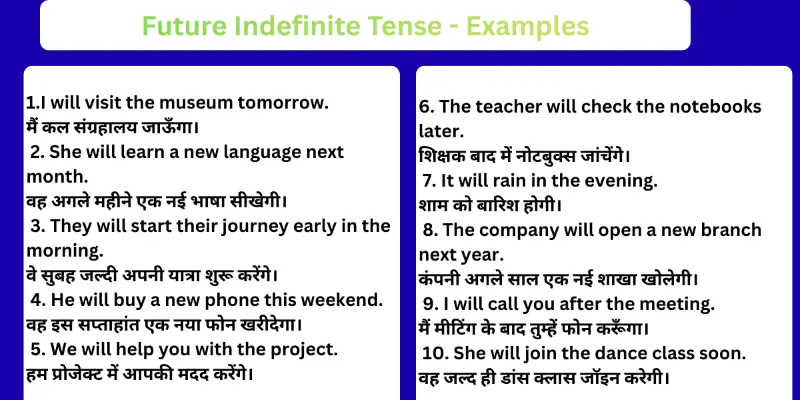
Examples of Future Indefinite Tense :
1. I will plant a new tree in my garden tomorrow.
मैं कल अपने बगीचे में एक नया पेड़ लगाऊँगा।
2. She will bake a special cake for the festival.
वह त्योहार के लिए एक खास केक बनाएगी।
3. They will repair the old bridge next month.
वे अगले महीने पुराने पुल की मरम्मत करेंगे।
4. He will clean his study room in the evening.
वह शाम को अपना अध्ययन कक्ष साफ करेगा।
5. We will organize a cultural event next week.
हम अगले सप्ताह एक सांस्कृतिक कार्यक्रम आयोजित करेंगे।
6. The teacher will check all the notebooks today.
शिक्षक आज सभी कॉपियों की जाँच करेंगे।
7. I will start learning guitar from Monday.
मैं सोमवार से गिटार सीखना शुरू करूँगा।
8. She will bring fresh vegetables from the market.
वह बाज़ार से ताज़ी सब्जियाँ लाएगी।
9. They will shift to a new apartment soon.
वे जल्द ही नए अपार्टमेंट में शिफ्ट होंगे।
10. He will design a logo for the new company.
वह नई कंपनी के लिए एक लोगो डिज़ाइन करेगा।
11. I will write an article for the school magazine.
मैं स्कूल मैगज़ीन के लिए एक लेख लिखूँगा।
12. She will open her boutique next year.
वह अगले साल अपना बुटीक खोलेगी।
13. The birds will return to their nests at sunset.
सूर्यास्त पर पक्षी अपने घोंसलों में लौटेंगे।
14. We will paint our house this winter.
हम इस सर्दी में अपना घर रंगेंगे।
15. He will send the parcel in the morning.
वह सुबह पार्सल भेजेगा।
16. They will celebrate their anniversary in Goa.
वे अपनी सालगिरह गोवा में मनाएँगे।
17. I will attend an online seminar tonight.
मैं आज रात एक ऑनलाइन सेमिनार में भाग लूँगा।
18. She will prepare a presentation for the meeting.
वह मीटिंग के लिए एक प्रेज़ेंटेशन तैयार करेगी।
19. The school will reopen after the holidays.
स्कूल छुट्टियों के बाद खुलेगा।
20. He will guide his younger brother in studies.
वह अपने छोटे भाई को पढ़ाई में मार्गदर्शन करेगा।
21. I will visit the new museum this weekend.
मैं इस सप्ताहांत नए म्यूज़ियम जाऊँगा।
22. She will join a fitness class next month.
वह अगले महीने फिटनेस क्लास जॉइन करेगी।
23. They will plant flowers around the lake.
वे झील के आसपास फूल लगाएंगे।
24. The company will launch a new product soon.
कंपनी जल्द ही नया उत्पाद लॉन्च करेगी।
25. He will participate in the science exhibition.
वह विज्ञान प्रदर्शनी में भाग लेगा।
26. I will buy a new mobile phone this year.
मैं इस साल नया मोबाइल फोन खरीदूँगा।
27. She will write a poem for her best friend.
वह अपनी सबसे अच्छी दोस्त के लिए एक कविता लिखेगी।
28. They will watch the sunrise from the hilltop.
वे पहाड़ी की चोटी से सूर्योदय देखेंगे।
29. We will plan a family trip in the summer.
हम गर्मियों में एक परिवारिक यात्रा की योजना बनाएँगे।
30. He will learn cooking from his mother.
वह अपनी माँ से खाना बनाना सीखेगा।
Read Tense and There Types
• Tense
• Present Tense
• Present Indefinite Tense • Present continuous tense
• Present Perfect Tense • Present Perfect Continuous Tense
• Past Tense
• Past Indefinite Tense • Past continuous tense
• Past Perfect Tense • Past Perfect Continuous Tense
• Future Tense
• Future Indefinite Tense
• future continuous tense • Future Perfect Tense
• Future Perfect Continuous Tense