11th Day Learning English – 11th day Challenge
Today is our 11th day of learning English. All the English lessons we've covered so far consist of words and sentences used in everyday conversation, so it was essential for us to learn them. That's why those lessons were placed first, to ensure you don't face any difficulties in learning English. Now we move on to a new stage, climbing the second step of our English learning journey. In this stage, we will learn something new and also learn how to construct sentences.
आज हमारा अंग्रेजी सीखने का 11वां दिन है अब तक हमने जितने भी अंग्रेजी के अध्याय हैं वह सब हमारी रोजमर्रा के बोलचाल में प्रयोग होने वाले शब्द वाक्य है तो उन्हें जानना हमारे लिए अत्यंत आवश्यक था इसलिए सबसे पहले उन अध्यायों को रखा गया ताकि आपको अंग्रेजी सीखने में कोई परेशानी ना हो अब हम एक नए पड़ाव की ओर बढ़ते हैं जब हम अंग्रेजी सीखने की दूसरी सीढ़ी पर चढ़ते हैं इसमें हम कुछ नया सीखेंगे तथा वाक्य बनाना भी सीखेंगे-
Today we will learn what a sentence is, what its definition is, and how many types of sentences there are. Today we will learn about sentences to improve our English, because when we communicate with someone, we have to speak in complete sentences. If we don't know how to form sentences, we will speak incorrectly, using jumbled words, which is not right. Therefore, today we will learn how to construct and use sentences.
आज हम सीखेंगे वाक्य किसे कहते हैं? वाक्य की परिभाषा क्या होती है? तथा वाक्य कितने प्रकार के होते हैं? आज हम अंग्रेजी सीखने के लिए वाक्य के बारे में सीखेंगे क्योंकि अगर हम किसी भी व्यक्ति या दूसरे व्यक्ति से बोल-चाल करते हैं तो हमें एक वाक्य बना कर ही बोलना पड़ता है अगर हमें वाक्य बनाना नहीं आएगा तोहम इधर-उधर करके गलत वाक्य बना कर बोलेंगे जो की सही नहीं होता है इसलिएआज हम वाक्य बनाएंगे और सीखेंगे-
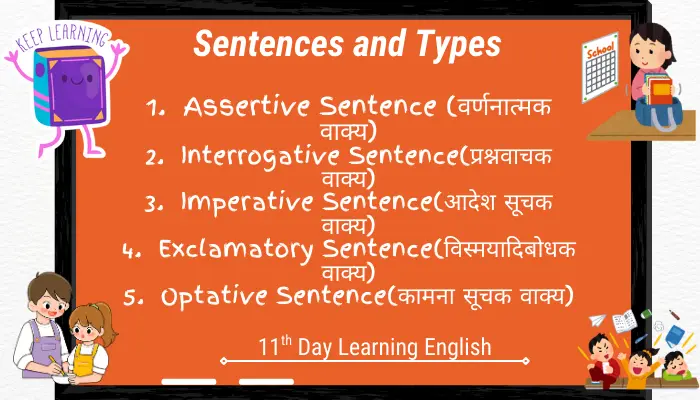
Sentences and Types
Definition -
A Sentence is a group of words that gives a complete meaning or expresses a complete thought.
वाक्य शब्दों का वह समूह है जो वाक्य को पूर्ण अर्थ या संपूर्ण विचार व्यक्त करता है, वाक्य कहलाता है।
Important Points (महत्वपूर्ण बिंदु)
1. A Sentence always starts with a capital letter.
वाक्य हमेशा बड़े अच्छे से शुरू होता है।
2. It always ends with a punctuation mark (., ?, !).
यह हमेशा विराम चिन्ह (जैसे पूर्ण विराम, प्रश्नवाचक चिन्ह, विस्मयादिबोधक चिन्ह) से समाप्त होता है।
3. It must make complete sense.
यह पूरा अर्थ देना चाहिए।
Parts of a Sentence (वाक्य के भाग)
Every sentence mainly has two parts:
दो मुख्य भाग होते हैं -
1. Subject (कर्ता) –
the person or thing who does the action.
जो कार्य करता है।
Riya plays cricket – Riya is the subject.
2. Predicate (विधेय) –
the part of the sentence that tells something about the subject.
जो कर्ता के बारे में कुछ बताता है।
Riya plays cricket. – plays cricket is the predicate.
Examples:
1. She is reading a book.
वह किताब पढ़ रही है।
2. The sun rises in the east.
सूरज पूरब दिशा में उगता है।
3. I am a doctor.
मैं एक छात्र हूँ।
4. They are playing football.
वे फुटबॉल खेल रहे हैं।
5. We should respect our parents.
हमें अपने माता – पिता का सम्मान करना चाहिए।
Kinds of Sentences (वाक्यों के प्रकार)
There are five main kind of sentences –
अंग्रेजी में वाक्य पांच प्रकार के होते हैं –
1. Assertive Sentence (वर्णनात्मक वाक्य)
2. Interrogative Sentence (प्रश्नवाचक वाक्य)
3. Imperative Sentence (आदेश सूचक वाक्य)
4. Exclamatory Sentence (विस्मयादिबोधक वाक्य)
5. Optative Sentence(कामना सूचक वाक्य)
1. Assertive Sentence (वर्णनात्मक वाक्य)
A Assertive Sentence is a sentenc that simple states or declars something. It tells a fact, opinion, idea, or information. It ends with a full stop. (.)
वर्णनात्मक वाक्य वह वाक्य होता है जो किसी तथ्य, विचार, राय या जानकारी को व्यक्त करता है।
Other name (अन्य नाम)
1. Declarative sentence
2. Statement Sentence
कथनात्मक वाक्य
Types of Assertive Sentence (वर्णनात्मक वाक्य के प्रकार)
1. Affirmative Assertive Sentence
सकारात्मक वर्णात्मक वाक्य
2. Negative Assertive Sentence
नकारात्मक वर्णात्मक वाक्य
(A) Affirmative Assertive Sentence (सकारात्मक वर्णात्मक वाक्य)
Definition -
An affirmative assertive sentence is a positive declarative statement that gives information or expresses truth.
परिभाषा -
साधारण भाषा में कहा जाए तो वह वाक्य होता है जो किसी बात को हाँ, मैं या सकारात्मक रूप से कहता है।
Examples:
1. I like apples.
मुझे सेब पसंद है।
2. She is a good girl.
वह एक अच्छी लड़की है।
3. They play football.
वे फुटबॉल खेलते हैं।
4. He works hard.
वह कड़ी मेहनत करता है।
5. We are friends.
हम दोस्त हैं।
6. The sun rises in the east.
सूरज पूरब दिशा में उगता है।
7. You look happy today.
तुम आज खुश लग रहे हो।
8. He reads a book every day.
वह रोज एक किताब पढ़ता है।
9. The baby is sleeping.
बच्चा सो रहा है।
10. She loves her parents.
वह अपने माता – पिता से प्यार करती है।
Read More About Affirmative Sentence
(B) Negative assertive sentence (नकारात्मक वर्णात्मक वाक्य)
Definition -
A Negative Assertive Sentence tells us what is not, instead of what is.
परिभाषा -
साधारण शब्दों में कहा जाए तो वह वाक्य जिसमें नहीं जैसे (not, never, no) शब्दों का प्रयोग किया जाता है।
1. I do not watch tv every day .
मैं हर दिन टीवी नहीं देखता।
2. She is not eating breakfast now.
वह अभी नाश्ता नहीं खा रही है।
3. They do not understand my problem.
तुम मेरी समस्या नहीं समझते।
4. I am not tired today.
मैं आज थका हुआ नहीं हूँ।
5. It is not raining now.
अभी बारिश नही हो रही है।
6. She never comes late.
वह कभी देर से नही आती ।
7. He is not writing a letter.
वह पत्र नहीं लिख रहा है।
8. The teacher does not shout at students.
शिक्षक विद्यार्थियों पर नहीं चिल्लाते।
9. The baby is not crying.
बच्चा नहीं रो रहा है।
10. He never smokes.
वह कभी धूम्रपान नहीं करता।
Read More About Negative Sentence
2. Interrogative sentence (प्रश्नवाचक वाक्य)
Definition -
An interrogative sentence is a question sentence that asks about something.
This sentence ends with a question mark (?)
परिभाषा -
जब कोई व्यक्ति किसी दूसरे व्यक्ति से प्रश्न पूछता हैं या अपनी बात को रखता है तो उसे प्रश्नवाचक वाक्य कहते हैं। वह वाक्य जिसमें किसी बात को पूछा जाता है। ऐसे वाक्य हमेशा प्रश्नवाचक चिन्ह (?) समाप्त होते हैं।
Types of Interrogative Sentences (प्रकार)
(A) Yes / No Types Interrogative Sentences
Examples:
1. Are you happy?
क्या तुम खुश हो?
2. Do you like mangoes?
क्या तुम्हें आम पसंद हैं?
3. Is he your brother?
क्या वह तुम्हारा भाई है?
4. Did she go school?
क्या वह स्कूल गई थी?
5. Have they finished their work?
क्या उन्होंने अपना काम पूरा कर लिया है?
(B) Wh – word Type Interrogative Sentence
These sentences begin with question words like What, Who, When, Where, Why, Which, Whose, How etc.
Examples:
1. What is your name?
तुम्हारा नाम क्या है?
2. Where do you live?
तुम कहाँ रहते हो?
3. Who is your teacher?
तुम्हारे शिक्षक कौन हैं?
4. When will you come?
तुम कब आओगे?
5. Why are you sad?
तुम उदास क्यों हो?
6. How are you feeling today?
आज तुम कैसा महसूस कर रहे हो?
Read More About Interrogative Sentence
3. Imperative Sentence (आदेशवाचक वाक्य)
Definition -
An imperative sentence is a type of sentence that gives a command, request, advice, suggestion, or instruction.
It usually begins with the base form of a verb and the subject (you) in understood, not written.
It ends with a full stop (.).
परिभाषा -
आदेशवाचक वाक्य वह वाक्य होता है जो आदेश, अनुरोध, सलाह या सुझाव प्रकट करता है ऐसे वाक्य में कर्म करने का निर्देश दिया जाता है। इन वाक्यों में प्राय Subject छिपा होता है और वाक्य की शुरुआत की Verb से होती है। इनमें अंत में (.) लगाया जाता है।
Examples:
1. Open the door.
2. Please sit down.
उपयुक्त वाक्यों में (You – Subject) छिपा हुआ है।
• Types of Imperative Sentence (प्रकार)
(A). Order( आदेश)
जब कोई व्यक्ति आदेश देता है।
Examples:
• Go away. दूर जाओ
• Close the window. खिड़की बंद करो।
(B). Request (अनुरोध)
जब कोई व्यक्ति दूसरे व्यक्ति के अनुरोध करता है।
Examples:
• Please help me. कृपया मेरी मदद करो।
• Kindly sit down. कृपया बैठ जाइए।
(C). Advice (सलाह)
जब कोई व्यक्ति दूसरे व्यक्ति को सलाह देता है।
Examples:
• Work hard. कड़ी मेहनत करो।
• Take medicine on time. समय पर दवा लो।
(D). Invitation (निमंत्रण)
जब कोई व्यक्ति दूसरे व्यक्ति को निमंत्रण देता है।
Examples:
• Come to my home. मेरे घर आओ।
• Please join us for dinner. कृपया हमारे साथ भोजन में शामिल हों।
(E). Warning (चेतावनी)
जब कोई व्यक्ति चेतावनी देता है।
Examples:
• Don’t touch it. इसे मत छूओ।
• Be careful! सावधान रहो।
Examples:
1. Open your book.
अपनी किताब खोलो।
2. Please sit down.
कृपया बैठ जाओ।
3. Don’t make noise.
शोर मत करो।
4. Help the poor.
गरीबों की मदद करो।
5. Work hard to succeed.
सफलता के लिए कड़ी मेहनत करो।
6. Be honest.
ईमानदार करो।
7. Never tell a lie.
कभी झूठ मत बोलो।
8. Come here quickly.
जल्दी यहाँ आओ।
9. Don’t waste your time.
अपना समय बर्बाद मत करो।
10. Please forgive me.
कृपया मुझे माफ कर दो।
4.Exclamatory Sentence (विस्मयादिबोधक वाक्य)
Definition -
Exclamatory Sentence is a type of sentence that expresses a strong emotion or feeling, such as happiness, surprise, anger, sorrow, or excitement.
These sentences always end with an exclamation mark (!) and often begin with what or how.
परिभाषा -
वह वाक्य होता है जो तीव्र भावनाएँ या अचानक महसूस की गई भावना प्रकट करता है - जैसे आश्चर्य, खुशी, दुख, गुस्सा, या उत्साह।
ऐसे वाक्य हमेशा अल्पविराम चिन्ह से समाप्त होते हैं और अक्सर what या how से शुरु होते हैं।
Examples:
1. What a lovely song this is!
यह कितना सुंदर गीत है!
2. How happy I am today!
आज मैं कितना खुश हूँ!
3. What a huge building it is!
यह कितनी बड़ी इमारत है!
4. How fast he runs!
वह कितनी तेज दौड़ता है!
5. What a tragedy it was!
वह कितनी बड़ी त्रासदी थी!
6. How sad she looks!
वह कितनी दुखी लग रही है!
7. What a shame!
कितनी शर्म की बात है!
8. How foolish you are!
तुम कितने मूर्ख हो!
9. What a beautiful painting!
कितनी सुंदर पेंटिंग है!
10. How wonderful the show was!
कार्यक्रम कितना शानदार था!
5. Optative Sentence
Definition -
An Optative Sentence expresses wishes, prayers, or blessings.
Optative sentences usually begin with may or wish and end with a full stop(.) or an exclamation mark (!) depending on emotion.
परिभाषा -
कामना सूचक वाक्य वह वाक्य होता है जो इच्छा, आशीर्वाद, प्रार्थना या शुभकामना प्रकट करता है। ऐसे वाक्य में प्रायः “may” and “wish” शब्दों का प्रयोग होता है वाक्य के अंत में (.) and (!) का प्रयोग किया जाता है।
Examples:
1. I wish I were rich.
काश मैं अमीर होता।
2. May God help you!
भगवान आपकी मदद करें।
3. May you live long!
आप दीर्घायु हों।
4. May you fail in your plan!
तुम्हारी योजना असफल हो जाए।
5. May god bless you.
भगवान तुम्हें आशीर्वाद दे।
6. I wish you were here.
काश तुम यहाँ होते।
7. May God forgive you.
भगवान तुम्हें माफ़ करे।
8. May peace prevail in the world.
दुनिया में शांति बनी रहे।
Below you will find an exercise; try to solve it yourself and then compare your answer with the answer key.
नीचे आपको एक एक्सरसाइज दी गई है उसे एक्सरसाइज को स्वयं से हल कीजिए और आंसर की से मिलान कीजिए
Exercise 1
Sentence & Types of Sentences
Direction: नीचे दिए गए वाक्यों का प्रकार पहचानो और लिखो:
Assertive / Interrogative / Imperative / Exclamatory
1. The sun rises in the east.
2. Where are you going?
3. Please close the window.
4. What a beautiful flower it is!
5. She is my best friend.
6. Do you like ice cream?
7. Finish your work on time.
8. How tall this building is!
9. We live in a small village.
10. Can you help me?
11. Do not waste water.
12. What a brave soldier he was!
13. My father works in a bank.
14. Is this your notebook?
15. Keep your room clean.
16. Alas! I lost my bag.
17. Children are playing in the park.
18. Who is standing outside?
19. Always speak the truth.
20. How sweet the baby looks!
21. She does not like coffee.
22. Are they coming today?
23. Please listen carefully.
24. Hurrah! We won the match.
25. The train is late today.
26. What is your name?
27. Never tell a lie.
28. Oh! What a pain it is!
29. He was absent yesterday.
30. Shall we start the class now?
Answer Key
1. Assertive
2. Interrogative
3. Imperative
4. Exclamatory
5. Assertive
6. Interrogative
7. Imperative
8. Exclamatory
9. Assertive
10. Interrogative
11. Imperative
12. Exclamatory
13. Assertive
14. Interrogative
15. Imperative
16. Exclamatory
17. Assertive
18. Interrogative
19. Imperative
20. Exclamatory
21. Assertive
22. Interrogative
23. Imperative
24. Exclamatory
25. Assertive
26. Interrogative
27. Imperative
28. Exclamatory
29. Assertive
30. Interrogative
Read All Sentences
• Sentences
• Parts of Sentence
• Affirmative Sentences
• Negative Sentences
• Interrogative Sentences
• Imperative Sentence
• Exlamatory Sentences
• Conditional Sentences