12th Day Learning English – 12th day Challenge
Today is our 12th day of learning English. English is extremely important for us, so in the previous chapters, we have explained the fundamental aspects of English to help you understand how to begin learning the language. In the previous chapter, which was day 11, we taught you how to use sentences in English, what a sentence is, the types of sentences, and how to construct sentences.
आज हमारा अंग्रेजी सीखने का12वां दिन है अंग्रेजी हमारे लिए अत्यंत महत्वपूर्ण है इसलिए हमने पिछले अध्यायों में पहले अंग्रेजी की बातें बताती गई है जिससे आपको पता चल जाएगा की अंग्रेजी में शुरुआत किस होती है इसके पहले हुए अध्याय अर्थात 11 दिन हमने अंग्रेजी में वाक्य प्रयोग कैसे किया करते हैं वाक्य किसे कहते हैं तथा वाक्य के प्रकार वाक्य बनाना सभी सिखाया है|
Do and Does
Definition -
“Do” and “Does” are auxiliary (helping ) verbs used in the Present Indefinite Tense (Present Simple Tense ) to form negative and Interrogative sentences.
They are also used as main verb meaning to perform an action.
परिभाषा -
“Do और “Does” दोनों सहायक क्रियाएं(Helping verbs) हैं। जिनका प्रयोग Present Indefinite Tense (साधारण वर्तमान काल) में किया जाता है। इन का उपयोग नकारात्मक, प्रश्नवाचक वाक्य बनाने में होता है। कभी कभी ये मुख्य क्रिया(Main verb) के रूप में भी प्रयोग होते हैं जिनका अर्थ होता है “करना”।
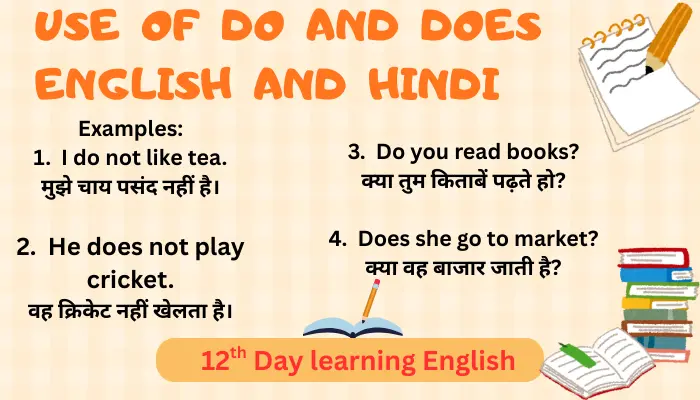
Examples:
1. I do not like tea.
मुझे चाय पसंद नहीं है।
2. He does not play cricket.
वह क्रिकेट नहीं खेलता है।
3. Do you read books?
क्या तुम किताबें पढ़ते हो?
4. Does she go to market?
क्या वह बाजार जाती है?
5. Do you eat rice?
क्या तुम चावल नहीं खाते हो?
6. Does he not go to school?
क्या वह स्कूल नहीं जाता है?
7. What do you do every morning?
तुम हर सुबह क्या करते हो?
8. Where does he live?
वह कहाँ रहता है?
Read Also
• Use of Do & Does
• Singular & Plural Numbers
• Article - A
• Use Had
Use of Do in Hindi
Definition -
“Do” is a helping verb (auxiliary verb) and also a main verb.
It used in the Present Indefinite Tense with subjects I, We, You, They.
“Do” helps to form negative and interrogative sentences.
It can also be used to emphasize an action or to express real work (as a main verb).
परिभाषा -
“Do” एक सहायक क्रिया(helping verb) और मुख्य क्रिया(Main verb) दोनों के रूप में प्रयोग होती है। इनका प्रयोग साधारण वर्तमान काल (Present Indefinite Tense) में I, We, You, They जैसे Subjects के साथ किया जाता है। यह नकारात्मक और प्रश्न वाचक वाक्य में सहायक क्रिया के रूप में उपयोग होती है, और जब “do” खुद किसी काम को दर्शाता है तो यह मुख्य क्रिया के रूप में प्रयुक्त होती है।
| Foorm |
Usage |
| Do |
Present (I , We, You, They) |
| Does |
Present (He, She, It, Singular Noun) |
| Did |
Past (All subjects) |
Use of “Do” as a Helping Verb (सहायक क्रिया के रूप में)
Used to Present Indefinite Tense to make negative and Interrogative Sentences.
Examples:
1. I do not read this book.
मैं यह किताब नहीं पढ़ता हूँ।
2. Do you play cricket?
क्या तुम क्रिकेट खेलते हो?
3. I do not like milk.
मुझे दूध पसंद नहीं है।
4. We do not go to school on Sunday.
हम रविवार को स्कूल नहीं जाते हैं।
5. Do they live here?
क्या वे यहाँ रहते हैं?
Use of “Do” as a Main Verb (मुख्य क्रिया के रूप में)
When “do” itself shows an action – like काम करना, अंजाम देना, पूरा करना आदि।
Examples:
1. They do exercise in the morning.
वे सुबह व्यायाम करते हैं।
2. I do household work daily.
मैं रोज़ घर का काम करता हूँ।
3. You do your best to win.
तुम जीतने के लिए पूरी कोशिश करते हो।
4. They do great work for society.
वे समाज के लिए महान काम करते हैं।
5. I do painting as a hobby.
मैं शौक से पेंटिंग करता हूँ।
Read Also
• Active voice & Passive voice
• Degree of comparision
• Direct indirect speech
• Use of Has & Have
Use of Does in Hindi
Definition -
“Does” is the helping verb used in the Present Indefinite Tense with He, She, It, or Singular Noun (like Sita, Ram, Cat, Doctor, Etc).
It is used to form negative and interrogative sentences in present tense.
It also used for emphasis or as a main verb in some cases.
परिभाषा -
“Does” एक सहायक क्रिया है जो साधारण वर्तमान काल में He, she, it और एकवचन संज्ञा (singular noun) के साथ प्रयोग की जाती है। इसका प्रयोग सकारात्मक और प्रश्नवाचक वाक्य बनाने में किया जाता है। कभी - कभी इसे ज़ोर देने (emphasis) या मुख्य क्रिया के रूप में भी प्रयोग किया जाता है।
1. Use of “Does” as a helping verb (सहायक क्रिया के रूप में)
इसका प्रयोग Present Indefinite Tense में Negative और Interrogative वाक्य बनाने में होता है। Positive वाक्य में “Does” नहीं लिखा जाता बल्कि verb में s/es जोड़ दिया जाता है।
Examples:
1. It does not rain in winter.
सर्दियों में बारिश नहीं होती है।
2. My father does not not smoke.
मेरे पिता धूम्रपान नहीं करते हैं।
3. Does your brother read books?
क्या तुम्हारा भाई किताबें पढ़ता है?
4. Does the dog bark at night?
क्या कुत्ता रात में भौंकता है?
5. Does your father not drive?
क्या तुम्हारे पिता गाड़ी नहीं चलाते हैं?
Emphatic Use of “Do” and “Does” (जोर देने वाला प्रयोग)
Definition -
The emphatic use of “Do’’ and “Does” is made to emphasize or stress the truth or importance of an action in the Present Indefinite Tense.
It is used to show that we really mean what we are saying – like truly, actually, indeed.
It adds emotion, confirmation, or insistence to the sentence.
परिभाषा -
“Do” और “Does” का जोर देने वाला प्रयोग तब किया जाता है जब हम किसी बात को ज़ोर देकर सच्चाई से या भावनात्मक रूप से कहना चाहते हैं। इसका अर्थ होता है -वास्तव में, सच में, निश्चित रूप से, वाकई में आदि। इसका प्रयोग Present indefinite Tense में किया जाता है।
Examples:
1. I do like mango juice.
मुझे सच में आम का जूस पसंद है।
2. You do work very hard.
तुम वास्तव में बहुत मेहनत करते हो।
3. We do believe in honesty.
हम सच में ईमानदारी पर विश्वास करते हैं।
4. They do want to help you.
वे वाकई में तुम्हारी मदद करना चाहते हैं।
5. I do understand your problem.
मैं वास्तव में तुम्हारी समस्या समझता हूँ।
6. He does respect his parents.
वह सच में अपने माता पिता का सम्मान करता है।
7. She does love her family.
वह वास्तव में अपने परिवार से प्यार करती है।
8. It does look beautiful.
यह वाकई सुन्दर दिखता है।
9. My brother does care for me.
मेरा भाई सच में मेरी परवाह करता है।
10. The teacher does teach well.
अध्यापक वास्तव में अच्छी तरह पढ़ाते हैं।
Now I will give you many examples about Do and Does , so that you can easily understand it. Both of these examples are in English and Hindi so that it is easy for you to read and understand.
अब मैं आपको Do and Does के बारे में बहुत सारे उदाहरण बता रहा हूं जिससे आपको के बारे में आसानी से समझ आ सके यह दोनों उदाहरण अंग्रेजी और हिंदी दोनों भाषाओं में है ताकि आपको पढ़ने और आसानी हो सके-
Read Also
• Singular & Plural Numbers
• Article - A
• Use of Do & Does
• Use Had
Do / Does Conversation Sentences (with Names)
1. Ravi: Do you like tea?
रवि: क्या तुम्हें चाय पसंद है?
Amit: Yes, I do.
अमित: हाँ, मुझे पसंद है।
2. Sita: Do you go to school daily?
सीता: क्या तुम रोज़ स्कूल जाते हो?
Mohan: Yes, I do.
मोहन: हाँ, मैं जाता हूँ।
3. Anjali: Do you play cricket?
अंजलि: क्या तुम क्रिकेट खेलते हो?
Rahul: No, I do not.
राहुल: नहीं, मैं नहीं खेलता।
4. Pooja: Do you understand this lesson?
पूजा: क्या तुम्हें यह पाठ समझ आता है?
Neha: Yes, I do.
नेहा: हाँ, मुझे समझ आता है।
5. Ramesh: Do you work here?
रमेश: क्या तुम यहाँ काम करते हो?
Suresh: No, I do not.
सुरेश: नहीं, मैं यहाँ काम नहीं करता।
6. Asha: Does he live near your house?
आशा: क्या वह तुम्हारे घर के पास रहता है?
Kiran: Yes, he does.
किरण: हाँ, वह रहता है।
7. Vikram: Does she know English?
विक्रम: क्या उसे अंग्रेज़ी आती है?
Meena: Yes, she does.
मीना: हाँ, उसे आती है।
8. Ritu: Does your brother help you?
रीतु: क्या तुम्हारा भाई तुम्हारी मदद करता है?
Nisha: No, he does not.
निशा: नहीं, वह मदद नहीं करता।
9. Sunil: Do they play football?
सुनील: क्या वे फुटबॉल खेलते हैं?
Aman: Yes, they do.
अमन: हाँ, वे खेलते हैं।
10. Kavita: Does your father work in an office?
कविता: क्या तुम्हारे पिता ऑफिस में काम करते हैं?
Rohit: Yes, he does.
रोहित: हाँ, वे करते हैं।
11. Deepak: Do you read newspapers?
दीपक: क्या तुम अख़बार पढ़ते हो?
Manoj: No, I do not.
मनोज: नहीं, मैं नहीं पढ़ता।
12. Priya: Does the shop open at 9 a.m.?
प्रिया: क्या दुकान सुबह 9 बजे खुलती है?
Alok: Yes, it does.
आलोक: हाँ, खुलती है।
13. Nitin: Do we have a test today?
नितिन: क्या आज हमारा टेस्ट है?
Teacher: Yes, you do.
शिक्षक: हाँ, है।
14. Sonam: Does she sing well?
सोनम: क्या वह अच्छा गाती है?
Rina: Yes, she does.
रीना: हाँ, वह गाती है।
15. Arjun: Do you need my help?
अर्जुन: क्या तुम्हें मेरी मदद चाहिए?
Kajal: Yes, I do.
काजल: हाँ, मुझे चाहिए।
16. Mahesh: Does this bus go to Delhi?
महेश: क्या यह बस दिल्ली जाती है?
Conductor: No, it does not.
कंडक्टर: नहीं, यह नहीं जाती।
17. Isha: Do you believe in hard work?
ईशा: क्या तुम मेहनत में विश्वास करते हो?
Rohini: Yes, I do.
रोहिणी: हाँ, मैं करती हूँ।
18. Gopal: Does your sister study here?
गोपाल: क्या तुम्हारी बहन यहाँ पढ़ती है?
Lata: No, she does not.
लता: नहीं, वह यहाँ नहीं पढ़ती।
19. Harsh: Do children like chocolates?
हर्ष: क्या बच्चों को चॉकलेट पसंद होती है?
Naveen: Yes, they do.
नवीन: हाँ, उन्हें पसंद होती है।
20. Reena: Does your mother cook food?
रीना: क्या तुम्हारी माँ खाना बनाती हैं?
Pankaj: Yes, she does.
पंकज: हाँ, वे बनाती हैं।
21. Tarun: Do you wake up early?
तरुण: क्या तुम जल्दी उठते हो?
Sahil: No, I do not.
साहिल: नहीं, मैं नहीं उठता।
22. Monika: Does he teach maths?
मोनिका: क्या वह गणित पढ़ाते हैं?
Rajat: Yes, he does.
रजत: हाँ, वे पढ़ाते हैं।
23. Aarti: Do girls play games?
आरती: क्या लड़कियाँ खेल खेलती हैं?
Pallavi: Yes, they do.
पल्लवी: हाँ, वे खेलती हैं।
24. Nakul: Does this phone work well?
नकुल: क्या यह फोन ठीक से काम करता है?
Shopkeeper: Yes, it does.
दुकानदार: हाँ, करता है।
25. Riya: Do you trust me?
रिया: क्या तुम मुझ पर भरोसा करते हो?
Aryan: Yes, I do.
आर्यन: हाँ, मैं करता हूँ।
26. Suman: Does your uncle live in Jaipur?
सुमन: क्या तुम्हारे चाचा जयपुर में रहते हैं?
Puneet: No, he does not.
पुनीत: नहीं, वे नहीं रहते।
27. Keshav: Do teachers help students?
केशव: क्या शिक्षक छात्रों की मदद करते हैं?
Ravi: Yes, they do.
रवि: हाँ, वे करते हैं।
28. Neelam: Does she come on time?
नीलम: क्या वह समय पर आती है?
Sonia: Yes, she does.
सोनिया: हाँ, वह आती है।
29. Yogesh: Do you enjoy music?
योगेश: क्या तुम्हें संगीत पसंद है?
Rohan: Yes, I do.
रोहन: हाँ, मुझे पसंद है।
30. Bhavna: Does your school have a library?
भावना: क्या तुम्हारे स्कूल में लाइब्रेरी है?
Ankit: Yes, it does.
अंकित: हाँ, है।
Exercise1: Use of Do / Does
Direction: खाली जगह में सही शब्द भरो – do या does
1. ___ you like milk?
2. ___ she go to school daily?
3. ___ they play in the park?
4. ___ he speak English?
5. ___ we need more time?
6. ___ your father work in a bank?
7. ___ I look tired today?
8. ___ the children enjoy the game?
9. ___ she help her mother?
10. ___ you understand this question?
11. ___ the train arrive on time?
12. ___ they live near your house?
13. ___ he know the answer?
14. ___ we have a holiday tomorrow?
15. ___ your sister read books?
16. ___ you want some water?
17. ___ the dog bark at night?
18. ___ she teach maths?
19. ___ they respect their elders?
20. ___ he play football well?
21. ___ I need your help?
22. ___ the shop open at 9 a.m.?
23. ___ you watch TV daily?
24. ___ she cook food every day?
25. ___ we follow the rules?
26. ___ your brother study hard?
27. ___ they speak the truth?
28. ___ he drive carefully?
29. ___ you believe in hard work?
30. ___ the sun rise in the east?
Answer Key
1. Do
2. Does
3. Do
4. Does
5. Do
6. Does
7. Do
8. Do
9. Does
10. Do
11. Does
12. Do
13. Does
14. Do
15. Does
16. Do
17. Does
18. Does
19. Do
20. Does
21. Do
22. Does
23. Do
24. Does
25. Do
26. Does
27. Do
28. Does
29. Do
30. Does
Read More About Use of Do & Does