NUMBERS (SINGULAR & PLURAL)
Definition of Number, Types of Number and Examples
(वचन की परिभाषा, वचन के भेद और उदाहरण)
Definition of Number:
Number is a grammatical concept that shows whether a noun, pronoun, or verb refers to one person/thing or more than one.
वचन की परिभाषा:
वचन वह रूप है जो यह बताता है कि कोई संज्ञा, सर्वनाम या क्रिया एक वस्तु या व्यक्ति के लिए है या एक से अधिक वस्तुओं या व्यक्तियों के लिए।
संज्ञा के जिस रूप से संख्या का बोध होता है उसे वचन कहते हैं।
Read Also
• Parts of speech • Noun
• Pronoun • Preposition
• Verb • Adverb
• Adjective • conjunction
• Interjection • Sentence Parts of Sentence
Read Tenses :
• Tense • Present Tense
• Present-indefinite-Tense • Present - Perfect Tense
• Present- continuous - Tense • Present - perfect - continuous -Tense
• Past Tense • Past Indefinite Tense
• Past Perfect Tense • Past continuous Tense
• Past- Perfect- continuous- Tense • Future Tense
• Future- Perfect- Tense • Future- Indefinite- Tense
• Future- continuous- Tense • Future- Perfect- continuous- Tense
वचन दो प्रकार के होते हैं-
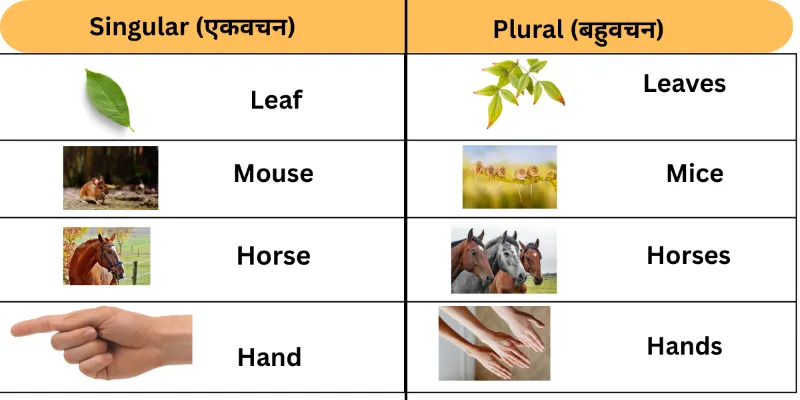
1. एकवचन (Singular)
जब किसी शब्द से एक का बोध होता है तो उसे एकवचन (singular) कहते हैं।
2.बहुवचन(Plural)
जब किसी शब्द से अनेक (एक से अधिक) का बोध होता है तो उसे बहुवचन (plural) कहते हैं।
(उदाहरण)-
1. यह लड़का खेल रहा है। - एकवचन
2. ये लड़के खेल रहे हैं। - बहुवचन।
आइए एकवचन और बहुवचन को स्पष्ट रूप से पढ़ते हैं तथा समझते हैं। एकवचन और बहुवचन को ff उदाहरणों सहित समझते हैं।
Uses Of ‘’SINGULAR’’ and ‘’PLURAL’’
‘’एकवचन’’ और ‘’बहुवचन’’ के प्रयोग
❖ ‘’SINGULAR’’- Definition
A Singular noun is a word that refers to one person, one place, one thing, or one idea.
❖ ‘’ एकवचन’’ – परिभाषा
एकवचन संज्ञा वह शब्द है जो केवल एक व्यक्ति, एक स्थान, एक वस्तु या एक विचार को दर्शाता है।
🞴 Rules Of Singular (एकवचन के नियम)
1. Singular हमेशा one (एक) को दर्शाता है।
➢ A boy (एक लड़का) , A cat (एक बिल्ली)
2. Singular noun के साथ singular verb का प्रयोग होता है।
➢ She is playing.( वह खेल रही है।)
3. Singular noun को a/an के साथ प्रयोग किया जाता है।
➢ A pen , An apple.
4. Singular noun sentence में subject या object दोनों हो सकता है।
Read Also
• Types of Sentence • Parts of Sentence
• Adjective • conjunction
• Interjection • Sentence Parts of Sentence
• Examples of Singular Nouns in Sentences(एकवचन संज्ञा के उदाहरण)
1.Singular Person (व्यक्ति)
➢ This boy is my friend.
यह लड़का मेरा दोस्त है।
➢ That girl is very intelligent.
वह लड़की बहुत होशियार है।
2.Singular Place (स्थान)
➢ This city is very big.
यह शहर बहुत बड़ा है।
➢ This village is beautiful.
यह गांव सुन्दर है।
3.Singular Thing (वस्तु)
➢ This book is new.
यह किताब नहीं है।
➢ That chair is broken.
वह कुर्सी टूटी हुई है।
4.Singular Animal(जानवर)
➢ A dog is barking.
एक कुत्ता भौंक रहा है।
➢ The cat is sleeping.
बिल्ली सो रही है।
5.Singular Idea / Concept(विचार/ भावना)
➢ Honesty is the best policy.
ईमानदारी सबसे अच्छी नीति है।
➢ Love is powerful.
प्यार शक्तिशाली है।
SINGULAR POSITIVE SENTENCES (एकवचन सकारात्मक वाक्य)
1.He reads a book.
वह किताब पढता है।
2.She sing a song.
वह गाना गाती है।
3.This boy plays cricket.
वह लड़क क्रिकेट खेलता है।
4.That girls dances well.
वह लड़की अच्छा नृत्य करती है।
5.Tha cat drink milk.
बिल्ली दूध पीती है।
6.A dog runs fast.
एक कुत्ता तेज दौड़ता है।
7.My friend write a letter.
मेरा दोस्त पत्र लिखता है।
8.The teacher teaches english.
अध्यापक अंग्रेजी पढ़ाते हैं।
9.The baby sleeps peacefully.
बच्चा चैन से सोता है।
10.The sun shines brightly.
सूरज चमकता है।
Read Also
• Affirmative Sentence • Conditional Sentence
• Modal verbs • Use of Can & Could
• Use of Shall & Will • Use of Is/am/are
SINGULAR NEGATIVE SENTENCES (एकवचन नकारात्मक वाक्य)
1.He does not read a book.
वह किताब नहीं पड़ता है।
2.She does not sing a song.
वह गाना नहीं गाती है।
3.The boy does not play cricket.
वह लड़का क्रिकेट नहीं खेलता है।
4.That girl does not dance.
वह लड़की नृत्य नहीं करती है।
5.The cat does not drink milk.
बिल्ली दूध नहीं पीती है।
6.A dog does not run fast.
कुत्ता तेज नहीं दौड़ता है।
7.My friend does not write a letter.
मेरा दोस्त पत्र नहीं लिखता है।
.The teacher does not teach hindi.
अध्यापक हिंदी नहीं पढ़ाते हैं।
9.The baby does not sleep peacefully.
बच्चा चैन से नहीं सोता है।
10.The sun does not shine at night.
सूरज रात में नहीं चमकता है।
Read Also
• Use of Dare • Use of May & Might
• Use of Dare • Use of May & Might
• Use of Must & Ought
SINGULAR INTERROGATIVE SENTENCES (एकवचन प्रश्नवाचक वाक्य)
1. Does he read a book?
क्या वह किताब पढ़ता है?
2.Does she sing a song?
क्या वह गाना गाती है?
3.Does the boy play cricket?
क्या यह लड़का क्रिकेट खेलता है?
4.Does that girl dance well?
क्या वह लड़की अच्छा नृत्य करती है?
5Does the cat drink milk?
क्या बिल्ली दूध पीती है?
6.Does a dog run fast?
क्या कुत्ता तेज दौड़ता है?
7.Does my friend write letter?
क्या मेरा दोस्त पत्र लिखता है?
8.Does the teacher teach english?
क्या अध्यापक अंग्रेजी पढ़ाते हैं?
9.Does the baby sleep pracefully?
क्या बच्चा चैन से सोता है?
10.Does the sun shine brightly?
क्या सूरज चमकता है?
Read Also
Read Also
• Interrogative Sentence • Exclamatory Sentence
• Active & Passive Voice • Use of Has & Have
• Use of Is/am/are • Number- Singular & Plural
SINGULAR INTERROGATIVE NEGATIVE SENTENCES(एकवचन प्रश्नवाचक नकारात्मक वाक्य)
1.Does he not read a book?
क्या वह किताब नहीं पढ़ता है?
2.Does she not sing a song?
क्या वह गाना नहीं गाती है?
3.Does this boy not play cricket?
क्या यह लड़का क्रिकेट नहीं खेलता है?
4.Does that girl not dance well?
क्या वह लड़की अच्छा नृत्य नहीं करती?
5.Does the cat not drink milk?
क्या बिल्ली दूध नहीं पीती हैं?
6.Does a dog not run fast?
क्या कुत्ता तेज नहीं दौड़ता है?
7.Does my friend not write letter?
क्या मेरा दोस्त पत्र नहीं लिखता है?
8.Does the teacher not teach english?
क्या अध्यापक अंग्रेजी नहीं पढ़ाते हैं?
9.Does the baby not sleep peacefully?
क्या बच्चा चैन से नहीं सोता है?
10.Does the sun not shine at night?
क्या सूरज रात में नहीं चमकता है?
SINGULAR WH- WORD INTERROGATIVE SENTENCES(एकवचन Wh -शब्द प्रश्नवाचक वाक्य)
1.Who is the boy?
यह लड़का कौन है?
2.Who teaches you English?
तुम्हें अंग्रेजी कौन पढ़ाता है?
3.What does she want?
वह क्या चाहती है?
4.What is your name?
तुम्हारा नाम क्या है?
5.Which book is on the table?
मेज पर कौन सी किताब है?
6.Where does he live?
वह कहाँ रहता है?
7.When does the teacher come?
अध्यापक कब आते हैं?
8.Why does the baby cry?
बच्चा क्यों रोता है?
9.How does this machine work?
यह मशीन कैसे काम करती है।
10.Whose pen is this?
यह पेन किसका है?
Read Also
• Use of Do & Does • Use of Had
• Use of These & Those • Use of This & That
• Use of Was & Were
Wh- Word INTERROGATIVE NEGATIVE SENTENCES(प्रश्नवाचक नकारात्मक वाक्य)
1.Why does he not study?
वह पढ़ाई क्यों नहीं करता है?
2.Why does she not come to school?
वह स्कूल क्यों नहीं आती है?
3.Where does this boy not go?
यह लड़का कहाँ नहीं जाता है।
4.What does the teacher not teach?
अध्यापक क्या नहीं पढ़ते हैं?
5.When does she not help you?
वह तुम्हारी मदद कब नहीं करती है।
6.Why did he not call you?
उसने तुम्हें फोन क्यों नहीं किया?
7.What did the student not write?
छात्र ने क्या नहीं लिखा?
8.Why is this girl not happy?
यह लड़की खुश क्यों नहीं है?
9.Why has he not complete his work?
उसने अपना काम क्यों नहीं पूरा किया है?
10.How does the baby not sleep at night?
बच्चा रात में कैसे नहीं सोता है?
🞴 IMPORTANT POINTS(महत्वपूर्ण बातें)
1.Singular हमेशा एक को दर्शाता है।
2.Singular noun के साथ is, was, has जैसे singular verbs आते हैं।
3.Singular noun plurals से अलग होता है।
❖ PLURAL – Definition
When a noun refers to more than one person, place, thing, or idea, it is said to be in Plural Number.
❖ ‘’बहुवचन’’ – परिभाषा
जब कोई संज्ञा एक से अधिक व्यक्ति, वस्तु, स्थान या विचार को प्रकट करती है तो उसे बहुवचन संख्या कहते हैं।
Examples(उदाहरण):
• These are boys.
ये लड़के हैं।
• They have many pens.
उनके पास कई पेन हैं।
• Books are on the table.
मेज पर किताबें हैं।
• Dogs are barking.
कुत्ते भौंक रहे हैं।
• They are engineers.
वह इंजीनियर हैं।
Rules For Plural Number(नियम):
1.Verb agreement(क्रिया का मेल)
•Plural Subject के साथ Plural verb आता है।
Example:
•They play cricket. वे क्रिकेट खेलते हैं।
•The boys are happy. लड़के खुश हैं।
2.Making Plurals ( Plural बनाने के नियम)
By adding – s:
• boy – boys (लड़का – लड़के)
• book- books(किताब – किताबें)
By adding – es (for s, sh, ch, x, o):
• bus – buses (बस – बसें)
• mango – mangoes(आम -आम)
By changing – y into – ies (if y after a consonant)
• Baby -babies (बच्चा – बच्चे)
• Lady – ladies (महिला -महिलाएं)
Irregular Plurals:
• Man – men (आदमी -आदमी)
• Woman – women (औरत – औरतें)
• Child – children (बच्चा – बच्चे)
• Foot – feet (पैर -पैर)
• Tooth – teeth (दाँत -दाँत)
• Mouse – mice (चूहा – चूहे)
3.Pronouns in plural:
• We, they, those – Plural pronouns
4.कुछ शब्द बहुवचन में नहीं बदलते (पर अर्थ बहुवचन होता है।):
• पानी, दूध, सोना, चांदी आदि।
PLURAL POSITIVE SENTENCES(बहुवचन सकारात्मक वाक्य)
1.They play cricket.
वे क्रिकेट खेलते हैं।
2.The boys read books.
लड़के किताबें पढ़ते हैं।
3.The girls sing songs.
लड़कियां गाने गाती है।
4. These dogs bark loudly.
ये कुत्ते जोर से भौंकते हैं।
5.My friends write letters.
मेरे दोस्त पत्र लिखते हैं।
6.The students study English.
विद्यार्थी अंग्रेजी पढ़ते हैं।
7.The babies sleep peacefully.
बच्चा चैन से सोते हैं।
8.The teachers teach Hindi.
अध्यापक हिंदी पढ़ाते हैं।
9. Those women work hard.
वे औरतें कड़ी मेहनत करती हैं।
10.The birds fly in the sky.
पक्षी आकाश में उड़ते हैं।
PLURAL NEGATIVE SENTENCES (बहुवचन नकारात्मक वाक्य)
1.They do not play cricket.
वे क्रिकेट नहीं खेलते हैं।
2.The boys do not read books.
लड़के किताबें नहीं पढ़ते हैं।
3.The girls do not sing songs.
लड़कियां गाने नहीं गाती हैं।
4.These dogs do not bark loudly.
ये कुत्ते ज़ोर से नहीं भौंकते हैं।
5.My friends do not write letters.
मेरे दोस्त पत्र नहीं लिखते हैं।
6.The students do not sleep English.
विद्यार्थी अंग्रेजी नहीं पढ़ते हैं।
7.The babies do not sleep peacefully.
बच्चा चैन से नहीं सोते हैं।
8.The teachers do not teach Hindi.
अध्यापक हिंदी नहीं पढ़ाते हैं।
9.Those women do not work hard.
वे औरतें कड़ी मेहनत नहीं करती हैं।
10.The birds do not fly at night.
पक्षी रात में नहीं उड़ते हैं।
PLURAL INTERROGATIVE SENTENCES (बहुवचन प्रश्नवाचक वाक्य)
1.Do they play cricket ?
क्या वे क्रिकेट खेलते हैं?
2.Do the boys read books?
क्या लड़के किताबें पढ़ते हैं।
3.Do the girls sing songs?
क्या लड़कियां गाने गाती हैं?
4.Do these dogs bark loudly?
क्या ये कुत्ते ज़ोर से भौकतें हैं?
5.Do my friends write letters?
क्या मेरे दोस्त पत्र लिखते हैं?
6.Do the students study English?
क्या विद्यार्थी अंग्रेजी पढ़ते है?
7.Do the babies sleep peacefully?
क्या बच्चे चैन से सोते हैं?
8.Do the teachers teach Hindi?
क्या अध्यापक हिंदी पढ़ाते हैं?
9.Do those women work hard ?
क्या वे औरतें कड़ी मेहनत करती है?
10.Do the birds fly in the sky?
क्या पक्षी आकाश में उड़ते हैं?
PLURAL INTERROGATIVE NEGATIVE SENTENCES (बहुवचन प्रश्नवाचक नकारात्मक वाक्य)
1.Do they not play cricket?
क्या वे क्रिकेट नहीं खेलते हैं?
2.Do the boys not read books?
क्या लड़के किताबें नहीं पढ़ते है?
3.Do the girls not sing songs?
क्या लड़कियां गाने नहीं गाती है?
4.Do these dogs not bark loudly?
क्या ये कुत्ते जोऱ से नहीं भौंकते हैं?
5.Do my friends not write letters?
क्या मेरे दोस्त पत्र नहीं लिखते हैं?
6.Do my babies not sleep peacefully?
क्या बच्चे चैन से नहीं सोते हैं?
7.Do the students not study English?
क्या विद्यार्थी अंग्रेजी नहीं पढ़ते हैं?
8.Do the teachers not teach Hindi?
क्या अध्यापक हिंदी नहीं पढ़ाते हैं?
9.Do those women not work hard?
क्या वे औरतें कड़ी मेहनत नहीं करती है।
10.Do the birds not fly at night?
क्या पक्षी रात में नहीं उड़ते है?
PLURAL Wh- Word INTERROGATIVE SENTENCES (बहुवचन Wh -शब्द प्रश्नवाचक वाक्य)
FORMULA-
1.Present Simple:
2.Past Simple:
3.With ‘’Be’’ Verb(is/are/was/were):
1.Who are these students?
ये विद्यार्थी कौन हैं?
2.What do the boys want?
लड़के क्या चाहते हैं?
3.Where do the teachers teach?
अध्यापक कहाँ पढ़ाते हैं?
4.When do the girls come to school?
लड़कियां स्कूल कब आती हैं?
5.Why do the dogs bark loudly?
कुत्ते ज़ोर से क्यों भौकतें हैं?
6.Which books do the students read?
विद्यार्थी कौन सी किताबें पढ़ते हैं?
7.How do the babies sleep?
बच्चे कैसे सोते हैं?
8.Who did the boys call yesterday?
लड़कों ने कल किसे बुलाया?
9.Where were the children yesterday?
बच्चे कल कहाँ थे?
10.Why did the women not attend the meeting?
औरतें बैठक में क्यों नहीं आई?
PLURAL Wh- Word INTERROGATIVE NEGATIVE SENTENCES (बहुवचन प्रश्नवाचक नकारात्मक वाक्य)
FORMULA:
1.Why do the boys not play cricket?
लड़के क्रिकेट क्यों नहीं खेलते हैं?
2.What do the students not read?
विद्यार्थी क्या नहीं पढ़ते हैं?
3.Where do the teachers not teach?
अध्यापक कहाँ नहीं पढ़ाते हैं?
4.When do the girls not come to school?
लड़कियां स्कूल कब नहीं आती हैं?
5.Who do the children not listen to?
बच्चे किसकी नहीं सुनते हैं?
6.Which books do the students not like?
विद्यार्थी कौन सी किताबें पसंद नहीं करते हैं?
7.How do the women not attend the meeting?
बच्चे चैन से कैसे नहीं सोते हैं?
8.Why did the women not attend the meeting?
औरतें बैठक में क्यों नहीं आई?
9.Where were the boys not present yesterday?
लड़के कल कहाँ उपस्थित नहीं थे।
10.Who are the students not satisfied with?
विद्यार्थी किससे संतुष्ट नहीं हैं?
Read Also
• Tense • Present Tense
• Past Tense • Future Tense
Helping Words (determiners) के साथ प्रयोग
| Singular के साथ |
Plural के साथ |
| A, an, one, this that |
some, many, few, These, those |
Examples:
1.This book is mine. -Singular
2.These books are mine. – Plural
3.That cat is cute. – Singular
4.Those cats are cute. – Plural
Verb Agreement (क्रिया का मेल)
Singular nouns के साथ singular verb और plural nouns के साथ plural verb लगती है।
| Singular Sentence |
Plural Sentence |
| The boy plays cricket. |
The boys play cricket. |
| A girl sings well. |
Girls sing well. |
| This car runs fast. |
These cars run fast. |
| That apple is red. |
Those apples are red. |
Note – Singular में verb में ‘s’ या ‘es’ आता है, लेकिन plural में नहीं आता।
❖ Rules for Changing Singular to Plural (एकवचन को बहुवचन में बदलने के नियम)
1. Regular Singular – Plural Examples (सामान्य नियम)
(s) जोड़कर –
1.Book – books (पुस्तक – पुस्तकें)
2.Pen – pens (कलम – कलमें)
3.Boy – boys (लड़का – लड़कें)
4.Girl – girls (लड़की – लड़कियाँ)
5.Cat – Cats (बिल्ली – बिल्लियाँ)
6.Dog – dogs (कुत्ता – कुत्ते)
7.Car – cars (गाड़ी – गाड़ियां)
8.Chair -chairs (कुर्सी – कुर्सियां)
9.Friend – friends (मित्र – मित्र)
10.Apple – apples (सेब – सेब)
2.जिनमें es लगता है(ch, sh, s, x, oपर अंत होने वाले शब्द)
1.Bus – buses (बस – बसें)
2.Box – boxes (डिब्बा – डिब्बे)
3.Dish – dishes (थाली – थालियाँ)
4.Watch – watches (घड़ी – घड़ियां)
5.Class – classes (कक्षा -कक्षाएं)
6.Fox – foxes (लोमड़ी – लोमड़ियाँ)
7.Potato – potatoes (आलू – आलू)
8.Hero – heroes (नायक – नायक)
9.Mango – Mangoes (आम – आम)
10.Brush – Brushes (ब्रश – ब्रश)
3.(y), (ies) (जब y से पहले consonant हो)
1.Lady – ladies (महिलाएँ -महिलाएँ)
2.Baby – babies (शिशु – शिशु)
3.City – cities (शहर – शहर)
4.Story – stories (कहानी – कहानी)
5.Country – countries (देश – देश)
6.Army – Armies (सेना – सेना)
7.Family – families (परिवार – परिवार)
8. Party – Parties (पार्टी – पार्टीयाँ)
9.Enemy – enemies (दुश्मन – दुश्मन)
10.Duty – Duties (कर्तव्य – कर्तव्य)
4. जिन शब्दों का अंत(F) / (fe)से होता है – उनमें ves लगा दिया जाता है।
1.Leaf – leaves (पत्ता – पत्ते)
2.Knife – knives (चाकू – चाकू)
3.Wife – Wives (पत्नी – पत्नियाँ)
4.Life – Lives (जीवन – जीवन)
5.Wolf – Wolves (भेडिया – भेड़िये)
6.Shelf – shelves (ताख़ – ताख़ें)
7.Thief – thieves (चोर – चोर)
8.Calf – Calves (बछड़ा – बछड़ा)
9.Self – selves (स्वयं -स्वयं)
10.Elf – elves (परी – परियाँ)
5.अनियमित (Irregular) Plurals
1.Man – men(पुरुष – पुरुष)
2.Woman -women (महिला – महिलाएँ)
3.Child – children (बच्चा – बच्चा)
4.Foot – feet (पैर – पैर)
5.Tooth -teeth (दाँत – दाँत)
6.Mouse – mice ( चूहा – चूहा)
7.Goose – geese (हंस – हंस)
8.Ox – oxen (बैल – बैल)
9.Person – people (व्यक्ति – लोग)
10.Louse -lice (जूँ – जूँएँ)
6.जिनका Singular और Plural एक जैसा होता है(same – Form)
1.Sheep – sheep(भेड़ – भेड़े)
2.Deer – deer (हिरन – हिरन)
3.Fish – fish (मछली – मछलियाँ)
4.Salmon – salmon (सामन मछली – सामन मछलियाँ)
5.Trout – trout(ट्राउट मछली -ट्राउट मछली)
6.Aircraft – aircraft (विमान - विमान)
7.Spacecraft – spacecraft (अंतरिक्ष यान – अंतरिक्ष यान)
8.Series -series(श्रृंखला – श्रृंखलाएँ)
9.Species – species (प्रजाति – प्रजातियाँ)
10.Means – means ( साधन -साधन)
7.विदेशी शब्द (Latin/ Greek origin)
1.Catus – cacti (कैक्टस – कैक्टस)
2.Formula – formulae (सूत्र – सूत्र)
3.Datum – data (तथ्य – तथ्य)
4.Medium -media (माध्यम – माध्यम)
5.Phenomenon – phenomena (घटना – घटना)
6.Criterion – criteria (मानदडं – मानदड़ं)
7.Radius – radii (त्रिज्या – त्रिज्याएँ)
8.Thesis – theses(प्रबंध – प्रबंध)
9.Index -indices (सूची – सूची)
10.Axis -axes (अक्ष – अक्ष)
8. Special and Mixed type(विशेष/ मिश्रित प्रकार)
1.Gentleman – gentlemen(सज्जन – सज्जन)
2.Englishman – englishmen (अंग्रेज – अंग्रेज)
3.Police -police (पुलिस – पुलिस)
4.News – news (सामाचार -सामाचार)
5.Furniture – furniture(फर्निचर – फर्निचर)
Some Words Always Singular (हमेशा एकवचन रहने वाले शब्द)
| Word |
Meaning (हिन्दी अर्थ) |
| News |
सामाचार |
| Physics |
भौतिकी |
| mathematics |
गणित |
| Music |
संगीत |
| Informatiion |
जानकारी |
| Furniture |
फर्नीचर |
| Advice |
सलाह |
Some Words Always Plural (हमेशा बहुवचन रहने वाले शब्द):
| Word |
Meaning (हिन्दी अर्थ) |
| Scissors |
कैंची |
| Trousers |
पतलून |
| Jeans |
जीन्स |
| Glasses |
चश्मा |
| Shoes |
जूते |
| Pants |
पैंठ |
| Shorts |
निकर |
Note - इन शब्दों के आगे ‘is’ की जगह ‘are’ आता है।
➢ My jeans are new.
मेरी जींस नई है।