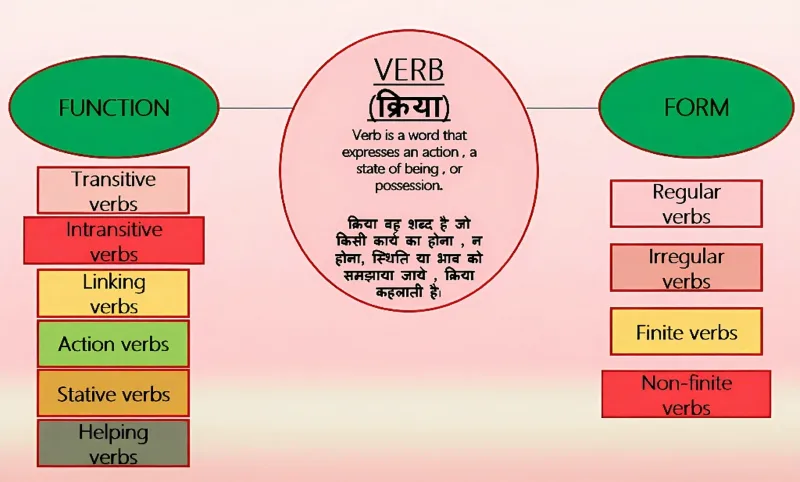
VERB (क्रिया)
Definition
A Verb is a word that expresses an action , a state of being , or possession.
It tells what a person, thing, or animal does, is, or has.
➢ Every sentence in english must have a verb, because without a verb, the sentence has no action or meaning.
Example:
run, eat, go, is, am, are, have, play, write etc.
पऱिभाषा
क्रिया वह शब्द है जो किसी कार्य का होना , न होना, स्थिति या भाव को समझाया जाये , क्रिया कहलाती है।
यह बताता है कि कोई व्यक्ति या वस्तु क्या करता है, क्या है, या क्या रखता है।
उदाहरण :
खाना, दौड़ना, जाना, होना, रखना आदि।
Example (उदाहरण)-
Action – He runs fast. (वह तेज़ दौड़ता है।)
State – She is happy. (वह खुश है।)
Possession – I have a car. (मेरे पास गाड़ी है।)
Read Also
• Tense
• Present Tense
• Past Tense
• Future tense Tense
Examples In Sentences:
1.She eats an apple.
वह एक सेब खाती है।
2.They go to school.
वे स्कूल जाते हैं।
3.The boys play football.
लड़के फुटबॉल खेलते हैं।
4.I write a letter.
मैं एक पत्र लिखता हूँ।
5.We watch TV.
हम टीवी देखते हैं।
6.I have a pen.
मेरे पास एक पेन है।
7.She was happy.
वह खुश थी।
8.My mother cooks food.
मेरी माँ खाना बनाती है।
9. They talk loudly.
वे ज़ोर से बात करते हैं।
10.She sings a song.
वह गाना गाती है।
उपर्युक्त वाक्यों में eat, go, play, watch, have, was, cook, talk, sing Verb हैं। यदि subject singular हो तो verb भी singular होती है तथा subject plural हो तो verb भी plural होती है।
Read also
• Parts of speech
• Noun
• Pronoun
• Verb meaning in hindi
Verb का हिंदी में अर्थ – क्रिया होता है।
Verb(क्रिया) = कार्य बताने वाला शब्द।
हिंदी क्रियाओं के अंत में ‘ना’ अक्षर जुड़ा होता है।
जैसे
- हँसना, रोना, खेलना, खाना, पीना, सोना, पड़ना, स्नान करना, शिकायत करना, टहलना, आदि।
Types of Verbs (क्रिया के प्रकार)
• Main/Principal Verbs (मुख्य क्रिया)
• Auxiliary/Helping Verbs (सहायक क्रिया)
(A) According to Function (रुप के अनुसार)
1. Main / Principal Verbs (मुख्य क्रिया)
Definition:
A Main Verb is the most important verb in a sentence.
It shows the main action or state of being of the subject.
It gives complete meaning to a sentence and can stand alone without any helping verb (in simple tenses).
➢ It tells what the subject does , has, or is.
Examples:
eat , go, run, play, write, read, sing, sleep
मुख्य क्रिया
परिभाषा-
मुख्य क्रिया वह क्रिया होती है, जो वाक्य में मुख्य कार्य या अवस्था को बताती है। यह वाक्य का मुख्य अर्थ बताती हैं और अपने आप में पूर्ण अर्थ रखती है।कई बार यह सहायक क्रिया(helping verb) की सहायता भी ले सकती है।
उदाहरण-
खाना, दौड़ना, लिखना, पड़ना, खेलना आदि।
Functions of Main Verb (Main Verb के कार्य)
1.यह मुख्य कार्य (main action) बताती है।
2.यह subject की अवस्था (state) दिखाती है।
3.यह कभी - कभी Helping Verb के साथ मिलकर tense बनाती है।
4.बिना Main Verb के कोई वाक्य पूरा नहीं होता।
Read also
• Active voice & Passive voice
• Is/am/are in hindi
• Sentence & types of Sentence
Examples in Sentences:
Formula – Subject + Main Verb + Object
1.I eat mangoes.
मैं आम खाता हूँ।
2.They go to school.
वे स्कूल जाते हैं।
3.She play football.
वह फुटबॉल खेलती है।
4.He runs fast.
वह तेज दौड़ता है।
5.I read a story.
मैं कहानी पढ़ता हूँ।
उपर्युक्त वाक्यों में eat, go, play, runs, read Main Verb हैं।
🞴 Important Notes:
• हर वाक्य में कम से कम एक Main Verb होती है।
• अगर tense दिखाना हो, तो helping verb + main verb साथ में आते हैं।
• Main verb हमेशा काम या अवस्था बताती है।
• Helping verb अकेली नहीं चल सकती, लेकिन Main verb अकेली चल सकती (simple tense)
Read also
• Gender
• Singular & Plural
2.Auxiliary/ Helping Verbs (सहायक क्रिया)
Definition:
A Helping Verb (also called Auxiliary verb ) is a verb that helps the main verb to form tenses, voices, moods, or questions.
It does not show action by itself but helps the main verb to make the meaning complete.
➢ It gives grammatical meaning to the main verb.
Examples:
is , am, are, was, were, have, has, had, do, does, will, shall, can, may, must,etc.
सहायक क्रिया
परिभाषा-
सहायक क्रिया वह क्रिया होती है जो मुख्य क्रिया (Main verb) की सहायता करती है ताकि वाक्य का काल(Tense), भाव(Mood) या वाच्य (Voice) सही रूप से व्यक्त हो सके। यह स्वयं कोई कार्य नहीं बताती, बल्कि मुख्य क्रिया को पूरा अर्थ देती है।
उदाहरण-
है, हूँ, हैं, था, थे, होगा, किया, रखा है, रखा था, आदि।
Examples in Sentences:
1. She is reading a book.
वह एक किताब पढ़ रही है।
2. I am going to school.
मैं स्कूल जा रहा हूँ।
3. They are playing football.
वे फुटबॉल खेल रहे हैं।
4. He was sleeping.
वह सो रहा था।
5. We were dancing at the party.
हम पार्टी में नाच रहे थे।
6. She has finished her homework.
उसने अपना होमवर्क पूरा कर लिया है।
7. I have eaten breakfast.
मैंने नाश्ता कर लिया है।
8. They had gone to Delhi.
वे दिल्ली जा चुके थे।
9. He will come tomorrow.
वह कल आएगा।
10. I do not like tea.
मुझे चाय पसंद नहीं है।
उपर्युक्त वाक्यों में is, am, are, was, were, has, have, had, will, do Helping Verb हैं।
Read Also
• Present Indefinite Tense
• Present Perfect Tense
• Present Continuous Tense
• Present Perfect Continuous Tense
Types of Helping Verb (Helping Verb के प्रकार)
1. Primary auxiliary Verb (मुख्य सहायक क्रिया)
2. Modals Auxiliary Verb (भाव सूचक सहायक क्रिया)
1.Primary Auxiliary verbs (मुख्य सहायक क्रिया)
ये verbs tense , voice आदि बनाने में मदद करती है।यहाँ तीन प्रकार की होती है। इनकी रूप अलग अलग होते हैं।
• Be
• Have
• Do
• Be Forms
Is, am,are, was, were, been, being
Examples:
1. She is reading. वह पढ़ रही है।
2. They were dancing.वे नाच रहे थे।
3. I am going.मैं जा रहा हूँ।
• Have Forms
Has, have, had
Examples:
1. I have finished my work.मैंने अपना काम पूरा किया है।
2. She has eaten food.उसने खाना खा लिया है।
3. They had gone.वे जा चुके थे।
• Do Forms
Do, does, did
Examples:
1. I do not like tea. मुझे चाय पसंद नहीं है।
2. He does his homework. वह अपना होमवर्क करता है।
3. We did our work. हमने अपना काम किया।
Read Also
• Past Indefinite Tense
• Past Perfect Tense
• Past Continuous Tense
• Past Perfect Continuous Tense
2.Modal Auxiliary Verbs (भाव सूचक सहायक क्रिया)
ये Verbs possibility, permission, ability, necessity, obligation आदि को दर्शाते हैं।
ये बताते हैं कि कोई कार्य संभव है, अनुमति है, जरूरी हैं, आदि।
Common Modals :
can, could, may, might, must, shall, should, will, would, dare, need, ought to, used to
Examples:
1. I can swim. मैं तैर सकता हूँ।
2. She could dance well.
वह अच्छा नाच सकती थी।
3. You may go now.
तुम अब जा सकते हो।
4. It might rain.
शायद बारिश हो सकती है।
5. I shall help you.
मैं तुम्हारी मदद करूँगा।
6. You should study.
तुम्हें पढ़ाई करनी चाहिए।
7. He will come tomorrow.
वह कल आएगा।
8. I would like some water.
मुझे थोड़ा पानी चाहिए।
9. We must obey our parents.
हम अपने माता पिता की आज्ञा माननी चाहिए।
10. You ought to speak truth.
तुम्हें सच बोलना चाहिए।
(B) According to Object (कार्य के अनुसार)
1. Transitive Verb (सकर्मक क्रिया)
A Transitive Verb is a verb that needs an object an object to complete its meaning.
It shows an action that passes from the subject to the object.
➢ Without an object , the sentence remains incomplete.
Example:
eat, make, buy, write, read, bring, build, open, close, kick Etc.
हिंदी में परिभाषा
सकर्मक क्रिया वह क्रिया होती है जिसे अपना अर्थ पूरा करने के लिए कर्म की आवश्यकता होती है।
अर्थात क्रिया का कार्य कर्ता से निकलकर कर्म पर पड़ता है। यदि वाक्य में कर्म ना हो ,तो वाक्य अपूर्ण लगता है।
उदाहरण-
खाना, लिखना, पढ़ना, बनाना, खरीदना आदि।
Examples:
1. I eat an apple.
मैं एक सेब खाता हूँ।
2. She writes a letter.
वह एक पत्र लिखती है।
3. He reads a book.
वह एक किताब पढ़ता है।
4. They make a cake.
वे एक केक बनाते हैं।
5. I buy vegetables.
मैं सब्जियां खरीदता हूँ।
6. She opens the door.
वह दरवाजा खोलती है।
7. He closes the window.
वह खिड़की बंद करता है।
8. The boy kicks the ball.
लड़का गेंद को मारता है।
9. She paints the wall.
वह दीवार पर रंग करती है।
10. He brings milk.
वह दूध लाता है।
उपर्युक्त वाक्यों में eat, write, read, make, buy, open, close, kick, paint, bring Transitive Verbs हैं।
Read also
• Subject & Predicate
• Adverb
• Adjective
• Preposition
• Conjunction
• Interjection
How to Identify a Transitive Verb (पहचान कैसे करें?)
1. वाक्य में Verb के बाद “क्या” या “किसको” सवाल पूछें। अगर जवाब मिलता है- तो वह Transitive Verb है।
Example:
He writes a letter. (वह क्या लिखता है? – पत्र)
✓ Transitive Verb = writes
2. यदि कर्म (object) हटाने पर वाक्य अधूरा लगे, तो वह Transitive verb है।
Example:
✕ He kicked. (अपूर्ण वाक्य)
✓ He kicked the ball. (पूर्ण वाक्य)
Read Also
• Future Indefinite Tense
• Future Perfect Tense
• Future Continuous Tense
• Future Perfect Continuous Tense
2. Intransitive Verbs (अकर्मक क्रिया)
Definition
An Intranstive Verb is a verb that does not need an object to complete its meaning.
The action does not pass from the subject to an object – It stays with the subject
➢ The sentence is complete without an object.
Example:
go , come, sleep, cry, laugh, run, sit, rise, fall, die
हिंदी में परिभाषा
अकर्मक क्रिया वह क्रिया होती है जिसे अपने अर्थ को पूरा करने के लिए किसी कर्म की आवश्यकता नहीं होती। क्रिया का कार्य कर्ता पर ही समाप्त हो जाता है।
➢ इन वाक्यों में कर्म नहीं होता, फिर भी वाक्य पूरा होता है।
उदाहरण -
सोना, हँसना, रोना, खाना, जाना, गिरना, बैठना, उठना आदि।
Examples:
1. They go to school.
वे स्कूल जाते हैं।
2. She comes late.
वह देर से आती है।
3. The baby sleeps well.
बच्चा अच्छे से सोता है।
4. He runs fast.
वह तेज दौड़ता है।
5. We laugh loudly.
हम जोर से हंसते हैं।
6. The child cries.
बच्चा रोता है।
7. Please sit here.
कृपया यहाँ बैठिए।
8. He stands near the gate.
वह गेट के पास खड़ा है।
9. The sun rises in the east.
सूरज पूरब दिशा में उगता है।
10. Leaves fall in autumn.
पतझड़ में पत्ते गिरते हैं।
उपर्युक्त वाक्यों में go, come, sleep, run, laugh, cry, sit, stand, rise, fall Intransitive Verbs हैं।
How to Identify an Intransitive Verb(पहचान कैसे करें?)
1. वाक्य में Verb के बाद “क्या” या “किसको” पूछने पर उत्तर नहीं मिलता, तो वह Intransitive Verb है।
Example:
He runs. - वह क्या दौड़ता है? - कोई उत्तर नहीं = Intransitive verb
2. यदि वाक्य में कर्म न हो और वाक्य पूरा अर्थ दे रहा हो, तो वह Intransitive है।
Example:
She laughs. (वह हँसती है।) - वाक्य पूर्ण है।
Difference between Transitive and Intransitive Verb (सकर्मक और अकर्मक क्रियाओं के बीच अंतर)
| Tran - sitive Verb |
Intra - nsitive Verb |
| 1.He reads a book |
1.He reads daily |
| 2.She eats an apple |
2.She eats well |
| 3.They play cricket |
3.They play happily |
| 4.I wrote a letter |
4.I wrote yesterday |
| 5.He built a house. |
5.He worked hard. |
| 6.I bought fruits. |
6.I went to the market. |
(C) According to Form (क्रिया के स्वरुप के अनुसार)
1. Finite Verb (परिमित क्रिया)
Definition:
A Finite verb is a verb that changes according to the subject and tense.
It shows person, number, and tense ina sentences.
Every complete sentence in English must have at least one finite verb.
Example:
go- goes, eat- eats, run- ran, write- wrote.
परिभाषा:
सिमित क्रिया है जो कर्ता या काल के अनुसार बदलती है। यह वाक्य में व्यक्ति (person), संख्या (Number) और काल (Tense) को दिखाती है।
मुख्य बिंदु –
• यह वाक्य का मुख्य क्रिया (Main verb) हो सकती है।
• हर पूर्ण वाक्य में कम से कम एक Finite verb होना चाहिए।
Examples:
1. She plays football.
वह फुटबॉल खेलती है।
2. I am going to school.
मैं स्कूल जा रहा हूँ।
3. They were singing.
वह गा रहे थे।
4. He runs fast.
वह तेज दौड़ता है।
5. She wrote a letter.
उसने एक पत्र लिखा।
उपयुक्त वाक्यों में plays, am, were, runs, wrote Finite Verbs हैं।
2. Non- Finite Verb (अपरिमित क्रिया)
A Non- Finite Verb is a verb that does not not change according to subject, persone, or tense.
It cannot act as the main verb of a complete sentence alone.
It usually function as a noun, adjective, or adverb in a sentence.
Example:
to go, to eat, eating, played, playing, written
परिभाषा
असीमित क्रिया वह क्रिया होती है जो कर्ता और काल के अनुसार बदलती नहीं है।
यह अकेले पूर्ण वाक्य बनाने में सक्षम नहीं होती। यह वाक्य में संज्ञा(Noun), विश्लेषण (Adjective) या क्रिया विश्लेषण (Adverb) की तरह काम करती है।
उदाहरण:
To eat (खाना), Eating (खा रहा/ रही), Written (लिखा हुआ), Playing (खेलते हुए)।
Types of Non – Finite Verb (असिमित क्रिया के प्रकार)
1. Infinitive (to + verb ) – to eat, to go, to write
2. Gerund (verb+ ing) – eating, reading, swimming
3. Participle (Past / Present Participle) –
• Present Participle – playing, running, singing
• Past participle – written, eaten, gone
Examples:
1. I like to read.
मुझे पढ़ना पसंद है।(Infinitive)
2. Swimming is fun.
वह घर जाना चाहती है।(Gerund)
3. The boy is running fast.
लड़का तेज दौड़ रहा है।(Present participle)
4. I have written a letter.
मैंने एक पत्र लिखा है।(Past participle)
5. We decided to help them.
हमने उनकी मदद करने का निर्णय है।(Infinitive)
6. Reading improves knowledge.
पढ़ना ज्ञान बढ़ाता है।(gerund)
उपर्युक्त वाक्य में Non- Finite verb की तीनो Types का use हुआ है।
(D) According to Meaning (अर्थ के अनुसार)
1. Action Verbs (क्रियात्मक क्रिया) –
Show action (run, write, eat) (खेलना, लिखना, खाना)
2. Stative Verbs (स्थितिवाचक क्रिया) –
Show state, condition, or feeling (be, have, believe, like) (होना, लगना, रहना)
3. Modal Verbs (भाववाचक क्रिया ) –
Express ability, possibility, necessity, permission (can, may, must, shall, will) (सकता है, चाहिए, होगा, सकता था)
4. Linking Verb (संबन्धसूचक क्रिया) in Hindi
A Linking Verb is a verb that connects the subject with a word or phrase that describes or identifies it.
It does not show any action.
It only links the subject to its quality, condition, or identity.
Common Linking verbs
is , am, are, was, were, seem, become, appear, feel, look, remain, stay
हिंदी में परिभाषा
अवस्था बताने वाली क्रिया वह क्रिया है जो कर्ता को संज्ञा या विशेषण से जोड़ती है। यहाँ किसी काम को नहीं दर्शाती। यह केवल विषय की अवस्था पहचान या विशेषता बताती हैं।
उदाहरण:
हैं, हूँ, हैं, था, थे, बनना, लगना, दिखाई देना महसूस करना।
Linking Verbs को Intransitive Verbs of Incomplete Prediction भी कहा जाता है।
Function Of linking Verbs (Linking verb के कार्य)
1. Subject को Noun से जोड़ना (Subject + Noun)
He is a doctor.- वह डॉक्टर है।
2. Subject को Adjectiveसे जोड़ना (Subject + Adjective)
The sky looks blue.- आकाश नीला दिखता है।
3. State or Condition दिखाना
She feels happy. – वह खुश महसूस करती है।
Examples:
1. She is happy.
वह खुश है।
2. He seems tired.
वह थका हुआ लगता है।
3. She became a teacher.
वह शिक्षक बन गयी।
4. He appears calm.
वह शांत दिखाई देता है।
5. I feel cold.
मुझे ठंड लग रही है।
6. The room looks clean.
कमरा साफ दिखता है।
7. He remains silent.
वह चुप रहता है।
8. She stays happy.
वह खुश रहती है।
उपर्युक्त वाक्यों में is, seems, become, appears, feel, looks, remains, stays Linking Verb है।
Read also
• Use of This & That
• Use of These & Those
• Use of Do & Does
• Use of Was & Were
• Use of Had
Forms of Verbs (5 Forms ) (क्रिया के रुप)
1. Base Form (V1) (धातु) :
go, eat, play (जा, खा, खेलना)
2. Past Form (V2) :
went, ate, played
3. Past Form (V3) :
gone, eaten, played
4. Present Participle (V4/-ing form) :
going, eating, playing
5. s/es Form (V5) :
goes, eates, plays
5.Verb and Tense (क्रिया और काल )
Present (वर्तमान काल) :
She writes a letter. (वह पत्र लिखती है।)
Past (भूतकाल) :
She wrote a letter. (उसने पत्र लिखा।)
Future (भविष्य काल) :
She will write a letter. (वह पत्र लिखेगी ।)
6.Important Notes (महत्वपूर्ण बिंदु)
Every sentence must have a verb.
हर वाक्य में क्रिया को होना आवश्यक है।
A verb may show action, state, condition, or possession.
क्रिया का रुप काल, पुरुष, वचन के अनुसार बदलता है।
Read also
• Active voice & Passive voice
• Article-A