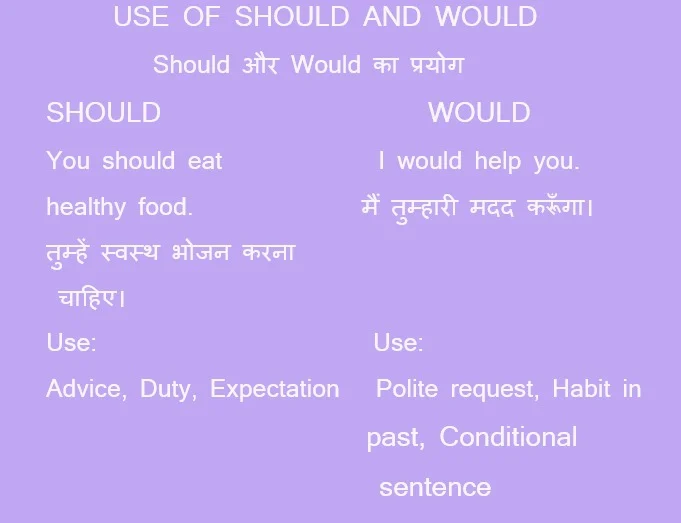
❖ ‘’SHOULD’’- Definition
• Should is a Modal auxiliary Verb used to express Duty, Advice, Suggestion, Obligation, Probability, or Expectaion.
• Should एक सहायक क्रिया है, जिसका प्रयोग कर्तव्य, सलाह, सुझाव, बाध्यता, संभावना या अपेक्षा व्यक्त करने के लिए किया जाता है।
• Shall के past tense के रूप में should का प्रयोग होता है।
Meaning of Should in hindi
• Should का प्रयोग उन वाक्यों में होता है, जिसके अंत में ‘चाहिए’, ‘करना चाहिए’, ‘करूँ’ आदि शब्द आते हैं।
Read Also
• Use of Can & Could
• may, might
• shall,Will
• Must & Ought
• need to
• dare
• Use of Used to
• POSITIVE SENTENCE (सकारात्मक वाक्य)
Examples (उदाहरण):
1.I should study regularly.
मुझे नियमित रूप से पढ़ाई करनी चाहिए।
2.We should respect our teacher.
हमें अपने शिक्षकों का सम्मान करना चाहिए।
3.You should eat healthy food.
तुम्हें स्वास्थ्य वर्धक भोजन करना चाहिए।
4.He should help the poor.
उसे गरीबों की मदद करनी चाहिए।
5.She should go to school daily.
उसे रोज़ स्कूल जाना चाहिए।
6.They should obey the rules.
उन्हें नियमों का पालन करना चाहिए।
7.We should protect the environment.
हमें पर्यावरण की रक्षा करनी चाहिए।
8.You should learn English.
तुम्हें अंग्रेजी सीखनी चाहिए?
9.He should work hard for success.
उसे सफलता के लिए कड़ी मेहनत करनी चाहिए।
10.Children should play outdoor games.
बच्चों को बाहर के खेल खेलने चाहिए।
Read Also
• Model- Auxiliary verb
• Sentence - Types of Sentence
• Parts of Sentence
• Affirmative Sentence
• NEGATIVE SENTENCE (नकारात्मक वाक्य)
Examples (उदाहरण):
1.I should not waste my time.
मुझे अपने समय बर्बाद नहीं करना चाहिए।
2.We should not fight with each other.
हमें आपस में नहीं लड़ना चाहिए।
3.You should not tell a lie.
तुम्हें झूठ नहीं बोलना चाहिए।
4.He should not hurt anyone.
उसे किसी को चोट नहीं पहुंचानी चाहिए।
5.She should not be late for school.
उसे स्कूल के लिए देर नहीं करनी चाहिए।
6.They should not pollute the environment.
उन्हें पर्यावरण को प्रदूषित नहीं करना चाहिए।
7.I should not forget my responsibilities.
मुझे अपनी जिम्मेदारियां नहीं भूलनी चाहिए।
8.You should not eat junk food.
तुम्हें जंक फूड नहीं खाना चाहिए।
9.He should not ignore his health.
उसे अपनी सेहत को नजरअंदाज नहीं करना चाहिए।
10.Children should not watch TV all day.
बच्चों को पूरा दिन टीवी नहीं देखना चाहिए।
Read Also
• Negative Sentence
• Conditional Sentence
• Exclamatory Sentence
• INTERROGATIVE SENTENCE (प्रश्नवाचक वाक्य)
Examples (उदाहरण):
1.Should I call him now? क्या मुझे उसे अभी फ़ोन करना चाहिए?
2.Should we start the meeting? क्या हमें मीटिंग शुरू करनी चाहिए?
3.Should she wear this dress for the party? क्या उसे पार्टी के लिए यह ड्रेस पहनी चाहिए?
4.Should they help the poor people? क्या उन्हें गरीब लोगों की मदद करनी चाहिए?
5.Should I wait here or outside? क्या मुझे या इंतज़ार करना चाहिए यह बाहर?
6.Should we go buy bus or train? क्या हमें बस से जाना चाहिए या ट्रेन से?
7.Should I bring some water for you? क्या मुझे तुम्हारे लिए थोड़ा पानी लाना चाहिए?
8.Should children obey their parents? क्या बच्चों को अपने माता पिता की आज्ञा माननी चाहिए?
9.Should I tell him the truth? क्या मुझे उनसे सच बता देना चाहिए?
10.Should we study hard to pass the exam? क्या हमें परीक्षा पास करने के लिए मेहनत से पढ़ाई करनी चाहिए?
Read Also
• Interrogative Sentence
• Imperative Sentence
• INTERROGATIVE NEGATIVE SENTENCE (प्रश्नवाचक नकारात्मक वाक्य)
Examples (उदाहरण):
1.Should I not help him?
क्या मुझे उसकी मदद नहीं करनी चाहिए?
2.Should we not respect our teachers?
क्या हमें अपने अध्यापकों का सम्मान नहीं करना चाहिए?
3.Should she not studay regularly?
क्या उसे नियमित रूप से पढ़ाई नहीं करनी चाहिए?
4.Should they not play fairly?
क्या उन्हें ईमानदारी से नहीं खेलना चाहिए?
5.Should he not apologize for his mistake?
क्या उसे अपनी गलती के लिए माफी नहीं मांगनी चाहिए?
6.Should we not start the work now?
क्या हमें अब काम शुरू नहीं करना चाहिए?
7.Should I not tell him the truth?
क्या मुझे उसे सच नहीं बता देना चाहिए?
8.Should children not obey their parents?
क्या बच्चों को अपने माता पिता की आज्ञा नहीं माननी चाहिए?
9.Should she not were warm clothes in winter?
क्या उसे सर्दियों में गर्म कपड़े नहीं पहनने चाहिये?
10.Should we not help the poor?
क्या हमें गरीबों की मदद नहीं करनी चाहिए?
Read Also
• Tense
• Present Tense
• Past Tense
• Future tense Tense
• Wh-Word INTERROGATIVE SENTENCE (Wh-Word प्रश्नवाचक वाक्य)
Examples (उदाहरण):
1.Why should we studay hard?
हमें कड़ी मेहनत क्यों करनी चाहिए?
2.What should I do now?
मुझे अब क्या करना चाहिए?
3.Where should we go tomorrow?
हमें कल कहाँ जाना चाहिए?
4.When should I call you?
हमें कल कहाँ जाना चाहिए?
5.Who should I trust in this matter?
हमें कल कहाँ जाना चाहिए?
6.Whom should I trust in this matter?
इस मामले में मुझे किसी पर भरोसा करना चाहिए?
7.Which subject should I choose?
मुझे कौन सा विषय चुनना चाहिए?
8.Whose advice should we follow?
हमें किस की सलाह माननी चाहिए?
9.How should we solve this problem?
हमें इस समस्या का समाधान कैसे करना चाहिए?
10.How many hours should a student study daily?
एक छात्र को रोज कितने घंटे पढ़ाई करनी चाहिए?
Read Also
• Present Indefinite Tense
• Present Perfect Tense
• Present Continuous Tense
• Present Perfect Continuous Tense
• Wh-Word INTERROGATIVE NEGATIVE SENTENCES (Wh-Word प्रश्नवाचक नकारात्मक वाक्य)
Examples (उदाहरण):
1.Why should we not help the poor?
हमें गरीबों की मदद क्यों नहीं करनी चाहिए?
2.What should I not say in the meeting?
मुझे मीटिंग में क्या नहीं कहना चाहिए?
3.Where should students not waste their time?
छात्रों को अपना समय कहाँ बर्बाद नहीं करना चाहिए?
4.When should we not disturb the teacher?
हमें शिक्षक को कब परेशान नहीं करना चाहिए?
5.Who should not take part in this competition?
इस प्रतियोगिता में किसी भाग नहीं लेना चाहिए?
6.Whom should I not believe in this matter?
इस मामले में मुझे किसी पर भरोसा नहीं करना चाहिए?
7.Which books should we not ignore?
हमें किन किताबों को नजरअंदाज नहीं करना चाहिए?
8.Whose advice should we not reject?
हम किसकी सलाह नहीं ठुकरानी चाहिए?
9.How should children not behave with elders?
बच्चों को बड़ों के साथ कैसे व्यवहार नहीं करना चाहिए?
10.How many hours should a student not waste daily?
एक छात्र को रोज़ कितने घंटे बर्बाद नहीं करने चाहिए?
Read Also
• Past Indefinite Tense
• Past Perfect Tense
• Past Continuous Tense
• Past Perfect Continuous Tense
❖ USES OF SHOULD (प्रयोग)
Duty/ Obligation (कर्तव्य/ जिम्मेदारी)
Should is a modal verb used to express duty, obligation, moral responsibility, or advice.
It shows what is right, proper, or expected in a given situation.
Should एक modal verb है जिसका प्रयोग कर्तव्य, दायित्व, नैतिक जिम्मेदारी या सलाह व्यक्त करने के लिए किया जाता है। यह बताता है कि किसी स्थिति में क्या उचित, सही या अपेक्षित है।
Examples:
1.You should respect your parents.
तुम्हें अपने माता पिता का सम्मान करना चाहिए।
2.Students should to their homework on time.
छात्रों को अपना होमवर्क समय पर करना चाहिए।
3.We should help the poor and needy.
हमें गरीब और जरूरतमंदों की मदद करनी चाहिए।
4.You should tell the truth.
तुम्हें सच बोलना चाहिए।
5.Everyone should follow the rules.
हर किसी को नियमों का पालन करना चाहिए।
6.She should take care of her health.
उसे अपनी सेहत का ध्यान रखना चाहिए।
7.You should apologize if you are wrong.
अगर तुम गलत हो तो उसे माफी मांगनी चाहिए।
8.People should plant more tree.
लोगों को ज्यादा पेड़ लगाने चाहिए।
Read Also
• Active & Passive voice
• Gender
• Use of Has & Have
• Parts of Sentence
Advice/Suggestion (सलाह/ सुझाव)
Should is a modal verb to give advice, recommendations, or suggestions.
It tells someone what is best, proper, or wise to do in a situation.
Should का प्रयोग सलाह, सुझाव या अनुशंसा देने के लिए किया जाता है यह बताता है कि किसी स्थिति में कौन सा कार्य उचित या सही रहेगा।
Examples:
1.He should take rest after work.
उसे काम के बाद आराम करना चाहिए।
2.You should take rest.
तुम्हे आराम करना चाहिए।
3.She should eat healthy food.
उसे स्वस्थ भोजन करना चाहिए
4.We should study regularly.
हमें नियमित रूप से पढ़ाई करनी चाहिए।
5.You should listen to your teacher.
तुम्हें अपने शिक्षक की बात सुननी चाहिए।
6.He should save money for the future.
उसे भविष्य के लिए पैसे बचाने चाहिए।
7.Children should obey their parents.
बच्चों को अपने माता पिता की आज्ञा माननी चाहिए।
8.You should exercise daily.
तुम्हें रोज़ व्यायाम करना चाहिए।
Read Also
• Future Indefinite Tense
• Future Perfect Tense
• Future Continuous Tense
• Future Perfect Continuous Tense
Mild Command (हल्का आदेश)
Should can be used to give a mild or gentle command, meaning it tells someone politely what they ought to do rather than ordering forcefully.
It is less direct than a normal command like “Do it” and expresses politeness or suggestion with a sense of duty.
Should का प्रयोग हलका आदेश देने के लिए किया जाता है। यह किसी को नरमी से विनम्रता के साथ बताता है कि उन्हें क्या करना चाहिए। यह सख्त आदेश की तुलना में अधिक शिष्ट और सुझावात्मक होता है।
Examples:
1.Students should be honest.
विद्यार्थियों को ईमानदार होना चाहिए।
2.You should respect your elders.
तुम्हें अपने बड़ों का सम्मान करना चाहिए।
3.She should avoid making noise in the library.
उसे लाइब्रेरी में शोर नहीं करना चाहिए।
4.Employees should submit the report on time.
कर्मचारियों को रिपोर्ट समय पर जमा करनी चाहिए।
5.You should were your seatbelt while driving.
तुम्हे गाड़ी चलाते समय सीट बेल्ट पहननी चाहिए।
6.Students should maintain discipline in the classroom.
छात्रों को कक्षा में अनुशासन बनाए रखना चाहिए।
7.You should not waste water.
तुम्हें पानी बर्बाद नहीं करना चाहिए।
8.He should be polite to everyone.
उसे सभी के प्रति विनम्र होना चाहिए।
Read Also
• Use of Had
• Use of These & Those
• Use of This & That
• Use of Was & Were
Expecation (अपेक्षा /उम्मीद)
Should is used to express expectations, meaning what is likely, reasonable, or expected to happen in a situation.
It shows what someone thinks ought to happen.
Should का प्रयोग अपेक्षाएं व्यक्त करने के लिए किया जाता है। यह बताता है कि किसी स्थिति में क्या होना चाहिए या अपेक्षित है।
Examples:
1.The train should arrive at 6 o’clock.
ट्रेन 6:00 बजे आनी चाहिए।
2.You should receive the letter by tomorrow.
तुम्हें कल तक पत्र मिल जाना चाहिए।
3.Students should know their lessons well.
छात्रों को अपने पाठ अच्छे से जानना चाहिए।
4.He should be back by evening.
उसे शाम तक वापस आ जाना चाहिए।
5.The results should be announced soon.
परिणाम जल्द घोषित होने चाहिए।
6.She should be able to solve this problem.
वह यह समस्या हल कर पाएगी।
7.We should finish the work today.
हमें यह काम आज खत्म कर लेना चाहिए।
8.The weather should improve by tomorrow.
मौसम कल तक सुधर जाना चाहिए।
Probability (संभावना)
Should can be used to express probability, meaning what is likely or expected to happen.
It shows that something is reasonably likely, based on circumstances or logic.
Should का प्रयोग संभावना व्यक्त करने के लिए किया जाता है। यह बताता है कि किसी स्थिति के आधार पर कोई घटना या परिणाम संभवता होने वाला है।
Examples:
1.She should be at home now.
वह अभी घर पर होनी चाहिए।
2.The train should reach the station by 10a.m.
ट्रेन 10:00 बजे तक स्टेशन पहुँच जाएगी।
3.They should have received the parcel by now.
उन्हें अब तक पार्सल मिल जाना चाहिए।
4.She should be able to solve this question.
वह इस प्रश्न को हल कर पाएंगी।
5.He should know about the meeting.
इस मीटिंग के बारे में पता होना चाहिए।
6.The bike should arrive in five minutes.
बाइक 5 मिनट में पहुँच जाएगी।
7.You should hear the news soon.
तुम्हें जल्द ही खबर मिलनी चाहिए।
Read Also
• Use of Is/am/are
• Singular & Plural
• Use of Can & Could
Condition (शर्त के वाक्यों में)
Should can be used to express conditions, often in formal or hypothetical situations.
It indicates that if a particular condition occurs, then a certain result is expected.
Should का प्रयोग शर्त व्यक्त करने के लिए किया जाता है, खासकर formal या hypothetical situations में। यह दर्शाता है कि कोई विशेष स्थिती पूरी होती है तो एक निश्चित परिणाम अपेक्षित है।
Examples:
1.If it should rain, the match will be cancelled.
यदि बारिश हो गई तो मैच रद्द हो जाएगा।
2.If you should need any help, call me.
यदि तुम्हें किसी मदद की जरूरत हो तो मुझे कॉल करो।
3.Should you see him, please give him this message.
यदि तुम उसे देखो तो कृपया यह संदेश दे दो।
4.Should there be any problem, let me know immediately.
यदि कोई समस्या हो तो तुरंत मुझे बता दे।
5.It you should forget your homework, I will help you.
यदि तुम अपना होमवर्क भूल जाओ, तो मैं तुम्हारी मदद करूँगा।
6.Should you require further information, please contact us.
यदि आपको और जानकारी चाहिए तो कृपया हमसे संपर्क करें।
7.If you should feel unwell, rest immediately.
यदि तुम आश्वस्त महसूस करो, तो तुरंत आराम करो।
8.Should there be any changes, we will inform you.
यदि कोई बदलाव होता है तो हम आपको सूचित करेंगे।
Politeness (शिष्टाचार/ विनम्रता)
Should is often used to express politeness or a gentle, respectful tone while giving advice, making requests, or suggestion.
It helps to make sentence softer, more courteous, and less direct.
Should का प्रयोग विनम्रता व्यक्त करने के लिए किया जाता है। जब हम किसी को सलाह, सुझाव या अनुरोध देना चाहते हैं तो Should वाक्य को शालीन, सभ्य बना देता है। यह वाक्य को सीधे आदेश से बचाकर शालीन सुझाव का रूप देता है।
Examples:
1.Should I open the window?
क्या मैं खिड़की खोल दूँ?
2.You should try this dish; it’s really delicious.
तुम्हें यह व्यंजन जरूर आजमाना चाहिए; यह बहुत स्वादिष्ट है।
3.You should visit your grandparents more often.
तुम्हें अपने दादा दादी से अक्सर मिलना चाहिए।
4.Should we start the meeting now?
क्या हमें अब मीटिंग शुरू कर देनी चाहिए?
5.You should speak politely to others.
तुम्हें दूसरों से विनम्रता से बात करनी चाहिए।
6.Should I help you with your bag?
क्या मैं तुम्हारे बैग में मदद कर दूँ?
7.You should thank her for her help.
तुम्हे उसकी मदद के लिए उसे धन्यवाद देना चाहिए।
8.Should we go out for lunch?
क्या हम लंच के लिए बाहर जाएं?
Read Also
• Use of Had
• Use of These & Those
• Use of This & That
• Use of Was & Were
In this post learn about Would English and Hindi – Definition, Hindi meaning, Positive, Negative, Interrogative, Interrogative negative, Wh – word interrogative , Wh- word interrogative negative Sentence, Uses of Would with Examples.
इस पोस्ट में Would को अंग्रेजी और हिंदी में समझाया गया है – परिभाषा, हिंदी अर्थ, सकारात्मक, नकारात्मक, प्रश्नवाचक, प्रश्नवाचक नकारात्मक, Wh- word प्रश्नवाचक, Wh – word प्रश्न नकारात्मक को विस्तार पूर्वक समझाया गया है तथा Would के प्रयोग को उदाहरण सहित बताया गया है।
Would एक बहुप्रयोगी (multi – use) modal verb है, जो विभिन्न संदर्भों में विनम्रता, काल्पनिक स्थिति इच्छा, अतीत में भविष्य और आदत को दर्शाने के लिए प्रयोग होता है । यह will का past form है, लेकिन इसका अर्थ केवल भूतकाल नहीं बल्कि भावनात्मक या शर्तीय अर्थ भी दर्शाता है।
❖ ‘’WOULD’’ – Defination
• ‘’Would’’ is Modal Verb used to express:
•Polite request or offers.
•Future-in-the-past (something planned or predicicted in the past)
•Hypothetical situations(imaginary/conditional)
•Preferences and wishes.
•Past habits.
•Would एक सहायक क्रिया है जिसका प्रयोग होता है:
•विनम्र अनुरोध या ऑफर के लिये
•भूतकाल में भविष्य व्यक्त करने के लिए
•काल्पनिक या सर्दी स्थितियों के लिए
•पसंद और इच्छा व्यक्त करने के लिए
•अतीत की आदतें बताने के लिए।
Meaning of Would in Hindi
Would का प्रयोग उन वाक्यों के अंत के लिए होता है जिनके अंत में किया करता था,करती थी, क्या करते थे, चाहूंगा, चाहेगी, चाहेंगे, करेंगे, करूँगा, करेगी, लगेगा, लगेगी, लगेगें, ता रहा होता, आती रही होती, रहे होते, आदि शब्द आने वाले होता है।
• POSITIVE SENTENCE (सकारात्मक वाक्य)
EXAMPLES(उदाहरण):
1.I would help you.
मैं तुम्हारी मदद करूँगा।
2.She would sing a song.
वह एक गीत गाएंगी।
3.They would play football in the evening.
वे शाम को फुटबॉल खेलेंगे।
4.We would like some coffee.
हमें थोड़ी कॉफी चाहिए होगी।
5.He would teach us English.
वह हमें अंग्रेजी पढ़ाएगा।
6.I would always respect my parents
मैं हमेशा अपने माता पिता का सम्मान करूँगा।.
7.She would travel to London.
वह लंदन यात्रा करेंगी।
8.We would support our team.
हम अपनी टीम का समर्थन करेंगे।
9.They would buy a new car.
वह एक नई कार खरीदेंगे।
10.I would call you tomorrow.
मैं तुम्हें कल फ़ोन करूँगा।
• NEGATIVE SENTENCE (नकारात्मक वाक्य)
EXAMPLES (उदाहरण):
1.I would not tell a lie.
मैं झूठ नहीं बोलूंगा।
2.She would not help me.
वह मेरी मदद नहीं करेगी।
3.They would not play outside in the rain.
वे बारिश में बाहर नहीं खेलेंगे।
4.We should not go to the market today.
हम आज बाजार नहीं जाएंगे।
5.He would not eat junk food.
वह जंक फूड नहीं खाएगा।
6.I would not leave my friends alone.
मैं अपने दोस्तों को अकेला नहीं छोड़ूँगा।
7.She would not watch TV at night.
वह रात को टीवी नहीं दिखेगी।
8.We would not waste our time.
हम अपना समय बर्बाद नहीं करेंगे।
9.They would not buy an old car.
वे पुरानी कार नहीं खरीदेंगे।
10.He would not forget his promise.
वह अपना वादा नहीं भूलेगा।
Read Also
• Article-A
• Use of Do&Does
• Use of Dare
• INTERROGATIVE SENTENCE (प्रश्नवाचक वाक्य)
EXAMPLES (उदाहरण):
1.Would you help me?
क्या तुम मेरी मदद करोगे?
2.Would she sing a song?
क्या वह एक गीत गाएगी?
3.Would they play cricket tomorrow?
क्या वे कल क्रिकेट खेलेंगे?
4.Would he come to my home?
क्या वह मेरे घर आएगा?
5.Would you like some tea?
क्या आपको थोड़ी चाय पसंद होगी?
6.Would we go to the park in the evening?
क्या हम शाम को पार्क जाएंगे?
7.Would she help the poor?
क्या वह गरीबों की मदद करेगी?
8.Would they support their friends?
क्या वे अपने दोस्तों का समर्थन करेंगे?
9.Would he read this book?
क्या वह यह किताब पड़ेगा?
10.Would you call me tomorrow?
क्या तुम मुझे कल फ़ोन करोगे?
• INTERROGATIVE NEGATIVE SENTENCE (प्रश्नवाचक नकारात्मक वाक्य)
EXAMPLES(उदाहरण):
1.Would you not help me?
क्या तुम मेरी मदद नहीं करोगे?
2.Would she not sing a song?
क्या वह गीत नहीं गाएगी?
3.Would they not play cricket tomorrow?
क्या वे कल क्रिकेट नहीं खेलेंगे?
4.Would he not come to the party?
क्या वह पार्टी में नहीं आएगा?
5.Would you not like some tea?
क्या तुम्हें थोड़ी चाय नहीं पसंद होगी?
6.Would we not visit the park today?
क्या हम आज पार्क नहीं जाएंगे?
7.Would she not help the poor?
क्या वह गरीबों की मदद नहीं करेगी?
8.Would they not support their friends?
क्या वे अपने दोस्तों का साथ नहीं देंगे?
9.Would he not read this book?
क्या वह यह किताब नहीं पड़ेगा?
10.Would you not call me tomorrow?
क्या तुम मुझे कल फ़ोन नहीं करोगे?
• Wh-Word INTERROGATIVE SENTENCES (Wh-Word प्रश्नवाचक वाक्य)
EXAMPLES (उदाहरण):
1.What would you do in my place?
तुम मेरी जगह क्या करते?
2.Where would we go tomorrow?
हम कल कहाँ जाएंगे?
3.When would he come to meet you?
वह तुमसे मिलने कब आएगा?
4.Who would help the poor people?
गरीब लोगों की मदद कौन करेगा?
5.Whom would she invite to the party?
वह पार्टी में किसे बुलाएगी?
6.Which book would you choose for the exam?
तुम परीक्षा के लिए कौन सी किताब चुनोगे?
7.Why would they refuse your offer?
वह तुम्हारा प्रस्ताव क्यों ठुकराएंगे?
8.How would you solve this problem?
तुम इस समस्या को कैसे हल करोगे?
9.Whose pen would you borrow?
तुम किसका पेन उधार लोगे?
10.How many days would it take to finish the work?
काम पूरा करने में कितने दिन लगेंगे?
• Wh-Word INTERROGATIVE NEGATIVE SENTENCES (Wh-Word प्रश्नवाचक नकारात्मक वाक्य)
EXAMPLES (उदाहरण):
1.Why would you not help me?
तुम मेरी मदद क्यों नहीं करोगे?
2.What would he not say in the meeting?
वह मीटिंग में क्या नहीं कहेगा?
3.Where would they not go on Sunday?
वे रविवार को कहाँ नहीं जाएंगे?
4.When would she not come to school?
वह स्कूल कब नहीं आएगी?
5.Who would not support you in trouble?
मुश्किल में तुम्हारा साथ कौन नहीं देगा?
6.Whom would you not invite to the party?
तुम पार्टी में किसे नहीं बुलाओगे?
7.Which book would you not read?
तुम कौन सी किताब नहीं पढ़ोगे?
8.Whose advice would we not follow?
हम इसकी सलाह नहीं मानेंगे?
9.How much children not respect their elders?
बच्चे अपने बड़ों का सम्मान कैसे नहीं करेंगे?
10.How many tasks would you not complete today?
तुम आज कितने काम पूरे नहीं करोगे?
❖ USES OF WOULD (मुख्य प्रयोग)
Polite request or offers(विनम्र अनुरोध या ऑफर)
किसी से शालीनता से पूछने या ऑफर देने के लिए।
Examples:
1.Would you like some tea?
क्या आप थोड़ी चाय लेना चाहेंगे?
2.Would you please help me?
क्या आप मेरी मदद करेंगे?
3.Would you like to join us for dinner?
क्या आप हमारे साथ डिनर करना पसंद करेंगे?
4.Would you like to see my new house?
क्या आप मेरा नया घर देखना चाहेंगे?
5.Would you mind waiting for a minute?
क्या आप 1 मिनट रुकने की कृपा करेंगे?
6.Would you like to come with me?
क्या आप मेरे साथ आना पसंद करेंगे?
Read Also
• need to
• dare
• Use of Used to
Future-in-the-Past (भूतकाल में भविष्य)
When we talk about an action that was in the future at some point in the past, we use would as the past form of will.
जब हम किसी ऐसी क्रिया की बात करते हैं जो भूतकाल के किसी समय भविष्य में होने वाली थी तब will की जगह would का प्रयोग करते हैं।
जब अतीत से भविष्य की बात करनी हो।
Example:
1.He said he would call me tomorrow.
इसमें कहा है कि वह मुझे कल फ़ोन करेगा।
2.They promised they would help us.
उन्होंने वादा किया कि वे हमारी मदद करेंगे।
3.We thought it would rain in the evening.
हमें लगा था की शाम को बारिश होगी।
4.She told me she would call later.
उसने कहा था कि वह बाद में फ़ोन करेंगी।
5.I was sure you would win the game.
मुझे पूरा विश्वास था कि तुम खेल जीतोगे।
Hypothetical / Conditional Situations (काल्पनिक या शर्तीय स्थिति)
When we talk about imaginary, unreal or unlikely situations, we use would to express what might happen if something were true.
जब हम किसी कॉलपनिक अवास्तविक या असंभव स्थिति की बात करते हैं, तो would का प्रयोग यह बताने के लिए किया जाता है कि अगर वह बात सच होती तो क्या होता।
Would shows imaginary result of a condition (if – clause).
Would किसी शर्त के कल्पित परिणाम को दर्शाता है।
Examples:
1.If I were rich, I would buy a big house.
अगर मैं अमीर होता तो, एक बड़ा घर खरीदता।
2.She would travel the world if she had money.
अगर उसके पास पैसे होते तो वह दुनिया घूमती।
3.If I had a car, I would go to school by car.
अगर मेरे पास कार होती तो मैं कार से स्कूल जाता।
4.If she studied hard, she would pass the exam.
अगर वहाँ मेहनत करती तो परीक्षा पास कर लेती।
5.If you helped me, I would finish this work faster.
अगर तुम मेरी मदद करते हैं, तो मैं यह काम जल्द ही खत्म कर लेता।
Preference and Wishes (पसंद और इच्छा)
हम would rather या would prefer का प्रयोग यह बताने के लिए करते हैं कि हमें क्या करना अधिक पसंद है।
हम would like का प्रयोग इच्छा, चाहत या शालीनता से कुछ कहने के लिए करते हैं।
Examples:
1.I would like to meet the manager.
मैं मैनेजर से मिलना चाहूंगा।
2.I would rather stay at home than go out.
मैं बाहर जाने के बजाय घर पर रहना पसंद करूँगा।
3.He would prefer to walk to the office.
वह दफ्तर पैदल जाना पसंद करेगा।
4.I would like to learn English.
मैं अंग्रेजी सीखना चाहता हूँ।
Read Also
• Parts of speech
• Noun
• Pronoun
• Verb
• Adverb
• Adjective
• Preposition
• Conjunction
• Interjection
Past Habits (अतीत की आदतें)
We use would to talk about past habits or repeated action that happened regularly in the past, but do not happen now.
Would का प्रयोग उन आदतों या बार-बार होने वाले कार्यों के लिए किया जाता है जो भूतकाल में नियमित रूप से होते हैं, लेकिन अब नहीं होते।
It is simlar in meaning to used to , but would is used only for actions, not for states.
यह used to जैसा होता है लेकिन would केवल क्रियाओं के लिए प्रयोग होता है, स्थिति के लिए नहीं।
Examples:
1.When we were kids, we would play in the park every evening.
जब हम बच्चे थे, तो रोज़ शाम पार्क में खेलते थे।
2.My grandfather would tell us stories at night.
मेरे दादा जी हमें रात की कहानियाँ सुनाती थे।
3.She would visit her friends every Sunday.
वह हर रविवार अपने दोस्तों से मिलने जाया करती थी।
4.We would go to the river for swimming in summer.
हम गर्मियों में तैरने के लिए नदी जाया करते थे।
5.He would always help others in need.
वह हमेशा जरूरतमंदों की मदद किया करता था।