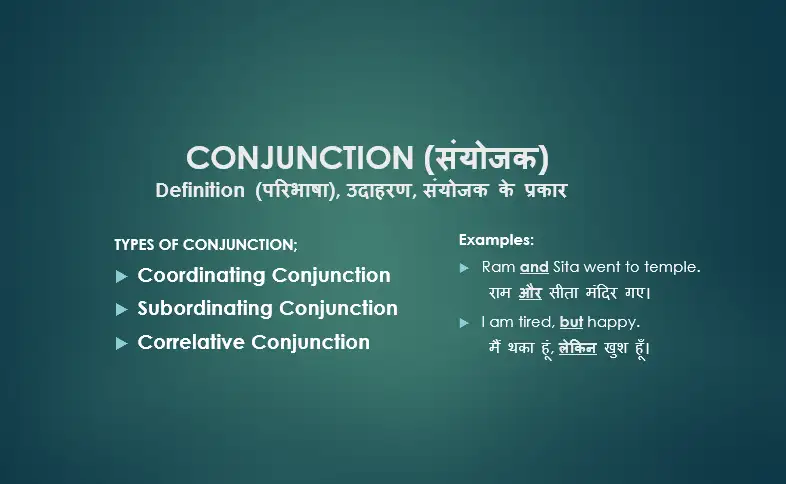
CONJUNCTION (संयोजक)
Definition
A Conjunction is a word used to join words, phrases, or sentences together.
It helps to connect ideas and make sentences smoother and more meaningful
A conjuctions joins two or more words, phrases, clauses, in a sentences.
पऱिभाषा
वे अव्यय (शब्द) जो दो या दो से अधिक शब्दों, वाक्याशों या वाक्यों को जोड़ते है, समुच्चयबोधक अव्यय कहलाता है।
ये शब्द विचारों, कार्यों या वाक्यों को एक साथ जोड़कर वाक्य को अर्थपूर्ण और सुगम बनाते हैं।
समूच्चबोधक अव्यय वे शब्द है, जो शब्दों, वाक्यांशों या उपवाक्यों को जोड़ते हैं।
It is also called a joining word.
इन्हें संयोजक शब्द भी कहा जाता है।
Common Conjunction:
and, but, or, so, because, although, if, when, while, since, either…or, neither….nor, both….and
और, लेकिन, या, क्योंकि, यदि ,जब, जबकि, इसलिए, चाहे...या, न ही, दोनों....और
Example (उदाहरण)-
1.Ram and Sita went to temple.
राम और सीता मंदिर गए।
2.I am tired, but happy.
मैं थका हूं, लेकिन खुश हूँ।
3.You can go if you want.
तुम जा सकते हो यदि तुम चाहो।
4.He did not come because he was sick.
वह नहीं आया क्योंकि वह बीमार था।
5. Either you study or you fail.
या तो तुम पढ़ो या फेल हो जाओ।
6.I am poor butt honest.
मैं गरीब हूँ लेकिन ईमानदार हूँ।
7.You can take tea or coffee.
तुम चाय या कॉफी ले सकते हो।
8.He was tired, so he went to bed early.
वह थका हुआ था, इसलिए वह जल्दी सो गया।
• Meaning of Conjunction in Hindi
Conjunction का हिंदी अर्थ – समुच्चयबोधक या संयोजक होता है।
समुच्चबोधक यह वह शब्द है जो शब्दों और वाक्यों को जोड़कर भाषा को सुसंघर्ष, सुगम और अर्थपूर्ण बनाते हैं।
Read Tenses & there Types
• Tense • Present Tense
• Present Indefinite Tense • Present Perfect Tense
• Present Continuous Tense • Present Perfect Continuous Tense
• Past Tense • Past Indefinite Tense
• Past Perfect Tense • Past Continuous Tense
• Past Perfect Continuous Tense • Future Tense
• Future Indefinite Tense • Future Perfect Tense
• Future Continuous Tense • Future Perfect Continuous Tense
Types of Conjunctions in Hindi (समुच्चयबोधक अव्यय)
समुच्चयबोधक अव्यय निम्नलिखित प्रकार की होते हैं –
1. Coordinating Conjunctions (समन्वयी समुच्चयबोधक)
• There are 4 main types of Coordinating Conjunction:
• Cumulative or Copulative Conjunctions
समाहार या संयोग सूचक अव्यय
• Adversative Conjunction
विरोध या विपरीत भाव सूचक अव्यय
• Disjunctive or Alternative Conjunctions
विकल्प सूचक अव्यय
• Illative Conjunction
परिणाम या निष्कर्ष सूचक अव्यय
2.Subordinating Conjunctions (अधीनस्थ समुच्चयबोधक अव्यय)
• Conjunction Of Time (समय सूचक समुच्चयबोधक)
• Conjunction of Cause / Reason (कारण सूचक समुच्चयबोधक अव्यय)
• Conjunction Of Purpose (उद्देश्य सूचक समुच्चयबोधक अव्यय)
• Conjunction of Condition (शर्त सूचक समुच्चयबोधक अव्यय)
• Conjunction of Result / Consequence (परिणाम सूचक समुच्चयबोधक अव्यय)
• Conjunction of Comparison (तुलना सूचक समुच्चबोधक अव्यय)
• Conjunction of Contrast / Concession (विपरीत भाव समुच्चयबोधक अव्यय)
• Conjunction of Place (स्थान सूचक समुच्चयबोधक अव्यय)
• Degrees of Adverbs (क्रिया विशेषण के रुप)
3.Correlative Conjunctions (सहसम्बन्धक समुच्चयबोधक अव्यय)
4. Compound Conjunctions in Hindi (संयुक्त समुच्चयबोधक)
5.Conjunctive Adverbs (Linking Words) in Hindi (संयुक्त क्रियाविशेषण )
◕ Coordinating Conjunctions (समन्वयी समुच्चयबोधक)
Definition:
A Coordinating Conjunction is a word that joins two or more words, phrases, or independent clauses of equal importance.
It simple words, it connects similar or equal ideas in a sentence.
➢ It joins words + words, phrases + phrases, or clauses + clauses that are equal in rank (none depends on the other.)
परिभाषा-
समन्वयी समुच्चबोधक अव्यय वे शब्द होते हैं जो समान स्तर के शब्दों, वाक्याशों या वाक्यों को जोड़ते हैं।
इनके द्वारा जुड़े हुए भाग एक – दूसरे पर निर्भर नहीं होते।
➢ यह सामान विचारों या समकक्ष वाक्यों को जोड़ने का कार्य करते हैं।
Common coordinating conjunction :
for, and, nor, but, or, yet, so
सामान्य समन्वयी अव्यय :
क्योंकि, और, न ही, लेकिन, या, फिर भी, इसलिए
Examples (उदाहरण) :
1.I like tea and coffee.
मुझे चाय और काफी पसंद है।
2.She is poor, but honest.
वह गरीब है, लेकिन ईमानदार है।
3.Work hard, or you will fail.
कड़ी मेहनत करो , वरना असफल हो जाओगे।
4.He did not come, for he was ill.
वह नहीं आया क्योंकि वह बीमार था।
5.She tried hard, yet she failed.
उसने मेहनत की फिर भी असफल रही।
6.It was raining, so we stayed home.
बारिश हो रही थी इसलिए हम घर पर रहे।
7.He didn’t eat, nor did he drink.
उसने खाया नहीं, न ही पानी पीया।
उपर्युक्त वाक्यों में and, but, or, for, yet, so, nor Coordinating Conjunction (समन्वयी अव्यय) हैं।
➢ An easy way to remember them : FANBOYS
• There are 4 main types of Coordinating Conjunction:
समन्वय अव्यय चार प्रकार के होते हैं –
1.Cumulative or Copulative Conjunctions
समाहार या संयोग सूचक अव्यय
2.Adversative Conjunction
विरोध या विपरीत भाव सूचक अव्यय
3.Disjunctive or Alternative Conjunctions
विकल्प सूचक अव्यय
4.Illative Conjunction
परिणाम या निष्कर्ष सूचक अव्यय
1. Cumulative or Copulative Conjunction in Hindi (समाहार या संयोग समुच्चयबोधक अव्यय)
Definition:
A Cumulative or Copulative Conjunction is a Coordinating Conjunction that joins one idea to another similar idea.
It used to add one statement or fact to another.
Cumulative Conjunctions are used to Combine or add ideas, actions, or statements.
परिभाषा-
समाहार या संयोग सूचक समुच्चयबोधक अव्यय वे शब्द होते हैं जो एक विचार या वाक्य के दूसरे समान विचार या वाक्य से जोड़ते हैं। ये शब्द समान बातों को जोड़ने या जोड़कर अर्थ पूरा करने का मुख्य कार्य करते हैं।
इनका मुख्य उद्देश्य दो समान कार्यों, विचारों या वाक्यों मिलाना (जोड़ना) होता है।
Examples:
1.Ram and Shyam are playing.
राम और श्याम खेल रहे हैं।
2.He is both intelligent and hardworking.
वह दोनों बुद्धिमान और परिश्रमी है।
3.She sings as well as dances.
वह गाती है के साथ - साथ नाचती भी है।
4.He is not only tall but also strong.
वह न केवल लंबा है बल्कि मजबूत भी है।
5.The teacher was kind and helpful.
अध्यापक दयालु और सहायक थे।
6.He is brave as well as honest.
वह बहादुर हैं के साथ - साथ ईमानदार भी हैं।
7.She speaks English and Hindi.
वह अंग्रेजी और हिंदी बोलती है।
उपर्युक्त वाक्यों में and, both, as well as, not only, Cumulative Conjunction है।
Read also
• Parts of speech
• Noun
• Pronoun
• Verb
• Adverb
• Adjective
• Preposition
2.Adversative Conjunction in Hindi (विरोध सूचक समुच्चयबोधक अव्यय)
Definition:
An Adversative Conjunction is a Coordinating Conjunction that expresses contrast, opposition, or difference between two statements or ideas.
It connects two idea that oppose or contrast each other.
परिभाषा-
विरोध सूचक समुच्चयबोधक अव्यय वे शब्द होते हैं जो दो वाक्यों या विचारों में विरोध, अंतर या विपरीत भाव का प्रकट करते हैं।
ये ऐसे अवयव हैं जो दो विपरीत बातों को जोड़ते हैं, जैसे - लेकिन, फिर भी, हालांकि आदि।
Examples:
1.He is poor, but honest.
वह गरीब है, लेकिन ईमानदार है।
2.She worked hard, yet she failed.
उसने कड़ी मेहनत की, फिर भी असफल रही।
3.It was raining, still we want out.
बारिश हो रही थी, फिर भी वे बाहर गए।
4.He is rich, however he is not happy.
वह अमीर है, फिर भी खुश नहीं हैं।
5.Though he is old, he is strong.
हालांकि वह बूढ़ा है, वह मजबूत है।
6.He is tall, whereas his brother is short.
वह लंबा है, जबकि उसका भाई छोटा है।
7.She tried her best, nevertheless she lost.
उसने पूरी कोशिश की, फिर भी हार गई।
उपर्युक्त वाक्यों में but, yet, still, however, though, whereas, nevertheless Adversative Conjunction है।
3.Disjunctive or Alternative Conjunctions in Hindi (विकल्प सूचक अव्यय)
Definition:
It connects two clauses or ideas that offer a choice – if one happens, the other cannot.
परिभाषा-
ये ऐसे अव्यय हैं जो दो में से एक विकल्प चुनने या एक कार्य के न होने पर दूसरे के होने का संकेत देते हैं।
Examples:
1.You can have tea or coffiee.
तुम चाय या कॉफी ले सकते हो।
2.Either come now ordon’t come at all.
या तो अभी आओ या बिल्कुल मत आओ।
3.He is neither rich nor poor.
वहाँ न तो अमीर हैं न गरीब।
4.Work hard, else you will fail.
मेहनत करो अन्यथा असफल हो जाओगे।
5.Study well, otherwise you will not pass.
अच्छी तरह पढ़ो, नहीं तो पास नहीं होंगे।
उपर्युक्त वाक्यों में or, either….or, neither….nor, else, otherwise Disjunctive Conjunction है।
Read also
• Active voice & Passive voice
• Sentence in Hindi
• Model Auxiliary-verbs
4.Illative Conjunction in Hindi (परिणाम सूचक अव्यय)
Definition:
It joins two clauses in which the second clause shows a result, conclusion, or inference of the first clause.
परिभाषा-
ये ऐसे अव्यव है जो दो वाक्यों को जोड़ते हैं, जहाँ दूसरे वाक्य पहले वाक्य का परिणाम, कारण, या निष्कर्ष बताता है।
Examples:
1.He was ill, therefore he could not come to school.
वह बीमार था इसलिए स्कूल नहीं गया।
2.It was raining, so we stayed at home.
बारिश हो रही थी तो हम घर पर ही रहे।
3.He worked hard, hence he succeeded.
उसने कड़ी मेहनत की अतः वह सफल हुआ।
4.The sun has set, therefore it is dark.
सूरज डूब गया है, इसलिए अँधेरा है।
5.She was hungry, so she ate some food.
वह भूखी थी, इसलिए उसने खाना खा लिया।
6.He is honest, for he never tells a lie.
वह ईमानदार है, क्योंकि वह झूठ नहीं बोलता।
7.He studied well, thus he got good marks.
उसने मन लगाकर पढ़ाई की, परिणामस्वरूप उसे अच्छे अंक मिले।
उपरोक्त वाक्य में therefore, so, hence, so, for, thus Illative Conjunction है।
◕ Subordinating Conjunctions in Hindi (अधीनस्थ समुच्चयबोधक अव्यय)
Definition:
A Subordinating Conjunction is a word that joins a dependent (subordinate) clause to an independent (main) clause.
➢ It shows the relationship between the two clauses – like time, reason, condition, contrast, purpose, or result.
In simple words:
A subordinating conjunction connects a dependent clause (which cannot stand alone) with a main clause (which can stand alone).
परिभाषा:
अधीनस्थ समुच्चयबोधक अव्यय वे शब्द होते हैं जो एक अधीन उपवाक्य को मुख्य वाक्य से जोड़ते हैं।
➢ ये दो वाक्यों के बीच संबंध दर्शाते हैं - जैसे समय, कारण, शर्त, विरोध, उद्देश्य, आदि।
सरल शब्दों में-
यह ऐसे शब्द हैं जो मुख्य वाक्य को किसी अधीन वाक्य से जोड़ते हैं और दोनों के बीच संबंध बताते हैं।
Common subordinating conjunctions:
because, if, although, since, while, when, unless, before, after, though, as etc.
मुख्य शब्द –
यदि, क्योंकि, ताकि, जब, जब तक, यघपि, जबकि, जैसे, चूँकि, यदि नहीं आदि।
Examples (उदाहरण):
1.I stayed home because it was raining.
मैं घर रहा क्योंकि बारिश हो रही थी ।
2.You will pass if you work hard.
अगर आप कड़ी मेहनत करेंगे तोतो आप पास हो जायेंगे।
3.She cried although she was strong.
वह रोई, हालाँकि वह मजबूत थी ।
4.She went to bed after she finished her homework.
उसमें काम पूरा किया, उसके बाद वह सो गई।
5.When he came, everyone clapped.
जब वह आया सबने तालियां बजाईं।
6.I will wait until you come.
मैं जब तक तुम नहीं आओगे इंतज़ार करूँगा।
7.He spoke softly so that the baby would not wake up.
उसने धीरे बोला ताकि बच्चा जाग न जाए।
उपर्युक्त वाक्य में because, if, after, when, although, until, so that Subordinating Conjunction (अधीनस्थ समुच्चयबोधक अव्यय) है।
Read also
• Use of is/am/are
• Use of Do & Does
• Use of Had
• Types of Subordinating Conjunctions in Hindi
अधीनस्थ समुच्चयबोधक अव्यय को निम्नलिखित प्रयोगों के आधार पर वर्गीकरण किया गया है – समय, कारण, उद्देश्य, शर्त , परिणाम, तुलना, विपरीत भाव, स्थान, ढ़ंग या तरीका।
1.Conjunction Of Time in Hindi (समय सूचक समुच्चयबोधक)
Definition:
It connects two clauses and tells when something happens – before, after, while, until, since, etc.
परिभाषा:
ये अव्यय बताते हैं कि एक कार्य दूसरे कार्य के पहले बाद या साथ - साथ कब हुआ।
Examples:
1.I will call you when I reach home.
मैं तुम्हें फ़ोन करूँगा जब मैं घर पहुंचूंगा।
2.She was reading while I was cooking.
वहाँ पढ़ रही थी जबकि मैं खाना बना रहा था।
3.We went out after it stopped raining.
हम बाहर गए जब बारिश बंद हो गई।
4.Wait here until I come back.
यहाँ रुको जब तक मैं वापस नहीं आता।
5.He has been sad since his father died.
वह दुखी है जब से उसके पिता की मृत्यु हुई।
6.I will start my work as soon as I finish breakfast.
मैं काम शुरू करूँगा। जैसे ही नाश्ता खत्म कर लूँ।
7.Before you leave, lock the door.
पहले तुम आओ, फिर हम चलेंगे।
8.You can go when the bell rings.
तुम जा सकते हो जब घंटी बजे।
2.Conjunction of Cause/Reason in Hindi (कारण सूचक समुच्चयबोधक अव्यय)
Definition
It connects two clauses – one tells the result, and the other gives the reason for that result.
परिभाषा :
ये अव्यव दो वाक्यों को जोड़ते हैं - एक वाक्य परिणाम बताता है और दूसरा कारण।
Examples:
1.He did not go to school because he was ill.
वह स्कूल नहीं गया क्योंकि वह बीमार था।
2.Since it was raining , we stayed at home.
चूँकि बारिश हो रही थी, हम घर पर ही रहे।
3.As he was raining, we stayed at home.
जैसा कि वह व्यस्त था, वह मुझसे नहीं मिल सका।
4.She was happy, for she had passed the exam.
वहाँ खुश थी क्योंकि उसने परीक्षा पास की थी।
5.Now that you are here, we can start the meeting.
अब जब तुम यहाँ हो, तो हम बैठक शुरू कर सकते हैं।
3.Conjunction Of Purpose in Hindi (उद्देश्य सूचक समुच्चयबोधक अव्यय)
Definition:
It connects two clauses where one clause explains why the action of the main clause is performed.
परिभाषा:
ये अव्यव दो वाक्यों को जोड़ते हैं और बताते हैं की मुख्य कार्य क्यों किया गया, यह किस उद्देश्य से किया गया।
Examples:
1.Work hard so that you may succeed.
मेहनत करो ताकि तुम सफल हो सको।
2.She left early in order that she could catch the train.
वह जल्दी निकली इसलिए कि वह ट्रेन पकड़ सके।
3.He spoke softly lest he should wake the baby.
उसने धीरे बोला ताकि बच्चे जाग न जाए।
4.I study daily so that I can get good marks.
मैं रोज़ पढ़ाई करता हूँ ताकि अच्छे अंक ला सकूं।
5.They planned everything carefully in order that nothing goes wrong.
उन्होंने सब कुछ ध्यान से योजना बनाई ताकि कुछ भी गलत न हो।
Read also
• Affirmative Sentence
• Negative Sentence
• Imperative Sentence
• Conditional Sentence
4.Conjunction of Condition in Hindi (शर्त सूचक समुच्चयबोधक अव्यय)
Definition:
It connects two clauses where one clause states a condition, and the other shows the result if the condition is fulfilled.
परिभाषा:
ये अव्यव दो वाक्यों को जोड़ते हैं, एक वाक्य शर्त बताता है और दूसरा वाक्य उस शर्त के पूरा होने पर परिणाम दिखाता है।
Examples:
1.Provided that it doesn’t rain, we will go out.
हम बाहर जाएंगे बस शर्त है कि बारिश न हो।
2.Take an umbrella in case it rains.
छाता ले लो मामले में बारिश हो जाए।
3.He will succeed only if he works sincerely.
वह सफल होगा केवल यदि वह ईमानदारी से काम करे.
4.Even if you fail, try again.
भले ही तुम असफल हो जाओ, फिर भी कोशिश करो।
5.You can borrow the car on condition that you return it on time.
तुम कार उधार ले सकते हो इस शर्त पर कि समय पर लौटा दो।
5.Conjunction of Result/Consequence in Hindi (परिणाम सूचक समुच्चयबोधक अव्यय)
Definition
It connects two clauses where the second clauses states the result or consequence of the first clause.
परिभाषा
ये दो वाक्यों को जोड़ते हैं - एक वाक्य कारण/ स्थिति को बताता है, दूसरा वाक्य उसका परिणाम/ नतीजा दिखाता है।
Examples:
1.He was so tired that he fell asleep immediately.
वह इतना थका हुआ था कि तुरंत सो गया।
2.She spoke in such a way that everyone.
उसने ऐसे तरीके से कहा है कि सब समझ गए।
3.It rained heavily, so the match was canceled.
बारिश बहुत हुई, इसलिए मैच रद्द कर दिया गया।
4.He worked hard; consequently, he passed the exam.
उसने कड़ी मेहनत की, परिणामस्वरूप वह सफल हुआ।
5.The sun set; therefore, it became dark.
उसने पढ़ाई नहीं की, इस वजह से वह फेल हो गया।
6. Conjunction of Comparison in Hindi (तुलना सूचक समुच्चबोधक अव्यय)
Definition:
It connects two clauses to compare one thing with another.
परिभाषा:
ये अव्यय दो वाक्यों को जोड़ते हैं और एक चीज़ की तुलना दूसरे से करते हैं।
Examples:
1.He works as hard as his father.
वह अपने पिता जितना मेहनती काम करता है।
2.The movie was not interesting as I expected.
फ़िल्म उतनी रोचक नहीं थी जितनी मैंने सोंची थी।
3.She sings beautifully, like her mother.
वह अपनी माँ जैसे सुन्दर गाती है।
4.Whereas he is tall, his brother is short.
जबकि वह लंबा है उसका भाई छोटा है।
5.I enjoy reading, while my sister prefers painting.
मुझे पढ़ाई पसंद है, जबकि मेरी बहन पेंटिंग पसंद करती है।
7.Conjunction of Contrast / Concession in Hindi (विपरीत भाव समुच्चयबोधक अव्यय)
Definition:
It connects two clauses where the second clause contrasts or differs from the first, or shows a concession.
परिभाषा:
ये अव्यय दो वाक्यों को जोड़ते हैं और विपरीत या विरोधी विचार दिखाते हैं।
Examples:
1.Although it was raining, they went out.
हालांकि बारिश हो रही थी, वे बाहर गए।
2.He is very young, however, he is very responsible.
वह बहुत युवा हैं, फिर भी बहुत जिम्मेदार है।
3.I like coffee, whereas my brother prefers tea.
मुझे काफी पसंद है, जबकि मेरे भाई को चाय पसंद है।
4.She is strict, while her sister is gentle.
वह सख्त है, जबकि उसकी बहन कोमल है।
5.He didn’t study, nevertheless he passed the exam.
उसने पढा़ई नहीं की, इसके बावजूद वह परीक्षा पास हो गया।
8.Conjunction of Place In Hindi (स्थान सूचक समुच्चयबोधक अव्यय)
Definition:
It connects two clauses and tells where something happens.
परिभाषा
ये अव्यय दो वाक्यों को जोड़ते हैं और बताते हैं कि कोई क्रिया कहाँ होती है।
Examples:
1.Go where you fell comfortable.
जाओ जहाँ तुम आराम महसूस करो।
2.You can sit wherever you like.
तुम जहाँ भी बैठना चाहो बैठ सकते हो।
3.I will follow you anywhere you go.
मैं तुम्हारे पीछे कहीं भी जाऊंगा।
4.Flowers grow where the soil is fertile.
फूल उगते है जहाँ मिट्टी उपजाऊ होती है।
9.Conjunction of Manner in Hindi (विधि /ढंग सूचक समुच्चयबोधक अव्यय)
Definition:
It connects two clauses and tells how something is done.
परिभाषा:
ये अव्यव दो वाक्यों को जोड़ते हैं और बताते हैं की क्रिया की व्याख्या कैसे हुई, या की गई।
Examples:
1.Do it as told you.
इसे वैसे ही करो जैसा मैंने कहा।
2.He acted as if he knew everything.
उसमें ऐसा अभिनय किया जैसे कि वह सब कुछ जानता हो।
3.She looked as though she had seen a ghost.
वह ऐसा देख रही थी जैसे कि उसने भूत देखा हो।
4.He runs like a professional athlete.
वह दौड़ता है जैसे कोई पेशेवर खिलाड़ी हो।
5.Speak as your teacher instructed.
अपने शिक्षक के निर्देशों के अनुसार बोलो जैसा उन्होंने कहा।
◕ Correlative Conjunctions in Hindi (सहसम्बन्धक समुच्चयबोधक अव्यय)
Definition:
A Correlative Conjunction is a pair of conjunction that work together to connect words, phrases, or clauses that have equal importance in a sentence.
These are two words used together to join sentence parts in a balanced or parallel way.
परिभाषा:
सहसम्बन्धक समुच्चयबोधक अव्यय वे शब्दों के जोड़े होते हैं, जो समान महत्व वाले वाक्यांश, शब्द या वाक्यों को जोड़ने के लिए साथ में प्रयोग किए जाते हैं।
ये दो शब्द मिलकर वाक्य के भागों को समान और संतुलित तरीके से जोड़ते हैं।
Common pairs:
either….or, neither….nor, both….and, not only….but also, whether….or
मुख्य युग्म –
या तो.....या, न...न, न केवल....वकन्, चाहे....चाहे, यदि ....तो
Examples (उदाहरण):
1.Both my father and mother are teachers.
मेरे पिता और माता दोनों शिक्षक हैं।
2.I will either go to the market or stay at home.
मैं या तो बाजार जाऊंगा या घर रहूँगा।
3.She is not only beautiful but also also talented.
वह न केवल सुंदर हैं, बल्कि प्रतिभाशाली भी है।
4.Whether you win or lose, try your best.
तुम चाहे जीतो या हारों पूरी कोशिश करो।
5.The more you read, the more you learn.
जितना तुम पढ़ोगे, उतना तुम सीखोगे।
उपर्युक्त वाक्यों में both….and, either….or, not only….but also, whether….or, the…..the Correlative Conjunction है।
◕ Compound Conjunctions in Hindi (संयुक्त समुच्चयबोधक)
Definition:
These are multiword conjunctions used to join ideas, showing relationships like cause, purpose, condition, contrast, or time.
परिभाषा:
ये ऐसे अवयव है जो एक साथ मिलकर किसी संबंध जैसे - कारण, शर्त, उद्देश्य, विरोध या समय को दिखाते हैं।
ये दो या दो से अधिक शब्दों के समूह से बने होते है।
Common Compound Conjunction:
As well so, so that, in order that, provided that, as soon as, even though, in case
इसलिए कि, जब से, ताकि, यहाँ तक कि, ऐसा कि, यदि कि, यघपि कि
Examples (उदाहरण):
1.He came as well as his brother.
वह आया साथ ही उसका भाई भी आया।
2.I left early so that I could catch the train.
मैं जल्दी निकल गया ताकि ट्रेन पकड़ सकूँ ।
3.I will help you as long as you ask.
मैं तुम्हारी मदद करूँगा जब तक तुम मांगो।
4.She left as well as the meeting ended.
बैठक खत्म होते ही वह चली गई।
5. We will win even if it is difficult.
हम जीतेंगे, भले ही यह कठिन हो।
उपर्युक्त वाक्यों में as well as, so that, as long as, as soon as, even if Compound Conjunction है।
◕ Conjunctive Adverbs (Linking Words) in Hindi (संयुक्त क्रियाविशेषण )
Definition:
It is a word that links two sentence or clauses and shows how they are related.
परिभाषा:
ये दिखने में क्रियाविशेषण होते है लेकिन काम संयोजक का करते है।
यह शब्द दो वाक्यों या वाक्यांशों को जोड़ता है और बताता है कि उनका संबंध कैसा है।
Common Conjunctive Adverbs:
However, therefore, moreover, otherwise, consequently, hence, thus, nevertheless
अतह, इसलिए, फिर भी, फलस्वरुप, किंतु, तथापि, दरअसल
Example (उदाहरण) :
1.He was tired; however , he finished his work.
वह थका हुआ था , तथापि , उसने अपना काम खत्म कर लिया ।
2.She studied hard; therefore , she succeeded.
उसने कड़ी मेहनत से पढाई की इसलिए, वह सफल हुई ।
3.He is intelligent , moreover, he is very kind.
वह बुद्धिमान है। इसके अलावा वह बहुत दयालु भी हैं।
4.She failed the test, nevertheless, she tried again.
वह परीक्षा में फेल हुई, इसके बावजूद उसने फिर से कोशिश की।
5.The sun set; meanwhile, the children were still playing.
सूरज डूब गया; इस बीच, बच्चे अभी भी खेल रहे थे।
उपर्युक्त वाक्यों में therefore, however, moreover, nevertheless, meanwhile Conjunctive Adverb हैं।
Position of Conjunctions (स्थान समुच्चयबोधक)
• Usually placed between the words/clauses they connect.
सामान्य संयोजक दो शब्दों या वाक्यों के बीच आता है।
• Some (like however, therefore) may appear at the beginning of a sentence.
कुछ (जैसे-अतह, इसलिए) वाक्य के आरंभ में भी प्रयुक्त हो सकते है।