Past Continuous Tense (अपूर्ण भूतकाल)
Definition -
Past Continuous Tense is used to describe an action that was happening or was in progress at a specific time in the past.
It tells that the action started earlier and was still continuing at that past moment.
It shows past + ongoing action.
Helping verbs: was, were
Main verb: verb + ing
We use this tense when we talk about:
• An action that was happening at a particular time in the past.
• Two actions happening at the same time in the past.
• A long action that was interrupted by a short action.
परिभाषा -
Past Continuous Tense का उपयोग उस क्रिया के लिए किया जाता है जो अतीत (past) के किसी समय पर चल रही थी।
यह बताता है कि क्रिया पहले शुरू हुई थी और उस समय तक जारी थी।
इन वाक्यों के अंत में रहा था, रही थी, रहे थे, आदि शब्द आते हैं।
यह बीता हुआ समय + चलती हुई क्रिया दिखाता है।
Helping verbs: was, were
Main verb: verb + ing
Past Continuous Tense का प्रयोग तब किया जाता है जब :
• कोई क्रिया अतीत के किसी निश्चित समय पर चल रही हो।
• दो क्रियाएँ एक साथ अतीत में हो रही हों।
• एक लंबी क्रिया को कोई छोटी क्रिया बीच में रोक दे।
Examples of such situations:
1. “At 8 PM, I was studying.” - action in progress at a fixed past time.
8 बजे मैं पढ़ रहा था।” - एक निश्चित समय पर चल रही क्रिया
2. “They were watching TV while I was cooking.” - two actions happening at the same time.
“जब मैं खाना बना रहा था, वे टीवी देख रहे थे।” - दो क्रियाएँ एक साथ
3. “I was walking when it started raining.” -long action interrupted by short action.
“मैं चल रहा था तभी बारिश शुरू हो गई।” → लंबी क्रिया को छोटी क्रिया ने रोका
Examples :
1. I was writing notes in my diary.
मैं अपनी डायरी में नोट्स लिख रहा था।
2. She was cooking pasta in the kitchen.
वह किचन में पास्ता बना रही थी।
3. They were playing in the garden.
वे बगीचे में खेल रहे थे।
4. We were watching a new movie.
हम एक नई फ़िल्म देख रहे थे।
5. He was reading a storybook.
वह कहानी की किताब पढ़ रहा था।
6. The children were drawing pictures.
बच्चे चित्र बना रहे थे।
7. I was cleaning my room yesterday evening.
मैं कल शाम अपना कमरा साफ कर रहा था।
8. Birds were flying in the sky.
पक्षी आकाश में उड़ रहे थे।
9. She was learning a new dance step.
वह एक नया डांस स्टेप सीख रही थी।
10. My brother was repairing his computer.
मेरा भाई अपना कंप्यूटर ठीक कर रहा था।
उपरोक्त दिये उदाहरणों में सभी उदाहरणों के अंत में रहा था, रही थी, रहे थे, आदि शब्द आ रहे हैं। अर्थात सभी उदाहरण अपूर्ण भूतकाल के हैं।
Read Also
• Past Tense
• Past Indefinite Tense • Past Continuous Tense
• Past Perfect Tense • Past Perfect Continuous Tense
Rules of Past Continuous Tense (अपूर्ण भूतकाल के नियम) :
RULE 1 — Use of “was/were” (Helping Verbs)
In Past Continuous Tense, we always use was or were as helping verbs.
• was - with I, he, she, it, singular nouns
• were - with you, we, they, plural nouns
Continuous Tense में हमेशा was और were का उपयोग किया जाता है।
• was - I, he, she, it और एकवचन नाम के साथ
• were - you, we, they और बहुवचन नाम के साथ
RULE 2 — Main Verb + ing Form
The main verb must be in -ing form (present participle).
Examples: going, reading, writing, playing, dancing
Main verb में हमेशा -ing जोड़ा जाता है,
जैसे:going (जाना), playing (खेलना), writing (लिखना), cooking (पकाना)
यह क्रिया के चलते रहने को दिखाता है।
RULE 3 – इन वाक्यों के अंत में रहा था, रही थी, रहे थे, आदि शब्द आते हैं।
Past Continuous Tense Table :
| Topic |
Explanation |
| Definition |
Shows an action that was continuing at a specific time in the past. |
| Helping verbs |
was, were |
| Verb form |
verb + ing |
| Use of "was" |
I, he, she, it, singular nouns |
| Use of “were” |
You, we, they, plural nouns |
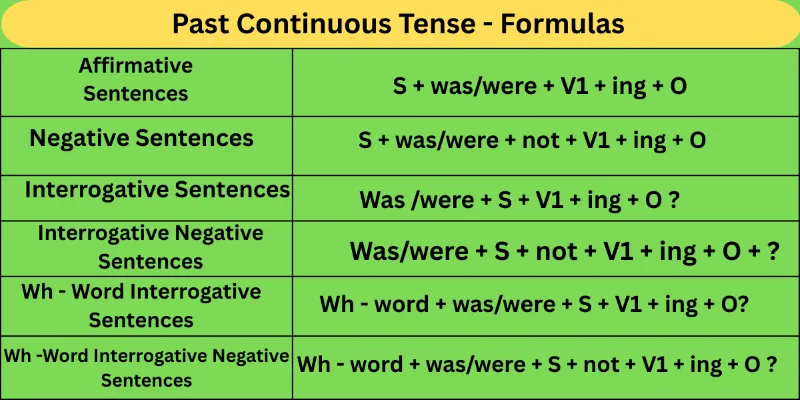
| Affirmative formula |
Subject + was/were + verb(ing) + Object |
| Negative Formula |
Subject + was/were + not + Verb(ing) + object |
| Interrogative Formula |
Was/were + subject + verb (ing) + object + ? |
| Wh – question Formula |
Wh -Word + was/were + subject + verb (ing) + ? |
1. Affirmative Sentences of Past Continuous Tense (सकारात्मक वाक्य)
A Past Continuous Affirmative sentence tells about an action that was happening/continuing at a particular time in the past in a positive way (without “not”).
Past Continuous के Affirmative वाक्य वे होते हैं जो अतीत के किसी समय पर चल रही सकारात्मक क्रिया को व्यक्त करते हैं (वाक्य में “not” नहीं होता)।
Rule (नियम):
1. SUBJECT चुनो (Subject of the sentence) पहला हिस्सा Subject होता है
2. SUBJECT के हिसाब से “was / were” लगाओ
Formula का दूसरा हिस्सा helping verb है — was / were
• was - I, he, she, it, one name
• were - you, we, they, more than one name
3. VERB में हमेशा “ing” जोड़ो (verb+ing)
Formula का तीसरा हिस्सा है verb (ing)।
Use verb + ing after was/were.
Examples: playing, writing, going, cooking
4. OBJECT जोड़ो (यदि वाक्य में हो)
Formula का चौथा हिस्सा — object।
Object is the receiver of the action.
Examples: a book, the door, the food, the room
Examples:
1. I was reading a new storybook.
मैं एक नई कहानी की किताब पढ़ रहा था।
2. She was cooking breakfast for her family.
वह अपने परिवार के लिए नाश्ता बना रही थी।
3. They were playing football in the ground.
वे मैदान में फुटबॉल खेल रहे थे।
4. We were watching clouds in the sky.
हम आसमान में बादलों को देख रहे थे।
5. He was writing notes for his exam.
वह अपने परीक्षा के लिए नोट्स लिख रहा था।
6. The dog was running behind the ball.
कुत्ता गेंद के पीछे दौड़ रहा था।
7. I was cleaning my cupboard yesterday.
मैं कल अपनी अलमारी साफ कर रहा था।
8. Birds were singing on the tree.
पक्षी पेड़ पर गा रहे थे।
9. She was learning a new art technique.
वह नई आर्ट तकनीक सीख रही थी।
10. We were preparing lunch together.
हम मिलकर दोपहर का खाना बना रहे थे।
11. He was repairing his old radio.
वह अपना पुराना रेडियो ठीक कर रहा था।
12. The students were completing their classwork.
विद्यार्थी अपना क्लासवर्क पूरा कर रहे थे।
13. I was watering the plants in the morning.
मैं सुबह पौधों को पानी दे रहा था।
14. They were travelling to Delhi by train.
वे ट्रेन से दिल्ली जा रहे थे।
15. She was drawing a beautiful sketch.
वह एक सुंदर स्केच बना रही थी।
16. We were listening to soft music.
हम धीमा संगीत सुन रहे थे।
17. He was helping his mother in the kitchen.
वह रसोई में अपनी माँ की मदद कर रहा था।
18. The baby was playing with toys.
बच्चा खिलौनों से खेल रहा था।
19. I was practicing for the dance competition.
मैं डांस प्रतियोगिता के लिए अभ्यास कर रहा था।
20. They were discussing their project.
वे अपने प्रोजेक्ट पर चर्चा कर रहे थे।
21. She was writing a letter to her cousin.
वह अपने कज़िन को पत्र लिख रही थी।
22. We were waiting for the teacher.
हम शिक्षक का इंतज़ार कर रहे थे।
23. He was fixing the broken chair.
वह टूटी हुई कुर्सी ठीक कर रहा था।
24. I was searching for my notebook.
मैं अपनी नोटबुक खोज रहा था।
25. They were arranging books on the shelf.
वे शेल्फ पर किताबें सजा रहे थे।
26. She was preparing notes for her class.
वह अपनी कक्षा के लिए नोट्स बना रही थी।
27. The children were jumping in the playground.
बच्चे मैदान में कूद रहे थे।
28. We were enjoying the cool breeze.
हम ठंडी हवा का आनंद ले रहे थे।
29. He was painting the gate blue.
वह गेट को नीला रंग कर रहा था।
30. I was recording a video for my project.
मैं अपने प्रोजेक्ट के लिए वीडियो बना रहा था।
Read Also
• Affirmative Sentence • Use of Had
• Active & Passive Voice • Gender
• Use of Has & Have • Use of Use of Is/am/are
2. Negative Sentences of Past Continuous Tense (नकारात्मक वाक्य)
Past Continuous Negative sentences show an action that was happening in the past, but in the negative form they show that the action was not happening at that time.
Past Continuous Negative वाक्य उस क्रिया को दर्शाते हैं
जो अतीत में हो रही थी, लेकिन Negative रूप में यह बताते हैं कि वह क्रिया उस समय नहीं हो रही थी।
Rules (नियम):
Rule 1: Choose the correct subject
English: Start the sentence with the subject.
Hindi: वाक्य हमेशा subject से शुरू होगा।
Rule 2: Use “was” or “were” according to subject
• I, he, she, it, singular noun → was
• you, we, they, plural nouns → were
Rule 3: Add “NOT” immediately after was/were
Negative बनाने के लिए was/were के तुरंत बाद NOT लगाना जरूरी है।
Rule 4: Use verb + ing
Main verb must be in “ing” form.
मुख्य क्रिया में हमेशा “ing” लगता है।
Rule 5: Add object and time (optional)
अंत में object और समय लगाया जा सकता है।
Example:
1. I was not reading the book in the evening.
मैं शाम को किताब नहीं पढ़ रहा था।
2. She was not cooking food at that time.
वह उस समय खाना नहीं पका रही थी।
3. They were not playing in the garden yesterday.
वे कल बगीचे में नहीं खेल रहे थे।
4. We were not watching the match last night.
हम कल रात मैच नहीं देख रहे थे।
5. He was not writing a letter in his room.
वह अपने कमरे में पत्र नहीं लिख रहा था।
6. You were not talking to anyone yesterday.
तुम कल किसी से बात नहीं कर रहे थे।
7. It was not raining in the morning.
सुबह बारिश नहीं हो रही थी।
8. The boys were not shouting in the class.
लड़के कक्षा में चिल्ला नहीं रहे थे।
9. My parents were not traveling to Delhi.
मेरे माता-पिता दिल्ली की यात्रा नहीं कर रहे थे।
10. She was not drawing a picture at home.
वह घर पर चित्र नहीं बना रही थी।
11. I was not cleaning my room at that time.
मैं उस समय अपना कमरा साफ नहीं कर रहा था।
12. They were not waiting for the bus.
वे बस का इंतज़ार नहीं कर रहे थे।
13. He was not fixing the fan.
वह पंखा नहीं ठीक कर रहा था।
14. We were not preparing for the test.
हम टेस्ट की तैयारी नहीं कर रहे थे।
15. She was not singing a song on stage.
वह मंच पर गीत नहीं गा रही थी।
16. You were not walking in the park yesterday.
तुम कल पार्क में नहीं चल रहे थे।
17. The baby was not sleeping in the cradle.
बच्चा पालने में नहीं सो रहा था।
18. Birds were not flying in the sky at that moment.
उस समय पक्षी आसमान में नहीं उड़ रहे थे।
19. I was not using my phone in the class.
मैं कक्षा में फोन का उपयोग नहीं कर रहा था।
20. He was not washing the car.
वह कार नहीं धो रहा था।
21. We were not celebrating any festival yesterday.
हम कल कोई त्योहार नहीं मना रहे थे।
22. She was not helping her sister.
वह अपनी बहन की मदद नहीं कर रही थी।
23. They were not repairing the road.
वे सड़क की मरम्मत नहीं कर रहे थे।
24. The teacher was not checking the copies.
शिक्षक कॉपियाँ जांच नहीं रहे थे।
25. I was not listening to music at that time.
मैं उस समय संगीत नहीं सुन रहा था।
26. You were not opening the shop yesterday.
तुम कल दुकान नहीं खोल रहे थे।
27. He was not learning the new topic.
वह नया टॉपिक नहीं सीख रहा था।
28. We were not visiting the museum.
हम संग्रहालय नहीं जा रहे थे।
29. She was not watering the plants in the morning.
वह सुबह पौधों को पानी नहीं दे रही थी।
30. They were not dancing in the function.
वे समारोह में नाच नहीं रहे थे।
Read Also
• Sentence Structure • Negative Sentence
• Singular & Plural Number • Articles
• Use of Do & Does • Use of Had
3. Interrogative Sentences of Past Continuous Tense (प्रश्नवाचक वाक्य)
Past Continuous Interrogative sentences are used to ask questions about actions that were happening at a particular time in the past.
Past Continuous Interrogative वाक्य उन क्रियाओं के बारे में प्रश्न पूछने के लिए प्रयोग होते हैं
जो अतीत के किसी विशेष समय पर हो रही थीं।
Rules (नियम):
RULE 1 — Start the sentence with ‘Was’ or ‘Were’
An interrogative question always begins with was/were.
Interrogative प्रश्न हमेशा was/were से शुरू होता है।
RULE 2 — Use the subject after was/were
Subject comes immediately after was/were.
Was/Were के बाद तुरंत subject आता है।
RULE 3 — Use Verb + ing form
The main verb must be in continuous (ing) form.
मुख्य क्रिया ing रूप में होगी।
RULE 4 — Add object and time (optional)
You may add object or time if needed.
आवश्यकता अनुसार object और समय जोड़ा जा सकता है।
RULE 5 — Put a question mark (?) at the end
Every interrogative sentence ends with a question mark.
हर प्रश्नवाचक वाक्य ? के साथ समाप्त होता है।
Examples:
1. Was I studying in my room last night?
क्या मैं कल रात अपने कमरे में पढ़ रहा था?
2. Was she cooking dinner at that time?
क्या वह उस समय खाना बना रही थी?
3. Was he writing a story in his notebook?
क्या वह अपनी नोटबुक में कहानी लिख रहा था?
4. Was it raining in the morning?
क्या सुबह बारिश हो रही थी?
5. Was the baby crying loudly?
क्या बच्चा ज़ोर से रो रहा था?
6. Were you playing football yesterday?
क्या तुम कल फ़ुटबॉल खेल रहे थे?
7. Were they waiting for the train?
क्या वे ट्रेन का इंतज़ार कर रहे थे?
8. Were we watching the movie together?
क्या हम साथ में फिल्म देख रहे थे?
9. Was Rohan calling you last evening?
क्या रोहन तुम्हें कल शाम कॉल कर रहा था?
10. Were the students practicing in the hall?
क्या छात्र हॉल में अभ्यास कर रहे थे?
11. Was she drawing a picture at home?
क्या वह घर पर चित्र बना रही थी?
12. Was he repairing the bicycle?
क्या वह साइकिल ठीक कर रहा था?
13. Were you listening to music then?
क्या तुम तब संगीत सुन रहे थे?
14. Were they cleaning the classroom?
क्या वे कक्षा साफ कर रहे थे?
15. Was the dog barking at night?
क्या कुत्ता रात में भौंक रहा था?
16. Was I talking too loudly?
क्या मैं बहुत ज़ोर से बात कर रहा था?
17. Was she teaching the children yesterday?
क्या वह कल बच्चों को पढ़ा रही थी?
18. Were we traveling to Jaipur last week?
क्या हम पिछले हफ्ते जयपुर जा रहे थे?
19. Was he searching for his keys?
क्या वह अपनी चाबियाँ ढूँढ रहा था?
20. Was she watering the plants in the morning?
क्या वह सुबह पौधों को पानी दे रही थी?
21. Were they dancing in the function?
क्या वे समारोह में नाच रहे थे?
22. Was the train moving very slowly?
क्या ट्रेन बहुत धीमे चल रही थी?
23. Were you reading the newspaper then?
क्या तुम तब अख़बार पढ़ रहे थे?
24. Was your brother watching TV?
क्या तुम्हारा भाई टीवी देख रहा था?
25. Were the children shouting in the park?
क्या बच्चे पार्क में चिल्ला रहे थे?
26. Was he learning a new skill?
क्या वह एक नई कला सीख रहा था?
27. Was she buying vegetables at the shop?
क्या वह दुकान से सब्ज़ियाँ खरीद रही थी?
28. Were we discussing the project yesterday?
क्या हम कल प्रोजेक्ट पर चर्चा कर रहे थे?
29. Was I disturbing you at that time?
क्या मैं उस समय तुम्हें परेशान कर रहा था?
30. Were they celebrating a birthday?
क्या वे जन्मदिन मना रहे थे?
Read Also
• Parts of Sentence • Interrogative Sentence
• Use of These & Those • Use of This & That
• Use of Was & Were • Noun
4. Interrogative Negative Sentences of Past Continuous Tense (प्रश्नवाचक नकारात्मक वाक्य)
Past Continuous Interrogative Negative sentences are used to ask questions about actions that were not happening at a particular time in the past.
Past Continuous Interrogative Negative वाक्य उन क्रियाओं के बारे में प्रश्न पूछने के लिए प्रयोग होते हैं
जो अतीत के किसी विशेष समय पर नहीं हो रही थीं।
Rules (नियम):
RULE 1 — Start the sentence with ‘Was’ or ‘Were’
English: Every interrogative negative sentence begins with was or were.
Hindi: Interrogative negative वाक्य हमेशा was/were से शुरू होता है।
RULE 2 — Place the subject after was/were
English: Put the subject immediately after was/were.
Hindi: Was/Were के बाद तुरंत subject आता है।
RULE 3 — Add “NOT” after the subject (or use wasn’t/weren’t)
English: To make it negative, add not after the subject.
Hindi: Negative बनाने के लिए subject के बाद not लगाया जाता है
या फिर wasn’t / weren’t का प्रयोग किया जाता है।
RULE 4 — Use verb + ing form
English: The verb must be in “ing” form.
Hindi: मुख्य क्रिया में हमेशा ing लगेगा।
RULE 5 — Add object/time if needed
English: Add object or time at the end.
Hindi: अंत में object और समय लगाया जा सकता है।
RULE 6 — Put a question mark (?)
English: Finish every interrogative negative sentence with a question mark.
Hindi: हर वाक्य के अंत में प्रश्नवाचक चिन्ह ? लगेगा।
या contracted form:
Examples:
1. Was I not studying in my room last night?
क्या मैं कल रात अपने कमरे में नहीं पढ़ रहा था?
2. Were you not playing cricket yesterday?
क्या तुम कल क्रिकेट नहीं खेल रहे थे?
3. Was he not writing a letter at that time?
क्या वह उस समय पत्र नहीं लिख रहा था?
4. Was she not cooking dinner in the kitchen?
क्या वह रसोई में खाना नहीं बना रही थी?
5. Were they not waiting for the bus?
क्या वे बस का इंतज़ार नहीं कर रहे थे?
6. Was it not raining in the morning?
क्या सुबह बारिश नहीं हो रही थी?
7. Were we not discussing the project yesterday?
क्या हम कल प्रोजेक्ट पर चर्चा नहीं कर रहे थे?
8. Was the baby not crying loudly?
क्या बच्चा ज़ोर से नहीं रो रहा था?
9. Were the students not practicing in the hall?
क्या छात्र हॉल में अभ्यास नहीं कर रहे थे?
10. Was your brother not watching TV at that time?
क्या तुम्हारा भाई उस समय टीवी नहीं देख रहा था?
11. Was she not drawing a picture at home?
क्या वह घर पर चित्र नहीं बना रही थी?
12. Were you not listening to music then?
क्या तुम तब संगीत नहीं सुन रहे थे?
13. Was he not cleaning his room in the morning?
क्या वह सुबह अपना कमरा साफ नहीं कर रहा था?
14. Were they not traveling to Delhi last week?
क्या वे पिछले हफ्ते दिल्ली नहीं जा रहे थे?
15. Was she not teaching the children yesterday?
क्या वह कल बच्चों को नहीं पढ़ा रही थी?
16. Was I not talking to you on the phone?
क्या मैं तुमसे फोन पर बात नहीं कर रहा था?
17. Were we not preparing for the exam?
क्या हम परीक्षा की तैयारी नहीं कर रहे थे?
18. Was he not repairing his bicycle?
क्या वह अपनी साइकिल नहीं ठीक कर रहा था?
19. Were they not shouting in the class?
क्या वे कक्षा में चिल्ला नहीं रहे थे?
20. Was the dog not barking at night?
क्या कुत्ता रात में भौंक नहीं रहा था?
21. Were you not opening the shop yesterday?
क्या तुम कल दुकान नहीं खोल रहे थे?
22. Was she not watering the plants in the morning?
क्या वह सुबह पौधों को पानी नहीं दे रही थी?
23. Was he not learning a new topic?
क्या वह नया टॉपिक नहीं सीख रहा था?
24. Were the workers not repairing the road?
क्या मजदूर सड़क की मरम्मत नहीं कर रहे थे?
25. Was the teacher not checking the copies?
क्या शिक्षक कॉपियाँ नहीं जांच रहे थे?
26. Were we not going to the market at that time?
क्या हम उस समय बाज़ार नहीं जा रहे थे?
27. Was she not singing a song on stage?
क्या वह मंच पर गीत नहीं गा रही थी?
28. Were they not joining the meeting yesterday?
क्या वे कल मीटिंग में शामिल नहीं हो रहे थे?
29. Was I not using my phone in the class?
क्या मैं कक्षा में अपना फोन इस्तेमाल नहीं कर रहा था?
30. Were you not helping your friend yesterday?
क्या तुम कल अपने दोस्त की मदद नहीं कर रहे थे?
Read Also
• Parts of Sentence • Conditional Sentence
• Model Verb • Use of Can & Could
• Use of Dare • Use of May & Might
5. Wh – word Interrogative Sentences of Past Continuous Tense (Wh – Word प्रश्नवाचक वाक्य)
WH-word interrogative sentences in Past Continuous Tense are used to ask questions about actions that were happening at a specific time in the past, using WH-words like what, where, when, why, who, whom, how etc.
Past Continuous Tense के WH-word interrogative वाक्य उन क्रियाओं के बारे में प्रश्न पूछने के लिए उपयोग किए जाते हैं
जो अतीत के किसी विशेष समय पर हो रही थीं, और प्रश्न पूछने के लिए WH-words जैसे क्या, कहाँ, कब, क्यों, कौन, कैसे आदि का प्रयोग होता है।
Rules (नियम):
RULE 1 — Start with a WH-word
Always begin the question with a WH-word (What, Where, Why, When, Who, How).
WH-word (क्या, कहाँ, क्यों, कब, कौन, कैसे) से वाक्य की शुरुआत होती है।
RULE 2 — Use “was/were” after WH-word
Place was/were immediately after the WH-word.
WH-word के तुरंत बाद was/were का प्रयोग होता है।
RULE 3 — Add the Subject
Subject comes after was/were.
Was/Were के बाद subject आता है।
RULE 4 — Use Verb + ing form
Verb must be in continuous (ing) form.
क्रिया हमेशा ing रूप में होगी।
RULE 5 — Add Object/Time if needed
Object or time may be added at the end.
अंत में object और समय लगाया जा सकता है।
RULE 6 — End with a question mark (?)
Every question ends with “?”.
हर प्रश्नवाचक वाक्य “?” के साथ समाप्त होता है।
Examples:
(1) What
1. What were you doing in the garden yesterday?
तुम कल बगीचे में क्या कर रहे थे?
2. What was she cooking in the kitchen?
वह रसोई में क्या पका रही थी?
3. What were they discussing in the meeting?
वे मीटिंग में क्या चर्चा कर रहे थे?
(2) Where
4. Where were you going last night?
तुम कल रात कहाँ जा रहे थे?
5. Where was he working in the morning?
वह सुबह कहाँ काम कर रहा था?
6. Where were the children playing?
बच्चे कहाँ खेल रहे थे?
(3) When
7. When were you studying yesterday?
तुम कल कब पढ़ रहे थे?
8. When was she calling you?
वह तुम्हें कब कॉल कर रही थी?
9. When were they leaving for school?
वे स्कूल कब जा रहे थे?
(4) Why
10. Why were you crying yesterday?
तुम कल क्यों रो रहे थे?
11. Why was he shouting in the class?
वह कक्षा में क्यों चिल्ला रहा था?
12. Why were they fighting in the park?
वे पार्क में क्यों लड़ रहे थे?
(5) Who
13. Who was calling you at that time?
उस समय तुम्हें कौन कॉल कर रहा था?
14. Who was talking to the teacher?
शिक्षक से कौन बात कर रहा था?
15. Who were they waiting for?
वे किसका इंतज़ार कर रहे थे?
(6) Whom
16. Whom was she helping in the room?
वह कमरे में किसकी मदद कर रही थी?
17. Whom were you meeting yesterday?
तुम कल किससे मिल रहे थे?
18. Whom was he teaching at that moment?
वह उस समय किसे पढ़ा रहा था?
(7) Which
19. Which book were you reading last night?
तुम कल रात कौन-सी किताब पढ़ रहे थे?
20. Which dress was she wearing at the function?
वह समारोह में कौन-सी ड्रेस पहन रही थी?
21. Which project were they working on?
वे किस प्रोजेक्ट पर काम कर रहे थे?
(8) How
22. How were you solving the problem?
तुम समस्या कैसे हल कर रहे थे?
23. How was he driving the car so slowly?
वह कार इतनी धीरे कैसे चला रहा था?
24. How were they preparing for the exam?
वे परीक्षा की तैयारी कैसे कर रहे थे?
More Mixed WH Examples
25. Why was it raining so heavily yesterday?
कल इतनी तेज बारिश क्यों हो रही थी?
26. Where was your sister studying last evening?
तुम्हारी बहन कल शाम कहाँ पढ़ रही थी?
27. When was the shopkeeper closing the shop?
दुकानदार दुकान कब बंद कर रहा था?
28. What were the workers repairing on the road?
मजदूर सड़क पर क्या ठीक कर रहे थे?
29. Who was sitting beside you in the bus?
बस में तुम्हारे बगल में कौन बैठा था?
30. How was the baby sleeping so peacefully?
बच्चा इतनी शांति से कैसे सो रहा था?
Read Also
• Exclamatory Sentence • Imperative Sentence
• Use of Must & Ought • Use of Shall & Will
• Use of Should & Would • Use of Used to
6. Wh – word Interrogative Negative Sentences of Past Continuous Tense (Wh – word प्रश्नवाचक नकारात्मक वाक्य)
WH-word interrogative negative sentences in Past Continuous Tense are used to ask questions about actions that were not happening at a specific time in the past, using WH-words like what, where, when, why, who, how, etc.
Past Continuous Tense में WH-word interrogative negative वाक्य उन क्रियाओं के बारे में प्रश्न पूछने के लिए उपयोग किए जाते हैं
जो अतीत के किसी विशेष समय पर नहीं हो रही थीं, और प्रश्न पूछने के लिए क्या, कहाँ, कब, क्यों, कौन, कैसे जैसे WH-words का प्रयोग किया जाता है।
Rules (नियम):
RULE 1 — Start with a WH-word
Begin every question with a WH-word.
हर वाक्य की शुरुआत WH-word से होगी।
RULE 2 — Use “was/were” after WH-word
Put was/were right after the WH-word.
WH-word के तुरंत बाद was/were लगाया जाता है।
RULE 3 — Add the Subject
Subject comes directly after was/were.
Was/Were के बाद subject आता है।
RULE 4 — Add “NOT” (or use wasn’t/weren’t)
Negative बनाने के लिए subject के बाद not लगाया जाता है।
Subject के बाद not या short form wasn’t / weren’t का प्रयोग किया जा सकता है।
RULE 5 — Use Verb + ing form
Main verb must be in continuous (-ing) form.
मुख्य क्रिया में हमेशा ing लगाया जाता है।
RULE 6 — Add Object and Time (optional)
Object and time can be added at the end.
अंत में object और समय लगाया जा सकता है।
RULE 7 — Use a question mark (?)
Every question ends with “?”.
हर वाक्य “?” से समाप्त होता है।
या short form:
Examples:
WHAT
1. What were you not doing in the park yesterday?
तुम कल पार्क में क्या नहीं कर रहे थे?
2. What was she not cooking in the kitchen?
वह रसोई में क्या नहीं पका रही थी?
3. What were they not discussing in the meeting?
वे मीटिंग में क्या चर्चा नहीं कर रहे थे?
WHERE
4. Where were you not going last evening?
तुम कल शाम कहाँ नहीं जा रहे थे?
5. Where was he not working in the morning?
वह सुबह कहाँ काम नहीं कर रहा था?
6. Where were the children not playing today?
बच्चे आज कहाँ नहीं खेल रहे थे?
WHEN
7. When were you not studying yesterday?
तुम कल कब नहीं पढ़ रहे थे?
8. When was she not calling you?
वह तुम्हें कब कॉल नहीं कर रही थी?
9. When were they not leaving for school?
वे स्कूल कब नहीं जा रहे थे?
WHY
10. Why were you not crying yesterday?
तुम कल क्यों नहीं रो रहे थे?
11. Why was he not shouting in the class?
वह कक्षा में क्यों नहीं चिल्ला रहा था?
12. Why were they not helping each other?
वे एक-दूसरे की मदद क्यों नहीं कर रहे थे?
WHO
13. Who was not talking to the teacher?
शिक्षक से कौन बात नहीं कर रहा था?
14. Who was not joining the meeting?
मीटिंग में कौन शामिल नहीं हो रहा था?
15. Who were they not waiting for?
वे किसका इंतज़ार नहीं कर रहे थे?
WHOM
16. Whom was she not helping yesterday?
वह कल किसकी मदद नहीं कर रही थी?
17. Whom were you not meeting at that time?
तुम उस समय किससे नहीं मिल रहे थे?
18. Whom was he not teaching in the class?
वह कक्षा में किसे नहीं पढ़ा रहा था?
WHICH
19. Which book were you not reading last night?
तुम कल रात कौन-सी किताब नहीं पढ़ रहे थे?
20. Which dress was she not wearing at the event?
वह कार्यक्रम में कौन-सी ड्रेस नहीं पहन रही थी?
21. Which topic were they not preparing for?
वे किस टॉपिक की तैयारी नहीं कर रहे थे?
HOW
22. How were you not solving the problem?
तुम समस्या कैसे नहीं हल कर रहे थे?
23. How was he not driving the car safely?
वह कार सुरक्षित रूप से कैसे नहीं चला रहा था?
24. How were they not preparing for the exam?
वे परीक्षा की तैयारी कैसे नहीं कर रहे थे?
🔹 MORE MIXED WH-NEGATIVE
25. Why was it not raining yesterday?
कल बारिश क्यों नहीं हो रही थी?
26. Where was your sister not studying?
तुम्हारी बहन कहाँ नहीं पढ़ रही थी?
27. When was the shopkeeper not opening the shop?
दुकानदार दुकान कब नहीं खोल रहा था?
28. What were the workers not repairing on the road?
मजदूर सड़क पर क्या नहीं ठीक कर रहे थे?
29. Who was not sitting beside you on the bus?
बस में तुम्हारे बगल में कौन नहीं बैठा था?
30. How was the baby not sleeping peacefully?
बच्चा शांति से कैसे नहीं सो रहा था?
• Uses of Past Continuous Tense:
USE 1 — Action happening at a specific time in the past
(अतीत के किसी खास समय पर चल रही क्रिया)
We use Past Continuous to show an action that was happening at a particular time in the past.
Past Continuous उस क्रिया के लिए प्रयोग होता है जो अतीत के किसी निश्चित समय पर जारी थी।
Examples:
1. I was reading a book at 8 pm.
मैं रात 8 बजे किताब पढ़ रहा था।
2. She was cooking dinner at that moment.
वह उस समय खाना बना रही थी।
3. They were playing cricket yesterday at 5.
वे कल पाँच बजे क्रिकेट खेल रहे थे।
4. He was sleeping when I called him.
जब मैंने उसे कॉल किया, वह सो रहा था।
5. We were watching TV at night.
हम रात को टीवी देख रहे थे।
USE 2 — Two actions happening at the same time
(एक साथ दो क्रियाएँ चल रही हों)
When two actions were happening simultaneously in the past, we use Past Continuous for both.
जब अतीत में दो क्रियाएँ एक साथ चल रही हों, दोनों के लिए Past Continuous प्रयोग होता है।
Examples:
1. I was studying while my sister was singing.
मैं पढ़ रहा था जबकि मेरी बहन गा रही थी।
2. He was driving while it was raining.
वह गाड़ी चला रहा था जबकि बारिश हो रही थी।
3. They were dancing while the DJ was playing music.
वे नाच रहे थे जबकि डीजे संगीत बजा रहा था।
4. We were talking while the teacher was writing.
हम बात कर रहे थे जबकि शिक्षक लिख रहे थे।
5. The children were shouting while the dogs were barking.
बच्चे चिल्ला रहे थे जबकि कुत्ते भौंक रहे थे।
USE 3 — Background action in a story
(कहानी में बैकग्राउंड में चल रही क्रिया)
Past Continuous is used to show background actions that set the scene in a story.
कहानी या घटना का माहौल दिखाने के लिए बैकग्राउंड में चल रही क्रियाओं में Past Continuous प्रयोग होता है।
Examples:
1. The wind was blowing and the birds were singing.
हवा चल रही थी और पक्षी गा रहे थे।
2. People were walking on the road when I reached.
जब मैं पहुँचा, लोग सड़क पर चल रहे थे।
3. The sun was setting and the sky was turning orange.
सूरज डूब रहा था और आसमान नारंगी हो रहा था।
4. The children were laughing as the show was starting.
शो शुरू हो रहा था और बच्चे हँस रहे थे।
5. The shopkeepers were closing their shops.
दुकानदार अपनी दुकानें बंद कर रहे थे।
USE 4 — Interrupted action in the past
(अतीत में चल रही क्रिया जिसे किसी ने बीच में रोका)
Past Continuous is used for an action which was happening when another action interrupted it.
Past Continuous उस क्रिया के लिए होता है जो चल रही थी और अचानक कोई दूसरी घटना हो गई।
Examples:
1. I was eating when the phone rang.
मैं खा रहा था जब फोन बजा।
2. She was studying when her friend came.
वह पढ़ रही थी जब उसका दोस्त आया।
3. They were playing when it started raining.
वे खेल रहे थे जब बारिश शुरू हो गई।
4. He was driving when the car stopped.
वह गाड़ी चला रहा था जब गाड़ी बंद हो गई।
5. We were sleeping when the alarm rang.
हम सो रहे थे जब अलार्म बजा।
USE 5 — Showing irritation or repeated past habits.
(बार-बार होने वाली परेशान करने वाली आदतों को दिखाना)
Past Continuous can show annoying repeated actions in the past, often with “always/constantly”.
Past Continuous का प्रयोग उन बार-बार होने वाली परेशान करने वाली आदतों के लिए भी होता है, कई बार always/constantly के साथ।
Examples:
1. She was always shouting at her brother.
वह हमेशा अपने भाई पर चिल्लाती रहती थी।
2. He was constantly losing his keys.
वह हमेशा अपनी चाबियाँ खो देता था।
3. They were always arguing with each other.
वे हमेशा आपस में बहस करते रहते थे।
4. You were always disturbing me.
तुम हमेशा मुझे परेशान करते रहते थे।
5. The baby was always crying at night.
बच्चा रात में हमेशा रोता रहता था।
Read Also
• Parts of Speech
• Noun • Pronoun
• Verb • Adverb
• Adjective • Conjunction
• Interjection • Preposition
• Examples of Past Continuous Tense:
1. I was cleaning my desk in the morning.
मैं सुबह अपनी मेज़ साफ़ कर रहा था।
2. She was watering the plants in the balcony.
वह बालकनी में पौधों को पानी दे रही थी।
3. They were painting their house last evening.
वे कल शाम अपना घर पेंट कर रहे थे।
4. He was ironing his clothes silently.
वह चुपचाप अपने कपड़े प्रेस कर रहा था।
5. We were waiting for the bus at the stop.
हम बस स्टॉप पर बस का इंतज़ार कर रहे थे।
6. The birds were chirping on the tree.
पेड़ पर पक्षी चहचहा रहे थे।
7. I was fixing my bicycle in the backyard.
मैं पिछवाड़े में अपनी साइकिल ठीक कर रहा था।
8. She was listening to soft music.
वह धीला संगीत सुन रही थी।
9. They were arranging chairs for the program.
वे कार्यक्रम के लिए कुर्सियाँ लगा रहे थे।
10. He was drawing a skyline on his notebook.
वह अपनी नोटबुक पर स्काईलाइन बना रहा था।
11. We were planning a surprise for her birthday.
हम उसके जन्मदिन के लिए सरप्राइज़ प्लान कर रहे थे।
12. The children were jumping in the garden.
बच्चे बगीचे में उछल-कूद कर रहे थे।
13. I was learning a new recipe yesterday.
मैं कल एक नई रेसिपी सीख रहा था।
14. She was polishing her shoes carefully.
वह ध्यान से अपने जूते पॉलिश कर रही थी।
15. They were searching for their lost puppy.
वे अपने खोए हुए पिल्ले को ढूँढ रहे थे।
16. He was repairing the old radio.
वह पुराना रेडियो ठीक कर रहा था।
17. We were discussing our future plans.
हम अपने भविष्य की योजनाओं पर बात कर रहे थे।
18. The wind was blowing softly.
हवा धीरे-धीरे चल रही थी।
19. I was checking my emails at that time.
मैं उस समय अपनी ईमेल देख रहा था।
20. She was decorating the room with lights.
वह कमरे को लाइटों से सजा रही थी।
21. They were practicing for their dance performance.
वे अपनी डांस परफॉर्मेंस के लिए प्रैक्टिस कर रहे थे।
22. He was polishing his bike when I met him.
जब मैं उससे मिला, वह अपनी बाइक पॉलिश कर रहा था।
23. We were cleaning the classroom together.
हम मिलकर कक्षा साफ कर रहे थे।
24. The baby was crawling near the sofa.
बच्चा सोफ़े के पास रेंग रहा था।
25. I was choosing a gift for my friend.
मैं अपने दोस्त के लिए एक उपहार चुन रहा था।
26. She was typing a message on her phone.
वह अपने फोन पर एक संदेश टाइप कर रही थी।
27. They were laughing loudly during the movie.
वे फिल्म के दौरान जोर से हँस रहे थे।
28. He was collecting coins for his project.
वह अपने प्रोजेक्ट के लिए सिक्के इकट्ठा कर रहा था।
29. We were walking along the riverside.
हम नदी किनारे चल रहे थे।
30. The students were revising the chapter before the test.
छात्र परीक्षा से पहले अध्याय दोहरा रहे थे।
Read Tense and There Types
• Tense
• Present Tense
• Present Indefinite Tense • Present continuous tense
• Present Perfect Tense • Present Perfect Continuous Tense
• Past Tense
• Past Indefinite Tense • Past continuous tense
• Past Perfect Tense • Past Perfect Continuous Tense
• Future Tense
• Future Indefinite Tense
• future continuous tense • Future Perfect Tense
• Future Perfect Continuous Tense