Definition
A NOUN is a naming word.It is the name of a persons , place , thing , quality ,idea , or feeling
इस पोस्ट में, हमनें संज्ञा के बारे में पूर्ण जानकारी दी है जिससे आपको संज्ञा को समझने में आसानी होगी। संज्ञा की परिभाषा , संज्ञा के सभी प्रकार, सभी प्रकारों के वाक्य सहित उदाहरण, संख्या का आधुनिक वर्गीकरण, संज्ञा के लिंग, संज्ञा के वचन, संज्ञा के कारक तथा कारकों के प्रकार आदि को हिंदी तथा अंग्रेजी में विस्तार रुप से समझाया है ताकि आप अच्छे ढंग से सीख पाएंगे।
Learn Noun In Hindi and English – Meaning, Definition, Examples, Types of Nouns, All Types Examples, Modern Classification of Noun, Gender of Noun, Number of Noun, Cases of Nouns.
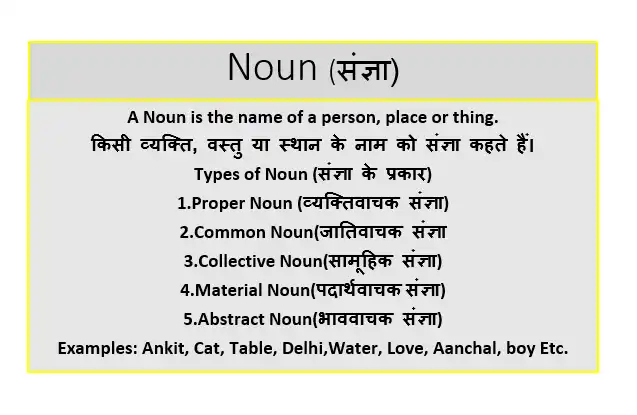
A NOUN is a naming word.It is the name of a persons , place , thing , quality ,idea , or feeling
Person – Aanchal, Doctor, Teacher
Place – Dehradun, Mall, Tample
Thing – Pen , Chair, Copy
Idea/Feeling- Cry, Love, Happiness
संज्ञा वह शब्द है, जिससे किसी व्यक्ति, वस्तु, स्थान, गुण, भाव, जीव, पदार्थ का नाम सूचित हो, संज्ञा कहलाती है।
अथवा
नाम बताने वाले शब्द को संज्ञा कहते है।
राम, सीता, दिल्ली, गंगा, खुशी, बगीचा, पेन, आदि ।
• Present Indefinite Tense
• Present Perfect Tense
• Present Continuous Tense
• Present Perfect Continuous Tense
1. Ram is a good boy.
राम एक अच्छा लड़का है।
2. Delhi is the capital of
India. दिल्ली भारत की राजधानी है।
3. The class is very noisy.
कक्षा बहुत शोर कर रही है।
4. The army is marching.
सेना मार्च कर रही है।
5. Gold is a precious metal.
सोना एक कीमती धातु है।
6. Water is essential for life.
पानी जीवन के लिए आवश्यक है।
7. Love is powerful.
प्रेम शक्तिशाली है।
8. Honesty is respected everywhere.
ईमानदारी हर जगह सम्मानित है।
9. Boys are playing in the park.
लड़के पार्क में खेल रहे हैं।
10. I bought the book.
मैंने तीन किताबें खरीदी।
11. Sugar is sweet.
चीनी मीठी होती है।
12. The crowed was huge.
भीड़ बहुत बड़ी थी।
13. This city is very old.
यह शहर बहुत पुराना है।
14. The Ganga is a holi river.
गंगा एक पवित्र नदी है।
15. Students are studing in the class.
छात्र कक्षा में पढ़ रहे हैं।
16. Milk keeps us healthy.
दूध हमें स्वस्थ रखता है।
17. Anger is harmful.
क्रोध हानिकारक है।
18. Books give us knowledge.
किताबें हमें ज्ञान देती है।
19. My brother is a doctor.
मेरा भाई एक डॉक्टर है।
20. India has a strong army.
भारत की सेना मजबूत है।
उपयुक्त वाक्यों में हमें किसी व्यक्ति, वस्तु, स्थान, गुण, भाव, दोष के बारे में पता चलता है संज्ञा हैं।
Noun – संज्ञा
Noun का अर्थ नाम भी होता है।
These are five types of noun.
संख्या के पांच प्रकार होते हैं।
• Proper noun
• Common Noun
• Collective noun
• Abstract noun
• Material noun
• Past Indefinite Tense
• Past Perfect Tense
• Past Continuous Tense
• Past Perfect Continuous Tense
A Proper Noun is the Specific name of a person, place, or thing , day, month, river, mountain, or institution.
It Always starts with a capital letter.
Ram, India, January, The Ganga
किसी विशेष व्यक्ति, स्थान, जीव, वस्तु, नदी, दिन, महीने, संस्था के नाम को व्यक्तिवाचक संज्ञा कहते है।
राम, भारत, जनवरी, गंगा, ताजमहल
1. Ram is a good boy.
राम एक अच्छा लड़का है।
2. Delhi is the capital of India.
दिल्ली भारत की राजधानी है।
3. Ganga is a holy river.
गंगा एक पवित्र नदी है।
4. Himalaya is the highest mountain range.
हिमालय सबसे ऊंची पर्वत श्रृंखला है।
5. Amazon is the largest rainforest.
अमेजॉन सबसे बड़ा वर्षावन है।
6. January is the first month of the year.
जनवरी साल का पहला महीना है।
7. Monday is the first day of the week.
सोमवार सप्ताह का पहला दिन है।
8. Sita is very kind.
सीता बहुत दयालु हैं।
उपर्युक्त वाक्यों में underline Ram, Sita, Delhi, Ganga, Himalaya, Amazon, January, Monday Proper Noun हैं।
• Proper noun हमेशा capital letter से शुरु होगा।
• Proper noun specific और unique होगा।
• Proper noun singular form में ही प्रयोग किया जाता है।
• Proper noun में a,an,the का प्रयोग नहीं किया जाता।
• Future Indefinite Tense
• Future Perfect Tense
• Future Continuous Tense
• Future Perfect Continuous Tense
A common noun is a General name for a person, place, thing, animal, or idea.
Girl, city, river, month, bird
किसी जाति, वर्ग या समूह के सामान्य नाम को जातिवाचक संज्ञा कहते है।
लडकी, शहर, नदी, महीना, पक्षी
1. The boy is reading a book.
लड़का किताब पढ़ रहा है।
2. There is a Chair in the room.
कमरे में एक कुर्सी है।
3. The apple is red.
सेब लाल है।
4. Milk is good for health.
दूध स्वास्थ्य के लिए अच्छा है।
5. I need some rice.
मुझे कुछ चावल चाहिए।
उपर्युक्त वाक्यों में boy, chair, apple, milk, rice common noun हैं।
• Common nouns small letter से शुरू होते हैं जब तक की वाक्य की शुरुआत में न हो।
• Common nouns किसी विशेष नाम को नहीं दर्शाते।
A collective noun is the name of a group of persons, animals, things taken together.
Class (students), army (soldiers), group (girls), bouquet (flowers)
किसी समूह या झुंड का नाम को समूहवाचक संज्ञा कहते है।
एक ही इकाई के रूप में समूह का नाम बताती है।
सेना (सैनिकों का समूह), झुंड (पक्षियों का), गुच्छा (फूलों का)
1. The team is playing well.
टीम अच्छा खेल रही है।
2. My family is going on a trip.
मेरा परिवार यात्रा पर जा रहा है।
3. The committee has passed the rules.
समिति ने नियम पास किये हैं।
4. The audience was clapping loudly.
दर्शक ज़ोर से ताली बजा रहे थे।
5. The staff is working hard.
स्टाफ कड़ी मेहनत कर रहा है।
उपर्युक्त वाक्यों में team, family, committee, audience, staff Collective Noun हैं।
• जब समूहों के सदस्य अलग अलग काम कर रहे हो तो plural verb का प्रयोग करें।
• जब समूह को एक यूनिट के रूप में दर्शाया जा रहा है तो singular verb का प्रयोग करें।
An abstract noun is a noun that names an ideas, qualities, emotions, or things we cannot touch.
Honesty, beauty,freedom,love,anger
जिससे किसी गुण, अवस्था या भाव का बोध होता है,
जिसे छू नहीं सकते ।
ईमानदारी, प्यार, सुंदरता, स्वतंत्रता, गुस्सा
1. Love is the greatest feeling.
प्रेम सबसे बड़ा एहसास है।
2. Honesty is the best policy.
ईमानदारी सबसे अच्छी नीति है।
3. Courage helps us face difficulties.
साहस हमें कठिनाइयों का सामना करने में मदद करता है।
4. Truth always wins.
सत्य हमेशा जीतता है।
5. Beauty lies in simplicity.
सुंदरता सादगी में होती है।
उपर्युक्त वाक्य में Love, Honesty, Courage, Truth, Beauty Abstract Noun हैं।
• Abstract nouns देखा या छुआ नहीं जा सकता।
• यह हमेशा capital letter से नहीं शुरू होते हैं, जब तक कि वाक्य की शुरुआत न हो।
• 3. Abstract nouns अक्सर -ness, -tion, -ity, -hood, -ship जैसी suffixes से बनते हैं।
Examples: Happiness, Creation, Ability
A Material Noun is the name of a substance or material from which things are made. It refers to raw materials or substances used to make other objects.
Gold, iron, cotton, sugar, wood
जिससे किसी धातु ,पदार्थ या द्रव्य का बोध हो।
ईमानदारी, प्यार, सुंदरता, स्वतंत्रता, गुस्सा
1. Gold is a precious metal.
सोना एक कीमती धातु है।
2. The ring is made of silver.
अंगूठी चांदी की बनी है।
3. The table is made of wood.
यह मेज लकड़ी की बनी है।
4. Cotton grows in fields.
कपास खेतों में उगता है।
5. India exports tea to many countries.
भारत कई देशों को चाय निर्यात करता है।
• Material nouns are uncountable अगणनीय होते हैं। हम इन्हें1gold, 2gold नहीं बोल सकते।
• Material nouns article (a,an) के साथ सामान्यतया नहीं प्रयोग किया जाता।
Modern linguistics में nouns को countability और function के आधार पर भी classify किया जाता है।
A Countable Noun is a noun that can be counted as individual items. It has both singular and plural forms.
One book, two books.
गणनीय संज्ञा वह संज्ञा है, जिसे हम गिन सकते हैं। इसके एकवचन और बहुवचन दोनों रूप होते हैं।
एक किताब, दो किताबें।
Countable Noun के अंतर्गत Proper Noun, Common Noun तथा Collective Noun आते है।
1. I have a pen.
मेरे पास एक पेन है।
2. She bought two apples.
उसने दो सेब खरीदे।
3. There are many books on the table.
मेज पर बहुत सारी किताबें हैं।
4. We saw three birds in the garden.
हमने बगीचे में तीन पक्षी देखे।
5. He has several friends in this city.
उसके इस शहर में कई दोस्त हैं।
उपयुक्त वाक्यों में pen, apples,books, birds, friends को गिना जा सकता है यह सभी Countable Noun हैं।
An Uncountable Noun is a Noun that cannot be counted individually. It does not have plural forms and usually treated as singular.
milk, water, sugar, information
अगणनीय संज्ञा वह संज्ञा है जिसे हम गिन नहीं सकते । इसके बहुवचन रुप नहीं होते और इसे सामान्यतः एकवचन माना जाता है।
दूध, पानी , चीनी, जानकारी
Countable Noun के अंतर्गत Proper Noun, Common Noun तथा Collective Noun आते है।
1. There is some water in the bottle.
बोतल में थोड़ा पानी है।
2. She gave me useful advice.
उसने मुझे उपयोगी सलाह दी।
3. We need more information about this topic.
हमें इस विषय के बारे में अधिक जानकारी चाहिए।
4. There is little sugar in the bowl.
कटोरी में थोड़ी चीनी है।
5. Honesty is the best policy.
ईमानदारी सबसे अच्छी नीति है।
उपर्युक्त वाक्यों में water, advice, information, suagr, honesty Uncountable Noun हैं।
Uncountable Noun के अंतर्गत Material Noun Abstract Nounआते हैं।
A Concrete Noun is a noun that refers to things which can be experienced through our five senses (see, hear, smell, taste, touch).
apple, dog, perfume, music, table
ठोस संज्ञा वह संज्ञा है जो किसी ऐसी वस्तु, व्यक्ति या स्थान को दर्शाती है जिसे हम अपनी पांचों इन्द्रियों (देखना, सुनना, चखना, छूना) से अनुभव कर सकते हैं।
सेब, कुत्ता, इत्र, संगीत, मेज़।
Countable Noun के अंतर्गत Proper Noun, Common Noun तथा Collective Noun आते है।
1. People- boy, girl, teacher, doctor
2. Animals – dog, cat, cow, tiger
3. Places – school, park, city, village
4. Objects – table, pen, book, car
5. Substances – water, sugar, gold, milk
6. Perceptible by Sense-
Abstract Noun को छोड़कर सभी Concrete Noun हैं।
A Compound Noun is a noun made up of two or more words that together act as a single noun.
समासिक संज्ञा वह संज्ञा है जो दो या अधिक शब्दों को मिलाकर बनी होती है और एक ही वस्तु, व्यक्ति, स्थान या विचार को दर्शाती है।
Toothpaste (tooth + paste) Mother-in-law, Playground
1. My mother-in-law is very kind.
मेरी सास बहुत दयालु हैं।
2. I went to the bus stop.
मैं बस स्टॉप गया।
3. He bought a tube of toothpaste.
उसने टूथपेस्ट की ट्यूब खरीदी।
उपर्युक्त वाक्यों में mother-in-law, bus stop, toothpaste Compound Nouns हैं।
Use of has&have
Use of Was&Were
Use of Do&Does
Use of Is/am/are
A possessive Noun is a noun that shows ownership, possession, or relationship. It is usually formed by adding ‘s or just an apostrophe (‘) to the noun.
संबंधवाचक संज्ञा वह संज्ञा है जो स्वामित्व, अधिकार या संबंध को दर्शाती है। इसे आमतौर पर संज्ञा के साथ ‘s या केवल (‘)लगाकर बनाया जाता है।
Ankit’s book, Teacher’s chair
1. This is Riya’ bag.
यह रिया का बैग है।
2. The dog’s tail is very long.
कुत्ते की पूंछ बहुत लंबी है।
3. I like India’s history.
मुझे भारत का इतिहास पसंद है।
उपर्युक्त वाक्यों में Riya’s bag, dog’s tail, India’s history Possessive Noun हैं।
Masculine (male) :king, boy, lion
पुल्लिंग- राजा, लड़का, शेर
Feminine (female): queen, girls, lioness
स्त्रीलिंग- रानी, लड़का, शेरनी
Neuter (things): table, pen, book
नपुंसकलिंग- मेज़, पेन, पुस्तक
Common (both): child, friend, student
Singular Noun :boy, book, flower
एकवचन – लड़का, किताब, फूल
Plural Noun: boys, books, flowers
बहुवचन - लड़के, किताबें, फूलों
Add (s) boy- boys
Add (es) box- boxes
Change (y) ies- babies
Irregular : man – men ,child- children
The case of a noun showes the function of that noun in a sentence.
संज्ञा या सर्वनाम का वाक्य में जो संबंध किसी अन्य शब्द के साथ होता है, कारक कहलाता है।
The case of a noun showes the function of that noun in a sentence.
When a noun is used as the subject of a verb.
जहां संज्ञा व सर्वनाम वाक्य का कर्त्ता होता है।
Examples:Ram plays cricket. (Ram = subject)
उदाहरण- राम खेलता है।
When a noun is used as the object of a verb or a preposition .
जब संज्ञा या सर्वनाम क्रिया का फल या प्रभावपाता है।
Examples: The Teacher called Riya.(Riya is the object of the verb called.)
उदाहरण- शिक्षक ने रिया को बुलाया । (रिया कर्म है।)
The Grammatical case that identifies the instrument or means by which an action is proformed.
जब क्रिया किसी साधन, औज़र, माध्यम से होती है ।
Examples: Ram killed Ravana with an arrow.
(The arrow is the instrument of the action)
उदाहरण- राम ने रावण को बाण से मारा ।
(यहाँ बाण करण है।)
Indicating the person or entity to whom or for whom something is given or done.
जब क्रिया किसी को देने, पहुँचाने या लाभ पहुँचाने के लिए हो।
Examples: Give food to the poor.
(The poor is the benefactive case)
उदाहरण- गरीबों को भोजन दें।
(यहाँ गरीबों को सम्प्रदान कारक है।)
It denotes the source of separation, a condition of being distanced,or the point of origin from which something moves.
जब किसी से अलग होने, छूटने या दूर होने का भाव हो।
Examples: A mango fell from the tree.
(the tree is the point of separation.)
उदाहरण- एक आम पेड़ से गिर गया ।
(यहाँ पेड़ से अपादान कारक है।)
When a noun shows possession or ownership.
जब संज्ञा का दूसरी संज्ञा से संबंध व्यक्त हो।
Examples: This is a ankit’s book.
(here Ankit’s shows possession of the book.)
उदाहरण- यह अकिंत की किताब है।
(यहाँ अकिंत की सम्बन्ध कारक है।)
Indicating the place or location where an action occurs.
जब क्रिया का स्थान या आधार बताया जाता है।
Examples: In the park, children are playing.
(In the park is locative case)
उदाहरण- बच्चे मैदान में खेल रहे हैं।
(यहाँ मैदान में खेल रहे हैं।)
When a noun is used to call or adress someone directly.
जब किसी को पुकारा या संभोधित किया जाता है।
Examples: Aanchal come here.
(Here Aanchal is the person being addressed.)
उदाहरण- आँचल यहाँ आओ।
इंग्लिश ग्रामर में Noun भाषा की नींव है। यह हमें चीजों, व्यक्तियों, स्थानों, भावनाओं और विचारो, को पहचानने और नाम देने में मदद करते हैं।Noun and types of Noun एक ऐसा टॉपिक है जिसका अध्ययन विस्तार से करना आवश्यक होता है। Grammer में Nouns के सही उपयोग से ही वाक्य अर्थपूर्ण और स्पष्ट बनते हैं। जब हम Noun को अच्छे से सीख लेते हैं तो हम उनका प्रयोग करने में कोई परेशानी नहीं होती। Noun की पूर्ण जानकारी होने पर संज्ञा(Noun) , संज्ञा के भेद(Types of Noun), संज्ञा के उदाहरण(Examples of Noun), संज्ञा के लिंग(Gender of Noun), संज्ञा के वचन(Number of Noun), संज्ञा के कारक (Cases of Nouns) के बारे में भी सीख पाएंगें । इसलिए Noun की विभिन्न श्रेणियों , उनके नियमों और उदाहरणों को समझना अंग्रेजी सीखने की पहली और सबसे आवश्यक सीढ़ी है।