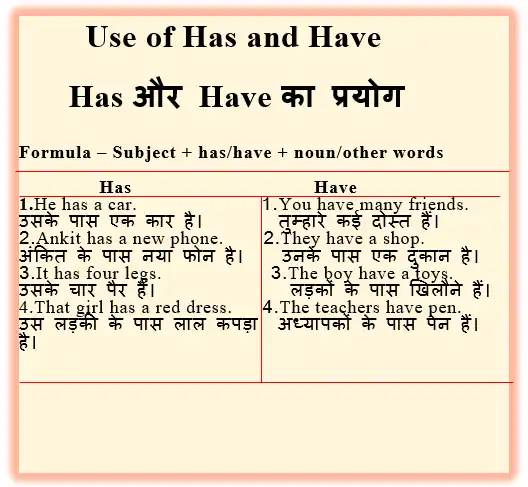
Use of “HAS” and “HAVE” in Hindi
• Has and Have का प्रयोग primary Auxiliary Verb की तरह करते हैं।
• Verb to have की Forms Has and have हैं।
• Simple Present tense में Has and have का प्रयोग Primary Auxiliary verb के रुप में करते हैं।
Has and Have Meaning in Hindi
Has – पास है, रखता है, रखती है।
Have – पास है, रखते हैं, रखते हो।
इस टेबल के अनुसार आप समझ पाएंगे कि Has and Have का प्रयोग Singular and Plural में कैसे किया जाता है?
| Person |
Singular |
Plural |
| First |
I have |
We have |
| Second |
You have |
You have |
| Third |
He has, She has, It has |
They have |
◕ Rules
Rule -1 Has का प्रयोग Singular Nouns या Singular Pronouns के साथ करते हैं।
Rule -2 Have का प्रयोग Plural Noun तथा Plural Pronouns के साथ करते हैं।
Rule -1 Has का प्रयोग Singular Nouns या Singular Pronouns के साथ करते हैं।
Example:
1. He has a car.
उसके पास एक कार है।
2. She has a book.
उसके पास एक किताब है।
3. It has four legs.
इसके चार पैर हैं।
4. Ram has a new phone.
राम के पास नया फ़ोन है।
5. Sita has a doll.
सीता के पास एक गुड़िया है।
6. This boy has a pen.
इस लड़के के पास एक पेन है।
7. That girl has a red dress.
उस लड़की के पास लाल कपड़ा है।
8. My father has a shop.
मेरे पिता के पास एक दुकान है।
9. The teacher has a laptop.
अध्यापक के पास लैपटॉप है।
10. The dog has a long tail.
कुत्ते की लंबी पूंछ है।
11. The cat has green eyes.
बिल्ली की हरी आंखें हैं।
12. The student has a note book.
छात्र के पास कॉपी है।
13. My sister has a problem.
मेरी बहन को एक समस्या है।
14. The house has a big garden.
उस घर में बड़ा बगीचा है।
15. This city has a big market.
उस शहर में बड़ा बाजार है।
16. That boy has a bicycle.
उस लड़के के पास साइकिल है।
17. The shopkeeper has a customer.
दुकानदार के पास एक ग्राहक है।
18. The doctor has a clinic.
डॉक्टर के पास एक क्लिनिक है।
19. The king has a golden crown.
राजा के पास सुनहरा मुकुट है।
20. The child has a toy.
बच्चे के पास खिलौना है।
Read Also
• Use of Used to • Use of Need to
• Active & Passive Voice • Use of Has & Have
• Use of Is/am/are • Number- Singular & Plural
Rule -2 Have का प्रयोग Plural Noun तथा Plural Pronouns के साथ करते हैं।
‘’not’’ जोड़कर नकारात्मक वाक्य बनाए जाते हैं।
Examples:
1. We have a big house.
हमारे पास एक बड़ा घर है।
2. We have some work today.
हमारे पास आज कुछ काम है।
3. You have a chance.
तुम्हारे पास एक मौका है।
4. You have two brothers.
तुम्हारे दो भाई हैं।
5. You have a problem.
तुम्हारे पास एक समस्या है।
6. They have a shop.
उनके पास एक दुकान है।
7. They have a big family.
उनका एक बड़ा परिवार है।
8. They have an idea.
उनके पास एक विचार है।
9. They have many books.
उनके पास कई किताबें हैं।
10. We have many friends.
हमारे कई दोस्त हैं।
11. The boys have toys.
लड़कों के पास खिलौने हैं।
12. The girls have red dresses.
लड़कियों के पास लाल कपड़े हैं।
13. The students have notebooks.
छात्रों के पास कॉपियां हैं।
14. The teachers have pens.
अध्यापकों के पास पेन हैं।
15. The children have chocolates.
बच्चों के पास चॉकलेट है।
16. The dogs have long tails.
कुत्तों की लंबी पूछें हैं।
17. The cats have shrap claws.
बिल्लियों की नुकीले पंजे हैं।
18. The farmers have fields.
किसानों के पास खेत हैं।
19. The shops have many custumers.
दुकानों के पास कई ग्राहक है।
20. The plyers have a match today.
खिलाड़ियों का आज एक मैच है।
Read Also
• Negative Sentence • Parts of Speech
• Active & Passive Voice • Use of Has & Have
• Use of Was & Were • Number- Singular & Plural
Affirmative Sentences of “Has” and “Have” in Hindi
Is, am, are का प्रयोग Affirmative Sentences में करना बहुत आसान है।
Examples:
1. He has a car.
उसके पास एक कार है।
2. She has a book.
उसके पास एक किताब है।
3. Ram has a new phone.
राम के पास नया फ़ोन है।
4. It has four legs.
उसके चार पैर हैं।
5. My mother has a bag.
मेरी माँ के पास एक बैग है।
6. This boy has a pen.
इस लड़के के पास एक पेन है।
7. That girl has a red dress.
उस लड़की के पास लाल कपड़ा है।
8. The dog has a long tail.
कुत्ते की लंबी पूंछ है।
9. We have a big house.
हमारे पास एक बड़ा घर है।
10. You have many friends.
तुम्हारे कई दोस्त हैं।
11. They have a shop.
उनके पास एक दुकान है।
12. The students have notebooks.
छात्रों के पास कॉपियां हैं।
13. The boy have a toys.
लड़कों के पास खिलौने हैं।
14. The girl have red dresses.
लड़कियों के पास लाल कपड़े हैं।
15. The teachers have pen.
अध्यापकों के पास पेन हैं।
Read Also
• Affirmative Sentence • Imperative Sentence
• Conditional Sentence • Exclamatory Sentence
Negative Sentences of “Has” and “Have” in Hindi
Have या Have के Negative Sentences बनाने के दो तरीके होते हैं।
1. Had and Have के बाद not लगाते हैं।
2. Singular subject के साथ does not have तथा Plural subject के साथ do not have का प्रयोग करते हैं।
➢ Has/Have Not – ज्यादातर Written English, formal context Present Perfect Tense में होता है।
➢ Does/Do not have – Spoken English, Daily conversation में होता है।
Examples:
1. He has not a car.
He does not have a car.
उसके पास कार नहीं है।
2. She has not a book.
She does not have a book.
उसके पास किताब नहीं है।
3. Ram has not a phone.
Ram does not have a phone.
राम के पास फ़ोन नहीं है।
4. It has not a tail.
It does not have a tail.
इसके पास पूछँ नहीं है।
5. My mother has not a bag.
My mother does not have a bag.
मेरे माँ के पास बैग नहीं है।
6. This boy has not a pen.
This boy does not have a pen.
इस लड़के के पास पेन नहीं है।
7. That girl has not a dress.
That girl does not have a dress.
उस लड़की के पास कपड़ा नहीं है।
8. The dog has not a collor.
The dog does not have a collar.
कुत्ते के पास कॉलर नहीं है।
9. We have not a big house.
We do not have a big house.
उसके पास बड़ा घर नहीं है।
10. You have not many friends.
You do not have many friends.
तुम्हारे पास कई दोस्त नहीं है।
11. They have not a shop.
They do not have a shop.
उनके पास दुकान नहीं है।
12. The students have not notebooks.
The students do not have notebooks.
छात्रों के पास कॉपियां नहीं है।
13. The boys have not toys.
The boys do not have toys.
लड़कों के पास खिलौने नहीं है।
14. The girls have not red dresses.
The girls do not have red dresses.
लड़कियों के पास लाल कपड़े नहीं हैं।
15. The teachers have not pens.
The teachers do not have pens.
अध्यापकों के पास पैन नहीं है।
Read Also
• Use of Has have • Negative Sentence
• Interrogative Sentence • Imperative Sentence
• Use of Is/am/are • Exclamatory Sentence
Interrogative Sentences of “Has” and “Have” in Hindi
First Type – yes – No Type Questions
Examples:
1. Has Ritu a notebook?
Does Ritu have a notebook?
क्या ऋतु के पास कॉपी है?
2. Have we a chance?
Do we have a chance?
क्या हमारे पास एक मौका है?
3. Has he a watch?
Does he have a watch?
क्या उसके पास घड़ी है?
4. Have they bikes?
Do they have bikes?
क्या उनके पास बाइक है?
5. Has Mohan a shop?
Does Mohan have a shop?
क्या मोहन की दुकान है?
6. Have you brothers?
Do you have brothers?
क्या तुम्हारे भाई हैं?
7. Has she a pen drive?
Does she have a pen drive?
क्या उसके पास पेन ड्राइव है?
8. Have we work?
Do we have work?
क्या हमारे पास काम है?
9. Has he a laptop?
Does he have a laptop?
क्या उसके पास लैपटॉप है?
10. Have they food?
Do they have food?
क्या उनके पास खाना है?
11. Has the farmer land?
Does the farmer have land?
क्या किसान के पास जमीन है?
12. Have she a cat?
Does she have a cat?
क्या उसके पास बिल्ली है?
13. Have the girls a toy?
Does the girls have a toy?
क्या उस लड़की के पास खिलौना है?
14. Have they tickets?
Do they have tickets?
क्या उनके पास टिकट है?
15. Has he a job?
Does he have a job?
क्या उनके पास नौकरी है?
Interrogative Negative Sentences of “Has” and “Have” in Hindi
Examples:
1. Has he not a mobile?
Does he not have a mobile?
क्या उनके पास मोबाइल नहीं है?
2. Have you not a bicycle?
Do you not have a bicycle?
क्या तुम्हारे पास साइकिल नहीं है?
3. Has she not a handbag?
Does she not have a handbag?
क्या उसके पास हैंडबैग नहीं है?
4. Has Amit not a computer?
Does Amit not have a computer?
क्या अमित के पास कंप्यूटर नहीं है?
5. Have they not a playground?
Do they not have a playground?
क्या उनके पास खेल का मैदान नहीं है?
6. Has your father not a scooter?
Does your father not have a scooter?
क्या आपके पिताजी के पास स्कूटर नहीं है?
7. Have we not a plan?
Do we not have a plan?
क्या हमारे पास कोई योजना नहीं है?
8. Has she not a gold ring?
Does she not have a gold ring?
क्या उसके पास सोने की अंगूठी नहीं है?
9. Has the students not a notebook?
Does the students not have a note book?
क्या छात्र के पास कॉपी नहीं है?
10. Have I not a chance?
Do I not have a chance?
क्या मेरे पास कोई मौका नहीं है?
11. Has he not a cricket bat?
Does he not have a cricket bat?
क्या उसके पास क्रिकेट बैट नहीं है?
12. Has Sita not a red dress?
Does Sita not have a red dress?
क्या सीता के पास लाल ड्रेस नहीं है?
13. Have you not an umbrella?
Do you not have am umbreela?
क्या तुम्हारे पास छतरी नहीं है?
14. Has the man not a bicycle?
Does the man not have a bicycle?
क्या उस आदमी के पास साइकिल नहीं है?
15. Have they not a library card?
Do they not have a library card?
क्या उनके पास लाइब्रेरी कार्ड नहीं है?
Read Also
• Use of Do & Does • Use of Had
• Use of These & Those • Use of This & That
• Use of Was & Were
Wh-Word Interrogative Sentences of “Has” and “Have” in Hindi
Examples:
1. What has a solution?
What does have a solution?
किसके पास हल है?
2. Who has a watch?
Who does have a watch?
किसके पास घड़ी है?
3. Who has the key?
Who does have the key?
किसके पास चाबी है?
4. When has he time?
When does he have time?
उनके पास समय कब है?
5. Where have they meetings?
Where do they meetings?
उनकी मीटिंग कहाँ होती है?
6. Why have we doubts?
Why do we have doubts?
हमारे पास संदेह क्यों है?
7. When has the teacher have a test?
When does the teacher have a test?
अध्यापक के पास टेस्ट कब है?
8. When have you a plan?
When do you have a plan?
तुम्हारे पास योजना कब है?
9. How many books has he?
How many books does he have?
उसके पास कितनी किताबें है?
10. How many friends have you?
How many frirends do you have ?
तुम्हारे कितने दोस्त है?
11. How much money has she?
How much money does she have?
उसके पास कितना पैसा है?
12. Which pen has ink?
Which pen does have ink?
किस पेन में स्याही है?
13. Which students has a laptop?
Which students does have a laptop?
किस छात्र के पास लैपटॉप है?
14. How many chances have we?
How many chances do we have?
हमारे पास कितने मौके हैं?
15. Which country has gold mines?
Which country does have gold mines?
किस देश में सोने की खान है?
Wh-Word Interrogative Negative Sentences of “Has” and “Have” in Hindi
Examples:
1. Why has he not a ticket?
Why does he not have a ticket?
उसके पास टिकट क्यों नहीं है?
2. Who has not a bicycle?
Who does not have a bicycle?
किसके पास साइकिल नहीं है?
3. When has she not free time?
When does she not have free time?
उसके पास खाली समय कब नहीं है?
4. Where has Ankit not a house?
Where does Ankit not have a house?
अंकित का घर कहाँ नहीं है?
5. Whose room has not a fan?
Whose room does not have a fan?
किसके कमरे में पंखा नहीं है?
6. How many pens have you not?
How many pens do you not have?
तुम्हारे पास कितने पैन नहीं है?
7. Why has the farmer not land?
Why does the farmer not have land?
किसान के पास जमीन क्यों नहीं है?
8. Which students has not a uniform?
Which students does not have a uniform?
किस छात्र के पास यूनिफॉर्म नहीं है?
9. Who has not a problem?
Who does not have a problem?
किसके पास समस्या नहीं है?
10. Why have we not a chance?
Why do we not have a chance?
हमारे पास मौका क्यों नहीं है?
11. Where has she not books?
Where does she not have books?
उसके पास किताबें कहाँ नहीं है?
12. Whose child has not shoes?
Whose child does not have shoes?
किसके बच्चे के पास जूते नहीं है?
13. How much knowedge has he not?
How much knowledge does he not have?
उसके पास इतना ज्ञान नहीं है?
14. When have they not work?
When do they not have work?
उनके पास काम कब नहीं है?
15. Why has Mohan not a computer?
Why does Mohan not have a computer?
मोहन के पास कंप्यूटर क्यों नहीं है?
Read Also
• Use of Do & Does
• Noun
• Active & Passive voice
• Singular & Plural Number
• Use of Use of Has & Have
Use of Has and Have In Present Perfect Tense in Hindi
Has and Have का use Present Perfect tense में Helping Verb के रुप में होता है।
Examples:
1. He has eaten food. उसने खाना खा लिया है।
2. She has completed her work.
उसने अपना काम पूरा कर लिया है।
3. It has rained heavily.
जोरदार बारिश हो चुकी है।
4. Ankit has bought a new car.
राम ने नई कार खरीद ली है।
5. The teacher has taught the lesson.
अध्यापक ने पाठ पढ़ा दिया है।
6. I have finished my homework.
मैंने अपना होमवर्क पूरा कर लिया है।
7. We have seen the Taj Mahal.
हमने ताजमहल देखा है।
8. They have started a new business.
उन्होंने नया व्यवसाय शुरू कर दिया है।
9. You have helped me a lot.
तुमने मेरी बहुत मदद की है।
10. Students have written the exam.
छात्रों ने परीक्षा लिख ली है।
Use of “Has” and “Have” in Passive Voice in Hindi
• Passive Voice में Has, Have को has been व Have been में बदलते हैं।
• Passive में हमेशा Has/Have + been + V3 का प्रयोग होता है।
• Object (Active का ) Passive का Subject बन जाता है।
Examples:
1.Active:
He has completed the work.
उसने काम पूरा कर लिया है।
Passive :
The work has been completed by him.
काम उसके द्वारा पूरा किया जा चुका है।
2.Active:
She has written a letter.
उसने पत्र लिखा है।
Passive :
A letter has been written by her.
पत्र उसके द्वारा लिखा गया है।
3.Active:
They have cleaned the room.
उन्होंने कमरा साफ किया है।
Passive :
The room has been cleaned by them.
कमरा उनके द्वारा साफ किया गया है।
4.Active:
I have finished my homework.
मैंने अपना होमवर्क पूरा कर लिया है।
Passive :
My homework has been finished by me.
मेरा होमवर्क मेरे द्वारा पूरा कर दिया गया है।
5.Active:
She has sung a song.
उसने गाना गाया है।
Passive :
A song has been sung by her.
गाना उसके द्वारा गाया गया है।
6.Active:
We have watched the movie.
हमने फ़िल्म देखी है।
Passive :
The movie has been watched by us.
फ़िल्म हमारे द्वारा देखी गई है।
7.Active:
The teacher has taught the lesson.
अध्यापक ने पाठ पढ़ाया है।
Passive :
The lesson has been taught by the teacher.
पाठ अध्यापक द्वारा पढ़ाया गया है।
8.Active:
Ankit Has bought a new car.
अंकित ने नई कार खरीदी है।
Passive :
A new car has been bought by ankit
नई कार अंकित द्वारा खरीदी गई है।
9.Active:
They have won the match.
उन्होंने मैच जीत लिया है।
Passive :
The match has been won by them.
मैच उनके द्वारा जीता गया है।
10.Active:
I have solved the problem.
मैंने समस्या हल की है।
Passive :
The problem has been solved by me.
समस्या मेरे द्वारा हल की गई है।
Read Also
• Affirmative Sentence • Negative Sentence
• Pronoun • Preposition
• Verb • Adverb
• Tenses • Past Tense
• Present Tense • Future Tense