Present tense (वर्तमान काल)
Definition -
Present Tense is the form of a verb that shows an action happening now, something that happens regularly, or a fact that is always true.
It is used to talk about what is going on at the present time.
परिभाषा -
Present Tense - वर्तमान काल वह काल है जो किसी क्रिया के वर्तमान समय में होने, बार-बार होने या सदैव सत्य रहने को दर्शाता है। इसका प्रयोग हम तब करते हैं जब कार्य अभी हो रहा हो या रोज़ होता हो, वर्तमान काल कहलाता है।
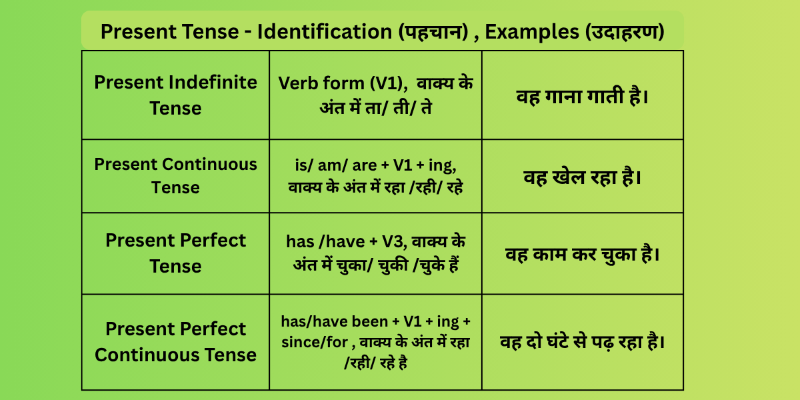
वर्तमान काल के वाक्यों के अंत में रहा है, रही है, रहा हूँ, चुका है, चुकी है, चुकी हैं, लिया है, दिया है, दिया हूँ, आदि शब्द आते हैं।
Examples :
1. I go to school every day.
मैं हर दिन स्कूल जाता हूँ।
2. She plays the piano.
वह पियानो बजाती है।
3. They read books daily.
वे रोज़ किताबें पढ़ते हैं।
4. The sun rises in the east.
सूरज पूर्व दिशा में उगता है।
5. He drinks milk every morning.
वह हर सुबह दूध पीता है।
6. We watch TV in the evening.
हम शाम को टीवी देखते हैं।
7. My father works in an office.
मेरे पिता एक दफ्तर में काम करते हैं।
8. You speak the truth.
तुम सच बोलते हो।
9. I am reading a book.
मैं एक किताब पढ़ रहा हूँ।
10. She is cooking food.
वह खाना बना रही है।
11. They are playing football.
वे फुटबॉल खेल रहे हैं।
12. He is writing a letter.
वह एक पत्र लिख रहा है।
13. We are watching a movie.
हम एक फिल्म देख रहे हैं।
14. The teacher is teaching in the class.
शिक्षक कक्षा में पढ़ा रहे हैं।
15. It is raining outside.
बाहर बारिश हो रही है।
16. I am talking to my friend.
मैं अपने दोस्त से बात कर रहा हूँ।
17. I have finished my homework.
मैंने अपना होमवर्क पूरा कर लिया है।
18. She has cooked the food.
उसने खाना बना लिया है।
19. They have gone to school.
वे स्कूल जा चुके हैं।
20. He has written a poem.
उसने एक कविता लिखी है।
21. We have completed our project.
हमने अपना प्रोजेक्ट पूरा कर लिया है।
22. You have washed the clothes.
तुमने कपड़े धो लिए हैं।
23. The sun has risen.
सूरज उग चुका है।
24. I have read that story.
मैंने वह कहानी पढ़ ली है।
25.I have been studying for two hours.
मैं दो घंटे से पढ़ रहा हूँ।
26. She has been cooking since morning.
वह सुबह से खाना बना रही है।
27. They have been working here for a long time.
वे यहाँ लंबे समय से काम कर रहे हैं।
28. He has been playing cricket since 5 o’clock.
वह पाँच बजे से क्रिकेट खेल रहा है।
29. We have been waiting for you for ten minutes.
हम दस मिनट से तुम्हारा इंतज़ार कर रहे हैं।
30. It has been raining since night.
रात से बारिश हो रही है।
उपरोक्त सभी वाक्य वर्तमान काल के उदाहरण हैं इन वाक्यों के अंत में रहा है, रही है, हो रहा है, आदि शब्द आ रहे हैं अथार्त आप ने समझ लिया होगा कि वर्तमान काल किसे कहते हैं। अब आपको वर्तमान काल के चारों भागों के बारे में नीचे विस्तार से समझाया गया है।निम्नलिखित की परिभाषा तथा उदाहरण को ध्यान से पढ़ें और सीखें।
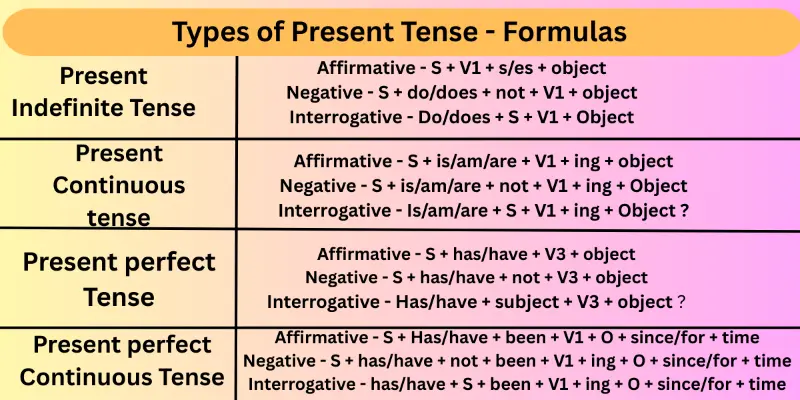
Parts of Present tense :
वर्तमान काल के भाग:
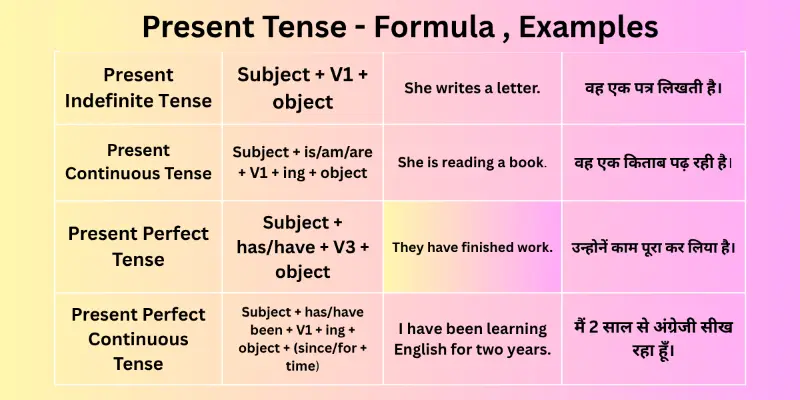
1. Present Indefinite Tense (Simple Present Tense) (अनिश्चित वर्तमान काल)
2. Present Continuous (Progressive) Tense (वर्तमान अपूर्ण काल)
3. Present Perfect Tense (वर्तमान पूर्णकाल)
4. Present Perfect Continuous Tense (वर्तमान पूर्ण सतत्काल)
नीचे आपको सभी भागों के प्रत्येक भाग के परिभाषा, उदाहरण अंग्रेजी और हिंदी में बताया गया है ताकि आपको दोनों भाषाओं में वर्तमान काल के बारे में पूर्ण जानकारी प्राप्त हो।
1. Present Indefinite Tense (अनिश्चित वर्तमान काल)
Definition -
The Present Indefinite Tense (Simple Present Tense) expresses an action that happens regularly, habitually, or universally. It is also used to express general truths, fixed arrangements, and feelings.
In this tense, the first form of the verb (V1) is used, and with He, She, It or singular noun, we add ‘s’ or ‘es’ to the verb.
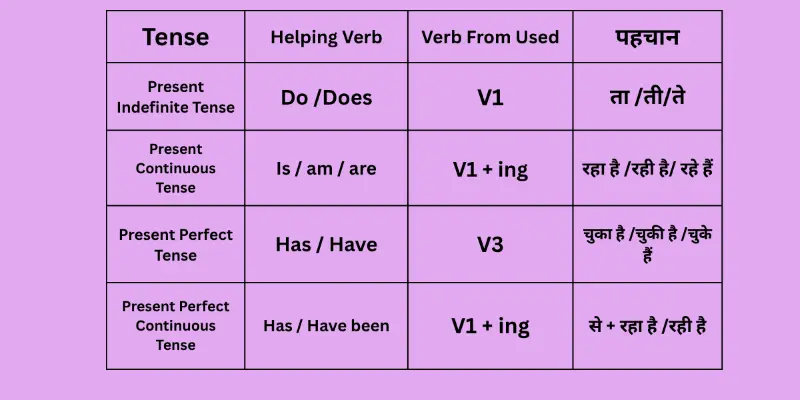
Helping Verb: Do / Does (used in negative or interrogative sentences)
परिभाषा -
Present Indefinite Tense (साधारण वर्तमान काल) उस कार्य को दर्शाता है जो नियमित रूप से होता है, आदतन किया जाता है या हमेशा सत्य होता है।
यह सामान्य सत्य, आदतें, दिनचर्या और स्थायी बातें बताने के लिए प्रयोग किया जाता है। इन वाक्यों के अंत में ता है, ती है, ता हूँ आदि शब्द आते हैं।
इसमें क्रिया की पहली रूप (V1) का प्रयोग होता है, और He, She, It या एकवचन संज्ञा के साथ ‘s’ या ‘es’ लगाया जाता है।
सहायक क्रिया (Helping Verb): Do / Does (नकारात्मक या प्रश्नवाचक वाक्य में)
Read More About Present Indefinite Tense (अनिश्चित वर्तमान काल)
Examples:
1. I go to school every day.
मैं हर दिन स्कूल जाता हूँ।
2. She plays the piano.
वह पियानो बजाती है।
3. They read newspapers in the morning.
वे सुबह अखबार पढ़ते हैं।
4. He drinks tea.
वह चाय पीता है।
5. The sun rises in the east.
सूरज पूर्व दिशा में उगता है।
6. You speak politely.
तुम विनम्रता से बोलते हो।
7. My father works in an office.
मेरे पिता एक दफ्तर में काम करते हैं।
8. We watch TV at night.
हम रात को टीवी देखते हैं।
9. The baby cries loudly.
बच्चा ज़ोर से रोता है।
10. Birds sing sweet songs.
पक्षी मधुर गीत गाते हैं।
Read Also
• Parts of Speech
• Noun • Pronoun
• Verb • Adverb
• Conjunction • Interjection
• Preposition • Adjective
2. Present Continuous Tense (वर्तमान अपूर्ण काल)
Definition -
The Present Continuous Tense is used to express an action that is happening right now or is going on at the present time.
It can also show a temporary action or an action that is currently in progress.
In this tense, we use the helping verbs am / is / are with the present participle (verb + ing) form.
परिभाषा -
Present Continuous Tense (वर्तमान अपूर्ण काल) उस कार्य को दर्शाता है जो अभी हो रहा है या इस समय जारी है।
इन वाक्यों के अंत में रहा है, रही है आदि शब्द आते हैं।
इसका प्रयोग चल रही या अस्थायी क्रिया को बताने के लिए किया जाता है।
इसमें am / is / are के साथ क्रिया की ‘ing’ रूप लगाई जाती है।
Read More About Present Continuous Tense (वर्तमान अपूर्ण काल)
Example:
1. I am reading a book.
मैं एक किताब पढ़ रहा हूँ।
2. She is cooking food.
वह खाना बना रही है।
3. They are playing football.
वे फुटबॉल खेल रहे हैं।
4. He is writing a letter.
वह एक पत्र लिख रहा है।
5. We are watching TV.
हम टीवी देख रहे हैं।
6. You are talking too loudly.
तुम बहुत ज़ोर से बात कर रहे हो।
7. It is raining outside.
बाहर बारिश हो रही है।
8. The teacher is teaching the class.
शिक्षक कक्षा में पढ़ा रहे हैं।
9. I am listening to music.
मैं संगीत सुन रहा हूँ।
10. The children are laughing.
बच्चे हँस रहे हैं।
Read Also
• Model Verb
• Use of Can & Could • Use of Dare
• Use of May & Might • Use of Must & Ought
• Use of Shall & Will • Use of Should & Would
• Use of Used to • Use of Need to
3. Present Perfect Tense (वर्तमान पूर्णकाल)
Definition -
The Present Perfect Tense is used to express an action that has just been completed or has occurred in the past but is connected to the present.
It shows the completion of an action.
In this tense, we use has / have with the past participle (verb’s third form, V3).
परिभाषा -
Present Perfect Tense (वर्तमान पूर्ण काल) उस क्रिया को दर्शाता है जो अभी-अभी पूरी हुई है या जिसका प्रभाव वर्तमान में दिखाई देता है।
इन वाक्यों के अंत में कर लिया है, दिया है, गया है, चुका है आदि शब्द आते हैं।
इसमें हम has / have के साथ क्रिया की तीसरी रूप (V3) का प्रयोग करते हैं।
Read More About Present Perfect Tense (वर्तमान पूर्णकाल)
Examples:
1. I have visited the Taj Mahal twice.
मैंने दो बार ताजमहल का दौरा किया है।
2. She has bought a new mobile phone.
उसने नया मोबाइल फोन खरीदा है।
3. They have cleaned the classroom.
उन्होंने कक्षा की सफाई कर दी है।
4. He has repaired his bicycle.
उसने अपनी साइकिल ठीक कर ली है।
5. We have learned many new words today.
हमने आज कई नए शब्द सीखे हैं।
6. You have improved your handwriting.
तुमने अपनी लिखावट सुधार ली है।
7. The teacher has checked our notebooks.
शिक्षक ने हमारी कॉपियाँ जाँच ली हैं।
8. My friend has won the race.
मेरे दोस्त ने दौड़ जीत ली है।
9. It has stopped raining now.
अब बारिश रुक गई है।
10. The children have decorated the room.
बच्चों ने कमरे को सजा दिया है।
Read Also
• Sentence & Structure of Sentence • Parts of Sentence
• Affirmative Sentence • Negative Sentence
• Interrogative Sentence • Conditional Sentence
• Exclamatory Sentence • Imperative Sentence
4. Present Perfect Continuous Tense (वर्तमान पूर्ण सतत्काल)
Definition -
The Present Perfect Continuous Tense is used to express an action that started in the past and is still continuing in the present.
It shows the duration or continuity of an ongoing action.
In this tense, we use has been / have been with the verb + ing, and usually add since (for point of time) or for (for period of time).
परिभाषा -
Present Perfect Continuous Tense (वर्तमान पूर्ण निरंतर काल) उस क्रिया को दर्शाता है जो अतीत में शुरू हुई थी और अब तक जारी है।
इन वाक्यों के अंत में रहा है, रही है, रहे हैं आदि शब्द आते हैं।
इस काल से हमें यह पता चलता है कि कोई कार्य कब से या कितनी देर से चल रहा है।
इसमें has been / have been के साथ क्रिया की ‘ing’ रूप और since / for का प्रयोग किया जाता है।
Read More About Present Perfect Continuous Tense (वर्तमान पूर्ण सतत्काल)
Examples:
1. I have been studying for two hours.
मैं दो घंटे से पढ़ रहा हूँ।
2. She has been cooking since morning.
वह सुबह से खाना बना रही है।
3. They have been working here for five years.
वे पाँच वर्षों से यहाँ काम कर रहे हैं।
4. He has been playing cricket since 4 o’clock.
वह चार बजे से क्रिकेट खेल रहा है।
5. We have been waiting for you for ten minutes.
हम दस मिनट से तुम्हारा इंतज़ार कर रहे हैं।
6. You have been talking on the phone for half an hour.
तुम आधे घंटे से फोन पर बात कर रहे हो।
7. It has been raining since night.
रात से बारिश हो रही है।
8. The teacher has been teaching in this school for ten years.
शिक्षक दस साल से इस स्कूल में पढ़ा रहे हैं।
9. My brother has been learning guitar for three months.
मेरा भाई तीन महीनों से गिटार सीख रहा है।
10. The children have been playing outside since evening.
बच्चे शाम से बाहर खेल रहे हैं।
Read Tense and There Types
• Tense
• Present Tense
• Present Indefinite Tense • Present continuous tense
• Present Perfect Tense • Present Perfect Continuous Tense
• Past Tense
• Past Indefinite Tense • Past continuous tense
• Past Perfect Tense • Past Perfect Continuous Tense
• Future Tense
• Future Indefinite Tense
• future continuous tense • Future Perfect Tense
• Future Perfect Continuous Tense