PREPOSITION (पूर्वसर्ग)
Definition
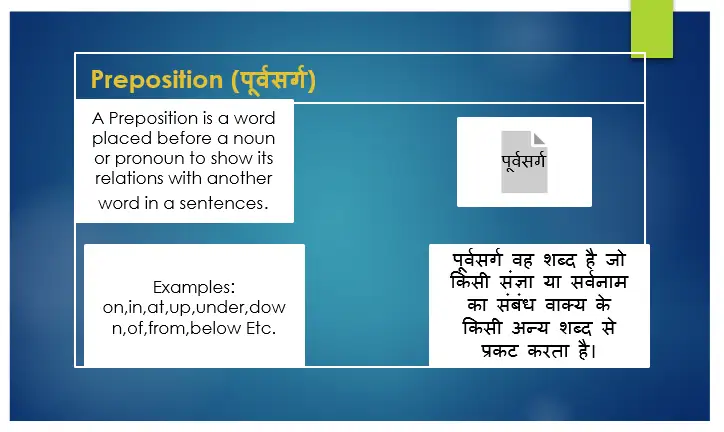
A prepositions is a word placed before a noun or pronoun to show its relations with another word in a sentence.
It expresses relations of place, time, cause, purpose, means, manner, instrument, possession, contrast, condition etc.
A Preposition shows the relation of a noun or pronoun with other words in the sentence.
पऱिभाषा
वह अव्यय (शब्द) जो किसी संज्ञा या सर्वनाम के पहले आकर उसके और वाक्य के अन्य शब्दों के बीच बताता है, उसे पूर्वसर्ग कहते हैं।
यह अक्सर स्थान, समय, दिशा, कारण आदि बताने के लिए प्रयोग किया जाता है।
पूर्वसर्ग वह शब्द है जो किसी संज्ञा या सर्वनाम का संबंध वाक्य के किसी अन्य शब्द से प्रकट होता है।
Read Also
• Tense
• Present Tense
• Past Tense
• Future tense Tense
Example (उदाहरण)-
1.The book is on the table.
किताब मेज़ पर रखी है।
2.He will come at 7 p.m.
वह शाम 7 बजे आएगा ।
3.She goes to school every day.
वह रोज़ स्कूल जाती है।
4.The cat is under the chair.
बिल्ली कुर्सी के नीचे है।
5.The boy ran across the road.
लड़का सड़क के पार भागा।
6.He is sitting between his friends.
वह अपने दोस्तों के बीच बैठा है।
7.They came from Mumbai.
वे मुंबई से आए।
8.She writes with a pen.
वह पेन से लिखती है।
9.The picture is above the bed.
तस्वीर बिस्तर के ऊपर है।
10.I was born in 2005.
मेरा जन्म 2005 में हुआ था।
उपयुक्त वाक्यों में on, at, to, under, across, between, from, with, above, in Preposition (पूर्वसर्ग) हैं।
Read Also
• Present Indefinite Tense
• Present Perfect Tense
• Present Continuous Tense
• Present Perfect Continuous Tense
• Meaning of Preposition In Hindi
Preposition का हिंदी अर्थ – पूर्वसर्ग होता है।
Preposition को संबंधसूचक अव्यय भी कहते हैं।
Read Also
• Past Indefinite Tense
• Past Perfect Tense
• Past Continuous Tense
• Past Perfect Continuous Tense
Kinds of Prepositions (पूर्वसर्ग के भेद)
Preposition को कार्य के आधार पर निम्नलिखित भागों में बांटा जा सकता है।
1.Preposition of Place / position (स्थान के पूर्वसर्ग)
2.Prepositions of Time (समय के पूर्वसर्ग)
3.Prepositions of Direction / Movement (दिशा के पूर्वसर्ग )
4.Prepostions of Cause/ Reason/ Purpose (कारण के पूर्वसर्ग )
5.Prepositions of Manner (रीति बताने वाला पूर्वसर्ग)
6.Prepositions of Measure, Standard, Rate, Value (मूल्य, परिमाण, माप के पूर्वसर्ग)
7.Prepositions of Contrast / Concession (विरोध, तुलना, स्वीकार के पूर्वसर्ग)
8.Prepositions of condition/Support (शर्त, समर्थन के पूर्वसर्ग)
Types According to From (रचना के आधार पर पूर्वसर्ग के प्रकार )
1.Simple Prepositions (सरल पूर्वसर्ग)
2.Compound Prepositions (संयुक्त पूर्वसर्ग) –
3.Pharse Prepositions (सामूहिक पूर्वसर्ग)
4.Participle Prepositions (कृंदतपूर्वसर्ग) –
Read also
• Parts of speech
• Noun
• Pronoun
• Verb
• Adverb
• Adjective
1.Preposition of Place/position (स्थान के पूर्वसर्ग)
Definition:
A Preposition of Place shows the position or location of a person or thing.
It tells where something or someone is.
Shows the location or position of something.
परिभाषा-
स्थान सूचक पूर्वसर्ग वे शब्द होते हैं जो किसी वस्तु या व्यक्ति का स्थान या स्थिति बताते हैं, यह बताते हैं कि कोई व्यक्ति या वस्तु कहाँ है।
किसी स्थान व स्थिति को दर्शाता है।
स्थान बताने वाले शब्द Examples:
is, on, at, under, over, above, below, between, among, behind, near, beside
उदाहरण-
में, पर, ऊपर, बीच, पास, पीछे, आगे, अंदर, बाहर, आदि को Preposition of Place कहा जाता है।
Examples:
1.The pen is in the bag.
कलम बैग में है।
2.She sit between her friends.
वह अपनी सहेली के बीच में बैठी।
3.The bottle is on the table.
बोतल मेज़ पर है।
4.The rabbit is under the chair.
खरगोश कुर्सी के नीचे है।
5.The picture is above the mirror.
तस्वीर आईने के ऊपर है।
6.He is at home now.
वह अब घर पर है।
7.The dog is behind the gate.
कुत्ता दरवाजे के पीछे है।
8.The car in front of the hose.
कार घर के सामने है।
9.The park is near my house.
पार्क मेरे घर के पास है।
10.He is standing opposite the school.
वह स्कूल के सामने खड़ा है।
उपयुक्त वाक्यों में on, under, at, above, behind, in, between, in front of, near, opposite Preposition of Place (स्थान सूचक पूर्वसर्ग) हैं।
Read Also
• Future Indefinite Tense
• Future Perfect Tense
• Future Continuous Tense
• Future Perfect Continuous Tense
2.Prepositions of Time (समय के पूर्वसर्ग)
Definition:
A Preposition of Time is a word that shows the relationship of time between a noun or pronoun and another word in the sentence.
It tells when something happens – at what time, on what day, in which month, season, year, or period.
परिभाषा-
समयवाचक संबंध सूचक यह बताता है कि जो समय के संबंध में दर्शाता है यह बताता है कि कोई कार्य कब हुआ, कब हो रहा है, या कब होगा।
या
जो समय को दिखाता है और कुछ घटित होना दिखाता है।
Examples:
at, on, in, during, since, for, from, till/until, by, before, after, within
उदाहरण-
पर, से, तक, के बाद, के पहले, दौरान आदि।
Examples:
1.She was born on Monday.
वह सोमवार को पैदा हुई थी।
2.I have been waiting since morning.
मैं सुबह से इंतजार कर रहा था।
3.We eat dinner at night.
हम रात में खाना खाते हैं।
4.It shows in winter.
सर्दियों में बर्फ़ गिरती है।
5.Wash your hands before dinner.
खाना खाने से पहले हाथ धो लो।
6.He called me after two hours.
उसने मुझे 2 घंटे बाद फ़ोन किया।
7.We have known each other for a long time.
हम एक दूसरे को लंबे समय से जानते हैं।
8.He ‘ll be back by next week.
वह अगले हफ्ते तक वापस आ जाएगा।
9.We met during the meeting.
हम मीटिंग के दौरान मिले।
10.You must reply within two days.
तुम्हें दो दिनों के भीतर जवाब देना होगा।
उपयुक्त वाक्यों में on, since, at, in, before, after, for, by, during, within Preposition of Time है।
Read also
• Sentence & Types of Sentence
• Affirmative Sentence
• Conditional Sentence
3.Prepositions of Direction/Movement (दिशा के पूर्वसर्ग)
Definition:
A Preposition of Direction/Movement shows the movement from one place to another or the direction in which someone or something moves.
It tells where something or someone is going or moving towards.
Or
Show movement from one place to another.
परिभाषा-
दिशा के पूर्वसर्ग वे शब्द होते हैं जो किसी व्यक्ति या वस्तु की दिशा या गति को दर्शाते हैं। यह बताते हैं कि कोई व्यक्ति या वस्तु किधर जा रही है, किस दिशा में चल रही है।
या
एक स्थान से दूसरे स्थान पर गति दिखाने वाले क्रियापद गमन या संचलन हैं।
Examples:
to, into, onto, towards, from, out, of, down, up, across, along, through, onto
उदाहरण –
की ओर, तक, से, में, की तरफ़ आदि।
Examples:
1.He went to the park.
वह पार्क में गया ।
2.The child fell into the river.
बच्चा नदी में गिर गया।
3.He jumped over the wall.
उसने दीवार के ऊपर से छलांग लगाई।
4.They are walking along the beach.
वे समुद्र तट के किनारे - किनारे चल रहे हैं।
5.She is moving towords the door.
वह दरवाजे की ओर जा रही है।
6.The cat came out of the box.
बिल्ली डिब्बे से बाहर आई।
7.We drove through the forest.
हम जंगल के आरपार गाड़ी चलाकर गयें।
8.He went up the mountain.
वह पहाड़ पर चढ़ गया।
9.The dog jumped onto the bed.
कुत्ता बिस्तर पर कूद गया।
10.The car went past my house.
कार मेरे घर के आगे से निकल गई।
उपयुक्त वाक्यों में into, over, along, towards, out of, through, up, onto, past Preposition of Direction (दिशा के पूर्वसर्ग) है।
4.Prepostions of Cause/ Reason/ Purpose (कारण के पूर्वसर्ग)
Definition:
A Preposition of Cause/Reason/Purpose isa word that shows why something happens – it express the cause, resone, purpose of an action or situation.
परिभाषा-
कारण के पूर्वसर्ग वह शब्द होते हैं जो यह बताते हैं कि कोई कार्य क्यों हुआ, उसका कारण या उद्देश्य क्या है।
या
जो कारण, उद्देश्य या मकसद को दिखाते है।
Examples:
because of, due to, owing to, for, from, of, through
उदाहरण –
के कारण, की वजह से, हेतु, लिए, से आदि।
Examples:
1.He could not attend the class because of illness.
वह बीमार होने के कारण कक्षा से अनुपस्थित था।
2.The match was cancelled due to rain.
बारिश की वजह से मैच रद हो गया।
3.Owing to the strike, offices were closed.
हड़ताल के कारण दफ्तर बंद थे।
4.She cried out of happiness.
वह खुशी के कारण रो पड़ीं।
5.The teacher punished him for being late.
शिक्षक ने उसे देर से आने के कारण दंड दिया।
6.The baby was smiling with joy.
बच्चा खुशी के कारण मुस्कुरा रहा था।
7.He left his job for the shake of peace.
उसने शांति की खातिर नौकरी छोड़ी।
8.The old man died from heart attack.
बूढ़े आदमी की दिल के दौरे से मृत्यु हुई।
9.They won the match thanks to teamwork.
उन्होंने टीम वर्क की वजह से मैच जीता।
10.The event was postponed on account of rain.
कार्यक्रम बारिश के कारण स्थगित किया गया।
उपयुक्त वाक्यों में because of, due to, owing to, out of, for, with, for the sake of, from, thanks to, on account of Preposition of Cause/Reason/Purpose (कारण के उपसर्ग) है।
Read also
• Use of Is/am/are
• Use of Was & Were
• Use of Has & Have
• Use of Had
5.Prepositions of Manner (रीति बताने वाला पूर्वसर्ग)
Definition:
A Preposition of Manner shows how or in what way an action happens.
It tells the manner, style, or methoud in which something is done.
परिभाषा-
रीति बताने वाला पूर्वसर्ग वह होता है जो यह बताता है कि कोई कार्य कैसे (किस रीति से/ किस प्रकार से) किया गया है यह कार्य करने की विधि, तरीके या ढंग को दर्शाता है।
जैसे – like, with, by
Examples:
1.The letter was written with a pen.
पत्र पेन से लिखा गया था।
2.He was punished by the teacher.
वह शिक्षक द्वाराद्वारा दंडित किया गया था।
3.She behave like a child.
वह बच्चे की तरह व्यवहार कर रही थी।
6.Prepositions of Measure, Standard, Rate, Value (मूल्य, परिमाण, माप के पूर्वसर्ग)
Definition:
Prepositions of Measure, Stabdaed, rate, or Value are words that show:
• Quantity, extent or degree of something
• Comparison to a standard
• Rate or value of something
They tell us how much, to what standard, or at what rate something is measured or valued.
परिभाषा:
वे संबंध सूचक अव्यव होते हैं जो यह बताते हैं किसी चीज़ की मात्रा, सीमा या स्तर । किसी मानक , स्तर के अनुसार तुलना । किसी चीज़ का दर या मूल्य। यह बताते हैं कि कोई चीज़ कितनी, किस दर से, या किस मानक पर मापी या मूल्यांकित की जाती है।
Examples:
by, at, for, to, of, per,over
उदाहरण-
के हिसाब से, प्रति दर
Examples:
1.Eggs are sold by the dozen.
अंडे दर्जन के हिसाब से बेचे जाते हैं।
2.Apples are available at 20 rupees a kilo.
सेब 20 रुपये किलो मिल रहा है।
3.I drank of glass of water.
मैंने एक गिलास पानी का पिया।
4.Gold is measured in grams.
सोना ग्राम में मापा जाता है।
5.The bag cots $30 for a price.
बैंक की कीमत एक पीस के लिए $30 है।
6.The box weight over 20kg.
डिब्बे का वजन 20 किलोग्राम से अधिक है।
7.Prepositions of Contrast / Concession (विरोध, तुलना, स्वीकार के पूर्वसर्ग)
Definition:
A Preposition of Contrast / Concession shows that two ideas are different , opposite or contradictory.
It express contrast or unexpected result despite certain conditions.
परिभाषा:
ये शब्द होते हैं जो यह दर्शाते हैं कि दो विचार, तथ्य या स्थिति अलग या विरोधाभासी है। ये बताते हैं कि किसी स्थिति के बावजूद दूसरा कार्य या परिणाम हुआ।
Examples:
despite, in spite of, contrary to, unlike, against, contrary to,different from, eathar than, except for Etc.
उदाहरण –
के बावजूद, के विरुद्ध, के विपरीत, होते हुए भी आदि।
Examples:
1.He came to school in spite of illness.
वह बीमारी के बावजूद स्कूल आया ।
2.The movie was dull despite the big star
Cast.
बड़ी स्टार कास्ट के बावजूद फिल्म फीकी थी।
3.Unlike his father, he is very friendly.
अपने पिता के विपरीत, वह बहुत दोस्ताना हैं।
4.His opinion is different from mine.
उसकी राय मेरे से अलग है।
5.I prefer walking rather than taking a bus.
मैं बस लेने के बजाय पैदल चलना पसंद करता हूँ।
8.Prepositions of condition / Support (शर्त, समर्थन के पूर्वसर्ग)
Definition
Condition: under what circumstances something happens.
Suppot: by what means or with whose help something is done.
परिभाषा :
शर्त या समर्थन दर्शाने वाले पूर्वसर्ग - किसी कार्य की होने की परिस्थिति, किसी कार्य को किस की सहायता से किया गया दर्शाते हैं।
Examples:
but for, except for, in case of , for the sake of Etc.
उदाहरण –
के बिना, के सिवा, की स्थिति में, के लिए आदि।
Examples:
1. But for your help, I would have failed.
लेकिन आपकी मदद के बिना मैं असफल हो जाता।
2.Take an umbrella in case of rain.
बारिश होने की स्थिति में छाता साथ रखें।
3.Everything was done according to the rules.
पिकनिक मौसम पर निर्भर करेगी।
Types According to From (रचना के आधार पर पूर्वसर्ग के प्रकार )
रचना के आधार पर, पूर्वसर्ग निम्नलिखित प्रकार के होते हैं-
1.Simple Prepositions (सरल पूर्वसर्ग)
Definition:
A Simple Preposition is a single – word preposition that shows the relationship between a noun or pronoun and another word in a sentence.
It usually indicates: place, time, direction, cause, manner, or agent.
परिभाषा:
सरल सम्बंध सूचक एक शब्द वाला सम्बंध सूचक अव्यव होता है जो संज्ञा या सर्वनाम और वाक्य के अन्य शब्दों के बीच संबंध दिखाता है। यह स्थान, समय, दिशा, कारण, तरीका को दर्शाता है।
जैसे- in, on, at, to, for, by, with, up, off, from (में, पर, से, तक, को, का) आदि।
Examples:
1.She sat on the chair.
वह कुर्सी पर बैठी।
2.The cat is hiding under the bed.
बिल्ली बिस्तर के नीचे छिपी हुई है।
3.He will arrive at the station soon.
वह जल्द ही स्टेशन पर पहुंचेगा।
4.They succeeded by working hard.
उन्होंने कड़ी मेहनत करके सफलता पाई।
5.The letter was written with care.
पत्र ध्यान से लिखा गया।
6.She moved from room to room.
वह कमरे से कमरे में चली।
7.I am going to the market.
मैं बाजार जा रहा हूँ।
8.This present is for my brother.
यह तोहफा मेरी माँ के लिए है।
9.The legs of the table are strong.
मेज के पैर मजबूत है।
10.We talked about our plans.
हमने अपनी योजनाओं के बारे में बात की।
उपयुक्त वाक्यों में on, under, at, by, with, from, to, for, of, about Single preposition है।
2.Compound Prepositions (संयुक्त पूर्वसर्ग) –
Definition:
A Compound Preposition is made up of two or more words that together act as a single preposition.
It shows the relationship of a noun or pronoun with another word in a sentence.
परिभाषा:
संयुक्त पूर्वसर्ग दो या दो से अधिक शब्दों से बनता है, जो मिलकर एक संबंधसूचक अव्यय का कार्य करते हैं,
यह संज्ञा या सर्वनाम और वाक्य के अन्य शब्दों के बीच संबंध दर्शाता है।
जैसे - inside, outside, without, within, upon, in
to (के ऊपर, के नीचे, के लिए, के कारण)
Examples:
1.Because of the heavy rain, the match was postponed.
भारी बारिश के कारण मैच स्थगित कर दिया गया।
2.He succeeded in spite of difficulties.
उसे कठिनाइयों के बावजूद सफलता पाई।
3.On account of his illness, he couldn’t attend the class.
उसकी बिमारी के कारण वह कक्षा में उपस्थित नहीं हो सका।
4. She sat in front of the teacher.
वह शिक्षक के सामने बैठी।
5.in addition to his studies, he does sports.
पढ़ाई के अलावा वह खेलों में भी हिस्सा लेता है।
उपयुक्त वाक्यों में because of, in spite of, on account of, in front of, in addition to Compound Preposition है।
Read also
• Gender
• Active voice & Passive voice
• Model Auxiliary-verb
3.Pharse Prepositions (सामूहिक पूर्वसर्ग)
Definition
A Phrase preposition is a group of words that acts as a single preposition to show the relationship of a noun or pronoun with other words in a sentence.
It usually contains two, or more words and can show place, time, cause, manner, or reason.
परिभाषा
वाक्यांश पूर्वसर्ग वह शब्दों का समूह है जो मिलकर एक संबंध सूचक अव्यय का कार्य करता है यह किसी संज्ञा या सर्वनाम और वाक्य के अन्य शब्दों के बीच संबंध दर्शाता है। यह आमतौर पर दो या दो से अधिक शब्दों से बना होता है। यह स्थान, समय, कारण, रीति, उद्देश्य दर्शा सकता है।
Examples:in front of, because of, instead of, in spite of(की ओर से, के बिना, की मदद से, के संबंध में) आदि।
Examples:
1.in spite of difficulties, he completed the project.
कठिनाइयों के बावजूद उसने परियोजना पूरी की।
2.The bank is closed On account of a holiday.
बैंक छुट्टी के कारण बंद है।
3.He solved the problem by means of a calculator.
उसने समस्या कैलकुलेटर के माध्यम से हाल की।
4.in addition to his homework , he did the chores.
अपने होमवर्क के अलावा उसने घर के काम भी किया।
5.Stant in front of the mirror.
दर्पण के सामने खड़े हो जाओ।
6.Ahead of schedule, the project was completed.
तय समय से पहले परियोजना पूरी हो गई।
7.Apart from his salary, he earns from investments.
अपनी तनख्वाह के अलावा वह निवेश से भी कम आता है।
8.By virtue of her hard work, she got promotion.
अपनी मेहनत के कारण उसे पदोन्न्ति मिली।
9.Inaccordance with the rules, everyone must wear a uniform.
नियमों के अनुसार सभी को यूनिफॉर्म पहनना अनिवार्य है।
10. I am speaking on behalf of the entire team.
मैं पूरी टीम की ओर से बोल रहा हूँ।
उपयुक्त वाक्यों में in spite of, on account of, ny means of, in addition to, in front of, Ahead of, Apart from, By virtue of, in accordance with, on behalf of Phrase preposition है।
Read also
• Use of Used to
• Use of Need to
• Use of Dare
4.Participle Prepositions (कृंदतपूर्वसर्ग) –
Definition:
A Partciple Preposition is a word that is originally a participle (verb + ing or past participle form) but is used as a preposition to show the relation of a noun or pronoun to another word in the sentence.
OR
It looks like a verb, but works as a preposition not as a verb.
परिभाषा:
कृदंत पूर्वसर्ग वे शब्द होते हैं जो मूल रुप से क्रिया के कृदंत रुप होते हैं, लेकिन वाक्य में संबंधसूचक अव्यय के रुप में प्रयोग किए जाते हैं।
यह संज्ञा या सर्वनाम और अन्य संबंधों के बीच संबंध दिखाते हैं।
जैसे - considering, concerning, during, regarding, pending (देखते हुए, मानते हुए, चलते हुए) आदि ।
Examples:
1.Condidering the weather, we stayed home.
मौसम को ध्यान में रखते हुए हम घर पर रहे।
2.I have a question regarding your project.
मुझे आपके प्रोजेक्ट के संबंध में एक प्रश्न है।
3.He gace a speech concerning global warming.
उसने ग्लोबल वार्मिंग के बारे में भाषण दिया।
4.She selpt during the movie.
वह फ़िल्म के दौरान सो गई।
5.Following the rain, the roads were muddy.
बारिश के बाद सड़कें कीचड़ भरी थी।
6.The result is pending approval.
परिणाम अनुमोदन की प्रतीक्षा में हैं।
7.He told a story touching everyone’s heart.
उसने एक कहानी सुनाई जो सब के दिल को छू गई।
8.Barring some errors, the work is perfect.
कुछ गलतियों को छोड़कर काम बिल्कुल सही है।
9.considering his age, he is very active.
उसकी उम्र को ध्यान में रखते हुए वह बहुत सक्रिय है।
10.Everything happened according to plan.
सब कुछ योजना के अनुसार हुआ।
उपरोक्त वाक्य में considering, regarding, concerning, during, following, pending, touching, barring, considering, according Participle Preposition (कृदंत पूर्वसर्ग) है।
Note – Although some words like during, considering, regarding look verbs (because of – ing ), they do not act as verb here – they link words like a preposition does.
🞴 Important Rules of Prepositions (पूर्वसर्ग से जुड़े नियम)
1.A prepositions is always followed by a noun or pronoun (never by a verb).
पूर्वसर्ग हमेशा संज्ञा या सर्वनाम के पहले आता है।
✓ He is fond of music.
✓ उसे संगीत से गहरा लगाव है।
2.The object of a perpositions is in the objective case.
वस्तुनिषठ मामले में पूर्वसर्ग का उद्देश्य
✓ This is for him. (not he)
✓ यह उसके लिए है। (वह नही)
3. Prepositions are normally placed before their objects.
सामान्यतः पूर्वसर्गों को उनकी वस्तु से पहले रखा जाता है।
✓ She is waiting for me.
✓ वह मेरे लिए रुकी है।
4.Sometimes prepositions come at the end of a sentence (especially in questions/relative clauses).
• कभी-कभी पूर्वसर्ग वाक्य के अंत में भी आ सकता है। (विशेषकर प्रश्नवाचक वाक्यों में)।
✓ What are you looking for?
✓ तुम क्या ढूंढ रहे हो?