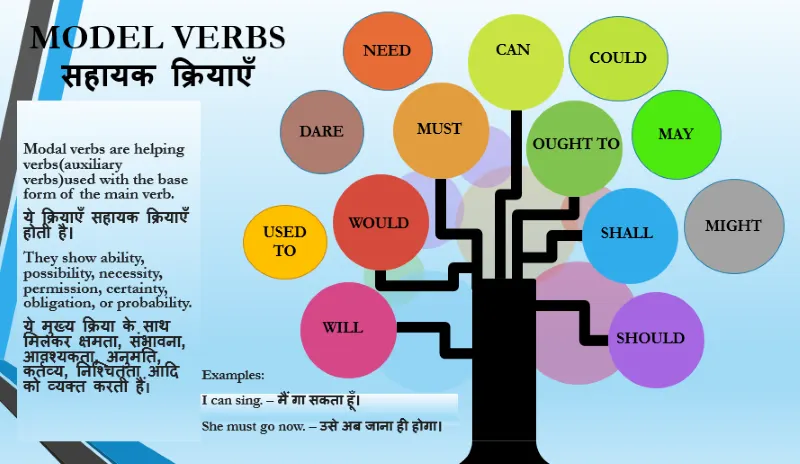
MODAL VERBS (सहायक क्रियाएँ)
Definition (परिभाषा)
• Modal verbs are helping verbs(auxiliary verbs)used with the base form of the main verb.
• ये क्रियाएँ सहायक क्रियाएँ होती है।
• They show ability, possibility, necessity, permission, certainty, obligation, or probability.
• ये मुख्य क्रिया के साथ मिलकर क्षमता, संभावना, आवश्यकता, अनुमति, कर्तव्य, निश्चितता आदि को व्यक्त करती हैं।
• They are always used with the base form of the main verb (V1 form).
Examples:
• I can sing. – मैं गा सकता हूँ।
• She must go now. – उसे अब जाना ही होगा।
Common modals:
Can, could, may, might, should,Would, Shall,will, must, ought to , need to, dare
Key Features of Modals(विशेषताएँ)
1. Always used with the base form of the main verb.
सहायक क्रिया के बाद हमेशा मुख्य क्रिया का base form आता है।
• She can sing well.
2. Do not change form according to subject.
ये कभी भी subject के अनुसार नहीं बदलती।
• I can swim. He can swim (same form for all).
3. Do not need’’-s,’’ ‘’-ed, or’’-ing’’ endings.
इनके साथ क्रिया की -s, -ed, -ing forms नही लगती।
4. Form questions and negatives without’’ do/does/did’’.
इनका नकारत्मक और प्रश्न बनाने के लिए do/does/did की जरुरत नहीं होती।
Can you help me ?
You should not lie.
5.Modals express mood, not time (tense).
Read Also
• Parts of speech
• Noun
• Pronoun
• Verb
• Adverb
• Adjective
• Preposition
• Conjunction
• Interjection
Functions of Modal Verbs
• Express ability – can, could
• Express permission – can, may
• Express possibility – may, might, could
• Express certainty/deduction – must, can't
• Express obligation/necessity – must, should, ought to
• Express future intention – will, shall
• Express condition – would, could, might
सभी मोडल को टेबल के द्वारा समझाया गया है कौन से मोडल पर कहाँ पर NOT लगता है तथा कौन सी Main verb Form use होती है । टेबल को ध्यान से समझें और सीखें।
| Models |
Where to use ‘not’ Which In negatives |
Which Form of Main Verb to Be used |
| Can |
Can not |
1st form |
| Could |
Could not |
3rd form |
| Could have |
Could not have |
1st form |
| May/Might |
May not/Might not |
1st form |
| May have / Might have |
May not have / Might not have |
3rd form |
| Should |
Should not |
1st form |
| Should have |
Should not have |
3rd form |
| Must |
Must not |
1st form |
| Must have |
Must not have |
3rd form |
| Ought to |
Ought not to |
1st form |
| Ought to have |
Ought not to have |
3rd form |
| Has to/Have to |
Has not to/Have not to |
1st form |
| Had to |
Had not to |
1st form |
| Will have to |
Will not have to |
1st form |
| Will be able to |
Will not be able to |
1st form |
| Would like to |
Would not like to |
1st form |
| Used to |
Did not use to |
1st form |
| Need / Needs / Needed |
Don’t need / Doesn’t need / Didn’t need |
1st form |
| Dare to / Dares to / Dared to |
Don’t dare to / Doesn’t dare to / Didn’t dare to |
1st form |
Types of Models
‘’CAN’’ Defination
• Can का प्रयोग सकना(ability), अनुमति(permission), और संभावना(possibility) के लिए होता है।
• इसे हम Present या Future के लिए करते है।
• Can से (informal) तरीके से question भी पूछे जाते हैं।
‘’COULD’’ Defination
• ‘’COULD’’ is a modal verb used to express past ability, polite permission, requests, possibility,or hypothetical situations.
• “COULD’’ एक सहायक क्रिया है, जिसका भूतकाल की क्षमता, विनम्र अनुमति, अनुरोध, संभावना या कल्पनात्मक स्थिति को व्यक्त करने के लिए किया जाता है।
• वाक्य के अंत में ‘’सकता था, सकता थी, सकते थे’’ आए ।
Read Also
• Active & Passive voice
• Gender
• Use of Has & Have
• Parts of Sentence
‘’SHALL’’ Defination
• Shall एक Modal Verb एक है, जिसका प्रयोग मुख्य रुप से –
1.भविष्य ( Future tense) दिखाने के लिए
2. निश्चय (Determination) बताने के लिए
3. Formal offers/ suggestion/ promises करने के लिए होता है।
‘’WILL’’ – Defination
• Will is a Modal auxiliary verb used to express Future action, Willingness, Intention, Determination, Promise, or Certainty.
• Will एक सहायक क्रिया है, जिसका प्रयोग
भविष्यकाल, इच्छा, इरादा, दृढ़ निश्चय, वचन, या निश्चितता व्यक्त के लिए किया जाता है।
‘’MAY’’ Definition
• May is a Modal Verb used to express Permission, Possibility, Polite request , and wishes.
• May का प्रयोग संभावना, अनुमति, आशीर्वाद, प्रार्थना, अभिशाप, अभिलाषा, आश्चर्य आदि को व्यकत करने के लिए सहायक क्रिया के रुप में होता है।
• May के साथ क्रिया I का प्रयोग करते हैं।
‘’MIGHT’’ – Definition
• Might is a Modal Verb Possibility ( Past, present, or Future), Polite suggestions or requests, Past possibility (less certain), Conditional situations ( with ‘’if’’)
• Might एक सहायक क्रिया है, जिसका प्रयोग संभावना( भूतकाल, वर्तमान काल, भविष्यकाल), विनम्र ,निवेदन, सुझाव, भूतकाल की संभावना, शर्त के लिए होता है।
Read Also
• Use of Is/am/are
• Singular & Plural
‘’SHOULD’’- Definition
• Should is a Modal auxiliary Verb used to express Duty, Advice, Suggestion, Obligation, Probability, or Expectaion.
• Should एक सहायक क्रिया है, जिसका प्रयोग
कर्तव्य, सलाह, सुझाव, बाध्यता, संभावना या अपेक्षा व्यक्त करने के लिए किया जाता है।
• Shall के past tense के रूप में should का प्रयोग होता है।
’WOULD’’ – Definition
• ‘’Would’’ is Modal Verb used to express:
• Polite request or offers.
• Future-in-the-past (something planned or predicicted in the past)
• Hypothetical situations(imaginary/conditional)
• Preferences and wishes.
• Past habits.
• Would एक सहायक क्रिया है जिसका प्रयोग होता है:
• विनम्र अनुरोध या ऑफर के लिये
• भूतकाल में भविष्य व्यक्त करने के लिए
• काल्पनिक या सर्दी स्थितियों के लिए
• पसंद और इच्छा व्यक्त करने के लिए
• अतीत की आदतें बताने के लिए।
Read Also
• Article-A
• Use of Do&Does
‘’MUST’’ – Definition
• Must is a Modal verb used to express:
• Strong necessity or obligation (something that is required).
• Prohibition (when used is negative).
• Logical certainty or strong deduction.
• Strong advice or recommendatiom.
• Must एक सहायक क्रिया है जिसका प्रयोग किया जाता है:
• कठोर आवश्यकता या दायित्व (जो करना अनिवार्य हो)।
• मनाही या निषेध (Negative में प्रयोग होने पर)।
• पक्की संभावना या निश्चित अनुमान।
• मजबूत सलाह या सिफारिश देने के लिए।
‘’OUGHT’’ – Definition
• Ought to is a Modal Verb used to Express:
• Duty / Moral obligation – something that is the right thing to do.
• Advice / Recommedation – giving suggestions in a softer way.
• Probability / Expectation – when something is likely to happen.
• कर्तव्य /नैतिक दायित्व- जो काम करना सही या उचित हो।
• सलाह/ सुझाव- किसी को सुझाव देने के लिए।
• संभावना /उम्मीद- किसी घटना के होने की संभावना बताने के लिए।
Read Also
• Sentence - Types of Sentence
• Affirmative Sentence
• Negative Sentence
• Interrogative Sentence
• Imperative Sentence
• Exclamatory Sentence
• Conditional Sentence
Use of used to in Hindi
Definition
As a Modal auxiliary verb, ‘’used to’’ expresses past habits, states, or actions that were regular or true in the past but no onger exist. It indicates something was customary or repeated in the past.
परिभाषा
Modal auxiliary verb के रूप में ‘’used to’’का प्रयोग भूतकाल की आदतें, स्थिति या कार्यों को व्यक्त करने के लिए किया जाता है जो पहले नियमित रूप से होते थे या सच थे, लेकिन अब नहीं है।
Use of Dare in Hindi
Definition
‘’Dare’’ is used both as a modal verb and a main verb. It expresses courage, boldness, or challenge to do something difficult, risky, or socially unacceptable.
परिभाषा
‘’Dare’’ एक ऐसा शब्द है जो मॉडल क्रिया, और मुख्य क्रिया दोनों के रूप में प्रयोग होता है। इसका प्रयोग किसी कठिन, साहसी या जोखिम भरे कार्य को करने की हिम्मत या चुनौती व्यक्त करने के लिए किया जाता है।
Read Also
• Use of Had
• Use of These & Those
• Use of This & That
• Use of Was & Were
‘’Need to’’ Definition
‘’Need to’’ is a semi – modal verb used to express necessity, requirement, or obligation. It shows that something is important or required to be done.
It is simliar in meaning to ‘’must’’ or ‘’have to’’, but it is often used in a softer or more polite way.
परिभाषा
‘’Need to’’ एक अर्ध मॉडल क्रिया है जो आवश्यकता, जरूरत या कर्तव्य को व्यक्त करती है, यह बताती है कि किसी कार्य को करना जरूरी या आवश्यक है यह ‘’must’’ ‘’have to’’ के समान अर्थ रखती है, लेकिन इसका प्रयोग थोड़ा नम्र या विनम्र ढंग से किया जाता है।
Read Also
• Tense
• Present Tense
• Past Tense
• Future tense Tense