What is Narration?
Narration means reporting the spoken words of a person.
It tells us what someone said—either in the exact words or in a changed form.
There are two types of narration:
1. Direct Speech – When we quote the speaker’s exact words.
2. Indirect Speech – When we report the meaning of the speaker’s words.
Narration का मतलब है किसी व्यक्ति द्वारा बोले गए शब्दों को बताना।
हम यह बताते हैं कि उसने क्या कहा, या तो उसी के बोले हुए शब्दों में, या फिर अपने शब्दों में।
Narration दो प्रकार का होता है:
1. Direct Speech – जब हम वक्ता के बिल्कुल वही शब्द दोहराते हैं।
2. Indirect Speech – जब हम उसके शब्दों का अर्थ अपने तरीके से बताते हैं।
Read Also
• Affirmative Sentence • Negative Sentence
• Interrogative Sentence • Imperative Sentence
• Conditional Sentence • Exclamatory Sentence
1. Direct Speech - Definition
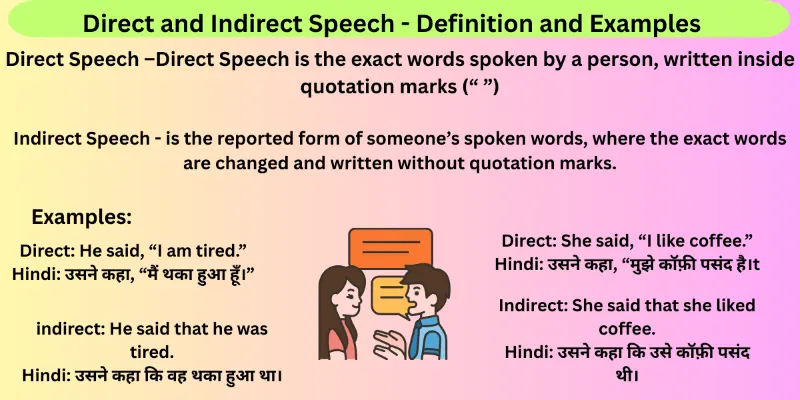
Direct speech is a way of repeating someone’s exact words without changing anything. The speaker’s original words are written inside quotation marks.
• We use direct speech when we want to show the speaker’s exact sentence.
• Quotation marks (“ ”) are used.
• Reporting verb is usually said, asked, replied, etc.
• No changes in tense, pronouns, or words.
Example - She said, “I am tired.”
परिभाषा-
Direct Speech वह तरीका है जिसमें किसी के बोले हुए exact शब्दों को बिना बदले वैसा ही लिखा या बताया जाता है।
इन शब्दों को quotation marks (“ ”) में लिखा जाता है।
• Direct speech में बोलने वाले के मूल शब्द लिखे जाते हैं।
• Quotation marks का प्रयोग होता है।
• Tense, pronoun या words को बदला नहीं जाता।
Example - उसने कहा, “मैं थक गई हूँ।”
2. Indirect Speech - Definition
Indirect speech is a way of reporting someone’s words by changing them into our own language without using quotation marks.
• The speaker’s words are not exact; they are reported in a changed form.
• Quotation marks are not used.
• Tense usually changes, pronouns change according to the context, and words like today, tomorrow, now also change.
• Reporting verbs like said, told, asked, etc. are used.
Examples:
Direct: She said, “I am tired.”
Indirect: She said that she was tired.
परिभाषा
Indirect Speech वह तरीका है जिसमें किसी के बोले हुए शब्दों को बदलकर, अपने वाक्य में बताया जाता है।
इसमें quotation marks का प्रयोग नहीं होता।
• Indirect speech में शब्द same नहीं रहते, उन्हें अर्थ अनुसार बदला जाता है।
• Tense बदलता है, pronoun बदलते हैं, और time words भी बदलते हैं।
• Reporting verb said, told, asked आदि का प्रयोग होता है।
Example :
Direct: उसने कहा, “मैं थक गई हूँ।”
Indirect: उसने कहा कि वह थक गई थी।
Main Parts of Narration
Narration दो मुख्य भागों से मिलकर बनता है:
1. Reporting Verb (आरंभ वाला भाग)
This is the verb that introduces the spoken words, such as said, told, asked, replied.
वह verb जो बताए कि किसने क्या कहा, जैसे:
said, told, asked, replied आदि।
Example- He said, “I am busy.”
2. Reported Speech (बोले गए शब्द)
This is the actual sentence spoken by the speaker.
In direct speech, it is inside quotation marks.
In indirect speech, we convert it.
वक्ता द्वारा कहे गए शब्द reported speech होते हैं।
Direct speech में ये quotation marks के अंदर होते हैं।
Indirect में इन्हें बदला जाता है।
Direct and Indirect Speech Rules:
प्रत्यक्ष और अप्रत्यक्ष कथन के नियम
Rule 1 : Change Of Pronouns
When we change Direct Speech into Indirect Speech, pronouns must change according to the sense of the sentence.
Pronouns change based on:
1. Speaker (who is speaking)
2. Listener (to whom speaking)
3. Person being discussed
This change ensures the meaning of the sentence stays correct in Indirect Speech.
जब Direct Speech को Indirect Speech में बदलते हैं, तो pronoun (सर्वनाम) को वाक्य के अनुसार बदलना पड़ता है।
Pronoun बदलते समय तीन बातों को देखा जाता है:
1. कौन बोल रहा है
2. किससे बात कर रहा है
3. किसके बारे में बात हो रही है
Pronoun बदलने से वाक्य का अर्थ सही बना रहता है।
Pronoun Change Table
| Direct Speech | Indirect Speech |
|---|---|
| I | he / she |
| Me | him / her |
| My | his / her |
| We | they |
| Us | them |
| Our | their |
| You | I / he / she / they |
| Your | my / his / her / their |
| This | that |
| These | Those |
How Pronoun Changes? (Pronoun बदलने का तरीका)
English
• I changes according to the subject of reporting verb.
• You changes according to the object of reporting verb.
• We changes according to context (often → they).
Hindi
• I उस व्यक्ति के अनुसार बदलता है जिसने बात कही है।
• You उस व्यक्ति के अनुसार बदलता है जिससे बात कही गई है।
• We परिस्थिति के अनुसार बदलता है (अक्सर → they बन जाता है)।
1. Pronoun changes according to Reporting Verb Subject
(Pronoun Reporting Verb के Subject के हिसाब से बदलता है)
1.Direct: He said, “I am happy.”
Indirect: He said that he was happy.
Direct: उसने कहा, “मैं खुश हूँ।”
Indirect: उसने कहा कि वह खुश था।
2. ‘You’ changes according to Object of Reporting Verb
(You pronoun Reporting Verb के object के अनुसार बदलता है)
Direct: She told me, “You are right.”
Indirect: She told me that I was right.
Direct: उसने मुझसे कहा, “तुम सही हो।”
Indirect: उसने मुझसे कहा कि मैं सही था।
3. ‘We’ becomes ‘They’
(“We” बदलकर “They” बन जाता है)
Direct: They said, “We love music.”
Indirect: They said that they loved music.
Direct: उन्होंने कहा, “हम संगीत पसंद करते हैं।”
Indirect: उन्होंने कहा कि वे संगीत पसंद करते थे।
4. Possessive Pronouns also change
(Possessive pronouns भी बदलते हैं)
Direct: He said, “My brother is a teacher.”
Indirect: He said that his brother was a teacher.
Direct: उसने कहा, “मेरा भाई एक शिक्षक है।”
Indirect: उसने कहा कि उसका भाई एक शिक्षक था।
5. ‘You’ may become He / She / They
(“You” कभी-कभी he, she, they बनता है)
Direct: I said to him, “You are late.”
Indirect: I told him that he was late.
Direct: मैंने उससे कहा, “तुम लेट हो।”
Indirect: मैंने उससे कहा कि वह लेट था।
6. ‘Me’ becomes Him/Her
(“Me” बदलकर him/her बन जाता है)
Direct: She said, “He helped me.”
Indirect: She said that he had helped her.
Direct: उसने कहा, “उसने मेरी मदद की।”
Indirect: उसने कहा कि उसने उसकी मदद की थी।
7. ‘Your’ changes according to who is speaking
(Your pronoun meaning के हिसाब से बदलता है)
Direct: She said to me, “Your idea is good.”
Indirect: She told me that my idea was good.
Direct: उसने मुझसे कहा, “तुम्हारा विचार अच्छा है।”
Indirect: उसने मुझसे कहा कि मेरा विचार अच्छा था।
Person Rule:
| Person | Pronoun in direct | Change Rule Indirect |
|---|---|---|
| 1st Person (I , we) | I /we | Change according to subject of reporting verb |
| 2nd Person (you) | you | Change according to Object of reporting verb |
| 3rd person (he,she, They, it) | he / she they / it | no change |
1. FIRST PERSON PRONOUNS
(I, me, we, us, my, our)
First-person pronouns change according to the subject of the reporting verb.
First person pronoun reporting verb के subject के अनुसार बदलता है।
Example (Simple Rule):
• If subject = he → I becomes he
• If subject = she → I becomes she
• If subject = they → I becomes they
2. SECOND PERSON PRONOUNS
(you, your)
Second-person pronouns change according to the object of the reporting verb.
Second person pronoun reporting verb के object के अनुसार बदलता है।
3. THIRD PERSON PRONOUNS
(he, she, it, they, his, her, their)
Third-person pronouns do not change.
Third person pronoun कभी नहीं बदलता।
Examples:
1.Direct: He said, “I am tired.”
Indirect : He said that he was tired.
Direct : उसने कहा, “मैं थक गया हूँ।”
Indirect : उसने कहा कि वह थक गया था।
(“I” speaker = He → he में बदला।)
2.Direct : She said, “My book is lost.”
Indirect : She said that her book was lost.
Direct: उसने कहा, “मेरी किताब खो गई है।”
Indirect : उसने कहा कि उसकी किताब खो गई थी।
( “My” → her)
3.Direct : I said, “We will win.”
Indirect : I said that we would win.
Direct : मैंने कहा, “हम जीतेंगे।”
Indirect : मैंने कहा कि हम जीतेंगे।
(Pronoun same रहा क्योंकि speaker और subject same हैं।)
4.Direct : They said, “We are ready.”
Indirect : They said that they were ready.
Direct : उन्होंने कहा, “हम तैयार हैं।”
Indirect : उन्होंने कहा कि वे तैयार थे।
( “We” → they)
5.Direct : He said to me, “You are honest.”
Indirect : He told me that I was honest.
Direct : उसने मुझसे कहा, “तुम ईमानदार हो।”
Indirect : उसने मुझे बताया कि मैं ईमानदार था।
(“You” listener = me → I)
6.Direct : She said to him, “I know you.”
Indirect : She told him that she knew him.
Direct : उसने उससे कहा, “मैं तुम्हें जानती हूँ।”
Indirect : उसने उससे कहा कि वह उसे जानती थी।
(“I” → she, “you” → him)
7.Direct : They said, “Our team is strong.”
Indirect : They said that their team was strong.
Direct : उन्होंने कहा, “हमारी टीम मजबूत है।”
Indirect : उन्होंने कहा कि उनकी टीम मजबूत थी।
( “Our” → their)
8.Direct : She said, “Give me my bag.”
Indirect : She asked me to give her her bag.
Direct : उसने कहा, “मुझे मेरा बैग दो।”
Indirect : उसने मुझसे अनुरोध किया कि मैं उसे उसका बैग दूँ।
( “me” → her, “my” → her)
9.Direct : I said to her, “You helped us.”
Indirect : I told her that she had helped us/them.
Direct : मैंने उससे कहा, “तुमने हमारी मदद की।”
Indirect : मैंने उससे कहा कि उसने हमारी मदद की थी।
( “You” → she)
10.Direct : He said, “This is my house.”
Indirect : He said that that was his house.
Direct : उसने कहा, “यह मेरा घर है।”
Indirect: उसने कहा कि वह उसका घर था।
( “This” → that, “my” → his)
Rule 2 : Tense Change Rule
When converting Direct Speech into Indirect Speech, tense changes only when the reporting verb is in past tense (said, told, asked, etc.).
If reporting verb is present or future, the tense does NOT change.
Direct Speech को Indirect Speech में बदलते समय tense तब बदलता है, जब reporting verb past tense में हो (said, told, asked आदि)।
अगर reporting verb present या future में है, तो tense नहीं बदलता।
IMPORTANT RULE
If Reporting Verb = Past Tense → Tense shifts one step back.
अगर Reporting Verb = Past Tense → Tense एक कदम पीछे चला जाता है।
Tense Change Table
| Direct Speech Tense | Indirect Speech Tense |
|---|---|
| Present Simple | Past Simple |
| Present Continuous | Past Continuous |
| Present Perfect | Past Perfect |
| Present Perfect Continuous | Past Perfect Continuous |
| Past Simple | Past Perfect |
| Past Continuous | Past Perfect Continuous |
| Will | Would |
| Can | Could |
| May | Might |
| Must | Had to |
Examples:
1. Present Simple → Past Simple
Direct: He said, “I play cricket.”
Indirect: He said that he played cricket.
Direct: उसने कहा, “मैं क्रिकेट खेलता हूँ।”
Indirect: उसने कहा कि वह क्रिकेट खेलता था।
2. Present Continuous → Past Continuous
Direct: She said, “I am reading.”
Indirect: She said that she was reading.
Direct: उसने कहा, “मैं पढ़ रही हूँ।”
Indirect: उसने कहा कि वह पढ़ रही थी।
3. Present Perfect → Past Perfect
Direct: He said, “I have finished my work.”
Indirect: He said that he had finished his work.
Direct: उसने कहा, “मैंने अपना काम पूरा कर लिया है।”
Indirect: उसने कहा कि उसने अपना काम पूरा कर लिया था।
4. Present Perfect Continuous → Past Perfect Continuous
Direct: She said, “I have been waiting for you.”
Indirect: She said that she had been waiting for me.
Direct: उसने कहा, “मैं तुम्हारा इंतज़ार कर रही हूँ।”
Indirect: उसने कहा कि वह मेरा इंतज़ार कर रही थी।
5. Past Simple → Past Perfect
Direct: He said, “I met him yesterday.”
Indirect: He said that he had met him the previous day.
Direct: उसने कहा, “मैं उससे कल मिला था।”
Indirect: उसने कहा कि वह उससे पिछले दिन मिला था।
6. Past Continuous → Past Perfect Continuous
Direct: She said, “I was cooking.”
Indirect: She said that she had been cooking.
Direct: उसने कहा, “मैं खाना बना रही थी।”
Indirect: उसने कहा कि वह खाना बना रही थी/रही थी।
7. Will → Would
Direct: He said, “I will help you.”
Indirect: He said that he would help me.
Direct: उसने कहा, “मैं तुम्हारी मदद करूँगा।”
Indirect: उसने कहा कि वह मेरी मदद करेगा/करता।
8. Can → Could
Direct: She said, “I can swim.”
Indirect: She said that she could swim.
Direct: उसने कहा, “मैं तैर सकती हूँ।”
Indirect: उसने कहा कि वह तैर सकती थी।
9. May → Might
Direct: He said, “I may come today.”
Indirect: He said that he might come that day
Direct: उसने कहा, “मैं आज आ सकता हूँ।”
Indirect: उसने कहा कि वह उस दिन आ सकता था।
10. Must → Had to
Direct: She said, “I must finish this task.”
Indirect: She said that she had to finish that task
Direct: उसने कहा, “मुझे यह काम करना ही होगा।”
Indirect: उसने कहा कि उसे यह काम करना पड़ा।
VERY IMPORTANT
A. Universal Truth – Tense does NOT change
(सार्वभौमिक सत्य में tense नहीं बदलता)
Direct: Teacher said, “The sun rises in the east.”
Indirect: Teacher said that the sun rises in the east.
Direct: शिक्षक ने कहा, “सूरज पूर्व में उगता है।”
Indirect: शिक्षक ने कहा कि सूरज पूर्व में उगता है।
B. Reporting Verb Present/Future → No Tense Change
Direct: He says, “I am ready.”
Indirect: He says that he is ready.
Direct: He will say, “I like music.”
Indirect: He will say that he likes music.
Direct: वह कहता है, “मैं तैयार हूँ।”
Indirect: वह कहता है कि वह तैयार है।
C. Would / Could / Should / Might / Had already → No Change
Direct: He said, “I could do this.”
Indirect: He said that he could do that.
Direct: उसने कहा, “मैं यह कर सकता था।”
Indirect: उसने कहा कि वह यह कर सकता था।
Rule 3: Change of Time and Place words
Direct Speech को Indirect Speech में बदलते समय, time (समय) और place (स्थान) से जुड़े शब्द बदल जाते हैं, क्योंकि reported statement अब किसी दूसरे समय और स्थान से बताया जा रहा होता है।
BASIC PRINCIPLE / मुख्य सिद्धांत
Time and place words change when:
• The reporting verb is in past tense
• The meaning requires shifting
जब reporting verb past tense में हो, या वाक्य का अर्थ बदलने की आवश्यकता हो, तो Time और Place के शब्द बदल जाते हैं।
Time Words Change – Table
| Direct Speech | Indirect Speech |
|---|---|
| Today | that day |
| Tomorrow | the next day / the Following day |
| Yesterday | the previous day / the Day before |
| Now | then |
| Just now | a moment before |
| Tonight | that night |
| This week | that week |
| Last week | that previous week |
| Next week | the next week |
| Ago | before |
| Hereafter | thereafter |
Place words Change – Table
| Direct | Indirect |
|---|---|
| Here | there |
| Hence | thence |
| This | that |
| These | those |
Rule -1 : Time Words Change According to Reporting Time
Direct: He said, “I will do it tomorrow.”
Indirect: He said that he would do it the next day.
Direct: उसने कहा, “मैं इसे कल करूँगा।”
Indirect: उसने कहा कि वह इसे अगले दिन करेगा।
Rule -2 : “Today” becomes “that day”
Direct: She said, “I am busy today.”
Indirect: She said that she was busy that day.
Direct: उसने कहा, “मैं आज व्यस्त हूँ।”
Indirect: उसने कहा कि वह उस दिन व्यस्त थी।
Rule – 3: “Yesterday” becomes “the previous day”
Direct: He said, “I met him yesterday.”
Indirect: He said that he had met him the previous day.
Direct: उसने कहा, “मैं उससे कल मिला था।”
Indirect: उसने कहा कि वह उससे पिछले दिन मिला था।
Rule – 4: “Here” becomes “there”
Direct: She said, “I live here.”
Indirect: She said that she lived there.
Direct: उसने कहा, “मैं यहाँ रहती हूँ।”
Indirect: उसने कहा कि वह वहाँ रहती थी।
Rule – 5: “Now” becomes “then”
Direct: He said, “I am leaving now.”
Indirect: He said that he was leaving then.
Direct: उसने कहा, “मैं अभी जा रहा हूँ।”
Indirect: उसने कहा कि वह तब जा रहा था।
Rule – 6: “This” becomes “that”
Direct: He said, “I like this book.”
Indirect: He said that he liked that book.
Direct: उसने कहा, “मुझे यह किताब पसंद है।”
Indirect: उसने कहा कि उसे वह किताब पसंद थी।
Rule - 7: “These” becomes “those”
Direct: She said, “These flowers are fresh.”
Indirect: She said that those flowers were fresh.
Direct: उसने कहा, “ये फूल ताज़े हैं।”
Indirect: उसने कहा कि वे फूल ताज़े थे।
Examples -
1.Direct:He said, “I will finish this work today.”
Indirect :He said that he would finish the work that day.
Direct :उसने कहा, “मैं यह काम आज पूरा करूँगा।”
Indirect:उसने कहा कि वह यह काम उस दिन पूरा करेगा।
2.Direct:She said, “I met him the day before yesterday.”
Indirect:She said that she had met him two days earlier.
Direct:उसने कहा, “मैं उससे परसों मिली थी।”
Indirect:उसने कहा कि वह उससे दो दिन पहले मिली थी।
3.Direct:They said, “We will go to Delhi next month.”
Indirect :They said that they would go to Delhi the following month.
Direct:उन्होंने कहा, “हम अगले महीने दिल्ली जाएँगे।”
Indirect:उन्होंने कहा कि वे दिल्ली अगले महीने जाएँगे।
4.Direct:He said, “We stayed here last week.”
Indirect:He said that they had stayed there the previous week.
Direct:उसने कहा, “हम पिछले हफ्ते यहाँ रहे थे।”
Indirect:उसने कहा कि वे पिछले हफ्ते वहाँ रहे थे।
5.Direct:She said, “I will talk to him tomorrow.”
Indirect:She said that she would talk to him the next day.
Direct:उसने कहा, “मैं उससे कल बात करूँगी।”
Indirect:उसने कहा कि वह उससे अगले दिन बात करेगी।
6.Direct:He said, “I came here a year ago.”
Indirect :He said that he had come there a year before.
Direct :उसने कहा, “मैं एक साल पहले यहाँ आया था।”
Indirect:उसने कहा कि वह एक साल पहले वहाँ आया था।
7.Direct:She said, “We will start this project now.”
Indirect:She said that they would start the project then.
Direct:उसने कहा, “हम यह प्रोजेक्ट अब शुरू करेंगे।”
Indirect :उसने कहा कि वे यह प्रोजेक्ट तभी शुरू करेंगे।
8.Direct:They said, “We will discuss it tonight.”
Indirect :They said that they would discuss it that night.
Direct :उन्होंने कहा, “हम इस पर आज रात चर्चा करेंगे।”
Indirect:उन्होंने कहा कि वे इस पर उस रात चर्चा करेंगे।
9.Direct:He said, “I will return this book tomorrow morning.”
Indirect:He said that he would return the book the next morning.
Direct:उसने कहा, “मैं यह किताब कल सुबह वापस कर दूँगा।”
Indirect:उसने कहा कि वह किताब अगली सुबह वापस कर देगा।
10.Direct:She said, “We visited this place last year.”
Indirect :She said that they had visited that place the previous year.
Direct:उसने कहा, “हमने इस जगह को पिछले साल देखा था।”
Indirect:उसने कहा कि उन्होंने उस जगह को पिछले साल देखा था।
Read Tenses & there Types
• Tense • Present Tense
• Present-indefinite-Tense • Present - Perfect Tense
• Present- continuous - Tense • Present - perfect - continuous -Tense
• Past Tense • Past Indefinite Tense
• Past Perfect Tense • Past continuous Tense
• Past- Perfect- continuous- Tense • Future Tense
• Future- Perfect- Tense • Future- Indefinite- Tense
• Future- continuous- Tense • Future- Perfect- continuous- Tense
ASSERTIVE SENTENCES (Direct → Indirect Speech)
Definition of Assertive Sentences
Assertive sentences are simple statements that express facts, opinions, information or feelings.
They end with a full stop ( . ).
Assertive sentences वे वाक्य होते हैं जो कोई बात बताते हैं—
जैसे तथ्य, विचार, जानकारी या भावना।
ये पूर्ण विराम (। / .) पर समाप्त होते हैं।
Assertive Sentences in Direct & Indirect Speech
When we change an assertive sentence from Direct to Indirect speech:
1. Add “that” after the reporting verb.
2. Change pronouns according to the Pronoun Rule.
3. Change tenses if reporting verb is in the past.
4. Remove comma + quotation marks.
5. Keep the statement structure same.
Assertive वाक्यों को Direct से Indirect Speech में बदलते समय:
1. Reporting verb के बाद that लगाया जाता है।
2. Pronoun को Person Rule के अनुसार बदला जाता है।
3. Reporting verb past हो तो tense बदलता है।
4. Comma और inverted commas (“ ”) हट जाते हैं।
5. Statement का भाव वही रखा जाता है।
Direct Speech Structure: Subject + said + “statement.”
Indirect Speech Structure: Subject + said/ told + that + statement (changed).
• उसने कहा, “वह आया है।” (Direct)
• उसने कहा कि वह आया था। (Indirect)
1.Direct:He said, “I am tired.”
Indirect:He said that he was tired.
Direct:उसने कहा, “मैं थक गया हूँ।”
Indirect:उसने कहा कि वह थक गया था।
2.Direct:She said, “We trust you.”
Indirect:She said that they trusted me.
Direct:उसने कहा, “हम तुम पर भरोसा करते हैं।”
Indirect:उसने कहा कि वे मुझ पर भरोसा करते थे।
3.Direct:I said, “He is honest.”
Indirect:I said that he was honest.
Direct:मैंने कहा, “वह ईमानदार है।”
Indirect:मैंने कहा कि वह ईमानदार था।
4.Direct :They said, “The weather is cold.”
Indirect:They said that the weather was cold.
Direct:उन्होंने कहा, “मौसम ठंडा है।”
Indirect:उन्होंने कहा कि मौसम ठंडा था।
5.DirectRiya said, “I know the truth.”
Indirect:Riya said that she knew the truth.
Direct:रिया ने कहा, “मैं सच जानती हूँ।”
Indirect:रिया ने कहा कि वह सच जानती थी।
6.Direct:He said, “You are my friend.”
Indirect:He told me that I was his friend.
Direct:उसने मुझसे कहा, “तुम मेरे दोस्त हो।”
Indirect:उसने मुझसे कहा कि मैं उसका दोस्त था।
7.Direct:She said, “The birds are singing.”
Indirect:She said that the birds were singing.
Direct:उसने कहा, “पक्षी गा रहे हैं।”
Indirect:उसने कहा कि पक्षी गा रहे थे।
8.Direct:He said, “I like reading books.”
Indirect:He said that he liked reading books.
Direct:उसने कहा, “मुझे किताबें पढ़ना पसंद है।”
Indirect:उसने कहा कि उसे किताबें पढ़ना पसंद था।
9.Direct:They said, “We will help you.”
Indirect:They said that they would help me.
Direct:उन्होंने कहा, “हम तुम्हारी मदद करेंगे।”
Indirect:उन्होंने कहा कि वे मेरी मदद करेंगे।
10.Direct:I said, “She works hard.”
Indirect:I said that she worked hard.
Direct:मैंने कहा, “वह मेहनत करती है।”
Indirect:मैंने कहा कि वह मेहनत करती थी।
11.Direct:He said, “The sky looks clear.”
Indirect:He said that the sky looked clear.
Direct:उसने कहा, “आसमान साफ दिख रहा है।”
Indirect:उसने कहा कि आसमान साफ दिख रहा था।
12.Direct:She said, “My brother is brave.”
Indirect:She said that her brother was brave.
Direct:उसने कहा, “मेरा भाई बहादुर है।”
Indirect:उसने कहा कि उसका भाई बहादुर था।
13.Direct:He said, “I enjoy music.”
Indirect:He said that he enjoyed music.
Direct:उसने कहा, “मुझे संगीत पसंद है।”
Indirect:उसने कहा कि उसे संगीत पसंद था।
14. Direct:They said, “Our teacher is strict.”
Indirect:They said that their teacher was strict.
Direct:उन्होंने कहा, “हमारे शिक्षक सख्त हैं।”
Indirect:उन्होंने कहा कि उनके शिक्षक सख्त थे।
15.Direct:I said, “You look happy.”
Indirect:I told him that he looked happy.
Direct :मैंने उससे कहा, “तुम खुश दिखते हो।”
Indirect:मैंने उससे कहा कि वह खुश दिखता था।
16.Direct:She said, “The room is clean.”
Indirect:She said that the room was clean.
Direct:उसने कहा, “कमरा साफ है।”
Indirect:उसने कहा कि कमरा साफ था।
17. Direct:He said, “I feel better now.”
Indirect:He said that he felt better then.
Direct:उसने कहा, “मैं अब बेहतर महसूस कर रहा हूँ।”
Indirect:उसने कहा कि वह तब बेहतर महसूस कर रहा था।
18.Direct:They said, “We live here.”
Indirect :They said that they lived there.
Direct:उन्होंने कहा, “हम यहाँ रहते हैं।”
Indirect:उन्होंने कहा कि वे वहाँ रहते थे।
19.Direct:Rohan said, “I love painting.”
Indirect:Rohan said that he loved painting.
Direct:रोहन ने कहा, “मुझे पेंटिंग पसंद है।”
Indirect:रोहन ने कहा कि उसे पेंटिंग पसंद थी।
20.Direct:She said, “The book is interesting.”
Indirect:She said that the book was interesting.
Direct:उसने कहा, “यह किताब रोचक है।”
Indirect:उसने कहा कि वह किताब रोचक थी।
INTERROGATIVE SENTENCES (Direct → Indirect Speech)
Definition -
Interrogative sentences are question sentences.
They begin with Helping Verbs (Do / Does / Did / Is / Are / Was / Were)
or WH-words (What, Why, When, Where, Who, Whom, How, Which).
Interrogative sentences वे वाक्य होते हैं जिनसे प्रश्न पूछा जाता है।
ये या तो helping verb से शुरू होते हैं या WH-word से।
Interrogative Sentences in Direct to Indirect Speech
While changing Interrogative sentences:
1. Reporting verb changes to “asked / inquired / demanded”
2. Remove comma + quotation marks
3. If the question starts with a helping verb, use if / whether
4. If the question starts with a WH-word, keep the WH-word
5. Change pronouns according to rules
6. Change tense if reporting verb is in past
7. The sentence does not remain a question → it becomes a statement
8. Remove question mark ( ? )
Interrogative sentence को Direct से Indirect में बदलते समय:
1. Reporting verb asked / inquired बनता है।
2. Comma और inverted commas हट जाते हैं।
3. अगर प्रश्न helping verb से शुरू हो तो “if / whether” लगाते हैं।
4. अगर प्रश्न WH-word से शुरू हो तो वही WH-word बना रहता है।
5. Pronoun नियम अनुसार बदलता है।
6. Reporting verb past हो तो tense बदलता है।
7. Indirect Speech में वाक्य statement बन जाता है।
8. Question mark (?) हट जाता है।
Two Main Types of Interrogative Rules:
Type 1: YES / NO Questions
(Do/Does/Did/Is/Are/Was/Were etc.)
Type 2: WH-Questions
(What, Why, When, Where, Who, Whom, How, Which)
1. YES/NO Question Examples
1.Direct:He said, “Do you like music?”
Indirect:He asked if I liked music.
Direct:उसने कहा, “क्या तुम्हें संगीत पसंद है?”
Indirect:उसने पूछा कि क्या मुझे संगीत पसंद था।
2.Direct:She said to him, “Are you tired?”
Indirect:She asked him if he was tired.
Direct:उसने उससे कहा, “क्या तुम थक गए हो?”
Indirect:उसने उससे पूछा कि क्या वह थक गया था।
3.Direct :They said, “Did he call you?”
Indirect:They asked whether he had called me.
Direct:उन्होंने कहा, “क्या उसने तुम्हें फोन किया?”
Indirect:उन्होंने पूछा कि क्या उसने मुझे फोन किया था।
4.Direct :I said, “Is it raining?”
Indirect:I asked if it was raining.
Direct:मैने कहा, “क्या बारिश हो रही है?”
Indirect :मैंने पूछा कि क्या बारिश हो रही थी।
5.Direct:Riya said, “Do they know the truth?”
Indirect:Riya asked whether they knew the truth.
Direct:रिया ने कहा, “क्या वे सच जानते हैं?”
Indirect:रिया ने पूछा कि क्या वे सच जानते थे।
6.Direct:He said, “Are we late?”
Indirect:He asked if they were late.
Direct :उसने कहा, “क्या हम देर से आए हैं?”
Indirect:उसने पूछा कि क्या वे देर से आए थे।
7.Direct:She said, “Do I look fine?”
Indirect:She asked if she looked fine.
Direct:उसने कहा, “क्या मैं ठीक दिख रही हूँ?”
Indirect:उसने पूछा कि क्या वह ठीक दिख रही थी।
8.Direct:He said, “Is your brother at home?”
Indirect:He asked if my brother was at home.
Direct:उसने कहा, “क्या तुम्हारा भाई घर पर है?”
Indirect:उसने पूछा कि क्या मेरा भाई घर पर था।
9.Direct:They said, “Were you busy yesterday?”
Indirect:They asked if I had been busy the previous day.
Direct:उन्होंने कहा, “क्या तुम कल व्यस्त थे?”
Indirect:उन्होंने पूछा कि क्या मैं पिछले दिन व्यस्त था।
10.Direct:She asked, “Is he your friend?”
Indirect:She asked whether he was my friend.
Direct :उसने पूछा, “क्या वह तुम्हारा दोस्त है?”
Indirect:उसने पूछा कि क्या वह मेरा दोस्त था।
2. WH-QUESTION Examples
1.Direct:He said, “Where do you live?”
Indirect :He asked where I lived.
Direct:उसने कहा, “तुम कहाँ रहते हो?”
Indirect:उसने पूछा कि मैं कहाँ रहता था।
2.Direct:She said, “Why are you crying?”
Indirect :She asked why I was crying.
Direct :उसने कहा, “तुम क्यों रो रहे हो?”
Indirect:उसने पूछा कि मैं क्यों रो रहा था।
3.Direct:They said, “When will the train arrive?”
Indirect:They asked when the train would arrive.
Direct:उन्होंने कहा, “ट्रेन कब आएगी?”
Indirect :उन्होंने पूछा कि ट्रेन कब आएगी।
4.Direct:I said, “How did you solve it?”
Indirect :I asked how he had solved it.
Direct:मैंने कहा, “तुमने इसे कैसे हल किया?”
Indirect:मैंने पूछा कि उसने इसे कैसे हल किया था।
5.Direct:He said, “What do you want?”
Indirect :He asked what I wanted.
Direct:उसने कहा, “तुम क्या चाहते हो?”
Indirect :उसने पूछा कि मैं क्या चाहता था।
6.Direct:She said, “Who is knocking at the door?”
Indirect:She asked who was knocking at the door.
Direct :उसने कहा, “दरवाज़े पर कौन दस्तक दे रहा है?”
Indirect :उसने पूछा कि दरवाज़े पर कौन दस्तक दे रहा था।
7.Direct:He said, “Which book do you prefer?”
Indirect:He asked which book I preferred.
Direct:उसने कहा, “तुम कौन-सी किताब पसंद करते हो?”
Indirect :उसने पूछा कि मैं कौन-सी किताब पसंद करता था।
8.Direct:They said, “Whom did you meet?”
Indirect :They asked whom I had met.
Direct:उन्होंने कहा, “तुम किससे मिले?”
Indirect :उन्होंने पूछा कि मैं किससे मिला था।
9.Direct:Rohan said, “Why is she upset?”
Indirect :Rohan asked why she was upset.
Direct:रोहन ने कहा, “वह परेशान क्यों है?”
Indirect:रोहन ने पूछा कि वह परेशान क्यों थी।
10.Direct:I said, “How can I help you?”
Indirect :I asked how I could help him.
Direct:मैंने कहा, “मैं तुम्हारी कैसे मदद कर सकता हूँ?”
Indirect:मैंने पूछा कि मैं उसकी कैसे मदद कर सकता था।
Read Also
• Interrogative Sentence • conjunction
• Use of Has & Have • Adjective
• Interjection • Sentence Types of Sentence
IMPERATIVE SENTENCES (Direct → Indirect Speech)
Definition of Imperative Sentences
Imperative sentences express orders, requests, advice, suggestions, warnings, instructions or permissions.
These sentences usually begin with a verb.
Imperative वाक्य वे होते हैं जिनमें आदेश, अनुरोध, सलाह, सुझाव, चेतावनी, निर्देश या अनुमति दी जाती है।
इन वाक्यों की शुरुआत अक्सर verb से होती है।
Read Also
• Affirmative Sentence • Use of Had
• Use of These & Those • Verb
• Adverb
Imperative Sentences in Direct → Indirect Speech
When changing Imperative sentences into Indirect Speech:
1. Reporting verb becomes:
• ordered (order)
• requested (request)
• advised (advice)
• suggested (suggestion)
• warned (warning)
• told (instruction)
2. Use to + verb (infinitive).
3. Remove comma + inverted commas.
4. Negative imperatives use not to + verb.
5. Pronouns change according to rules.
Imperative वाक्य को Indirect Speech में बदलते समय:
1. Reporting verb बदलकर यह हो जाता है—
• ordered (आदेश दिया)
• requested (अनुरोध किया)
• advised (सलाह दी)
• suggested (सुझाव दिया)
• warned (चेताया)
• told (कहा/निर्देश दिया)
2. Main verb के पहले to + verb लगाया जाता है।
3. Comma और inverted commas हट जाते हैं।
4. Negative वाक्यों में not to + verb आता है।
5. Pronoun नियम अनुसार बदलते हैं।
Direct Speech:Subject + said/said to + “Verb….”
Indirect Speech:Subject + ordered/requested/advised/told + object + to + verb
Negative Structure:
Subject + ordered/asked/advised + object + not to + verb
Example of Orders
1.Direct:He said to me, “Close the door.”
Indirect :He ordered me to close the door.
Direct:उसने मुझसे कहा, “दरवाज़ा बंद करो।”
Indirect:उसने मुझे दरवाज़ा बंद करने का आदेश दिया।
2.Direct:The teacher said, “Stand up.”
Indirect :The teacher ordered the students to stand up.
Direct :शिक्षक ने कहा, “खड़े हो जाओ।”
Indirect :शिक्षक ने छात्रों को खड़ा होने का आदेश दिया।
3.Direct:She said to him, “Write your name.”
Indirect:She ordered him to write his name.
Direct:उसने उससे कहा, “अपना नाम लिखो।”
Indirect :उसने उसे अपना नाम लिखने का आदेश दिया।
4.Direct:He said, “Bring the file.”
Indirect:He ordered them to bring the file.
Direct:उसने कहा, “फाइल लाओ।”
Indirect :उसने उन्हें फाइल लाने का आदेश दिया।
5.Direct:The officer said, “Report immediately.”
Indirect :The officer ordered them to report immediately.
Direct:अधिकारी ने कहा, “तुरंत रिपोर्ट करो।”
Indirect:अधिकारी ने उन्हें तुरंत रिपोर्ट करने का आदेश दिया।
Examples of Requests
1.Direct:He said to me, “Please help me.”
Indirect:He requested me to help him.
Direct:उसने मुझसे कहा, “कृपया मेरी मदद करो।”
Indirect:उसने मुझसे उसकी मदद करने का अनुरोध किया।
2.Direct:She said, “Please listen to me.”
Indirect:She requested them to listen to her.
Direct:उसने कहा, “कृपया मेरी बात सुनो।”
Indirect :उसने उनसे उसकी बात सुनने का अनुरोध किया।
3.Direct :They said, “Please wait here.”
Indirect:They requested me to wait there.
Direct:उन्होंने कहा, “कृपया यहाँ प्रतीक्षा करो।”
Indirect:उन्होंने मुझसे वहाँ प्रतीक्षा करने का अनुरोध किया।
4.Direct:I said to her, “Please sit down.”
Indirect:I requested her to sit down.
Direct:मैंने उससे कहा, “कृपया बैठ जाओ।”
Indirect:मैंने उससे बैठने का अनुरोध किया।
5.Direct:Riya said, “Please open the window.”
Indirect :Riya requested him to open the window.
Direct:रिया ने कहा, “कृपया खिड़की खोलो।”
Indirect:रिया ने उससे खिड़की खोलने का अनुरोध किया।
Examples of Advice
1.Direct:The doctor said, “Take rest.”
Indirect :The doctor advised me to take rest.
Direct:डॉक्टर ने कहा, “आराम करो।”
Indirect:डॉक्टर ने मुझे आराम करने की सलाह दी।
2.Direct:He said, “Work hard.”
Indirect:He advised me to work hard.
Direct:उसने कहा, “मेहनत करो।”
Indirect :उसने मुझे मेहनत करने की सलाह दी।
3. Direct:She said to him, “Eat healthy food.”
Indirect:She advised him to eat healthy food.
Direct :उसने उससे कहा, “स्वस्थ भोजन करो।”
Indirect:उसने उसे स्वस्थ भोजन करने की सलाह दी।
4.Direct:They said, “Save your time.”
Indirect :They advised us to save our time.
Direct :उन्होंने कहा, “अपना समय बचाओ।”
Indirect:उन्होंने हमें अपना समय बचाने की सलाह दी।
5.Direct:I said to him, “Study regularly.”
Indirect :I advised him to study regularly.
Direct :मैंने उससे कहा, “नियमित पढ़ाई करो।”
Indirect:मैंने उसे नियमित पढ़ाई करने की सलाह दी।
Read Also
• Past Tense • Past Indefinite Tense
• Past Perfect Tense • Past continuous Tense
• Past- Perfect- continuous- Tense • Future Tense
• Future- Perfect- Tense • Future- Indefinite- Tense
• Future- continuous- Tense • Future- Perfect- continuous- Tense
NEGATIVE IMPERATIVE SENTENCES- (Direct & Indirect Speech)
Definition -
A Negative Imperative Sentence expresses a command, order, advice, request, or warning in negative form.
It begins with
Don’t / Do not / Never
Examples:
• Don’t touch this.
• Never lie.
• Do not run.
Negative Imperative Sentence वह वाक्य होता है जिसमें नकारात्मक आदेश, सलाह, अनुरोध, चेतावनी दी जाती है।
इनकी शुरुआत होती है:
Don’t / Do not / Never
उदाहरण:
• इसे मत छुओ।
• कभी झूठ मत बोलो।
• दौड़ो मत।
Read Also
• Negative Sentence • Use of Had
• Use of These & Those • Parts of Sentences
• Parts of Speech
Rules for Changing to Indirect Speech :
Rule 1 - Reporting Verb
Use:
• told not to
• ordered not to
• advised not to
• requested not to
• forbade (very important!)
• warned not to
Note: “Forbade” is already negative, so “not” is not used with it.
Example:
Direct: He said, “Don’t run.”
Indirect: He forbade me to run.
(NOT: forbade me not to run ❌)
Rule 2 – Remove Do not / Don’t / Never
Replace with:
not to
OR
forbade + to + verb
Rule 3 – No exclamation mark
Punctuation (!) or comma is removed.
Rules
Rule 1 – Reporting verb बदलती है
Command/Order → ordered not to
Advice → advised not to
Request → requested not to
Warning → warned not to
Strict prohibition → forbade
➡ “Forbade” के साथ “not” नहीं लगता।
Rule 2 – Don’t / Do not / Never को हटाकर** “not to”** या “forbade to” लगाया जाता है।
Rule 3 – Indirect Speech में infinitive (to + verb) का प्रयोग होता है।
Examples:
1. Command / Order
1.Direct : He said to me, “Don’t touch the wire.”
Indirect : He warned me not to touch the wire.
Direct : उसने मुझसे कहा, “तार मत छुओ।”
Indirect : उसने मुझे चेतावनी दी कि तार न छूँ।
2.Direct : She said, “Don’t open the door.”
Indirect: She ordered me not to open the door.
Direct: उसने कहा, “दरवाज़ा मत खोलो।”
Indirect: उसने आदेश दिया कि मैं दरवाज़ा न खोलूँ।
3.Direct : Father said, “Don’t go there.”
Indirect : Father forbade me to go there.
Direct : पिता ने कहा, “वहाँ मत जाओ।”
Indirect : पिता ने मुझे वहाँ जाने से मना किया।
2. Advice
4.Direct : The doctor said, “Don’t eat junk food.”
Indirect : The doctor advised me not to eat junk food.
Direct : डॉक्टर ने कहा, “जंक फूड मत खाओ।”
Indirect : डॉक्टर ने मुझे सलाह दी कि मैं जंक फूड न खाऊँ।
5.Direct : She said, “Don’t study at night.”
Indirect : She advised me not to study at night.
Direct : उसने कहा, “रात में मत पढ़ो।”
Indirect : उसने मुझे सलाह दी कि मैं रात में न पढ़ूँ।
6.Direct : He said, “Never trust strangers.”
Indirect : He advised me never to trust strangers.
Direct : उसने कहा, “अजनबियों पर कभी भरोसा मत करो।”
Indirect: उसने मुझे सलाह दी कि मैं अजनबियों पर कभी भरोसा न करूँ।
3. Request
7.Direct : She said to him, “Don’t shout.”
Indirect : She requested him not to shout.
Direct : उसने उससे कहा, “चिल्लाओ मत।”
Indirect: उसने उससे अनुरोध किया कि वह चिल्लाए नहीं।
8.Direct: He said, “Don’t tell anyone.”
Indirect : He requested me not to tell anyone.
Direct : उसने कहा, “किसी को मत बताना।”
Indirect : उसने मुझसे अनुरोध किया कि मैं किसी को न बताऊँ।
4. Warning
9.Direct : Mother said, “Don’t play with fire.”
Indirect : Mother warned me not to play with fire.
Direct : माँ ने कहा, “आग से मत खेलो।”
Indirect : माँ ने मुझे चेतावनी दी कि मैं आग से न खेलूँ।
10.Direct : He said, “Don’t go out alone.”
Indirect : He warned me not to go out alone.
Direct : उसने कहा, “अकेले बाहर मत जाओ।”
Indirect : उसने चेतावनी दी कि मैं अकेले बाहर न जाऊँ।
5. Strict Prohibition (Forbade)
11.Direct : He said, “Don’t smoke here.”
Indirect : He forbade me to smoke there.
Direct : उसने कहा, “यहाँ धूम्रपान मत करो।”
Indirect : उसने मुझे वहाँ धूम्रपान करने से मना किया।
12.Direct: The teacher said, “Don’t talk in class.”
Indirect: The teacher forbade us to talk in class.
Direct: शिक्षक ने कहा, “क्लास में मत बोलो।”
Indirect : शिक्षक ने हमें क्लास में बोलने से मना किया।
6. More Mixed Examples
13.Direct : “Don’t waste time.”
Indirect : He advised me not to waste time.
Direct : “समय मत बर्बाद करो।”
Indirect : उसने मुझे सलाह दी कि मैं समय बर्बाद न करूँ।
14.Direct : “Never be rude.”
Indirect : He advised me never to be rude.
Direct : “कभी बदतमीज़ मत बनो।”
Indirect : उसने सलाह दी कि मैं कभी बदतमीज़ न बनूँ।
15.Direct : “Don’t cross the road quickly.”
Indirect: She warned me not to cross the road quickly.
Direct : “सड़क जल्दी मत पार करो।”
Indirect: उसने चेतावनी दी कि मैं सड़क जल्दी न पार करूँ।
16.Direct : “Don’t touch my bag.”
Indirect : He warned me not to touch his bag.
Direct : “मेरा बैग मत छूना।”
Indirect : उसने चेतावनी दी कि मैं उसका बैग न छूँ।
17.Direct : “Do not cry.”
Indirect : She requested me not to cry.
Direct : “मत रो।”
Indirect : उसने मुझसे अनुरोध किया कि मैं न रोऊँ।
18.Direct: “Never repeat this mistake.”
Indirect : He advised me never to repeat that mistake.
Direct : “यह गलती कभी मत दोहराना।”
Indirect: उसने कहा कि मैं वह गलती कभी न दोहराऊँ।
19.Direct : “Don’t leave the door open.”
Indirect: He told me not to leave the door open.
Direct : “दरवाज़ा खुला मत छोड़ना।”
Indirect : उसने मुझे कहा कि दरवाज़ा खुला न छोड़ूँ।
20.Direct : “Don’t forget this lesson.”
Indirect : She advised me not to forget that lesson.
Direct : “यह पाठ मत भूलना।”
Indirect : उसने मुझे सलाह दी कि मैं वह पाठ न भूलूँ।
OPTATIVE SENTENCES (Direct & Indirect Speech)
Definition -
Optative sentences are sentences that express wishes, blessings, prayers, curses, or good intentions.
These sentences usually begin with words like:
May, Wish, God, Long live, Would that, If only, etc.
Optative sentences वे वाक्य होते हैं जो इच्छा, आशीर्वाद, दुआ, श्राप या शुभ-कामनाएँ व्यक्त करते हैं।
इनमें अक्सर शब्द आते हैं:
May, Wish, God, Long live, Would that, If only आदि।
Read Also
• Use of Used to • Use of Need to
• Parts of Sentence • Use of Has & Have
• Use of Is/am/are • Number- Singular & Plural
Conversion Rules
How to change Optative sentences from Direct → Indirect:
Rule 1 — Reporting Verb Changes
The reporting verb changes into:
• wished
• prayed
• blessed
• cursed
• invoked
• hoped
depending on the emotion of the sentence.
Examples:
• May you succeed! → He wished
• May God bless you! → She prayed
• May you live long! → They blessed
Rule 2 — “May” changes
In indirect speech:
• May → might
• May God… → prayed that / wished that
• Long live… → wished that
• Would that / If only → wished that / expressed a desire that
Rule 3 — “That” is used
Indirect sentences usually begin with that.
Conversion Rules
Optative वाक्यों को Direct → Indirect में बदलने के नियम:
Rule 1 — Reporting verb बदली जाती है
Reporting verb बदलकर यह बनती है:
• wished (इच्छा व्यक्त करना)
• prayed (दुआ करना)
• blessed (आशीर्वाद देना)
• cursed (श्राप देना)
• hoped (आशा करना)
Rule 2 — ‘May’ का बदलाव
Indirect speech में:
• May → might
• May God… → prayed that
• Long live… → wished that
• Would that / If only → wished that
Rule 3 — “That” का प्रयोग
Indirect speech की शुरुआत that से होती है।
Examples:
1. Wish / Prayer Examples
1.Direct : He said, “May you be happy.”
Indirect : He wished that I might be happy.
Direct : उसने कहा, “तुम खुश रहो।”
Indirect : उसने इच्छा व्यक्त की कि मैं खुश रहूँ।
2.Direct : She said, “May God help you.”
Indirect : She prayed that God might help me.
Direct : उसने कहा, “भगवान तुम्हारी मदद करें।”
Indirect : उसने प्रार्थना की कि भगवान मेरी मदद करें।
3.Direct : They said, “May you win the race.”
Indirect : They wished that I might win the race.
Direct : उन्होंने कहा, “तुम दौड़ जीत जाओ।”
Indirect : उन्होंने इच्छा जताई कि मैं दौड़ जीत जाऊँ।
4.Direct : He said, “May your dreams come true.”
Indirect : He wished that my dreams might come true.
Direct : उसने कहा, “तुम्हारे सपने पूरे हों।”
Indirect : उसने इच्छा की कि मेरे सपने पूरे हों।
5.Direct : She said, “May God bless you.”
Indirect : She prayed that God might bless me.
Direct : उसने कहा, “भगवान तुम्हें आशीर्वाद दें।”
Indirect : उसने प्रार्थना की कि भगवान मुझे आशीर्वाद दें।
2. Blessing Examples
6.Direct : He said, “May you live long.”
Indirect : He blessed that I might live long.
Direct : उसने कहा, “तुम लंबी उम्र पाओ।”
Indirect : उसने आशीर्वाद दिया कि मैं लंबी उम्र पाऊँ।
7.Direct : She said, “May your family prosper.”
Indirect: She wished that my family might prosper.
Direct : उसने कहा, “तुम्हारा परिवार तरक्की करे।”
Indirect: उसने इच्छा ज़ाहिर की कि मेरा परिवार तरक्की करे।
8.Direct : They said, “May peace be with you.”
Indirect : They wished that peace might be with me.
Direct: उन्होंने कहा, “शांति तुम्हारे साथ रहे।”
Indirect : उन्होंने इच्छा की कि शांति मेरे साथ रहे।
Read also
• Tense • Present Tense
• Present-indefinite-Tense • Present - Perfect Tense
• Present- continuous - Tense • Present - perfect - continuous -Tense
3. Curse Example
9.Direct : He said, “May you fail in your plans.”
Indirect : He cursed that I might fail in my plans.
Direct : उसने कहा, “तुम अपनी योजनाओं में असफल हो जाओ।”
Indirect: उसने श्राप दिया कि मैं अपनी योजनाओं में असफल हो जाऊँ।
10.Direct : She said, “May trouble follow you.”
Indirect : She cursed that trouble might follow me.
Direct : उसने कहा, “मुसीबत तुम्हारे पीछे पड़े।”
Indirect : उसने श्राप दिया कि मुसीबत मेरे पीछे पड़े।
4. Desire (Would that / If only)
11.Direct : He said, “Would that I were rich.”
Indirect : He wished that he had been rich.
Direct : उसने कहा, “काश मैं अमीर होता।”
Indirect : उसने इच्छा की कि वह अमीर होता।
12.Direct : She said, “If only I could fly.”
Indirect : She wished that she could fly.
Direct : उसने कहा, “काश मैं उड़ पाती।”
Indirect : उसने इच्छा की कि वह उड़ पाती।
13.Direct : He said, “Would that we had a big house.”
Indirect : He wished that they had had a big house.
Direct : उसने कहा, “काश हमारा बड़ा घर होता।”
Indirect : उसने इच्छा की कि उनका बड़ा घर होता।
More Mixed Examples
14.Direct : She said, “May this day bring joy.”
Indirect : She wished that the day might bring joy.
Direct : उसने कहा, “आज का दिन खुशी लाए।”
Indirect : उसने इच्छा की कि दिन खुशी लाए।
15.Direct: He said, “May you recover soon.”
Indirect : He wished that I might recover soon.
Direct : उसने कहा, “तुम जल्दी ठीक हो जाओ।”
Indirect : उसने इच्छा की कि मैं जल्दी ठीक हो जाऊँ।
16.Direct: They said, “May the weather be pleasant.”
Indirect : They wished that the weather might be pleasant.
Direct : उन्होंने कहा, “मौसम सुहावना हो।”
Indirect : उन्होंने इच्छा की कि मौसम सुहावना हो।
17.Direct : She said, “May luck be with you.”
Indirect : She wished that luck might be with me.
Direct : उसने कहा, “किस्मत तुम्हारे साथ रहे।”
Indirect : उसने इच्छा की कि किस्मत मेरे साथ रहे।
18.Direct: He said, “May your journey be safe.”
Indirect : He wished that my journey might be safe.
Direct: उसने कहा, “तुम्हारी यात्रा सुरक्षित हो।”
Indirect : उसने इच्छा की कि मेरी यात्रा सुरक्षित हो।
19.Direct : She said, “May your exam go well.”
Indirect : She wished that my exam might go well.
Direct: उसने कहा, “तुम्हारा परीक्षा अच्छा जाए।”
Indirect: उसने इच्छा की कि मेरी परीक्षा अच्छा जाए।
20.Direct : They said, “May God protect us all.”
Indirect : They prayed that God might protect us all.
Direct : उन्होंने कहा, “भगवान हम सबकी रक्षा करें।”
Indirect : उन्होंने प्रार्थना की कि भगवान हम सबकी रक्षा करें।
Read Also
EXCLAMATORY SENTENCES
Definition -
Exclamatory sentences express strong feelings such as surprise, joy, sorrow, anger, disgust, wonder, etc.
They usually end with an exclamation mark ( ! ).
Common starting words:
What, How, Alas, Oh, Hurrah, Bravo, Ah, Fie, Shame!
Exclamatory sentences वे वाक्य होते हैं जिनमें ज़ोरदार भावनाएँ होती हैं — जैसे आश्चर्य, खुशी, दुख, गुस्सा, घृणा, प्रशंसा आदि।
अंत में (!) लगाया जाता है।
इनमें अक्सर उपयोग होते हैं:
What, How, Alas, Oh, Hurrah, Bravo, Ah, Fie, Shame!
Rules for Changing Exclamatory Sentences (Direct → Indirect Speech)
Rule 1 – Reporting Verb Changes
Reported verb becomes:
• exclaimed with joy
• exclaimed with sorrow
• exclaimed with surprise
• exclaimed with wonder
• exclaimed angrily
• exclaimed with regret
Depending on emotion.
Rule 2 – Remove Exclamation Mark
The ! is removed.
Rule 3 – “What/How” changes to “very/greatly”
• What a beautiful flower! → very beautiful
• How nice! → very nice
Rule 4 – “Alas, Hurrah, Bravo, Oh” removed
These words are removed and their meaning is expressed through the reporting verb.
Example:
• Hurrah! We won the match.
→ He exclaimed with joy that they had won the match.
Rule 5 – Use “that” in indirect speech
Indirect sentences start with that.
Rule 1 – Reporting verb बदलती है
Emotion के अनुसार reporting verb बनती है:
• exclaimed with joy (खुशी से कहा)
• exclaimed with sorrow (दुःख से कहा)
• exclaimed with surprise (आश्चर्य से कहा)
• exclaimed with anger (गुस्से से कहा)
• exclaimed with wonder (हैरानी से कहा)
Read Also
• Noun
• Pronoun
• Preposition
• Verb • Adverb
• Adjective • conjunction
• Interjection
Rule 2 – (!) हटाया जाता है
Rule 3 – What / How → very / greatly में बदला जाता है
Rule 4 – Alas / Hurrah / Oh / Bravo हटाए जाते हैं
और भावना reporting verb से लिखी जाती है।
Rule 5 – Indirect speech में “that” जोड़ा जाता है
Examples:
1. Happiness (Hurrah!)
1.Direct: He said, “Hurrah! We won the match!”
Indirect : He exclaimed with joy that they had won the match.
Direct : उसने कहा, “वाह! हम मैच जीत गए!”
Indirect: उसने खुशी से कहा कि वे मैच जीत गए थे।
2.Direct: She said, “Hurrah! My result is excellent!”
Indirect : She exclaimed with joy that her result was excellent.
Direct: उसने कहा, “अरे वाह! मेरा परिणाम बहुत अच्छा आया!”
Indirect: उसने खुशी से कहा कि उसका परिणाम बहुत अच्छा आया था।
Read Also
• Use of Has & Have
• Use of Is/am/are
• Number- Singular & Plural
2. Sorrow (Alas!)
3.Direct : He said, “Alas! I lost my wallet!”
Indirect : He exclaimed with sorrow that he had lost his wallet.
Direct : उसने कहा, “हाय! मेरा बटुआ खो गया!”
Indirect : उसने दुख से कहा कि उसका बटुआ खो गया था।
4.Direct: She said, “Alas! My friend is sick!”
Indirect : She exclaimed with sorrow that her friend was sick.
Direct : उसने कहा, “हाय! मेरी दोस्त बीमार है!”
Indirect : उसने दुख से कहा कि उसकी दोस्त बीमार थी।
3. Surprise (Oh!, What!, How!)
5.Direct : He said, “Oh! What a big house!”
Indirect : He exclaimed with surprise that it was a very big house.
Direct : उसने कहा, “ओह! कितना बड़ा घर है!”
Indirect : उसने आश्चर्य से कहा कि वह बहुत बड़ा घर था।
6.Direct : She said, “How beautiful this flower is!”
Indirect : She exclaimed with wonder that the flower was very beautiful.
Direct : उसने कहा, “यह फूल कितना सुंदर है!”
Indirect: उसने हैरानी से कहा कि फूल बहुत सुंदर था।
4. Anger / Disgust (Fie!, Shame!)
7.Direct : He said, “Fie! You cheated!”
Indirect : He exclaimed with disgust that I had cheated.
Direct : उसने कहा, “छी! तुमने धोखा दिया!”
Indirect : उसने घृणा से कहा कि मैंने धोखा दिया था।
8.Direct : She said, “Shame! You lied.”
Indirect : She exclaimed with anger that I had lied.
Direct : उसने कहा, “शर्म करो! तुम झूठ बोले!”
Indirect : उसने गुस्से से कहा कि मैंने झूठ बोला था।
5. Joy / Excitement (What!, How!)
9.Direct: They said, “What a wonderful day!”
Indirect : They exclaimed with joy that it was a very wonderful day.
Direct : उन्होंने कहा, “क्या शानदार दिन है!”
Indirect : उन्होंने खुशी से कहा कि वह बहुत शानदार दिन था।
10.Direct : He said, “How sweet the child is!”
Indirect : He exclaimed with joy that the child was very sweet.
Direct : उसने कहा, “यह बच्चा कितना प्यारा है!”
Indirect : उसने खुशी से कहा कि बच्चा बहुत प्यारा था।
6. Wonder / Amazement
11.Direct: She said, “What a clever idea!”
Indirect : She exclaimed with amazement that it was a very clever idea.
Direct : उसने कहा, “क्या होशियार आइडिया है!”
Indirect : उसने हैरानी से कहा कि वह बहुत होशियार आइडिया था।
12.Direct : He said, “How fast he runs!”
Indirect : He exclaimed with surprise that he ran very fast.
Direct : उसने कहा, “वह कितना तेज़ दौड़ता है!”
Indirect : उसने आश्चर्य से कहा कि वह बहुत तेज़ दौड़ता था।
7. Mixed Emotions
13.Direct : She said, “Oh! I forgot the keys!”
Indirect: She exclaimed with regret that she had forgotten the keys.
Direct : उसने कहा, “ओह! मैं चाबी भूल गई!”
Indirect : उसने पछतावे से कहा कि वह चाबी भूल गई थी।
14.Direct : He said, “Alas! The bird is dead!”
Indirect : He exclaimed with sorrow that the bird was dead.
Direct : उसने कहा, “हाय! पक्षी मर गया!”
Indirect : उसने दुख से कहा कि पक्षी मर गया था।
15.Direct : They said, “Bravo! You did well!”
Indirect : They exclaimed with praise that I had done well.
Direct : उन्होंने कहा, “वाह! तुमने बहुत अच्छा किया!”
Indirect : उन्होंने प्रशंसा करते हुए कहा कि मैंने बहुत अच्छा किया था।
8. More Examples
16.Direct: He said, “What a loud noise!”
Indirect : He exclaimed with surprise that it was a very loud noise.
Direct : उसने कहा, “कितना तेज़ शोर है!”
Indirect: उसने आश्चर्य से कहा कि वह बहुत तेज़ शोर था।
17.Direct : She said, “How cold the night is!”
Indirect : She exclaimed with surprise that the night was very cold.
Direct : उसने कहा, “रात कितनी ठंडी है!”
Indirect : उसने आश्चर्य से कहा कि रात बहुत ठंडी थी।
18.Direct : He said, “What a rude man he is!”
Indirect : He exclaimed with anger that he was a very rude man.
Direct : उसने कहा, “वह कितना बदतमीज़ आदमी है!”
Indirect: उसने गुस्से से कहा कि वह बहुत बदतमीज़ आदमी था।
19.Direct : She said, “How funny this joke is!”
Indirect : She exclaimed with joy that the joke was very funny.
Direct : उसने कहा, “यह जोक कितना मज़ेदार है!”
Indirect : उसने खुशी से कहा कि जोक बहुत मज़ेदार था।
20.Direct: They said, “What a peaceful place!”
Indirect : They exclaimed with wonder that it was a very peaceful place.
Direct: उन्होंने कहा, “कितनी शांत जगह है!”
Indirect : उन्होंने हैरानी से कहा कि वह बहुत शांत जगह थी।
Read Also
• Use of Do & Does • Use of Had
• Use of These & Those • Use of This & That
• Use of Was & Were • Active & Passive Voice
• degree-of-comparision