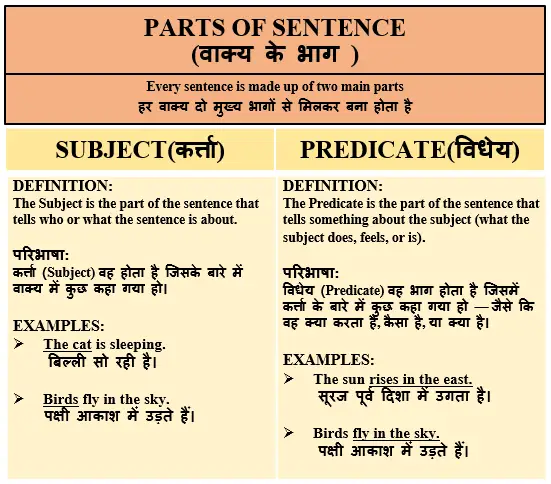
Every sentence is made up of two main parts –
1. Subject
2. Predicate.
• The Subject is the part of the sentence that tells who or what the sentence is about.
• The Predicate is the part of the sentence that tells something about the subject (what the subject does, feels, or is).
In short:
Subject = Who or what the sentence talks about
Predicate = What is said about the subject
हर वाक्य दो मुख्य भागों से मिलकर बना होता है —
1. कर्त्ता (Subject)
2. विधेय (Predicate)
• कर्त्ता (Subject) वह होता है जिसके बारे में वाक्य में कुछ कहा गया हो।
• विधेय (Predicate) वह भाग होता है जिसमें कर्त्ता के बारे में कुछ कहा गया हो — जैसे कि वह क्या करता है, कैसा है, या क्या है।
संक्षेप में:
कर्त्ता (Subject) – जिसके बारे में कहा गया है।
विधेय (Predicate) – उसके बारे में क्या कहा गया है।
1. Subject (कर्त्ता) – definition
Definition
he Subject of a sentence is the person, place, thing, or idea that the sentence is about.
It tells who or what performs the action or who or what the sentence is describing.
Or
The Subject tells who or what is doing the action in the sentence.
परिभाषा
वाक्य का कर्त्ता (Subject) वह शब्द या शब्द-समूह होता है जिसके बारे में वाक्य में कुछ कहा जाता है।
कर्त्ता यह बताता है कि कौन कार्य कर रहा है या किसके बारे में कुछ कहा जा रहा है।
or
कर्त्ता (Subject) वह होता है जो वाक्य में काम करता है या जिसके बारे में बताया जाता है।
Examples:
1. The cat is sleeping.
बिल्ली सो रही है।
2. Birds fly in the sky.
पक्षी आकाश में उड़ते हैं।
3. The sun gives us light.
सूरज हमें रोशनी देता है।
4. My mother cooks delicious food.
मेरी माँ स्वादिष्ट खाना बनाती हैं।
5. Rahul plays cricket.
राहुल क्रिकेट खेलता है।
6. The stars twinkle at night.
तारे रात में चमकते हैं।
7. The children are laughing.
बच्चे हँस रहे हैं।
8. My dog loves milk.
मेरा कुत्ता दूध पसंद करता है।
9. The teacher is explaining the lesson.
शिक्षक पाठ समझा रहे हैं।
10. Flowers bloom in spring.
फूल वसंत ऋतु में खिलते हैं।
Note: उपर्युक्त वाक्यों में अंडरलाइन किए गए शब्द Subject है तथा बाकी का बचा भाग Predicate है।
Read Also
• Tense
• Present Tense
• Past Tense
• Future tense Tense
❖ Parts of a Subject (कर्त्ता के भाग)
The Subject of a sentence can be divided into two main parts:
1. Simple Subject
2. Complete Subject
3. (Sometimes we also include Compound Subject)
The Subject tells who or what the sentence is about.
Each part gives more detail about that “who” or “what.”
कर्त्ता (Subject) वाक्य का वह भाग है जो बताता है कि वाक्य किसके बारे में या किस वस्तु के बारे में है।
कर्त्ता के भी मुख्य रूप से दो भाग होते हैं:
1. सरल कर्त्ता (Simple Subject)
2. पूरा कर्त्ता (Complete Subject)
3. (कभी-कभी तीसरा: संयुक्त कर्त्ता – Compound Subject भी होता है)
1.Simple subject
Definition
The Simple Subject is the main word (usually a noun or pronoun) that tells who or what the sentence is about.
It does not include any modifiers or extra words.
परिभाषा
सरल कर्त्ता वह मुख्य शब्द होता है (अक्सर संज्ञा या सर्वनाम) जो बताता है कि वाक्य किसके बारे में है।
इसमें कोई अतिरिक्त शब्द या विशेषण नहीं होता।
Examples:
1. The boy runs fast.
लड़का तेज़ दौड़ता है।
2. My teacher is kind.
मेरा शिक्षक दयालु है।
3. The birds are flying.
पक्षी उड़ रहे हैं।
4. She is singing.
वह गा रही है।
5. The dog barked.
कुत्ता भौंका।
Note : उपयुक्त वाक्यों में अंडरलाइन किए गए शब्द Simple subject है।
Read Also
• Sentence and Types of Sentence
• Affirmative Sentence
• Negative Sentence
• Interrogative Sentence
2. Complete Subject (पूरा कर्त्ता) – Definition
The Complete Subject includes the Simple Subject and all the words that describe or modify it.
परिभाषा
पूरा कर्त्ता में सरल कर्त्ता के साथ उसके बारे में बताने वाले सभी शब्द (विशेषण या वाक्यांश) शामिल होते हैं।
यह कर्त्ता की पूरी जानकारी देता है।
Examples:
1. The little boy runs fast.
वह छोटा लड़का तेज़ दौड़ता है।
2. My kind teacher is helping me.
मेरा दयालु शिक्षक मेरी मदद कर रहा है।
3. The two tall men are working.
वे दो लंबे आदमी काम कर रहे हैं।
4. The black cat is sleeping.
काली बिल्ली सो रही है।
5. Her best friend is dancing.
उसकी सबसे अच्छी दोस्त नाच रही है।
Note : उपयुक्त वाक्यों में अंडरलाइन किए गए शब्द Complete subject है।
Read Also
• Gender
• Singular & Plural
3. Compound Subject (संयुक्त कर्त्ता) – Definition
A Compound Subject has two or more simple subjects joined by a conjunction (like and, or).
They share the same predicate.
परिभाषा
संयुक्त कर्त्ता वह होता है जिसमें दो या दो से अधिक कर्त्ता होते हैं जिन्हें and या or जैसे शब्दों से जोड़ा जाता है,
और वे एक ही विधेय (Predicate) साझा करते हैं।
Examples:
1. Riya and Sita are dancing.
रिया और सीता नाच रही हैं।
2. The dog and the cat are friends.
कुत्ता और बिल्ली दोस्त हैं।
3. My brother and I play football.
मेरा भाई और मैं फुटबॉल खेलते हैं।
4. Birds and butterflies fly in the sky.
पक्षी और तितलियाँ आकाश में उड़ती हैं।
5. The teacher and students went on a trip.
शिक्षक और विद्यार्थी सैर पर गए।
Note : उपयुक्त वाक्यों में अंडरलाइन किए गए शब्द Compound subject है।
Read Also
• Active & Passive voice
• Article-A
2. Predicate (विधेय) – definition
The Predicate of a sentence tells something about the Subject.
It shows what the subject does, what the subject is, or what happens to the subject.
or
Predicate = the part of the sentence that tells what the subject does or is.
परिभाषा
विधेय (Predicate) वाक्य का वह भाग होता है जो कर्त्ता (Subject) के बारे में कुछ बताता है।
यह यह दर्शाता है कि कर्त्ता क्या करता है, कैसा है, या उसके साथ क्या होता है।
or
विधेय वाक्य का वह हिस्सा है जो कर्त्ता के बारे में जानकारी देता है।
Examples:
1.The sun rises in the east.
सूरज पूर्व दिशा में उगता है।
2.Birds fly in the sky.
पक्षी आकाश में उड़ते हैं।
3.My father is a doctor.
मेरे पिता डॉक्टर हैं।
4. The children are playing football.
बच्चे फुटबॉल खेल रहे हैं।
5. Dogs bark at strangers.
कुत्ते अनजान लोगों पर भौंकते हैं।
6. She speaks English fluently.
वह धाराप्रवाह अंग्रेजी बोलती है।
7. The stars shine at night.
तारे रात में चमकते हैं।
8. Our teacher teaches us grammar.
हमारे शिक्षक हमें व्याकरण पढ़ाते हैं।
9. The baby is crying.
बच्चा रो रहा है।
10. The boy runs fast.
लड़का तेज़ दौड़ता है।
Note : उपयुक्त वाक्यों में अंडरलाइन किए गए शब्द Predicate है।
Read Also
• Present Indefinite Tense
• Present Perfect Tense
• Present Continuous Tense
• Present Perfect Continuous Tense
❖ Parts of Predicate (विधेय के भाग)
The Predicate is the part of a sentence that tells something about the Subject — what the subject does, what happens to the subject, or what the subject is.
The Predicate can be divided into three main parts:
1. Verb
2. Object
3. Complement / Adverbial
विधेय (Predicate) वाक्य का वह भाग होता है जो कर्त्ता (Subject) के बारे में कुछ बताता है —
कर्त्ता क्या करता है, उसके साथ क्या होता है, या वह कैसा है।
विधेय के मुख्य तीन भाग होते हैं:
1. क्रिया (Verb)
2. कर्म (Object)
3. पूरक / विशेषण (Complement / Adverbial)
Read Also
• Imperative Sentence
• Exclamatory Sentence
• Conditional Sentence
1. Verb (क्रिया)
Definition
A verb is the main word in the predicate that shows the action or state of being of the subject.
परिभाषा
क्रिया वह मुख्य शब्द होता है जो कर्त्ता की क्रिया (काम) या अवस्था को दर्शाता है।
Examples:
1. She sings a song.
वह गाना गाती है।
2. The baby is crying.
बच्चा रो रहा है।
3. They played football.
उन्होंने फुटबॉल खेली।
4. The sun rises.
सूरज उगता है।
5. He runs fast.
वह तेज़ दौड़ता है।
Note: उपयुक्त वाक्यों में अंडरलाइन किए गए शब्द Verb है।
Read Also
• Parts of speech
• Verb and Types of verb
• Modal Auxiliary Verb
2. Object (कर्म)
Definition
he Object is the word or group of words that receives the action of the verb.
It answers the question “what?” or “whom?” after the verb.
Types of Objects:
1. Direct Object → answers what?
2. Indirect Object → answers to whom? or for whom?
परिभाषा
कर्म (Object) वह शब्द या शब्द समूह होता है जो क्रिया का प्रभाव सहता है।
यह “क्या?” या “किसे?” जैसे प्रश्नों का उत्तर देता है।
कर्म दो प्रकार के होते हैं:
1. सीधा कर्म (Direct Object) — “क्या?” का उत्तर देता है।
2. परोक्ष कर्म (Indirect Object) — “किसे?” या “किसके लिए?” का उत्तर देता है।
1. Direct object (सीधा कर्म)
Definition
Direct Object is the noun, pronoun, or phrase that receives the action of the verb directly.
It answers the question “What?” or “Whom?” after the verb.
It shows what or who is affected by the action of the subject.
परिभाषा
सीधा कर्म (Direct Object) वह शब्द (संज्ञा, सर्वनाम या वाक्यांश) होता है जो क्रिया का प्रभाव सीधे सहता है।
यह “क्या?” या “किसे?” जैसे प्रश्नों का उत्तर देता है।
यह बताता है कि कर्त्ता का कार्य किस पर या किस वस्तु पर हुआ है।
• How to Identify a Direct Object (पहचान कैसे करें):
1. सबसे पहले क्रिया (Verb) को पहचानें।
2. फिर पूछें — क्रिया के बाद “क्या?” या “किसे?”
3. जो उत्तर मिलता है, वही Direct Object होता है।
Examples:
1. She eats an apple.
Verb – eats
Eats what? – an apple
Direct object – an apple
2. The girl sang a song.
लड़की ने गाना गाया।
3. He bought a car.
उसने एक कार खरीदी।
4. They watched a movie.
उन्होंने फिल्म देखी।
5. The cat chased the mouse.
बिल्ली ने चूहे का पीछा किया।
6. She opened the door.
उसने दरवाज़ा खोला।
7. We cleaned the room.
हमने कमरा साफ किया।
8. He threw the ball.
उसने गेंद फेंकी।
9. Rohan ate the cake.
रोहन ने केक खाया।
10. The student answered the question.
छात्र ने प्रश्न का उत्तर दिया।
Note: उपयुक्त वाक्यों में अंडरलाइन किए गए शब्द Direct Object है।
2. Indirect Object (परोक्ष कर्म)
Definition
An Indirect Object is the noun or pronoun that receives the action indirectly, usually showing to whom or for whom something is done.
It answers the questions “To whom?”, “For whom?”, or “For what?” after the verb.
It always comes before the Direct Object in a sentence (in normal word order).
परिभाषा
परोक्ष कर्म (Indirect Object) वह शब्द होता है जो क्रिया का प्रभाव अप्रत्यक्ष रूप से प्राप्त करता है।
यह बताता है कि कर्त्ता ने कार्य “किसे” या “किसके लिए” किया।
यह “किसे? / किसके लिए? / किस हेतु?” जैसे प्रश्नों का उत्तर देता है।
आम तौर पर वाक्य में यह सीधे कर्म (Direct Object) से पहले आता है।
How to Identify the Indirect Object (पहचान कैसे करें):
1. Verb को पहचानिए।
2. फिर पूछिए — यह काम किसे? / किसके लिए? किया गया?
3. जो उत्तर मिले, वही Indirect Object है।
Examples:
1. She gave me a book.
Verb – gave
Indirect object – me (to whom?)
Direct object – a book (what?)
2. He sent her a letter.
उसने उसे एक पत्र भेजा।
3. My father bought me a new phone.
मेरे पिता ने मुझे नया फोन खरीदा।
4. The teacher taught us English.
शिक्षक ने हमें अंग्रेज़ी पढ़ाई।
5. I told him the truth.
मैंने उसे सच बताया।
6. They offered me a job.
उन्होंने मुझे नौकरी की पेशकश की।
7. She made him a cup of tea.
उसने उसके लिए एक कप चाय बनाई।
8. Riya showed her friend the picture.
रिया ने अपनी दोस्त को तस्वीर दिखाई।
9. He asked me a question.
उसने मुझसे एक सवाल पूछा।
10. We sent them an invitation.
हमने उन्हें निमंत्रण भेजा।
उपयुक्त वाक्यों में अंडरलाइन किए गए शब्द Indirect Object है।
Read Also
• Use of Used to
• Use of Dare
• Use of Must
3.Complement (पूरक)
Definition
Complement gives extra information about the subject or the object.
It completes the meaning of the verb.
Two main types
1. Subject Complement — describes or renames the subject.
2. Object Complement — gives more information about the object.
परिभाषा
पूरक वह शब्द होता है जो क्रिया के अर्थ को पूरा करता है या कर्त्ता/कर्म के बारे में अधिक जानकारी देता है।
दो प्रकार के पूरक:
1. कर्त्ता पूरक (Subject Complement) — कर्त्ता के बारे में बताता है।
2. कर्म पूरक (Object Complement) — कर्म के बारे में बताता है।
Examples:
1. She is a teacher. (Subject Complement)
वह एक शिक्षिका है।
2. The sky became dark.(Subject Complement)
आकाश अंधेरा हो गया।
3. They made him captain.(Object Complement)
उन्होंने उसे कप्तान बना दिया।
4. The food tastes delicious. (Subject Complement)
खाना स्वादिष्ट लगता है।
5. He called her beautiful.(Object Complement)
उसने उसे सुंदर कहा।
Note: उपयुक्त वाक्यों में अंडरलाइन किए गए शब्द Complement है।
Read Also
• Past Indefinite Tense
• Past Perfect Tense
• Past Continuous Tense
• Past Perfect Continuous Tense
4.Adverbial (क्रिया विशेषण)
Definition
An Adverbial adds information about the verb — it tells how, when, where, or why the action happens.
परिभाषा
क्रिया विशेषण (Adverbial) क्रिया के बारे में अतिरिक्त जानकारी देता है —
यह बताता है कि कार्य कैसे, कब, कहाँ या क्यों हुआ।
Examples:
1. She sings sweetly.
वह मीठे स्वर में गाती है।
2. He runs fast.
वह तेज़ दौड़ता है।
3. They will meet tomorrow.
वे कल मिलेंगे।
4. The boy sat here.
लड़का यहाँ बैठा।
5. He worked hard.
उसने कड़ी मेहनत की।
उपयुक्त वाक्यों में अंडरलाइन किए गए शब्द Adverbial है।
Read Also
• Future Indefinite Tense
• Future Perfect Tense
• Future Continuous Tense
• Future Perfect Continuous Tense