Past Indefinite Tense (Simple Past Tense) अनिश्चित भूतकाल (सामान्य भूतकाल)
Definition -
Past Indefinite Tense (Simple Past Tense) is the tense used to describe an action that started and finished completely in the past. The action has no connection with the present time.
It tells about:
• a completed action in the past,
• a past habit,
• a past event or fact.
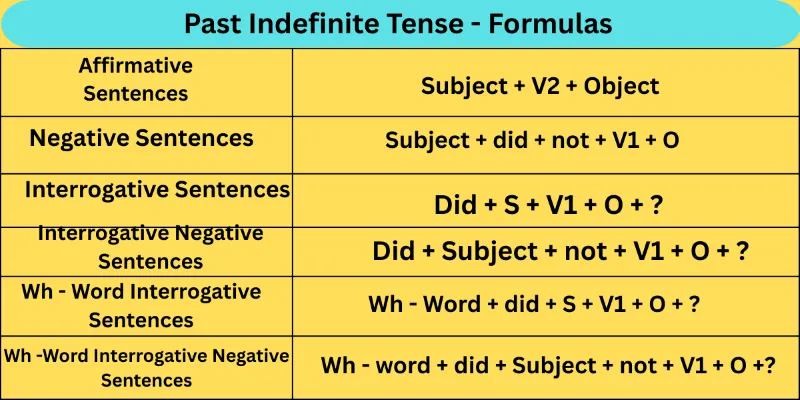
In this tense, we mainly use the second form of the verb (V2) in affirmative sentences, and did + V1 in negative and interrogative sentences.
परिभाषा -
Past Indefinite Tense वह काल है जो बीते हुए समय में शुरू होकर उसी समय में पूरा होने वाले कार्यों को दर्शाता है।
यह उन कार्यों के बारे में बताता है जिनका वर्तमान से कोई संबंध नहीं होता।
इसमें —
• पूरा हुआ कार्य,
• अतीत की आदत,
• पुरानी घटना या तथ्य बताए जाते हैं।
इन वाक्यों के अंत में गई, गया, ता था, ता थी, ता थे, आदि शब्द आते हैं।
इसके सकारात्मक (affirmative) वाक्यों में क्रिया का दूसरा रूप (V2) आता है, और नकारात्मक व प्रश्नवाचक वाक्यों में did + V1 का प्रयोग होता है।
Examples :
1. I visited the museum yesterday.
मैंने कल संग्रहालय का दौरा किया।
2. She cooked a special dish for me.
उसने मेरे लिए एक खास व्यंजन बनाया।
3. They watched a science show on TV.
उन्होंने टीवी पर एक विज्ञान शो देखा।
4. We celebrated his birthday last night.
हमने कल रात उसका जन्मदिन मनाया।
5. He repaired his old bicycle.
उसने अपनी पुरानी साइकिल ठीक की।
6. The train arrived on time.
ट्रेन समय पर पहुँची।
7. She cleaned her study room.
उसने अपना अध्ययन कक्ष साफ किया।
8. I bought a new notebook.
मैंने एक नई नोटबुक खरीदी।
9. They learned a new dance step.
उन्होंने एक नया डांस स्टेप सीखा।
10. The children played in the garden.
बच्चों ने बगीचे में खेला।
उपरोक्त दिए गए वाक्य सभी सामान्य भूतकाल के हैं सभी वाक्यों के अंत मे खाया, गया, गयी, सिखाया, खाया,आदि शब्द आ रहे हैं।
Read Also
• Past Tense
• Past Indefinite Tense • Past Continuous Tense
• Past Perfect Tense • Past Perfect Continuous Tense
Rules of Past Indefinite Tense (सामान्य भूतकाल के नियम) :
Rule 1: Use of Verb’s Second Form (V2)
In Past Indefinite Affirmative sentences, we always use V2 because the action finished completely in the past.
Past Indefinite के सकारात्मक वाक्यों में क्रिया का दूसरा रूप (V2) आता है,
क्योंकि काम अतीत में शुरू होकर उसी समय पूरा हो चुका होता है।
2. Rule of Time Words (Same like “since/for” explanation style)
Important Time Words Used in Past Indefinite
We use past time words such as:
yesterday, last night, last week, last year, ago, before, once, earlier, that day
Past Indefinite में ये समय शब्द आते हैं:
कल, बीती रात, पिछले हफ्ते, सालों पहले, अभी कुछ देर पहले, पहले, एक बार
ये शब्द दिखाते हैं कि क्रिया अतीत में हुई और खत्म हो गई।
3. Rule for Negative Sentences
To make a negative sentence, we use did not (didn’t).
After “did not”, the verb becomes V1 because “did” already shows past.
Negative वाक्य बनाने के लिए did not लगाया जाता है, और इसके बाद क्रिया का पहला रूप (V1) आता है क्योंकि “did” पहले ही past दिखाता है।
4. Rule for Interrogative Sentences (Questions)
Questions begin with Did, and the verb remains in V1.
प्रश्नवाचक वाक्यों की शुरुआत हमेशा Did से होती है और क्रिया का रूप V1 रहता है।
5. Rule for Interrogative Negative Sentences
When a question is also negative, we use:
Did + subject + not + V1 + … ?
जब प्रश्नवाचक वाक्य नकारात्मक हो, तब क्रम होता है—
Did + subject + not + V1 + … ?
6. Identification Rule (Same style as “ending rule” from previous tenses)
Past Indefinite के वाक्यों के अंत में आमतौर पर ये रूप आते हैं:
–ा, –ई, –ए, –ओं, –या, –यी, –ये
Example: गया, गई, किया, पढ़ा, लिखा, खेले
ये अंत दिखाते हैं कि काम पूरा हो चुका है।
• Verb Forms Used
| Sentence |
Verb Form |
Example |
| Affirmative |
Verb V2 |
went, wrote |
| Negative |
Did + V1 |
Did not go |
| Interrogative |
Did + V1 |
Did you write |
1. Affirmative Sentences of Past Indefinite Tense (सकारात्मक वाक्य)
Affirmative sentences of the Past Indefinite Tense are used to express an action that started and finished completely in the past.
These sentences always use the second form of the verb (V2).
Past Indefinite Tense के Affirmative वाक्य उन कार्यों को दर्शाते हैं जो अतीत में शुरू होकर उसी समय पूरे हो गए हों।
इन वाक्यों में हमेशा क्रिया का दूसरा रूप (V2) प्रयोग होता है।
Rule (नियम):
Use V2 with subject to show a completed past action.
किसी भी subject के साथ क्रिया का दूसरा रूप (V2) लगाकर पूरा हुआ कार्य दर्शाया जाता है।
Examples:
1. He opened the window.
उसने खिड़की खोली।
2. She washed the clothes.
उसने कपड़े धोए।
3. They visited my house.
वे मेरे घर आए।
4. I completed my project.
मैंने अपना प्रोजेक्ट पूरा किया।
5. We tasted the new dish.
हमने नई डिश चखी।
6. The teacher checked the notebooks.
शिक्षक ने नोटबुक जाँची।
7. Riya called her friend.
रिया ने अपनी दोस्त को फोन किया।
8. He cleaned the room.
उसने कमरा साफ किया।
9. She watered the plants.
उसने पौधों को पानी दिया।
10. They built a small hut.
उन्होंने एक छोटी झोपड़ी बनाई।
11. I lost my keys.
मैंने अपनी चाबियाँ खो दीं।
12. We celebrated the festival.
हमने त्योहार मनाया।
13. The dog barked loudly.
कुत्ता जोर से भौंका।
14. She painted a beautiful picture.
उसने एक सुंदर चित्र बनाया।
15. He fixed the broken chair.
उसने टूटी हुई कुर्सी ठीक की।
16. They played in the rain.
वे बारिश में खेले।
17. I helped an old man.
मैंने एक बूढ़े आदमी की मदद की।
18. She bought fresh vegetables.
उसने ताज़ी सब्ज़ियाँ खरीदीं।
19. He cleaned his shoes.
उसने अपने जूते साफ किए।
20. The students prepared a chart.
छात्रों ने चार्ट तैयार किया।
21. We watched the sunrise.
हमने सूर्योदय देखा।
22. She joined the meeting.
वह मीटिंग में शामिल हुई।
23. He wrote a short story.
उसने एक छोटी कहानी लिखी।
24. The birds flew over the river.
पक्षी नदी के ऊपर उड़े।
25. I cooked rice.
मैंने चावल पकाए।
26. They planted new trees.
उन्होंने नए पेड़ लगाए।
27. She borrowed a book.
उसने एक किताब उधार ली।
28. He asked an important question.
उसने एक महत्वपूर्ण प्रश्न पूछा।
29. We shared our lunch.
हमने अपना खाना साझा किया।
30. The baby smiled at me.
बच्चे ने मुझे देखकर मुस्कुराया।
Read Also
• Affirmative Sentence • Use of Had
• Active & Passive Voice • Gender
• Use of Has & Have • Use of Use of Is/am/are
2. Negative Sentences of Past Indefinite Tense (नकारात्मक वाक्य)
Negative sentences of the Past Indefinite Tense are used to express actions that did not happen in the past.
These sentences always use did not (didn’t) + V1.
Past Indefinite Tense के Negative वाक्य उन कार्यों को बताते हैं जो अतीत में नहीं हुए।
इन वाक्यों में हमेशा did not + क्रिया का प्रथम रूप (V1) प्रयोग होता है।
Rules (नियम):
1. Use did not before the main verb to show that the action did not happen.
जिस कार्य का होना न हो, उस क्रिया से पहले did not का प्रयोग किया जाता है।
2. After did not, always use the first form of the verb (V1).
Did not के बाद हमेशा क्रिया का पहला रूप (V1) आता है, V2 नहीं।
3. Subject remains the same for all persons (I, you, he, she, they, etc.)
Subject चाहे कोई भी हो, negative बनाने में did not ही लगता है।
Example:
1. I did not close the main gate.
मैंने मुख्य गेट बंद नहीं किया।
2. She did not pack her suitcase.
उसने अपना सूटकेस नहीं पैक किया।
3. They did not climb the staircase.
वे सीढ़ियाँ नहीं चढ़े।
4. He did not drink the warm milk.
उसने गरम दूध नहीं पिया।
5. We did not reserve the seats.
हमने सीटें बुक नहीं कीं।
6. The child did not finish his drawing.
बच्चे ने अपनी ड्राइंग पूरी नहीं की।
7. Rohan did not find the correct address.
रोहन को सही पता नहीं मिला।
8. The shopkeeper did not open the shutters.
दुकानदार ने शटर नहीं खोले।
9. I did not check the message.
मैंने संदेश नहीं देखा।
10. She did not iron her clothes.
उसने अपने कपड़े नहीं प्रेस किए।
11. They did not join the training session.
उन्होंने प्रशिक्षण सत्र में भाग नहीं लिया।
12. He did not return the umbrella.
उसने छाता वापस नहीं किया।
13. We did not repair the broken table.
हमने टूटी मेज़ ठीक नहीं की।
14. The students did not repeat the answer.
छात्रों ने उत्तर दोहराया नहीं।
15. She did not follow the instructions.
उसने निर्देशों का पालन नहीं किया।
16. I did not switch off the lights.
मैंने लाइटें बंद नहीं कीं।
17. They did not welcome the guests.
उन्होंने मेहमानों का स्वागत नहीं किया।
18. He did not open his notebook.
उसने अपनी नोटबुक नहीं खोली।
19. The birds did not sit on the roof.
पक्षी छत पर नहीं बैठे।
20. She did not buy the blue dress.
उसने नीली ड्रेस नहीं खरीदी।
21. We did not start the engine.
हमने इंजन चालू नहीं किया।
22. He did not wash the utensils.
उसने बरतन नहीं धोए।
23. They did not plant the saplings.
उन्होंने पौधे नहीं लगाए।
24. I did not answer the phone call.
मैंने फोन कॉल का जवाब नहीं दिया।
25. The team did not complete the task.
टीम ने कार्य पूरा नहीं किया।
26. She did not visit the clinic.
वह क्लिनिक नहीं गई।
27. He did not lock the drawer.
उसने दराज बंद नहीं की।
28. The children did not collect the stones.
बच्चों ने पत्थर नहीं इकट्ठे किए।
29. We did not arrange the chairs.
हमने कुर्सियाँ नहीं लगाईं।
30. I did not send the invitation.
मैंने निमंत्रण नहीं भेजा।
Read Also
• Sentence Structure • Negative Sentence
• Singular & Plural Number • Articles
• Use of Do & Does • Use of Had
3.Interrogative Sentence of Past Indefinite Tense (प्रश्नवाचक वाक्य)
Interrogative sentences of the Past Indefinite Tense are used to ask questions about an action that was done completely in the past.
These questions always begin with Did, and the main verb remains in V1 (base form).
Past Indefinite Tense के Interrogative वाक्य उन प्रश्नों को व्यक्त करते हैं जिनमें किसी पूरा हुए भूतकाल के कार्य के बारे में पूछा जाता है।
इन वाक्यों की शुरुआत हमेशा Did से होती है और मुख्य क्रिया V1 (मूल रूप) में रहती है।
Rules (नियम):
1. Start the sentence with Did to form a question.
प्रश्न बनाने के लिए वाक्य की शुरुआत Did से की जाती है।
2. Use V1 after the subject because Did already shows past tense.
Subject के बाद क्रिया का V1 रूप लगता है क्योंकि Did ही past का भाव दिखा देता है।
3. Add a question mark (?) at the end.
वाक्य के अंत में प्रश्नवाचक चिन्ह (?) लगाया जाता
Examples:
1. Did you lock the main door?
क्या तुमने मुख्य दरवाज़ा बंद किया?
2. Did she complete her homework?
क्या उसने अपना होमवर्क पूरा किया?
3. Did they visit the new museum?
क्या वे नए संग्रहालय गए?
4. Did he check the timetable?
क्या उसने समय-सारणी देखी?
5. Did you call your cousin?
क्या तुमने अपने कज़िन को फोन किया?
6. Did the baby sleep early?
क्या बच्चा जल्दी सोया?
7. Did she bake a chocolate cake?
क्या उसने चॉकलेट केक बनाया?
8. Did he fix the bicycle?
क्या उसने साइकिल ठीक की?
9. Did they open the store on time?
क्या उन्होंने समय पर दुकान खोली?
10. Did you wash your hands?
क्या तुमने हाथ धोए?
11. Did the teacher explain the chapter?
क्या शिक्षक ने अध्याय समझाया?
12. Did she paint the wall?
क्या उसने दीवार रंगी?
13. Did he find his lost wallet?
क्या उसे अपना खोया बटुआ मिला?
14. Did the students write the report?
क्या छात्रों ने रिपोर्ट लिखी?
15. Did you attend the online class?
क्या तुमने ऑनलाइन क्लास अटेंड की?
16. Did they win the match?
क्या वे मैच जीते?
17. Did she water the plants?
क्या उसने पौधों को पानी दिया?
18. Did he bring the documents?
क्या वह दस्तावेज़ लाया?
19. Did you see the rainbow?
क्या तुमने इंद्रधनुष देखा?
20. Did they switch off the lights?
क्या उन्होंने लाइटें बंद कीं?
21. Did she borrow a novel from you?
क्या उसने तुमसे एक नावेल उधार ली?
22. Did he open the laptop?
क्या उसने लैपटॉप खोला?
23. Did you taste the soup?
क्या तुमने सूप चखा?
24. Did they clean the classroom?
क्या उन्होंने कक्षा साफ की?
25. Did she attend the meeting?
क्या वह मीटिंग में शामिल हुई?
26. Did he buy fresh fruits?
क्या उसने ताज़े फल खरीदे?
27. Did you send the parcel?
क्या तुम ने पार्सल भेजा?
28. Did the cat jump on the table?
क्या बिल्ली मेज़ पर कूदी?
29. Did they decorate the hall?
क्या उन्होंने हॉल सजाया?
30. Did he help his neighbor?
क्या उसने अपने पड़ोसी की मदद की?
Read Also
• Parts of Sentence • Interrogative Sentence
• Use of These & Those • Use of This & That
• Use of Was & Were • Noun
4. Interrogative Negative Sentences of Past Indefinite Tense (प्रश्नवाचक नकारात्मक वाक्य)
Interrogative negative sentences of the Past Indefinite Tense are used to ask questions about an action that did not happen in the past.
These sentences begin with Did, followed by the subject and not, and the main verb always stays in V1 form.
Past Indefinite Tense के Interrogative Negative वाक्य उन बातों के लिए उपयोग होते हैं जहाँ भूतकाल में कोई कार्य नहीं हुआ और उसके बारे में प्रश्न पूछा जा रहा हो।
इन वाक्यों में शुरुआत Did से होती है, उसके बाद Subject + not आता है, और मुख्य क्रिया हमेशा V1 रूप में रहती है।
Rules (नियम):
1. Start the question with Did.
प्रश्न बनाने के लिए वाक्य की शुरुआत Did से करें।
2. Place not immediately after the subject to show negativity.
नकारात्मकता दिखाने के लिए subject के बाद not लगाया जाता है।
3. Use V1 form of the verb because Did already indicates past.
क्रिया हमेशा V1 रूप में लगती है क्योंकि past का भाव Did से ही आ जाता है।
4. Put the question mark (?) at the end.
वाक्य के अंत में प्रश्नवाचक चिन्ह (?) लगाया जाता है।
Examples:
1. Did you not close the kitchen door?
क्या तुमने रसोई का दरवाज़ा नहीं बंद किया?
2. Did she not finish her drawing?
क्या उसने अपनी ड्राइंग पूरी नहीं की?
3. Did they not attend the evening class?
क्या उन्होंने शाम की कक्षा अटेंड नहीं की?
4. Did he not wash the vegetables?
क्या उसने सब्ज़ियाँ नहीं धोईं?
5. Did you not pay the bill yesterday?
क्या तुमने कल बिल नहीं भरा?
6. Did she not check her email?
क्या उसने अपना ईमेल नहीं देखा?
7. Did he not carry his identity card?
क्या वह अपना पहचान पत्र नहीं लाया?
8. Did they not visit the hospital?
क्या वे अस्पताल नहीं गए?
9. Did you not start the engine?
क्या तुमने इंजन शुरू नहीं किया?
10. Did she not arrange the files?
क्या उसने फाइलें व्यवस्थित नहीं कीं?
11. Did he not open the window?
क्या उसने खिड़की नहीं खोली?
12. Did they not plant the seeds?
क्या उन्होंने बीज नहीं लगाए?
13. Did you not call the plumber?
क्या तुमने प्लंबर को नहीं बुलाया?
14. Did she not bring the notebook?
क्या वह नोटबुक नहीं लाई?
15. Did he not follow the instructions?
क्या उसने निर्देशों का पालन नहीं किया?
16. Did they not hear the announcement?
क्या उन्होंने घोषणा नहीं सुनी?
17. Did you not taste the new recipe?
क्या तुमने नई रेसिपी नहीं चखी?
18. Did she not join the online meeting?
क्या वह ऑनलाइन मीटिंग में शामिल नहीं हुई?
19. Did he not iron his clothes?
क्या उसने अपने कपड़े प्रेस नहीं किए?
20. Did they not decorate the room?
क्या उन्होंने कमरा सजाया नहीं?
21. Did you not return the book?
क्या तुमने किताब वापस नहीं की?
22. Did she not clean the mirror?
क्या उसने आईना नहीं साफ किया?
23. Did he not buy the medicine?
क्या उसने दवाई नहीं खरीदी?
24. Did they not prepare the slides?
क्या उन्होंने स्लाइड्स तैयार नहीं कीं?
25. Did you not share the information?
क्या तुमने जानकारी साझा नहीं की?
26. Did she not close her laptop?
क्या उसने अपना लैपटॉप बंद नहीं किया?
27. Did he not practice the speech?
क्या उसने भाषण का अभ्यास नहीं किया?
28. Did they not feed the cows?
क्या उन्होंने गायों को चारा नहीं खिलाया?
29. Did you not fix the chair?
क्या तुमने कुर्सी ठीक नहीं की?
30. Did she not visit your home?
क्या वह तुम्हारे घर नहीं आई?
Read Also
• Parts of Sentence • Conditional Sentence
• Model Verb • Use of Can & Could
• Use of Dare • Use of May & Might
5. Wh -Word Interrogative Sentences of Past Indefinite Tense (प्रश्नवाचक वाक्य)
WH-word interrogative sentences in the Past Indefinite Tense are used to ask detailed questions about an action that happened completely in the past.
These questions start with a WH-word (What, When, Where, Why, Whom, Which, How, How many, etc.) and then take Did before the subject.
The main verb always stays in V1 (base form).
Past Indefinite Tense के WH-word Interrogative वाक्य उन कार्यों के बारे में विस्तृत प्रश्न पूछने के लिए बनाए जाते हैं जो अतीत में पूरी तरह संपन्न हो चुके हों।
इन वाक्यों की शुरुआत किसी WH-word (क्या, कब, कहाँ, क्यों, किससे, किसको, कैसे आदि) से होती है।
फिर Did + Subject + V1 का प्रयोग किया जाता है।
Rules (नियम):
1. Start the sentence with an appropriate WH-word according to the question type.
प्रश्न के प्रकार के अनुसार वाक्य की शुरुआत किसी WH-word से करें।
2. Place Did after the WH-word.
WH-word के तुरंत बाद Did लगाया जाता है।
3. Use V1 form of the main verb because Did shows the past.
मुख्य क्रिया हमेशा V1 रूप में आती है क्योंकि past का भाव Did से ही आता है।
4. End the sentence with a question mark (?).
वाक्य के अंत में (?) लगाया जाता है।
Examples:
1. What did you cook for dinner?
तुमने रात के खाने में क्या पकाया?
2. Where did she keep the documents?
उसने दस्तावेज़ कहाँ रखे?
3. When did they leave for Jaipur?
वे जयपुर के लिए कब निकले?
4. Why did he ignore your message?
उसने तुम्हारा संदेश क्यों अनदेखा किया?
5. Which book did you buy yesterday?
तुमने कल कौन सी किताब खरीदी?
6. Whom did she meet at the station?
वह स्टेशन पर किससे मिली?
7. How did he solve the problem?
उसने समस्या कैसे हल की?
8. What did they discuss in the meeting?
उन्होंने मीटिंग में क्या चर्चा की?
9. Where did you find this wallet?
तुम्हें यह बटुआ कहाँ मिला?
10. When did the movie start?
फ़िल्म कब शुरू हुई?
11. Why did she cancel the plan?
उसने योजना क्यों रद्द की?
12. Which color did he choose for the wall?
उसने दीवार के लिए कौन-सा रंग चुना?
13. How many students did participate?
कितने छात्रों ने भाग लिया?
14. What did the teacher explain yesterday?
शिक्षक ने कल क्या समझाया?
15. Where did he park the car?
उसने कार कहाँ पार्क की?
16. When did you meet your uncle last time?
तुम आख़िरी बार अपने अंकल से कब मिले?
17. Why did they skip the class?
उन्होंने कक्षा क्यों छोड़ी?
18. Which song did she sing on stage?
उसने मंच पर कौन-सा गीत गाया?
19. How did you open the lock?
तुमने ताला कैसे खोला?
20. What did he bring from the market?
वह बाज़ार से क्या लाया?
21. Where did the children play yesterday?
बच्चों ने कल कहाँ खेला?
22. When did she arrive at your home?
वह तुम्हारे घर कब पहुँची?
23. Why did he break the glass?
उसने गिलास क्यों तोड़ा?
24. Which dress did you select?
तुमने कौन-सी ड्रेस चुनी?
25. How much money did they spend?
उन्होंने कितना पैसा खर्च किया?
26. What did the doctor advise you?
डॉक्टर ने तुम्हें क्या सलाह दी?
27. Where did she hide the keys?
उसने चाबियाँ कहाँ छिपाईं?
28. When did the rain stop?
बारिश कब रुकी?
29. Why did he refuse the offer?
उसने प्रस्ताव क्यों ठुकराया?
30. How did they repair the radio?
उन्होंने रेडियो कैसे ठीक किया?
Read Also
• Exclamatory Sentence • Imperative Sentence
• Use of Must & Ought • Use of Shall & Will
• Use of Should & Would • Use of Used to
6.Wh – Word Interrogative Negative Sentences of Past Indefinite Tense (प्रश्नवाचक नकारात्मक वाक्य)
WH-word Interrogative Negative sentences in the Past Indefinite Tense are used to ask negative questions about an action that did not happen in the past and also require specific information (what, where, why, when, how, etc.).
These sentences start with a WH-word, followed by Did + subject + not + V1.
Past Indefinite Tense के WH-word Interrogative Negative वाक्य उन स्थितियों में बनाए जाते हैं जब अतीत में कोई कार्य नहीं हुआ और उसके बारे में विशेष जानकारी वाला प्रश्न पूछा जा रहा हो।
इन वाक्यों की शुरुआत WH-word से होती है, फिर Did + subject + not + V1 का प्रयोग किया जाता है।
Rules (नियम):
1. Start the sentence with the correct WH-word (What, Why, When, Where, Which, Whom, How, etc.).
वाक्य की शुरुआत उपयुक्त WH-word से करें (क्या, कहाँ, क्यों, कब, किससे, कैसे आदि)।
2. Place Did right after the WH-word.
WH-word के बाद तुरंत Did लगाएँ।
3. Add subject + not and use V1 (base form) after it.
Did के बाद Subject + not लिखकर क्रिया का V1 रूप लगाएँ।
4. Put a question mark (?) at the end.
अंत में प्रश्नवाचक चिन्ह (?) लगाएँ।
Examples:
1. Why did you not reply to my message?
तुमने मेरे संदेश का जवाब क्यों नहीं दिया?
2. Where did she not go yesterday?
वह कल कहाँ नहीं गई?
3. When did they not attend the meeting?
उन्होंने मीटिंग में कब हिस्सा नहीं लिया?
4. What did he not bring from the store?
वह स्टोर से क्या नहीं लाया?
5. Which task did you not complete?
तुमने कौन-सा काम पूरा नहीं किया?
6. Why did she not wear the uniform?
उसने यूनिफ़ॉर्म क्यों नहीं पहनी?
7. Where did he not keep the keys?
उसने चाबियाँ कहाँ नहीं रखीं?
8. How did they not hear the announcement?
उन्होंने घोषणा कैसे नहीं सुनी?
9. Whom did you not meet at the event?
तुम कार्यक्रम में किससे नहीं मिले?
10. Why did he not open the door?
उसने दरवाज़ा क्यों नहीं खोला?
11. What did you not understand in the chapter?
तुमने अध्याय में क्या नहीं समझा?
12. Where did the children not play yesterday?
बच्चों ने कल कहाँ नहीं खेला?
13. Why did the teacher not check the homework?
शिक्षक ने होमवर्क क्यों नहीं जांचा?
14. When did she not visit the office?
वह ऑफिस कब नहीं गई?
15. Which dish did he not taste?
उसने कौन-सी डिश नहीं चखी?
16. Why did they not join the session?
उन्होंने सत्र में भाग क्यों नहीं लिया?
17. How did you not notice the mistake?
तुमने गलती कैसे नहीं देखी?
18. Where did she not look for her phone?
उसने अपना फोन कहाँ नहीं ढूँढा?
19. Whom did he not call last night?
उसने कल रात किसे फोन नहीं किया?
20. Why did the driver not stop the bus?
चालक ने बस क्यों नहीं रोकी?
21. What did the team not finish on time?
टीम ने समय पर क्या पूरा नहीं किया?
22. When did you not pay the fee?
तुमने फीस कब नहीं भरी?
23. Why did she not send the invitation?
उसने निमंत्रण क्यों नहीं भेजा?
24. Where did he not keep his books?
उसने अपनी किताबें कहाँ नहीं रखीं?
25. Which option did you not choose?
तुमने कौन-सा विकल्प नहीं चुना?
26. Why did they not repair the chair?
उन्होंने कुर्सी ठीक क्यों नहीं की?
27. How did she not hear the alarm?
उसने अलार्म कैसे नहीं सुना?
28. What did you not record in the file?
तुमने फाइल में क्या दर्ज नहीं किया?
29. Where did the guests not visit?
मेहमान कहाँ नहीं गए?
30. Why did he not follow the rules?
उसने नियमों का पालन क्यों नहीं किया?
• Uses of Past Indefinite Tense:
1. किसी भी Completed Action को बताने के लिए
(Any action that happened & finished in the past)
Examples:
1. I cleaned my room yesterday.
मैंने कल अपना कमरा साफ किया।
2. She cooked dinner last night.
उसने कल रात खाना बनाया।
2. Past में हुई आदत या Routine बताने के लिए
(Habits or repeated actions in the past)
Examples:
1. He walked to school every day.
वह रोज़ स्कूल पैदल जाता था।
2. We visited our grandparents every summer.
हम हर गर्मी में अपने दादा-दादी से मिलने जाते थे।
3. Past में हुई घटना या Incident बताने के लिए
(Events, accidents, experiences)
Examples:
1. They met an actor at the mall.
वे मॉल में एक अभिनेता से मिले।
2. I lost my phone last week.
मैंने पिछली हफ्ते अपना फोन खो दिया।
4. Past में कोई Fact या Truth बताने के लिए
(A fact that was true in the past but not now)
Examples:
1. This place belonged to my uncle.
यह जगह मेरे चाचा की थी।
2. The shop sold only books earlier.
Hindi: यह दुकान पहले सिर्फ किताबें बेचती थी।
5. Short Story या कहानी में Events बताने के लिए
(Used widely in storytelling)
Examples:
1. The lion saw the hunter and ran away.
शेर ने शिकारी को देखा और भाग गया।
2. The king called his minister.
राजा ने अपने मंत्री को बुलाया।
6. Past में एक Action के बाद दूसरा Action बताने के लिए
(Sequence of actions in the past)
Examples:
1. She opened the door and entered the room.
उसने दरवाजा खोला और कमरे में दाखिल हुई।
2. He took the book and sat on the chair.
उसने किताब उठाई और कुर्सी पर बैठ गया।
7. किसी के बारे में Past Opinion/Feeling बताने के लिए
(Past thoughts, feelings)
Examples:
1. I believed her words.
मैंने उसकी बातों पर विश्वास किया।
2. They liked the new teacher.
उन्हें नए शिक्षक पसंद आए।
Read Also
• Parts of Speech
• Noun • Pronoun
• Verb • Adverb
• Adjective • Conjunction
• Interjection • Preposition
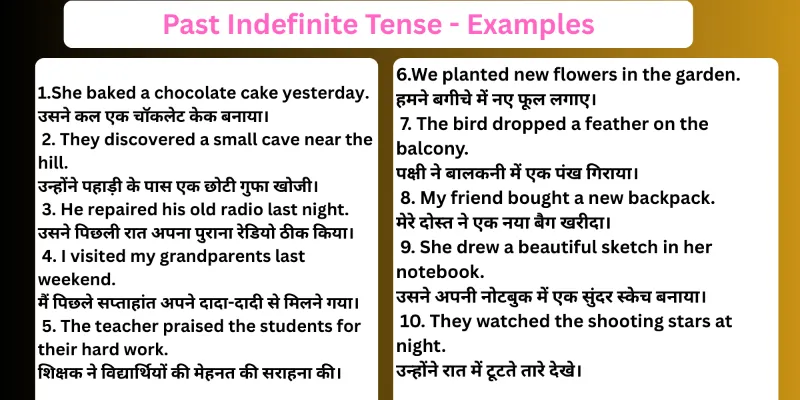
Examples of Past Indefinite Tense :
1. She opened the old wooden box.
उसने पुराना लकड़ी का डिब्बा खोला।
2. They visited the science museum yesterday.
उन्होंने कल विज्ञान संग्रहालय का दौरा किया।
3. I cleaned my study table in the morning.
मैंने सुबह अपनी पढ़ाई की मेज़ साफ की।
4. He repaired his bicycle last week.
उसने पिछले हफ्ते अपनी साइकिल ठीक की।
5. We enjoyed the rain on the terrace.
हमने छत पर बारिश का आनंद लिया।
6. The teacher praised my project.
शिक्षक ने मेरी परियोजना की प्रशंसा की।
7. She baked a chocolate cake for me.
उसने मेरे लिए चॉकलेट का केक बनाया।
8. I watched a documentary about oceans.
मैंने महासागरों पर एक डॉक्यूमेंट्री देखी।
9. They planted two mango trees in the garden.
उन्होंने बगीचे में दो आम के पेड़ लगाए।
10. He completed his homework on time.
उसने अपना होमवर्क समय पर पूरा किया।
11. The dog chased the ball quickly.
कुत्ते ने गेंद को तेजी से पीछा किया।
12. I bought a new notebook from the market.
मैंने बाज़ार से नई नोटबुक खरीदी।
13. She painted a beautiful landscape.
उसने एक सुंदर दृश्यचित्र बनाया।
14. We celebrated my sister’s birthday.
हमने मेरी बहन का जन्मदिन मनाया।
15. He forgot his wallet at home.
वह अपना बटुआ घर पर भूल गया।
16. The birds flew over the tall trees.
पक्षी ऊँचे पेड़ों के ऊपर उड़े।
17. I listened to calm music last night.
मैंने कल रात शांत संगीत सुना।
18. They cooked dinner together.
उन्होंने मिलकर रात का खाना बनाया।
19. She wrote a letter to her friend.
उसने अपने दोस्त को एक पत्र लिखा।
20. The sun rose early today.
आज सूरज जल्दी निकला।
21. We travelled to Jaipur by bus.
हम बस से जयपुर गए।
22. He shared an interesting story.
उसने एक दिलचस्प कहानी सुनाई।
23. I washed my clothes on Sunday.
मैंने रविवार को अपने कपड़े धोए।
24. They watched stars in the clear sky.
उन्होंने साफ आसमान में तारों को देखा।
25. She learned a new dance step.
उसने एक नया डांस स्टेप सीखा।
26. I visited my cousin in the afternoon.
मैंने दोपहर में अपने चचेरे भाई से मुलाकात की।
27. He climbed the small hill easily.
उसने छोटी पहाड़ी को आसानी से चढ़ा।
28. We played indoor games during the holiday.
हमने छुट्टी के दौरान इंडोर गेम खेले।
29. The baby smiled at me.
बच्चे ने मुझे देखकर मुस्कुराया।
30. I switched off the lights before leaving.
मैं निकलने से पहले लाइटें बंद करके गया।
Read Tense and There Types
• Tense
• Present Tense
• Present Indefinite Tense • Present continuous tense
• Present Perfect Tense • Present Perfect Continuous Tense
• Past Tense
• Past Indefinite Tense • Past continuous tense
• Past Perfect Tense • Past Perfect Continuous Tense
• Future Tense
• Future Indefinite Tense
• future continuous tense • Future Perfect Tense
• Future Perfect Continuous Tense