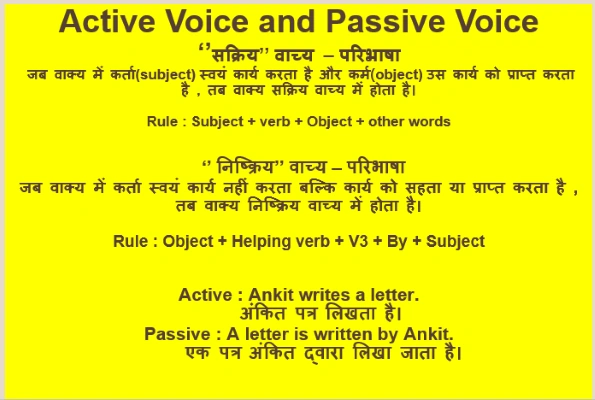
❖ ‘’ACTIVE’’ Voice – Definition
When the subject of the sentence performs the action of the verb , the sentence is in Active Voice.
❖ ‘’सक्रिय’’ वाच्य – परिभाषा
जब वाक्य में कर्ता (subject) स्वयं कार्य करता है और कर्म (object) उस कार्य को प्राप्त करता है , तब वाक्य सक्रिय वाच्य में होता है।
General Formula (संरचना) :
Examples (उदाहरण):
1.He cooks the food.
वह खाना पकाती है।
2.You write a letter.
तुम पत्र लिखते हो।
3.Ram eats mangoes.
राम आम खाता है।
4.He plays football.
वह फुटबॉल खेलता है।
5.She sings a song.
वह खाना खाती है।
6.The sun gives us light.
सूरज हमें प्रकाश देता है।
7.Mohan reads a newspaper.
मोहन अख़बार पढ़ता है।
8.Children are playing in the park.
बच्चे पार्क में खेल रहे हैं।
Read Also
• Affirmative Sentence • Negative Sentence
• Interrogative Sentence • Imperative Sentence
• Conditional Sentence • Exclamatory Sentence
• Key Points (मुख्य बिंदु)
1.Active Voice में Subject = Doer of Action (कार्य करने वाला ) होता है।
2.Verb(क्रिया) Subject की ओर से की जाती है।
3.Object वह होता है जिस पर कार्य का प्रभाव पड़ता है।
4.वाक्य अधिक सीधा, स्पष्ट और प्रभावी बनता है।
• Active Voice क्यों प्रयोग करते हैं?
1.साफ और सीधी भाषा – समझाना आसान होता है।
2.प्रभावशाली लेखन – पाठक को जल्दी संदेश मिलता है।
3.स्पषट जिम्मेदारी – पता चलता है कि काम किसने किया।
4.Daily use sentences – ज्यादातर Active Voice में ही होते हैं।
• Active Voice की पहचान कैसे करें?
1.वाक्य में Subject (कर्ता) कार्य कर रहा हो।
2.Verb की क्रिया Subject द्वारा की जा रही हो।
3.केवल उस क्रिया को प्राप्त कर रहा हो।
Example (उदाहरण):
➢ The teacher teaches English.
शिक्षक अंग्रेजी पढ़ता है।
✓ यहाँ teacher (subject)काम कर रहा है।
❖ ‘’PASSIVE’’ Voice – Definition
When the subject of a sentence does not perform the action but instead receives the action, the sentence is in Passive Voice.
❖ ‘’ निष्क्रिय’’ वाच्य – परिभाषा
जब वाक्य में कर्ता स्वयं कार्य नहीं करता बल्कि कार्य को सहता या प्राप्त करता है , तब वाक्य निष्क्रिय वाच्य में होता है।
General rule (संरचना) :
Examples (उदाहरण):
1. Mangoes are eaten by Ram.
आम राम द्वारा खाए जाते हैं।
2. English is taught by the teacher.
अंग्रेजी शिक्षक द्वारा पढ़ाई जाती है।
3. A song is being sung by Mohan.
गाना मोहन द्वारा गाया जा रहा है।
4. Cricket was played by them.
क्रिकेट उनके द्वारा खेला गया।
5. The problem has been solved by her.
समस्या उसके द्वारा हल कर दी गयी है।
6. His friend will be helped by Ram.
राम अपने दोस्त की मदद करेगा।
Passive Voice की पहचान
• Verb हमेशा 3rd form (V3) में होती है।
• Sentence में अक्सर ‘’by’’ का प्रयोग होता है।
• Subject ज़रूरी नहीं हमेशा लिखा जाए, (by+ Subject) कभी -कभी हटा भी दिया जाता है।
• Passive Voice का प्रयोग कब करते हैं?
1.जब Subject अज्ञात या महत्वहीन हो।
➢ The road was repaired yesterday.
सड़क कल मरम्मत की गई थी।
✓ यहाँ किसने किया, यह महत्वपूर्ण नहीं है।
2.जब Object पर ज़ोर देना हो।
➢ The Taj Mahal is admired by millions.
ताजमहल की लाखों लोग प्रशंसा करते हैं।
3. जब Formal writing/ reports / scientific facts में लिखना हो।
➢ The experiment was conducted successfully.
प्रयोग सफलतापूर्वक किया गया।
• Passive Voice की विशेष बातें
1.Verb हमेशा 3rd form (V3) में होगी ।
2.Continuous और Perfect Coutinuous Tense का Passive Voice नहीं बनता ।
3.Modal verbs (can, may, should , etc.)में Passive आसानी से बनता है।
➢ The work must be completed by you.
काम तुम्हारे द्वारा पूरा किया जाना चाहिए।
• Quick Active – Passive Conversion Formula
1.Object को आगे लगाओ।
2.Proper Helping Verb जोडों
(is/are/was/were/has/been/will be आदि)।
3.Verb को 3rd Form (V3) में बदलो।
4.Subject के पहले ‘’by’’ लगाओ (अगर जरुरी हो)।
➢ Active : The boy kicks the ball.
➢ Passive : The ball is kicked by the boy.
❖ All Tenses Convert Into Active Voice To Passive Voice :
सभी टेनसेस को सक्रिय आवाज़ से निष्क्रिय आवाज में चेंज :
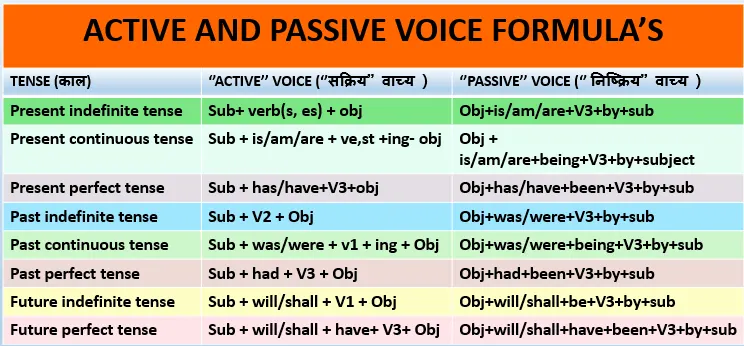
नीचे दी गई टेबल में विस्तार पूर्वक बताया गया है कि कौन से टेंस में कौन से हेल्पिंग वर्ब यूज़ होती है। नीचे दी गई टेबल को ध्यानपूर्वक समझिए, तभी आप Active to Passive voice चेंज करना सीख पाएंगे।
| Tense |
Active Voice Helping Verb |
Passive Voice Helping Verb |
| Present Indefinite Tense |
Do, Does |
Is, am, are |
| Present Countinous Tense |
Is, am, are |
Is being, am being, Are being |
| Present perfect Tense |
Has, have |
Has been, have been |
| Past Indefinite Tense |
did |
was, were |
| Past Countinous Tense |
was, were |
was being, were being, |
| Past perfect Tense |
had |
had been |
| Future Indefinite Tense |
Shall, will |
Shall be, will be |
| Future perfect Tense |
Shall have, will have |
Shall have been, will have been |
Note – Passive Voice केवल ऊपर दिये गयें आठ टेंशन्स को बनाता है बचे हुए चार टेंस Persent perfect continouse tense, Past perfect continouous tense, Future continuous tense, Future perfect continuous tense का Passive voice नहीं बनता है।
1.Passive Voice – Present Indefinite Tense (साधारण वर्तमान काल)
Rules (नियम)
1.Object को वाक्य की शरुआत में लाया जाता है।
2.Verb हमेशा Past Participle (V3) रुप में आएगा।
Helping Verb –
• Is – Singular subject (He , she, it , Name , One Object)
• Are – Plural subject (They, We, Many object)
• Am – Only With ‘’I’’
3.‘’By’’ का प्रयोग agent (doer/subject) बताने के लिए किया जाता है।
4.अगर subject ज़रूरी ना हो तो passive वाक्य without ‘’by’’ भी लिखा जा सकता है।
Read Tenses & there Types
• Tense • Present Tense
• Present-indefinite-Tense • Present - Perfect Tense
• Present- continuous - Tense • Present - perfect - continuous -Tense
• Past Tense • Past Indefinite Tense
• Past Perfect Tense • Past continuous Tense
• Past- Perfect- continuous- Tense • Future Tense
• Future- Perfect- Tense • Future- Indefinite- Tense
• Future- continuous- Tense • Future- Perfect- continuous- Tense
Examples Active to Passive Voice Sentences Present Indefinite Tense:
❖ Positive Sentences (सकारात्मक वाक्य)
1.Active:
Ankit writes a letter.
अंकित पत्र लिखता है।
Passive :
A letter is written by Ankit.
एक पत्र अंकित द्वारा लिखा जाता है।
2.Active:
She sings a song.
वह एक गाना गाती है।
Passive :
A song is sung by her.
एक गीत उसके द्वारा गाया जाता है।
3.Active:
They read books.
वे किताबें पढ़ते हैं।
Passive :
Books are read by them.
किताबें उनके द्वारा पढ़ी जाती है।
4.Active:
I help him.
मैंने उसकी मदद की।
Passive :
He is helped by me.
उसकी मदद मेरे द्वारा की जाती है।
5.Active:
The teacher teaches English.
अध्यापक अंग्रेजी पढ़ाता है।
Passive :
English is taught by the teacher.
अंग्रेजी अध्यापक द्वारा पढ़ाई जाती है।
6.Active:
The postman delivers letters.
डाकिया सामान पहुँचाता है।
Passive :
Letters are delivered by the postman.
चिट्ठियाँ डाकिए द्वारा पहुंचाई जाती है।
7.Active:
She decorates the house.
वह घर सजाती है।
Passive :
The house is decorated by her.
घर उसके द्वारा सजाया जाता है।
8.Active:
Farmers grow crops.
किसान फसलें उगाते हैं।
Passive :
Crops are grown by Farmers.
फसलें किसानों द्वारा उगाई जाती है।
9.Active:
He paints picture.
वह चित्र बनाता है।
Passive :
Pictures are painted by him.
चित्र उसके द्वारा बनाए जाते हैं।
10.Active:
We play muscial instruments.
हम वाद्ययंत्र को बजाते हैं।
Passive :
Musical instrument are played by us.
वाद्ययंत्र हमारे द्वारा बजाए जाते हैं।
❖ Negative Sentences (नकारात्मक वाक्य)
1.Active:
He does not eat apples.
वह सेब नहीं खाता।
Passive :
Apples are not eaten by him.
सेब उसके द्वारा नहीं खाये जाते।
2.Active:
She does not make tea.
वह चाय नहीं बनाती।
Passive :
Tea is not make by her.
चाय उसके द्वारा नहीं बनाई जाती।
3.Active:
They do not play football.
वे फुटबॉल नहीं खेलते।
Passive :
Football is not played by them.
फुटबॉल उनके द्वारा नहीं खेला जाता है।
4.Active:
I do not write poems.
मैं कविताएँ नहीं लिखता।
Passive :
Poems are not written by me.
कविताएँ मेरे द्वारा नहीं लिखी जाती।
5.Active:
We do not watch movies.
हम फ़िल्में नहीं देखते।
Passive :
Movies are not watched by us.
फ़िल्में हमारे द्वारा नहीं देखी जाती।
6.Active:
He does not clean the room.
वह कमरा साफ़ नहीं करता।
Passive :
The room is not cleaned by him.
कमरा उसके द्वारा साफ नहीं किया जाता।
7.Active:
They do not solve problems.
वे समस्याओं का समाधान नहीं करते।
Passive :
Problems are not solved by them.
समस्याएँ उनके द्वारा हल नहीं की जाती।
8.Active:
She does not open the door.
वह दरवाज़ा नहीं खोलती।
Passive :
The door is not opened by her.
दरवाजा उसके द्वारा नहीं खोला जाता।
9.Active:
We do not celebrate birthday.
हम जन्मदिन नहीं मनाते।
Passive :
Birthday are not celebrated by us.
जन्मदिन हमारे द्वारा नहीं मनाए जाते।
10.Active:
The teacher does not punish students.
शिक्षक छात्रों को दंड नहीं देते है।
Passive :
Students are not punished by the teacher.
विद्यार्थियों को अध्यापक द्वारा दंडित नहीं किया जाता।
Read Also
• Affirmative Sentence • Negative Sentence
• Pronoun • Preposition
• Verb • Adverb
❖ Interrogative Sentences (प्रश्नवाचक वाक्य)
1.Active:
Does he cook food?
क्या वह खाना पकाता है?
Passive :
Is food cooked by him?
क्या भोजन उसके द्वारा पकाया जाता है?
2.Active:
Do they play football?
क्या वे फुटबॉल खेलते हैं?
Passive :
Is football played by them?
क्या फुटबॉल उनके द्वारा खेला जाता है?
3.Active:
Does she speaks English?
क्या वह अंग्रेज़ी बोलती है?
Passive :
Is English spoken by her?
क्या अंग्रेजी उसके द्वारा बोली जाती है?
4.Active:
Do you learn Grammar?
क्या आप व्याकरण सीखते हैं?
Passive :
Is Grammer learnt by you?
क्या व्याकरण तुम्हारे द्वारा सीखी जाती है?
5.Active:
Does the child break toys?
क्या बच्चा खिलौने तोड़ता है?
Passive :
Are toys broken by the child?
क्या खिलौने बच्चे द्वारा तोड़े जाते हैं?
6.Active:
Do they speak Hindi?
क्या वे हिन्दी बोलते हैं?
Passive :
Is Hindi spoken by them?
क्या हिंदी उनके द्वारा बोली जाती है?
7.Active:
Does she complete homework?
क्या वह पूरा होमवर्क करती है?
Passive :
Is homework completed by her?
क्या होमवर्क उसके द्वारा पूरा किया जाता है?
8.Active:
Do you send messages?
क्या आप सन्देश भेजते हैं?
Passive :
Are messages sent by you?
क्या संदेश तुम्हारे द्वारा भेजे जाते हैं?
9.Active:
Does the child play games?
क्या बच्चा खेल खेलता है?
Passive :
Are games played by the child?
क्या खेल बच्चे द्वारा खेले जाते हैं?
10.Active:
Do the workrs build houses?
क्या मजदूर घर बनाते हैं?
Passive :
Are houses built by the workers?
क्या मकान मज़दूरों द्वारा बनाए जाते हैं?
2.Passive Voice – Present Continuous Tense (साधारण वर्तमान अपूर्ण काल)
Rules (नियम)
1. Object को वाक्य की शुरुआत में लाते हैं।।
2. Passive में हमेशा being + V3 का प्रयोग होता है।
3. Helping Verb –
• Is being – Singular subject (He , she, it , Name , Singular noun)
• Are being – Plural subject (They, We, Many things)
• Am being – सिर्फ ‘’I’’ के लिए।
4.Agent (Subject) को by के साथ लिखा जाता है।
5.Interrogative वाक्यों में is/am/are को शुरुआत में रखते हैं।
Examples Active to Passive Voice – Present Continuous Tense:
❖ Positive Sentences (सकारात्मक वाक्य)
1.Active:
She is cooking food.
वह खाना बना रही है।
Passive :
Food is being cooked by her.
खाना उसके द्वारा पकाया जा रहा है।
2.Active:
They are watching a movie.
वे एक फिल्म देख रहे हैं।
Passive :
A movie is being watched by them.
एक फिल्म उनके द्वार देखी जा रही है।
3.Active:
He is writing a letter.
वह एक पत्र लिख रहा है।
Passive :
A letter is being watched by them.
them.पत्र उसका द्वार लिखा जा रहा है।
4.Active:
The workers are building a house.
मजदूर एक घर बना रहे हैं।
Passive :
A house is being built by the workers.
मकान मज़दूरों द्वारा बनाया जा रहा है।
5.Active:
I am reading a story.
मैं एक कहानी पढ़ रहा हूं।
Passive :
A story is being read by me
कहानी मेरे द्वारा पढ़ी जा रही है।
6.Active:
The teacher is teaching English.
शिक्षक अंग्रेजी पढ़ा रहे हैं।
Passive :
English is being taught by the teacher.
अंग्रेजी अध्यापक द्वारा पढ़ाई जा रही है।
7.Active:
The mechanic is repairing the car.
मैकेनिक कार की मरम्मत कर रहा है।
Passive :
The car is being repaired by the mechanic.
गाड़ी मैकेनिक द्वारा ठीक की जा रही है।
8.Active:
The gardener is watering the plants.
माली पौधों को पानी दे रहा है।
Passive :
The plants are being watered by the gardener.
पौधों को माली द्वारा पानी दिया जा रहा है।
9.Active:
She is baking a cake.
वह केक पका रही है।
Passive :
A cake is being baked by her.
केक उसके द्वारा बनाया जा रहा है।
10.Active:
The students are preparing a project.
छात्र एक परियोजना तैयार कर रहे हैं।
Passive :
A project is being prepared by the students.
एक प्रोजेक्ट विद्यार्थियों द्वारा तैयार किया जा रहा है।
❖ Negative Sentences (नकारात्मक वाक्य)
1.Active:
The tailor is not stitching clothes.
दर्जी कपड़े नहीं सिल रहा है।
Passive :
Clothes are not being stitched by the tailor.
कपड़े दर्जी द्वारा नहीं सिले जा रहे हैं।
2.Active:
The nurse is not giving medicine.
नर्स दवा नहीं दे रही है।
Passive :
Medicine is not being given by the nurse.
दवा नर्स द्वारा नहीं दी जा रही है।
3.Active:
The players are not practicing football.
खिलाड़ी फुटबॉल का अभ्यास नहीं कर रहे हैं।
Passive :
Football is not being practiced by the players.
फुटबॉल खिलाड़ियों द्वारा अभ्यास नहीं किया जा रहा है।
4.Active:
She is not cleaning the floor.
वह फर्श साफ नहीं कर रही है।
Passive :
The floor is not being cleaned by her
फर्श उसके द्वारा साफ नहीं किया जा रहा है।
5.Active:
The chef is not serving food.
शेफ खाना नहीं परोस रहा है।
Passive :
Food is not being served by the chef.
खाना शेफ द्वारा परोसा नहीं जा रहा है।
6.Active:
She is not making tea.
वह चाय नहीं बना रही है।
Passive :
Tea is not being made by her.
चाय उसके द्वारा नहीं बनाई जा रही है।
7.Active:
They are not playing cricket.
वे क्रिकेट नहीं खेल रहे हैं.
Passive :
Cricket is not being played by them.
क्रिकेट उनके द्वारा नहीं खेला जा रहा है।
8.Active:
He is not drawing a picture.
वह कोई चित्र नहीं बना रहा है।
Passive :
A picture is not being drawn by him.
चित्र उसके द्वारा नहीं बनाया जा रहा है।
9.Active:
We are not singing a song.
हम कोई गाना नहीं गा रहे हैं।
Passive :
A song is not being sung a song.
गीत हमारे द्वारा नहीं गाया जा रहा है।
10.Active:
I am not solving the problem.
मैं समस्या का समाधान नहीं कर रहा हूं।
Passive :
The problem is not being solved by me.
समस्या मेरे द्वारा नहीं सुलझाई जा रही है।
Read Also
• Past Tense • Past Indefinite Tense
• Past Perfect Tense • Past continuous Tense
• Past- Perfect- continuous- Tense • Future Tense
• Future- Perfect- Tense • Future- Indefinite- Tense
• Future- continuous- Tense • Future- Perfect- continuous- Tense
❖ Interrogative Sentences (प्रश्नवाचक वाक्य)
1.Active:
Is she cooking food?
क्या वह खाना पका रही है?
Passive :
Is food being cooked by her?
क्या खाना उसके द्वारा पकाया जा रहा है?
2.Active:
Are they cleaing the room?
क्या वे कमरा साफ़ कर रहे हैं?
Passive :
Is the room being cleaned by them?
क्या कमरा उनके द्वारा साफ किया जा रहा है?
3.Active:
Is he writing a poem?
क्या वह कविता लिख रहा है?
Passive :
Is a poem being written by him?
क्या कविता उसके द्वारा लिखी जा रही है?
4.Active:
Am I learing English?
क्या मैं अंग्रेजी सीख रहा हूँ?
Passive :
Is English being Learnt by me ?
क्या अंग्रेजी मेरे द्वारा सीखी जा रही है?
5.Active:
Are the children playing games?
क्या बच्चे खेल खेल रहे हैं?
Passive :
Are games being played by the children?
क्या खेल बच्चों द्वारा खेले जा रहे हैं?
6.Active:
Is the manager checking the files?
क्या प्रबंधक फाइलों की जांच कर रहा है?
Passive :
Are the files being checked by the manger?
क्या फाइलें मैनेजर द्वारा जांची जा रही है?
7.Active:
Are the workers painting the wall?
क्या मजदूर दीवार पर पेंटिंग कर रहे हैं?
Passive :
Is the wall being painted by the woekers?
क्या दीवार मज़दूरों द्वारा रगीं जा रही है?
8.Active:
Is she preparing breakfat?
क्या वह नाश्ता तैयार कर रही है?
Passive :
Is breakfast being prepared by her?
क्या नाश्ता उसके द्वारा तैयार किया जा रहा है?
9.Active:
Are the children learning poems?
क्या बच्चे कविताएँ सीख रहे हैं?
Passive :
Are poems being learnt by the children?
क्या कवितायें बच्चों द्वारा सीखी जा रही है?
10.Active:
Is he repairing the computer?
क्या वह कंप्यूटर की मरम्मत कर रहा है?
Passive :
Is the computer being repaired by him?
क्या कंप्यूटर उसके द्वारा ठीक किया जा रहा है?
Read Also
• Interrogative Sentence • Conditonal Sentence
• Use of Is/am/are • Article-A
3.Passive Voice – Present Perfect Tense (वर्तमान पूर्णकाल)
Rules (नियम)
1. Positive Sentences में passive voice में ‘’been’’ जरुर लगता है और verb हमेशा V3 (past partciple) में ही रहगी।
2. Negative sentences में बस Not को has/have के बाद और been के पहले रखा जाता है।
3. Interrogative Sentences में helping verb (has / have) शुरु में आता है।
4. ऐसे वाक्यों के अंत में गया है, गयी है, किया है आता है।
Examples Active to Passive Voice – Present Perfect Tense:
❖ Positive Sentences (सकारात्मक वाक्य)
1.Active:
She has written a letter.
उसने एक पत्र लिखा है।
Passive :
A letter has been written by her.
एक पत्र उसके द्वारा लिखा गया है।
2.Active:
They have completed the work.
उन्होंने काम पूरा कर लिया है।
Passive :
The work has been completed by them.
काम उनके द्वारा पूरा किया गया है।
3.Active:
He has eaten the mango.
उसने आम खा लिया है।
Passive :
The mango has been eaten by him.
आम उसके द्वारा खाया गया है।
4.Active:
I have read the book.
मैंने किताब पढ़ ली है।
Passive :
The book has been read by me.
किताब मेरे द्वारा पढ़ी गई है।
5.Active:
We have solved the problem.
हमने समस्या हल कर ली है।
Passive :
The problem has been solved by us.
समस्या हमारे द्वारा हल की गई है।
6.Active:
She has cleaned the room.
उसने कमरा साफ़ कर दिया है।
Passive :
The room has been cleaned by her.
कमरा उसके द्वारा साफ किया गया।
7.Active:
They have painted the house.
उन्होंने घर को रंग दिया है
Passive :
The house has been painted by them.
कमरा उसके द्वारा साफ किया गया है।
8.Active:
He has opened the door.
उसने कमरा खोल दिया है।
Passive :
The door has been opened by him.
दरवाजा उसके द्वारा खोला गया है।
9.Active:
I have prepared tea.
मैंने चाय बना ली है।
Passive :
Tea has been prepared by me.
चाय मेरे द्वारा बनायी गयी है।
10.Active:
We have learned the lesson.
हमने पाठ सीख लिया है।
Passive :
The lesson has been learned by us.
पाठ हमारे द्वारा सीखा गया।
Read Also
• Interrogative Sentence • conjunction
• Use of Has & Have • Adjective
• Interjection • Sentence Types of Sentence
❖ Negative Sentences (नकारात्मक वाक्य)
1.Active:
She has not written a letter.
उसने एक पत्र नहीं लिखा है.
Passive :
A letter has not been written by her
एक पत्र उसके द्वारा नहीं लिखा गया है।
2.Active:
They have not completed the work.
उन्होंने काम पूरा नहीं किया है.
Passive :
The work has not been completed by them.
काम उनके द्वारा पूरा नहीं किया गया है।
3.Active:
He has not eaten the mango.
उसने आम नहीं खाया है।
Passive :
The mango has not been eaten by him.
आम उसके द्वारा नहीं खाया गया।
4.Active:
I have not read the book.
मैंने किताब नहीं पढ़ी है।
Passive :
The book has not been read by me.
किताब मेरे द्वारा नहीं पढ़ी गई है।
5.Active:
She has not cleaned the room.
उसने कमरा साफ़ नहीं किया है।
Passive :
The room has not been cleaned by her.
कमरा उसके द्वारा साफ नहीं किया गया है।
6.Active:
We have not solved the problem.
हमने समस्या का समाधान नहीं किया है।
Passive :
The problem has not been solved by us
समस्या हमारे द्वारा हल नहीं की गई है।
7.Active:
They have not painted the house.
उन्होंने घर की पुताई नहीं की है।
Passive :
The house has not been painted by them.
घर उनके द्वारा रगां नहीं गया है।
8.Active:
He has not opened the door.
उसने दरवाज़ा नहीं खोला है।
Passive :
The door has not been opened by him.
दरवाजा उसके द्वारा नहीं खोला गया है।
9.Active:
I have not prepared tea.
मैंने चाय नहीं बनाई है.
Passive :
Tea has not been prepared tea.
चाय मेरे द्वारा नहीं बनाई गई।
10.Active:
We have not learned the lesson.
हमने पाठ नहीं सीखा है.
Passive :
The lesson has not been learned by us.
पाठ हमारे द्वारा नहीं सीखा गया है।
❖ Interrogative Sentences (प्रश्नवाचक वाक्य)
1.Active:
Has she written a letter?
क्या उसने कोई पत्र लिखा है?
Passive :
Has a letter been written by her?
क्या पत्र उसके द्वारा लिखा गया है?
2.Active:
Have they completed the work?
क्या उन्होंने काम पूरा कर लिया है?
Passive :
Has the work been completed by them?
क्या काम उनके द्वारा पूरा किया गया है?
3.Active:
Has he eaten the mango?
क्या उसने आम खाया है?
Passive :
Has the mango been eaten by him?
क्या आम उसके द्वारा खाया गया है?
4.Active:
Have I read the book?
क्या मैंने किताब पढ़ी है?
Passive :
Has the book read by me?
क्या किताब मेरे द्वारा पढ़ी गई है?
5.Active:
Have we solved the problem?
क्या हमने समस्या हल कर ली है?
Passive :
Has the problem been solved by us?
क्या समस्या हमारे द्वारा हल की गई?
6.Active:
Has they painted the house?
क्या उसने कमरा साफ़ कर दिया है?
Passive :
Has the house been painted by them?
क्या कमरा उसके द्वारा साफ किया गया है?
7.Active:
Has she cleaned the room?
क्या उन्होंने घर को रंग दिया है?
Passive :
Has the room been cleaned by them?
क्या घर उनके द्वारा रंगा गया है?
8.Active:
Has he opened the door?
क्या उसने दरवाज़ा खोल दिया है?
Passive :
Has the door been opened by him?
क्या दरवाजा उसके द्वारा खोला गया है?
9.Active:
Have I prepared tea?
क्या मैंने चाय बना ली है?
Passive :
Has tea been prepared by me?
Was the tea made by me?
10.Active:
Have we learned the lesson?
क्या हमने पाठ सीखा है?
Passive :
Has the lesson been learned by us?
क्या पाठ हमारे द्वारा सीखा गया है?
Read also
• Tense • Present Tense
• Present-indefinite-Tense • Present - Perfect Tense
• Present- continuous - Tense • Present - perfect - continuous -Tense
4.Passive Voice – Present Perfect Continuous Tense (वर्तमान पूर्ण सतत् काल)
✕ Present Perfect Continuous Tense का Passive Voice नहीं बनता।
क्योंकि इसमें Structure होता है:
Active : Subject + Has/have + been + V1 + Ing + Object(since/for)
• इसमें ‘’been+V1+ing (continuous action)आता है।
• लेकिन Passive voice में पहले से ही been + V3 लगाना जरुरी होता है।
• अगर हम दोंनों को मिलाएँ तो stucture बन जाएगा Been + being + V3 – यह बहुत awkward और ungrammatical लगता है।
Example:
Active : He has been writing a letter for two hours.
✕ Passive : A letter has been being written by him for two hours. (यह Theoretically possible है लेकिन practically use नहीं होता)
➢ इसलिए English Grammar में Present Perfect Continuous Tense का passive Voice प्रयोग नहीं होता।
5.Passive Voice – Past Indefinite Tense (भूतकाल अनिश्चित काल या सामान्य भूतकाल)
Rules (नियम)
1.Helping Verb Rule
• Passive Voice में हमेशा was/ were का प्रयोग न होता है।
• Singular subject – was
• Plural subject – were
2.Verb Rule
• 1. Passive में main verb हमेशा V3 (past Partciple form) में होती है।
3.Negative Sentences का Rule
• 1. Active : Did not + V1 आता है।
2. Passive : Was/were +not + V3 आता है।
4.Interrogative Sentences का Rule
• 1. Active : Did + Sub + V1 + Obj ?
2. Passive : Was/were + Obj + V3 + By + Sub +?
5.Object-subject Rule
1. Passive voice में हमेशा object को subject की जगह लाते हैं।
2. और Subject को ‘’by’’ preposition के साथ पीछे ले जाते हैं।
6. Tense बदलते समय time expressions (yesterday , last night , ago)वैसे ही रहते हैं।
7. Passive में भी truth/fact का अर्थ वही रहता है, form बदलता है।
8. इसको अंत में था, थी, थे, गया, गई, किया शब्द आते हैं।
Examples Active to Passive Voice – Past Indefinite Tense:
❖ Positive Sentences (सकारात्मक वाक्य)
1.Active:
She wrote a letter.
उसने एक पत्र लिखा।
Passive :
A letter was written by her.
पत्र उसके द्वारा लिखा गया।
2.Active:
They completed the work.
उन्होंने काम पूरा कर लिया।
Passive :
The work was completed by them.
काम उनके द्वारा पूरा किया गया।
3.Active:
He ate the mango.
उसने आम खाया।
Passive :
The mango was eaten by him.
आम उसके द्वारा खाया गया।
4.Active:
I read the book.
मैंने पुस्तक पढ़ ली।
Passive :
The book was read by me.
पुस्तक मेरे द्वारा पढ़ी गई।
5.Active:
We solved the problem.
हमने समस्या हल कर ली।
Passive :
The problem was solved by us.
समस्या हमारे द्वारा हल की गई।
6.Active:
She cleaned the room.
उसने कमरा साफ़ किया।
Passive :
The room was cleaned by her.
कमरा उसके द्वारा साफ किया गया।
7.Active:
They painted the house.
उन्होंने घर को रंग दिया।
Passive :
The house has was painted by them.
घर उनके द्वारा रंगा गया।
8.Active:
He opened the door.
उसने दरवाजा खोला।
Passive :
The door was opened by him.
दरवाजा उसके द्वारा खोला गया।
9.Active:
I prepared tea.
मैंने चाय बनाई।
Passive :
Tea was prepared by me.
चाय मेरे द्वारा बनायी गयी।
10.Active:
We learned the lesson.
हमने पाठ सीख लिया।
Passive :
The lesson was learned by us.
पाठ हमारे द्वारा सीखा गया।
Read Also
• Modal verbs • Use of Can & Could
• Use of Shall & Will • Use of Was & were
❖ Negative Sentences (नकारात्मक वाक्य)
1.Active:
She did not buy a pen.
उसने पेन नहीं खरीदा.
Passive :
A pen was not bought by her.
एक पेन उसके द्वारा नहीं खरीदा गया।
2.Active:
They did not watch the movie.
उन्होंने फिल्म नहीं देखी।
Passive :
The movie was not watched by them.
फ़िल्म उनके द्वारा नहीं देखी गई।
3.Active:
He did not call me.
उसने मुझे फोन नहीं किया।
Passive :
I was not called by him.
मुझे उसके द्वारा नहीं बुलाया गया।
4.Active:
I did not send the message.
मैंने कोई संदेश नहीं भेजा।
Passive :
The message was not sent by me.
संदेश मेरे द्वारा नहीं भेजा गया।
5.Active:
We did not play cricket.
हमने क्रिकेट नहीं खेला।
Passive :
Cricket was not played by us.
क्रिकेट हमारे द्वारा नहीं खेला गया।
6.Active:
They did not complete the project.
उन्होंने परियोजना पूरी नहीं की।
Passive :
The project was not completed by them.
प्रोजेक्ट उनके द्वारा पूरा नहीं किया गया।
7.Active:
She did not open the window.
उसने खिड़की नहीं खोली।
Passive :
The window was not opened by her.
खिड़की उसके द्वारा नहीं खोली गई।
8.Active:
He did not repair the bike.
उसने बाइक की मरम्मत नहीं की।
Passive :
The bikes was not repaired by him.
बाइक उसके द्वारा ठीक नहीं की गई।
9.Active:
I did not clean the room.
मैंने कमरा साफ़ नहीं किया.
Passive :
The room was not cleaned by me.
कमरा मेरे द्वारा साफ नहीं किया गया।
10.Active:
We did not invite them.
हमनें उन्हें आमंत्रित नहीं किया।
Passive :
They were not invited by us.
उन्होंने हमारे द्वारा आमंत्रित नहीं किया गया।
Read Also
• Noun
• Pronoun
• Preposition
• Verb • Adverb
• Adjective • conjunction
• Interjection
❖ Interrogative Sentences (प्रश्नवाचक वाक्य)
1.Active:
Did the teacher punish the students?
क्या शिक्षक ने छात्रों को दंड दिया?
Passive :
Were the students punished by the teacher?
क्या विद्यार्थियों को शिक्षक द्वारा दडिंत किया गया?
2.Active:
Did Mohan sing a song?
क्या मोहन ने गाना गाया?
Passive :
Was a song sung by Mohan?
क्या गाना मोहन द्वारा गाया गया?
3.Active:
Did the police catch the thief?
क्या पुलिस ने चोर को पकड़ लिया?
Passive :
Was the thief caught by the police?
क्या चोर पुलिस द्वारा पकड़ा गया?
4.Active:
Did Sita tell a story?
क्या सीता ने कोई कहानी सुनाई?
Passive :
Was a story told by Sita?
क्या कहानी सीता द्वारा सुनाई गई?
5.Active:
Did they build a bridge?
क्या उन्होंने पुल बनाया?
Passive :
Was a bridge built by them?
क्या पुल उनके द्वारा बनाया गया?
6.Active:
Did he answer the question?
क्या उसने प्रश्न का उत्तर दिया?
Passive :
Was the question answered by him?
क्या प्रश्न का उत्तर उसके द्वारा दिया गया?
7.Active:
Did we play a game?
क्या हमने कोई खेल खेला?
Passive :
Was a game played by us?
क्या खेल हमारे द्वारा खेला गया?
8.Active:
Did she draw a picture?
क्या उसने कोई चित्र बनाया?
Passive :
Was a picture drawn by her?
क्या चित्र उसके द्वारा बनाया गया?
9.Active:
Did the company sell the car?
क्या कंपनी ने कार बेची?
Passive :
Was the car sold by the company?
क्या कार कंपनी द्वारा बेची गई?
10.Active:
Did Ram breaks the glass?
क्या राम ने शीशा तोड़ा?
Passive :
Was the glass broken by Ram?
क्या शीशा राम द्वारा तोड़ा गया?
Read Also
• Use of Dare • Use of May & Might
• Use of Must & Ought
6.Passive Voice – Past Continuous Tense (भूत अपूर्ण काल)
Rules (नियम)
1.Subject को Object में बदलना
• Active sentence में जो object है उसे passive sentence में subject बना देते हैं।
• Active sentence का subject ‘’by+ subject’’ के साथ passive में अंत में जाता है।
2.नए Subject (जो कि active का object है) के अनुसार helping verb ‘’was’’या ‘’were’’चुना जाता है।
• यदि नया Subject singular है – was
• यदि नया Subject plural है – were
3.Passive में ‘’was/were + being + V3’’ .constuct हमेशा होता है।
4.जो Helping verb है (was/were),उसके बाद ‘’not + being + V3’’ आता है।
5.Passive Question बनाने के लिए : Was/were + Object + being + V3 + By + Subject?
6. Passive में subject को ‘’by …’’ के बाद लिखा जाता है।
लेकिन अगर ‘’by + subject’’जरुरी न हो (subject ज्ञात न हो या मायने न रखता हो) ,तो उसे छोड़ सकते हैं।
7. ऐसे वाक्यों के अंत में रहा था, रहा थी, रहे थे आता है।
Read Also
• Use of Used to • Use of Need to
• Parts of Sentence • Use of Has & Have
• Use of Is/am/are • Number- Singular & Plural
Examples Active to Passive Voice – Past Continuous Tense:
❖ Positive Sentences(सकारात्मक वाक्य)
1.Active:
The Tailor was sititching the colthes.
दर्जी कपड़े सिल रहा था।
Passive :
The clothes were being stitched by the tailor.
कपड़े दर्जी द्वारा सीले जा रहे थे।
2.Active:
The drive was driving the bus.
ड्राइवर बस चला रहा था।
Passive :
The bus was being driven by the driver.
बस चालक द्वारा चलाई जा रही थी।
3.Active:
The farmer was ploughing the field.
किसान खेत जोत रहा था।
Passive :
The field was being ploughed by the farmer.
खेत किसान द्वारा जोता जा रहा था।
4.Active:
The servant was washing the dishes.
नौकर बर्तन धो रहा था।
Passive :
The dishes were being washed by the servant.
बर्तन नौकर द्वारा धोए जा रहे थे।
5.Active:
The police was catching the thief.
पुलिस चोर को पकड़ रही थी।
Passive :
The thief was being caught by the police.
चोर पुलिस द्वारा पकड़ा जा रहा था।
6.Active:
The mason was building the wall.
राजमिस्त्री दीवार बना रहा था।
Passive :
The wall was being built caught by the mason.
दीवार राजमिस्त्री द्वारा बनाई जा रही थी।
7.Active:
The teacher was ecplaining the lesson.
शिक्षक पाठ समझा रहे थे।
Passive :
The lesson was being explained by the teacher.
पाठ अध्यापक द्वारा समझाया जा रहा था।
8.Active:
The nurse was giving medicine to the patient.
नर्स मरीज को दवा दे रही थी।
Passive :
Medicine was being given to the patient by the nurse.
मरीज को दवाई नर्स द्वारा दी जा रही थी।
9.Active:
The boy was flying a kite.
लड़का पतंग उड़ा रहा था।
Passive :
A kite was being flown by the boy.
पतंग लड़के द्वारा उड़ाई जा रही थी।
10.Active:
The manager was checking the reports.
प्रबंधक रिपोर्टें की जांच कर रहा था।
Passive :
The reports were being checked by the manger.
रिपोर्टें प्रबंधक द्वारा जांचे जा रही थी।
Read Also
• Use of Has & Have
• Use of Is/am/are
• Number- Singular & Plural
❖ Negative Sentences (नकारात्मक वाक्य)
1.Active:
The postman was not delivering the letters.
डाकिया पत्र वितरित नहीं कर रहा था।
Passive :
The letters were not being delivered by the postman.
चिट्ठियां डाकिया द्वारा नहीं वितरित की जा रही थी।
2.Active:
The child was not eating the cake.
बच्चा केक नहीं खा रहा था।
Passive :
The cake was not being eaten by the child.
केक बच्चे द्वारा नहीं खाया जा रहा था।
3.Active:
The workers were not repairing the road.
मजदूर सड़क की मरम्मत नहीं कर रहे थे।
Passive :
The road was not being repaired by the workers.
सड़क मज़दूरों द्वारा नहीं ठीक की जा रही थी।
4.Active:
The mechanic was not repairing the car.
मैकेनिक कार की मरम्मत नहीं कर रहा था।
Passive :
The car was not being repaired by the mechanic.
कार मैकेनिक द्वारा नहीं ठीक की जा रही थी।
5.Active:
The painter was not painting the house.
पेंटर घर को नहीं रंग रहा था।
Passive :
The house was not being painted by the painter.
घर पेंटर द्वारा नहीं रंगा जा रहा था।
6.Active:
The students were not completing the project.
छात्र परियोजना पूरी नहीं कर रहे थे।
Passive :
The project was not being completed by the students.
परियोजना विद्यार्थियों द्वारा पूरा नहीं किया जा रहा था।
7.Active:
The chef was not preparing the meal.
रसोइया भोजन तैयार नहीं कर कहा था।
Passive :
The meal was not being prepared by the chef.
भोजन रसोइयें द्वारा तैयार नहीं किया जा रहा था।
8.Active:
The garderner was not watering the plants.
माली पौधों को पानी नहीं दे रहा था।
Passive :
The plants were not being watered by the garderner.
पौधों को माली द्वारा पानी नहीं दिया जा रहा था।
9.Active:
The officer was not singing the papers.
अधिकारी कागजात पर हस्ताक्षर नहीं कर रहा था।
Passive :
The papers were not being signed by the officer.
कागजात अधिकारी द्वारा हस्ताक्षर नहीं किए जा रहे थे।
10.Active:
The doctor was not checking the patients.
डॉक्टर मरीजों की जांच नहीं कर रहे थे।
Passive :
The patients were not being checked by the doctor.
मरीज डॉक्टर द्वारा नहीं देखे जा रहे थे।
❖ Interrogative Sentences (प्रश्नवाचक वाक्य)
1.Active:
Was the musician playing the piano?
क्या सगींतकार पियानो बजा रहा था?
Passive :
Was the piano being played by the musician?
क्या पियानो संगीतकार द्वारा बजाया जा रहा था?
2.Active:
Was the actor performing the drama?
क्या अभिनेता नाटक प्रस्तुत कर रहा था?
Passive :
Was the drama being performed by the actor?
क्या नाटक अभिनेता द्वारा प्रस्तुत किया जा रहा था?
3.Active:
Were the women making garlands?
क्या महिलाएं मालाएं बना रही थी?
Passive :
Were garlands being made by the women?
क्या मालाएं महिलाओं द्वारा बनायी जा रही थी?
4.Active:
Was the company launching a new product?
क्या कंपनी नया उत्पाद लॉन्च कर रही थी?
Passive :
Was a new product being launched by the company?
क्या नया उत्पाद कंपनियों द्वारा लॉन्च किया जा रहा था?
5.Active:
Were the soldiers guarding the border?
क्या सैनिक सीमा की रक्षा कर रहे थे?
Passive :
Was the border being guarded by the soldiers?
क्या सीमा सैनिकों द्वारा सुरक्षित की जा रही थी?
6.Active:
Was the artist painting a picture?
क्या कलाकार कोई चित्र बना रहा था?
Passive :
Was a picture being painted by the artist?
क्या चित्र कलाकार द्वारा बनाया जा रहा था?
7.Active:
Were the students learning the poem?
क्या छात्र कविता सीख रहे थे?
Passive :
Was the poem being learnt by the students?
क्या कविता छात्रों द्वारा सीखी जा रही थी?
8.Active:
Was the mother feeding the baby?
क्या माँ बच्चे को दूध पिला रही थी?
Passive :
Was the baby being fed by the mother?
क्या बच्चे को माँ द्वारा खिलाया जा रहा था?
9.Active:
Were the farmers harvesting the crops?
क्या किसान फसल काट रहे थे?
Passive :
Were the cropes being harvested by the farmers?
क्या फसलें किसानों द्वारा काटी जा रही थी?
10.Active:
Was the judge hearing the case?
क्या जज मुकदमा सुना रहा था?
Passive :
Was the case being heard by the judge?
क्या मुकदमा जज द्वारा सुनाया जा रहा था?
Read Also
• Use of Do & Does • Use of Had
• Use of These & Those • Use of This & That
• Use of Was & Were
7.Passive Voice – Past Perfect Tense (भूतकाल पूर्णकाल)
Rules (नियम)
1.Helping Verb का नियम
• Past Perfect Tense में हमेशा Had का प्रयोग होता है।
• जब sentence को passive voice में बदलते हैं तो Had been + V3 का प्रयोग होता है।
2.Active sentence का object passive में subject बन जाता है।
• Subject passive में ‘’by’’ के साथ प्रयोग होता है।
3.Active में verb = had + V3
• Passive में verb = had been + V3
4.Negative sentences में not हमेशा had के बाद और been के पहले आता है।
5.Interrogative sentences का नियम
(i) Yes/ No Type Questions
(ii) Wh – Word Questions
6.Past Perfect Active – Past Perfect Passive ही रहेगा।
• केवल structure बदलता है, समय नहीं।
7.इन वाक्यों के अंत में गया था, गयी थी, गये थे आते हैं।
Examples Active to Passive Voice – Past Perfect Tense:
❖ Positive Sentences (सकारात्मक वाक्य)
1.Active:
She had cleaned the room.
उसने कमरा साफ़ कर दिया था।
Passive :
The room had been cleaned by her.
कमरा उसके द्वारा साफ किया गया था।
2.Active:
They had finished the project.
उन्होंने परियोजना पूरी कर ली थी।
Passive :
The project had been finished by them.
परियोजना उनके द्वारा पूरा किया गया था।
3.Active:
He had repaired the car.
उसने कार की मरम्मत करवाई थी।
Passive :
The car had been repaired by him.
गाडी उसके द्वारा ठीक की गई थी।
4.Active:
We had decorated the hall.
हमने हॉल को सजाया था।
Passive :
The hall had been decorated by us.
हाल हमारे द्वारा सजाया गया था।
5.Active:
The teacher had explained the lesson.
शिक्षक ने पाठ समझाया था।
Passive :
The lesson had been explained by the teacher.
पाठ शिक्षक के द्वारा समझाया गया था।
6.Active:
She had posted the letter.
उसने पत्र डाक में डाल दिया था।
Passive :
The letter had been posted by her.
पत्र उसके द्वारा डाक से डाला गया था।
7.Active:
The police had arrested the thief.
पुलिस ने चोर को गिरफ्तार कर लिया था।
Passive :
The thief had been arrested by the police.
चोर पुलिस द्वारा गिरफ्तार किया गया था।
8.Active:
They had organized the meeting.
उन्होंने बैठक का आयोजन किया था।
Passive :
The meeting had been organized by them.
बैठक उनके द्वारा आयोजित की गई थी।
9.Active:
He had planted the tree.
उसने पेड़ लगाया था।
Passive :
The tree had been planted by him.
पेड़ उसके द्वारा लगाया गया था।
10.Active:
Ram had drawn a picture.
राम ने एक चित्र बनाया था।
Passive :
A picture had been drawn by Ram.
चित्र राम के द्वारा बनाया गया था।
Read Also
• Affirmative Sentence • Use of Had
• Use of These & Those • Verb
• Adverb
❖ Negative Sentences (नकारात्मक वाक्य)
1.Active:
She had not sung a song.
उसने कोई गाना नहीं गाया था।
Passive :
A song had not been sung by her.
गीत उसके द्वारा नहीं गाया गया था।
2.Active:
They had not completed their homework.
उन्होंने अपना गृहकार्य पूरा नहीं किया था।
Passive :
The homework had not been completed by them.
गृहकार्य उनके द्वारा पूरा नहीं किया गया था।
3.Active:
He had not solved the problem.
उसने समस्या का समाधान नहीं किया था।
Passive :
The problem had not been solved by him.
समस्या उसके द्वारा हल नहीं की गयी थी।
4.Active:
We had not watched the movie.
हमने फिल्म नहीं देखी थी।
Passive :
The movie had not been watched by us.
फ़िल्म हमारे द्वारा नहीं देखी गयी थी।
5.Active:
The servant had not washed the clothes.
नौकर ने कपड़े नहीं धोये थे।
Passive :
The clothes had not been washed by the servant.br>
कपड़े नौकर के द्वारा नहीं धोए गए थे।
6.Active:
She had not baked the cake.
उसने केक नहीं बनाया था।
Passive :
The cake had not been baked by her.
केक उसके द्वारा नहीं बनाया गया था।
7.Active:
They had not played the match.
उन्होंने मैच नहीं खेला था।
Passive :
The match had not been played by them.
मैच उनके द्वारा नहीं खेला गया था।
8.Active:
He had not repaired the mobiles.
उसने मोबाइल ठीक नहीं किया था।
Passive :
The mobiles had not been repaired by him.
मोबाइल उसके द्वारा ठीक नहीं किया गया था।
9.Active:
We had not opened the door.
हमने दरवाज़ा नहीं खोला था।
Passive :
The door had not been opened by us.
दरवाजा हमारे द्वारा नहीं खोला गया था।
10.Active:
The farmer had not watered the plants.
किसान ने पौधों को पानी नहीं दिया था।
Passive :
The plants had not been watered by the farmer.
पौधों को किसान के द्वारा पानी नहीं दिया गया था।
Read Also
• Negative Sentence • Use of Had
• Use of These & Those • Parts of Sentences
• Parts of Speech
❖ Interrogative Sentences (प्रश्नवाचक वाक्य)
1.Active:
Had she completed the project ?
क्या उसनें प्रोजेक्ट पूरा कर लिया था?
Passive :
Had the project been completed by her?
क्या प्रोजेक्ट उसके द्वारा पूरा किया गया था?
2.Active:
Had they repaired the laptop?
क्या उन्होंने लैपटॉप ठीक कर दिया था?
Passive :
Had the laptop been repaired by them?
क्या लैपटॉप उनके द्वारा ठीक किया गया था?
3.Active:
Had he written a poem?
क्या उसने कोई कविता लिखी थी?
Passive :
Had a poem been written by him?
क्या कविता उसके द्वारा लिखी गई थी?
4.Active:
Had the students solved the question?
क्या विद्यार्थियों ने प्रश्न हल कर लिया था?
Passive :
Had the question been solved by the students?
क्या प्रश्न विद्यार्थियों द्वारा हल किया गया था?
5.Active:
Had the chef cooked the food?
क्या रसोइये ने खाना पका दिया था?
Passive :
Had the food been cooked by the chef?
क्या खाना रसोइये द्वारा पकाया गया था?
6.Active:
Had the manger called the meeting?
क्या मैनेजर ने बैठक बुलाई थी?
Passive :
Had the meeting been called by the manger?
क्या बैठक मैनेजर द्वारा बुलाई गई थी?
7.Active:
Had the artist painted the wall?
क्या कलाकार ने दीवार पर पेंटिंग की थी?
Passive :
Had the wall been painted by the artist?
क्या दीवार कलाकार द्वारा रंगी गई थी?
8.Active:
Had they planted the trees?
क्या उन्होंने पेड़ लगाये थे?
Passive :
Had the trees been planted by them?
क्या पेड़ उनके द्वारा लगाए गए थे?
9.Active:
Had the doctor examined the patient?
क्या डॉक्टर ने मरीज की जांच की थी?
Passive :
Had the patient been ecamined by the doctor?
क्या मरीज डॉक्टर द्वारा जांचा गया था?
10.Active:
Had the farmer sold the cropes?
क्या किसान ने फसल बेच दी थी?
Passive :
Had the cropes been sold by the farmer?
क्या फसल किसान द्वारा बेची गई थी?
❖ Wh – Word Interrogative Sentences (Wh-Word प्रश्नवाचक वाक्य)
1.Active:
Who had completed the homework?
होमवर्क किसने पूरा किया था?
Passive :
By whom had the homework been completed?
होमवर्क किसके द्वारा पूरा किया गया था?
2.Active:
When had they started the project?
उन्होंने यह परियोजना कब शुरू की थी?
Passive :
When had the project been started by them?
परियोजना उनके द्वारा कब शुरू किया गया था?
3.Active:
Why had she left the meeting?
वह बैठक क्यों छोड़कर चली गयी?
Passive :
Why had the meeting been left by her?
बैठक उसके द्वारा क्यों छोड़ी गई थी?
4.Active:
Where had he built the house?
उसने घर कहां बनाया था?
Passive :
Where had the house been built by him?
घर उसके द्वारा कहाँ बनाया गया था?
5.Active:
How had the teacher explained the story?
शिक्षक ने कहानी कैसे समझाई?
Passive :
How had the story been explained by the teacher?
कहानी अध्यापक द्वारा कैसे समझाई गई थी ?
6.Active:
Who had repaired the bicycle?
साइकिल की मरम्मत किसने की थी?
Passive :
By whom had the bicycle been repaired?
साइकिल किसके द्वारा ठीक की गई थी?
7.Active:
Why had the police arrested the man?
पुलिस ने उस आदमी को क्यों गिरफ्तार किया?
Passive :
Why had the men been arrested by the police?
उस आदमी को पुलिस द्वारा क्यों गिरफ्तार किया गया था?
8.Active:
When had she decorated the hall?
उसने हॉल को कब सजाया था?
Passive :
When had the hall been decorated by her?
हॉल उसके द्वारा कब सजाया गया था?
9.Active:
Where had the king built the palace?
राजा ने महल कहाँ बनवाया था?
Passive :
Where had the palace been built by the king?
महल राजा द्वारा कहाँ बनाया गया था?
10.Active:
How had the students solved the problem?
छात्रों ने समस्या का समाधान कैसे किया?
Passive :
How had the problem been solved by the students?
समस्या छात्रों द्वारा कैसे हल की गयी थी?
8.Passive Voice – Past Perfect Continuous Tense
✕ Past Perfect Continuous Passive Voice बहुत rare है और अक्सर सिर्फ Theoretical examples में दिखाया जाता है।
✕ Practially इसका प्रयोग नहीं किया जाता।
9.Passive Voice – Future Indefinite Tense (भविष्य अनिश्चित काल)
Rules (नियम)
1.Passive Voice में object को subject बनाते हैं और verb का रुप बदलते हैं।
2.Helping Verb ‘’will be’’ + Past participle (V3) का प्रयोग होता है।
3.Verb के लिए ‘’will/shall + be + V3’’ प्रयोग होता है।
4.Negative में ‘’not’’ हमेशा will/shall के बाद आता है।
5.Interrogative में ‘’will/shall’’ sentence के शुरुआत में आता है।
6.Wh- Word Question में Wh-Word सबसे पहले आता है।
7.‘’Shall’’ का प्रयोग केवल I और We के साथ किया जाता है।
8.‘’Will’’ का प्रयोग बाकी subject (you, he, she, it. They) के साथ होता है।
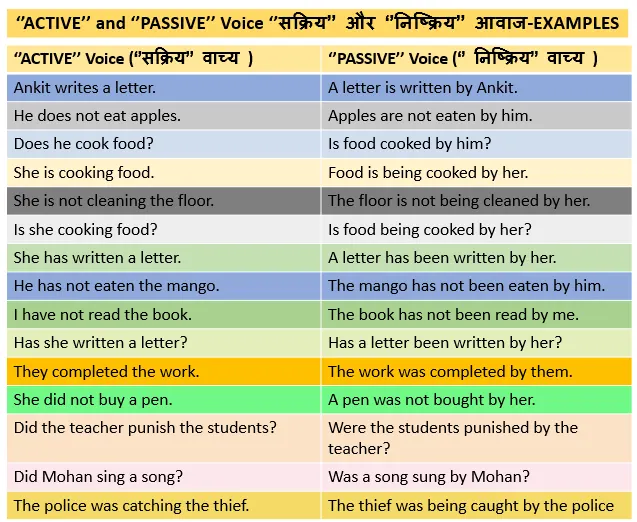
Examples Active to Passive Voice – Future Indefinite Tense:
❖ Positive Sentences (सकारात्मक वाक्य)
1.Active:
She will cook a meal.
वह खाना पकाएगी।
Passive :
A meal will be cooked by her.
एक खाना उसके द्वारा बनाया जाएगा।
2.Active:
They will complete the project.
वे परियोजना को पूरा करेंगे।
Passive :
The project will be completed by them.
परियोजना उनके द्वारा पूरा किया जाएगा।
3.Active:
He will repair the roof.
वह छत की मरम्मत करेगा।
Passive :
The roof will be repaired by him.
छत उसके द्वारा ठीक की जाएगी।
4.Active:
We shall organize a party.
हम एक पार्टी का आयोजन करेंगे।
Passive :
A party shall be organized by us.
एक पार्टी हमारे द्वारा आयोजित की जाएगी।
5.Active:
The students will write the exam.
छात्र परीक्षा लिखेंगे।
Passive :
The exam will be written by the students.
परीक्षा विद्यार्थियों द्वारा लिखी जाएगी।
6.Active:
The gardener will plant trees.
माली पेड़ लगाएगा।
Passive :
Trees will be planted by the gardener.
पेड़ माली द्वारा लगाये जाएंगे।
7.Active:
The company will launch a new product.
कंपनी एक नया उत्पाद लॉन्च करेगी।
Passive :
A new product will be launched by the company.
एक नया उत्पाद कंपनी द्वारा लॉन्च किया जाएगा।
8.Active:
The teacher will correct the papers.
शिक्षक कागजात सही कर देंगे।
Passive :
The papers will be corrected by the teacher.
पाठ्य पत्र अध्यापक द्वारा ठीक किए जाएंगे।
9.Active:
They will clean the classroom.
वे कक्षा की सफाई करेंगे।
Passive :
The classroom will be cleaned by them.
कक्षा उनके द्वारा साफ की जाएगी।
10.Active:
He will paint the wall.
वह दीवार पर रंग लगाएगा।
Passive :
The wall will be painted by him.
दीवार उसके द्वारा रंगी जाएगी।
❖ Negative Sentences (नकारात्मक वाक्य)
1.Active:
She will not clean the kitchen.
वह रसोई साफ़ नहीं करेगी।
Passive :
The kitchen will not be cleaned by her.
रसोई उसके द्वारा साफ नहीं की जाएगी।
2.Active:
They will not deliver the parcels.
वे पार्सल नहीं पहुंचाएंगे।
Passive :
The parcels will not be deliverd by them.
पार्सल उनके द्वारा नहीं पहुँचाए जाएंगे।
3.Active:
He will not fix the computer.
वह कंप्यूटर ठीक नहीं करेगा।
Passive :
The computer will not fixed by him.
कंप्यूटर उसके द्वारा ठीक नहीं किया जाएगा।
4.Active:
We shall not arrange the meeting.
बैठक की व्यवस्था नहीं की जाएगी।
Passive :
The meeting shall not be arranged by us.
बैठक हमारे द्वारा आयोजित नहीं की जाएगी।
5.Active:
The teacher will not explain the lesson.
शिक्षक पाठ नहीं समझाएंगे।
Passive :
The lesson will not be explained by the teacher.
पाठ अध्यापक द्वारा नहीं समझाया जाएगा।
6.Active:
They will not decorate the hall.
वे हॉल को नहीं सजाएंगे।
Passive :
The hall will not be decorated by them.
हॉल उनके द्वारा सजाया नहीं जाएगा।
7.Active:
He will not repair the bicycle.
वह साइकिल की मरम्मत नहीं करेगा।
Passive :
The bicycle will not be repaired by him.
साइकिल उसके द्वारा ठीक नहीं की जाएगी।
8.Active:
The chef will not cook lunch.
रसोईया दोपहर का खाना नहीं बनाएगा।
Passive :
Lunch will not be repaired by him.
दोपहर का खाना रसोइया द्वारा नहीं बनाया जाएगा।
9.Active:
She will not write the report.
वह रिपोर्ट नहीं लिखेगी।
Passive :
The report will not written by her.
रिपोर्ट उसके द्वारा नहीं लिखी जाएगी।
10.Active:
They will not clean the classroom.
वे कक्षा की सफ़ाई नहीं करेंगे।
Passive :
The classroom will not be cleaned by them.
कक्षा उनके द्वारा साफ नहीं की जाएगी।
❖ Interrogative Sentences (प्रश्नवाचक वाक्य)
1.Active:
Will she send the invitation?
क्या वह निमंत्रण भेजेगी?
Passive :
Will the invitation be sent by her?
क्या निमंत्रण उसके द्वारा भेजा जायेगा?
2.Active:
Will they repair the bridge?
क्या वे पुल की मरम्मत करेंगे?
Passive :
Will the bridge be repaired by them?
क्या पुल उनके द्वारा ठीक किया जाएगा?
3.Active:
Will he wash the car?
क्या वह कार धोएगा?
Passive :
Will the car be washed by him?
क्या गाड़ी उसके द्वारा धोई जाएगी?
4.Active:
Shall we decorate the hall?
क्या हम हॉल को सजाएं?
Passive :
Shall the hall be decorated by us?
क्या हॉल हमारे द्वारा सजाया जाएगा?
5.Active:
Will the students submit the project?
क्या छात्र परियोजना जमा करेंगे?
Passive :
Shall the hall be decorated by us?
क्या परियोजना छात्रों द्वारा जमा किया जाएगा?
6.Active:
Will the gardener water the plants?
क्या माली पौधों को पानी देगा?
Passive :
Will the plants by watered by the gardener?
क्या पौधों को माली द्वारा पानी दिया जाएगा?
7.Active:
Will the company build a new office?
क्या कंपनी नया कार्यालय बनाएगी?
Passive :
Will a new office be built by the company?
क्या नया कार्यालय कंपनी द्वारा बनाया जाएगा।
8.Active:
Will the teacher assign homework?
क्या शिक्षक गृहकार्य देंगे?
Passive :
Will homework be assigned by the teacher?
क्या गृहकार्य अध्यापक द्वारा दिया जाएगा?
9.Active:
Will they clean the park?
क्या वे पार्क साफ़ करेंगे?
Passive :
Will the park be cleaned by them?
क्या पार्क उनके द्वारा साफ किया जाएगा?
10.Active:
Will he paint the fence?
क्या बाड़ रंगी जाएगी?
Passive :
Will the fence be painted by him?
क्या बाड़ उसके द्वारा रंगी जाएगी?
❖ Wh – Word Interrogative Sentences (Wh-Word प्रश्नवाचक वाक्य)
1.Active:
Who will send the invitation?
निमंत्रण कौन भेजेगा?
Passive :
By whom will the invitation be sent?
निमंत्रण किसके द्वारा भेजा जायेगा?
2.Active:
When will they repair the bridge?
वे पुल की मरम्मत कब करेंगे?
Passive :
When will the bridge be repaired by them?
पुल उनके द्वारा कब ठीक किया जाएगा?
3.Active:
What shall we decorate?
हम क्या सजाएंगे?
Passive :
What shall be decorated by us?
हम क्या सजाएंगे?
4.Active:
Who will submit the project?
परियोजना कौन प्रस्तुत करेगा?
Passive :
By whom will the project be submitted?
परियोजना कौन जमा करेगा?
5.Active:
Where will he wash the car?
वह कार कहां धोएगा?
Passive :
Where will the car be washed by him?
कार उनके द्वारा कहाँ धोई जाएगी?
6.Active:
How will the gardener water the plants?
माली पौधों को पानी कैसे देगा?
Passive :
How will the plants be watered by the gardener?
पौधों को माली द्वारा कैसे पानी दिया जाएगा?
7.Active:
Which office will the company build?
कंपनी कौन सा कार्यालय बनाएगी?
Passive :
Which office will be built by the company?
कौन सा कार्यालय कंपनी द्वारा बनाया जाएगा?
8.Active:
When will the teacher assign homework?
शिक्षक होमवर्क कब देंगे?
Passive :
when will homework be assigned by the teacher?
होमवर्क शिक्षक द्वारा कब दिया जाएगा?
9.Active:
Where will they clean the park?
वे पार्क की सफ़ाई कहाँ करेंगे?
Passive :
Where will the park be cleaned by them?
पार्क उनके द्वारा कहाँ साफ किया जाएगा?
10.Active:
How will he paint the fence?
वह बाड़ को कैसे रंगेगा?
Passive :
How will the fence be painted by him?
बाड़ उसके द्वारा कैसे रंगी जाएगी?
10.Passive Voice – Future Continuous Tense (भविष्य सतत काल)
NOTE:
✕ Future Continuous Tense का Passive Voice आमतौर पर प्रयोग नहीं किया जाता है।
✕ क्योंकि इसमें Action (काम) के साथ-साथ उसका ongoing (चलता हुआ) रुप भी होता है।
✕ Passive में ऐसे ongoing action को सही ढंग से व्यक्त करना मुश्किल होता है।
REASON?
1. Passive Voice हमेशा Object को Subject बनाता है।
2. लेकिन Future Continuous में Verb के साथ be+ ing होता है।
3. अगर इसमें Object को आगे लाएँगे तो Verb का रुप अजीब लगेगा और Natural English नहीं बनेगी।
11. Passive Voice – Future Perfect Tense (भविष्य पूर्ण काल)
Rules (नियम)
1.Object को Subject की जगह पर लाएँ।
2.Helping Verb वही रहगी (will/shall+have)।
3.Passive में हमेशा been लगाना अनिवार्य है।
4.Main verb हमेशा Past Participle (V3) रुप में होगी।
5.अंत में ‘’by + subject’’ लिखना optional है।
6.Future Perfect Tense में Passive Voice हमेशा have been + V3 से बनता है।
7.इन वाक्यों के अंत में रहा होगा, रही होगी, चुका होगा, चुकी होगी आते हैं।
Examples Active to Passive Voice – Future Perfect Tense:
❖ Positive Sentences (सकारात्मक वाक्य)
1.Active:
The scientist will have discovered a new planet.
वैज्ञानिकों ने एक नये ग्रह की खोज कर ली होगी।
Passive :
A new planet will have been discovered by the scientist.
एक नया गृह वैज्ञानिक द्वारा खोजा जा चुका होगा।
2.Active:
She will have cleaned the house before evening.
वह शाम से पहले घर साफ़ कर लेगी।
Passive :
The house will have been cleaned by her before evening
शाम से पहले घर उसके द्वारा साफ किया जा चुका होगा।
3.Active:
The farmers will have harvested the crops by October.
शाम से पहले घर उसके द्वारा साफ किया जा चुका होगा।
Passive :
The cropes will have been harvested by the farmers by October.
फसलें अक्टूबर तक किसानों द्वारा काटी जा चुकी होगी।
4.Active:
He will have completed his book by next year.
अगले वर्ष तक वह अपनी पुस्तक पूरी कर लेंगे।
Passive :
The book will have been completed by him by next year.
अगले साल तक किताब उसके द्वारा पूरी की जा चुकी होगी।
5.Active:
The engineer will have designed the new machine.
इंजीनियर ने नई मशीन का डिज़ाइन तैयार कर लिया होगा।
Passive :
The new machine will have been designed by the engineer.
नई मशीन इंजीनियर द्वारा डिजाइन की जा चुकी होगी।
6.Active:
They will have painted the walls of the house.
उन्होंने घर की दीवारों पर रंग किया होगा।
Passive :
The wall of the house will have been painted by them.
घर की दीवारें उनके द्वारा रगीं जा चुकी होगी।
7.Active:
The judge will have announced the result.
जज ने परिणाम की घोषणा कर दी होगी।
Passive :
The result will have been announced by the judge.
परिणाम जज द्वारा घोषित किया जा चुका होगा।
8.Active:
The doctor will have prescribed the medicines.
डॉक्टर ने दवाइयां लिख दी होंगी।
Passive :
The medicines will have been prescribed by the doctor.
दवाइयां डॉक्टर द्वारा लिखी जा चुकी होगी।
9.Active:
We will have booked the tickets before Monday.
हम सोमवार से पहले टिकट बुक कर लेंगे।
Passive :
The tickets will have been booked by us before Monday.
सोमवार से पहले टिकटें हमारे द्वारा बुक किए जा चुकी होगी।
10.Active:
The soldiers will have captured the enemy base.
सैनिकों ने दुश्मन के अड्डे पर कब्ज़ा कर लिया होगा।
Passive :
The enemy base will have been captured by the soldiers.
दुश्मन का अड्डा सैनिकों द्वारा कब्जा किया जा चुका होगा।
❖ Negative Sentences (नकारात्मक वाक्य)
1.Active:
She will not have written the report
उसने रिपोर्ट नहीं लिखी होगी.
Passive :
The report will not have been written by her.
रिपोर्ट उसके द्वारा नहीं लिखी जा चुकी होगी।
2.Active:
They will not have finished the project by Friday.
वे शुक्रवार तक परियोजना पूरी नहीं कर पाएंगे।
Passive :
The project will not have been finished Friday.
परियोजना शुक्रवार तक पूरा नहीं किया जा चुका होगा।
3.Active:
The teacher will not have checked the homework.
शिक्षक ने गृहकार्य की जाँच नहीं की होगी।
Passive :
The homework will not have been checked by the teacher.
गृहकार्य शिक्षक द्वारा जांचा नहीं जा चुका होगा।
4.Active:
He will not have repaired the computer.
उसने कंप्यूटर की मरम्मत नहीं की होगी।
Passive :
The computer will not have been repaired by him.
कंप्यूटर उसके द्वारा ठीक नहीं किया जा चुका होगा।
5.Active:
The workers will not have completed the building.
श्रमिकों ने भवन का निर्माण पूरा नहीं किया होगा।
Passive :
The building will not have been completed the workers.
भवन का निर्माण कार्य श्रमिकों द्वारा पूरा नहीं किया जा चुका होगा।
6.Active:
The manager will not have signed the documents.
प्रबंधक ने दस्तावेजों पर हस्ताक्षर नहीं किये होंगे।
Passive :
The documents will not have been signed by the manager.
दस्तावेज़ प्रबंधन द्वारा हस्ताक्षरित नहीं किए जा चुके होंगे।
7.Active:
The company will not have launched the new software.
कंपनी ने नया सॉफ्टवेयर लॉन्च नहीं किया होगा।
Passive :
The new software will not have been launched by the company.
नया सॉफ्टवेयर कंपनी द्वारा लॉन्च नहीं किया जा चुका होगा।
8.Active:
We will not have booked the tickets by tomorrow.
कल तक हम टिकट बुक नहीं कर पाएंगे।
Passive :
The tickets will not have been booked by us by tomorrow.
टिकटें हमारे द्वारा कल तक बुक नहीं की जा चुकी होगी।
9.Active:
The students will not have solved the question.
छात्रों ने प्रश्न हल नहीं किये होंगे।
Passive :
The question will not have been solved by the students.
प्रश्न छात्रों द्वारा हल नहीं किए जा चुके होंगे।
10.Active:
The police will not have caught the thief.
पुलिस चोर को नहीं पकड़ पाएगी।
Passive :
The thief will not have been caught by the police.
चोर पुलिस द्वारा पकड़ा नहीं जा चुका होगा।
❖ Interrogative Sentences (प्रश्नवाचक वाक्य)
1.Active:
Will she have sung the song by tomorrow?
क्या वह कल तक गाना गा लेगी?
Passive :
Will the song have been sung by her by tomorrow?
क्या गीत कल तक उसके द्वारा गाया जा चुका होगा?
2.Active:
Will they have cleaned the classroom before noon?
क्या वे दोपहर से पहले कक्षा साफ़ कर चुके होंगे?
Passive :
Will the classroom have been cleaned by them before noon?
क्या दोपहर से पहले कक्षा उनके द्वारा साफ की जा चुकी होगी?
3.Active:
Will he have delivered the speech?
क्या वह भाषण देंगे?
Passive :
Will the speech have been delivered by him?
क्या भाषण उसके द्वारा दिया जा चुका होगा?
4.Active:
Will the chef have prepared the meal?
क्या रसोइये ने भोजन तैयार कर लिया होगा?
Passive :
Will the meal have been prepared by the chef?
क्या खाना रसोइये द्वारा तैयार किया जा चुका होगा?
5.Active:
Will the students have completed the assignment by tonight?
क्या छात्र आज रात तक अपना असाइमेंट पूरा कर लेंगे?
Passive :
Will the assignment have been completed by the students by tonight?
क्या असाइनमेंट छात्रों द्वारा आज रात तक पूरा किया जा चुका होगा?
6.Active:
Will the company have organized the event?
क्या कंपनी ने इस कार्यक्रम का आयोजन किया होगा?
Passive :
Will the event have been organized by the company?
क्या कार्यक्रम कंपनी द्वारा आयोजित किया जा चुका होगा?
7.Active:
Will the driver have parked the car by then?
क्या तब तक ड्राइवर कार पार्क कर चुका होगा?
Passive :
Will the car have been parked by the driver by then?
क्या तब तक गाड़ी ड्राइवर द्वारा खड़ी की जा चुकी होगी?
8.Active:
Will the children have read the story?
क्या बच्चों ने कहानी पढ़ी होगी?
Passive :
Will the story have been read by the children?
क्या कहानी बच्चों द्वारा पढ़ी जा चुकी होगी?
9.Active:
Will the artist have painted the picture?
क्या कलाकार ने चित्र बनाया होगा?
Passive :
Will the picture have been painted by the artist?
क्या चित्र कलाकार द्वारा बनाया जा चुका होगा?
10.Active:
Will the officer have signed the letter?
क्या अधिकारी ने पत्र पर हस्ताक्षर किये होंगे?
Passive :
Will the letter have been signed by the officer?
क्या पत्र अधिकारी द्वारा हस्ताक्षरित किया जा चुका होगा?
❖ Wh – Word Interrogative Sentences (Wh-Word प्रश्नवाचक वाक्य)
1.Active:
Who will have completed the assignment by tomorrow?
कल तक कौन कार्य पूरा कर लेगा?
Passive :
By whom will the assignment have been completed by tomorrow?
असाइनमेंट कल तक किसके द्वारा पूरा किया जा चुका होगा?
2.Active:
What will they have built by next month?
अगले महीने तक वे क्या बना लेंगे?
Passive :
What will have been built by them by next month?
अगले महीने तक उनके द्वारा क्या बनाया जा चुका होगा?
3.Active:
When will she have submitted the report?
वह रिपोर्ट कब प्रस्तुत करेगी?
Passive :
When will the report have been submitted by her?
रिपोर्ट उसने कब तक जमा कर दी होगी?
4.Active:
Which documents will he have signed?
कौन से दस्तावेजों पर हस्ताक्षर होंगे?
Passive :
Which documents will have been signed by him?
कौन से दस्तावेज उसने हस्ताक्षर कर दिए होंगें?
5.Active:
Where will the workers have stored the materials?
श्रमिकों ने सामग्री कहां संग्रहित की होगी?
Passive :
Where will the materials have been stored by the workers?
सामग्री श्रमिकों द्वारा कहाँ संग्रहीत की जा चुकी होगी?
6.Active:
Why will the manger have delayed the decision?
प्रबंधक ने निर्णय लेने में देरी क्यों की?
Passive :
Why will the decision have been delayed by the manger?
निर्णय प्रबंधक द्वारा क्यों विलंबित किया जा चुका होगा?
7.Active:
How will the chef have decorated the cake?
शेफ ने केक को कैसे सजाया होगा?
Passive :
How will the cake have been decorated by the chef?
केक शेफ द्वारा कैसे सजाया जा चुका होगा?
8.Active:
Which award will she have won by then?
तब तक वह कौन सा पुरस्कार जीत चुकी होगी?
Passive :
Which award will have been won by her by then?
कौन सा पुरस्कार उसने तब तक जीत लिया होगा?
9.Active:
Whom will they have chosen as the leader?
उन्होंने नेता के रूप में किसे चुना होगा?
Passive :
Who will have been chosen as the leader by them?
किसे उन्होंने नेता के रूप में चुना होगा?
10.Active:
What time will the workers have completed the task?
श्रमिक कब तक कार्य पूरा कर लेंगे?
Passive :
At what time will the task have been completed by the workers?
किस समय तक काम श्रमिकों द्वारा पूरा किया जा चुका होगा?
12. Passive Voice – Future Perfect Continuous Tense (भविष्य पूर्ण सतत काल)
✕ Future Perfect Continuous Tense Passive Voice Practically नहीं होता।
✕ कारण – में को बनाना पड़ता है, लेकिन (चलती क्रिया) + duration के कारण सही और natural passive बनना लगभग असंभव होता है।
क्यों?
1.Passive Voice में हमेशा Object को Subject बनाना पड़ता है।
2.Continuous Tense में be+ ing होती है।
3.Future Perfect Continuous में will + have + been + V (ing) होती है।
4.इस Stucture में Object को Subject बनाने पर ‘’been being + V3’’ जैसी awkward construction बनती है।
5.इसलिए Future Perfect Continuous Passive आम तौर पर English Grammar में प्रयोग नहीं होती ।