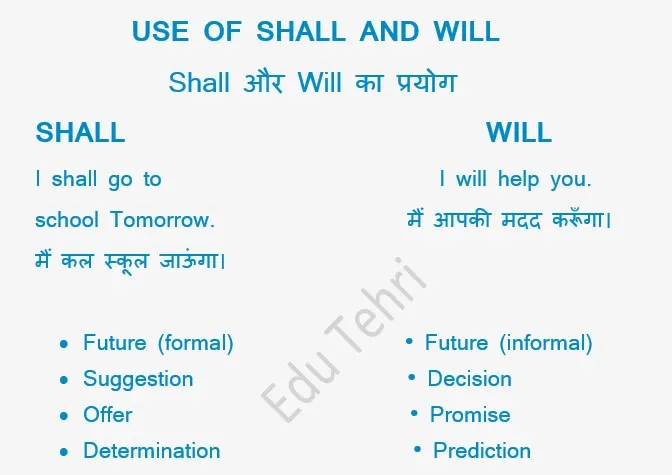
❖ ‘’SHALL’’ Defination
• Shall एक Modal Verb एक है, जिसका प्रयोग मुख्य रुप से –
1. भविष्य (Future tense) दिखाने के लिए
2. निश्चय (Determination) बताने के लिए
3. Formal offers/ suggestion/ promises करने के लिए होता है।
• Shall का अर्थ – होगा, होगी, होगें, रहेगा, रहेगी, रहेगीं, रहगें, बनेगा, बनेगें आदि होता है।
• इसका प्रयोग भविष्य मैं किसी व्यक्ति की दशा या स्थिति को व्यक्त करने के लिए करते हैं।
Shall Meaning in Hindi
वाक्य के अंत में गा, गी, गे , होगा, होगी, रहेगा, रहेगी, बनेगा, बनेगी आदि आता है।
नीचे दिये गए वाक्यों को ध्यानपूर्वक पढ़ें और सीखें।
Read Also
• Use of Can & Could
• may, might
• should,Would
• Must & Ought
• need to
• dare
• Use of Used to
• POSITIVE SENTENCE (सकारात्मक वाक्य)
Examples (उदाहरण):
1.I shall go to school tomorrow.
मैं कल स्कूल जाऊँगा।
2.We Shall help you.
हम तुम्हारी मदद करेगें।
3.He shall play cricket in the evening.
वह शाम को क्रिकेट खेलेगा।
4.They shall visit the park on Sunday.
वे रविवार को पार्क जाएँगे।
5.You shall see a rainbow after the rain.
तुम बारिश के बाद इंद्रधनुष देखोगे।
6.The teacher shall teach a new lesson today.
अध्यापक आज नया पाठ पढ़ाएँगे ।
7.I shall meet my friend next week.
मैं अगले हफ्ते अपने दोस्त से मिलूगाँ।
8.We shall win the match.
हम मैच जीतेगें।
9.She shall cook food tonight.
वह आज रात खाना पकाएगी।
10.They shall reach home on time.
वे समय पर घर पहुँचेगें।
Read Also
• Model- Auxiliary verb
• Sentence - Types of Sentence
• Parts of Sentence
• Affirmative Sentence
• NEGATIVE SENTENCE (नकारात्मक वाक्य)
इसका प्रयोग भविष्य में किसी काम को न होने के लिए किया जाता है।
Examples (उदाहरण):
1.I shall not eat food.
मैं खाना नहीं खाऊंगा।
2.We shall not go to school tomorrow.
हम कल स्कूल नहीं जाएंगे।
3.He shall not play football.
वहाँ फुटबॉल नहीं खेलेगा।
4.She shall not sing a song.
वह गाना नहीं गाएगी।
5.They shall not watch TV.
वे टीवी नहीं देखेंगे।
6.You shall not waste time.
तुम समय बर्बाद नहीं करोगे।
7.The child shall not cry.
बच्चा नहीं रोएगा
8.My Friends shall not forget me.
मेरे दोस्त मुझे नहीं भूलेंगे।
9.They shall not watch a movie.
वे फ़िल्म नहीं देखेंगे।
10.You shall not get a gift.
तुम्हें कोई तौहफ़ा नहीं मिलेगा।
Read Also
• Negative Sentence
• Conditional Sentence
• Exclamatory Sentence
• INTERROGATIVE SENTENCE (प्रश्नवाचक वाक्य)
इसका प्रयोग भविष्य से संबंधित प्रयोग प्रश्न पूछने के लिए होता है।
Examples (उदाहरण):
1.Shall I help you?
क्या मैं तुम्हारी मदद करूँ?
2.Shall we go to the park?
क्या हम पार्क जाएंगे?
3.Shall he read the book?
क्या वह किताब पढेगा?
4.Shall she dance on the stage?
क्या वह मंच पर नाचेगी?
5.Shall they play cricket tomorrow?
क्या वे कल क्रिकेट खेलेंगे?
6.Shall we start the meeting now?
क्या हम अब मीटिंग शुरू करें?
7.Shall I open the window?
क्या मैं खिड़की खोल लूँ?
8.Shall we go for a walk?
क्या हम टहलने जाएं?
9.Shall I call you in the evening?
क्या मैं तुम्हें शाम को फोन करुँ?
10.Shall I bring some water for you?
क्या मैं तुम्हारे लिए थोड़ा पानी लाऊं?
Read Also
• Interrogative Sentence
• Imperative Sentence
• INTERROGATIVE NEGATIVE SENTENCE (प्रश्नवाचक नकारात्मक वाक्य)
इसका प्रयोग भविष्य में न होने वाले कार्य के बारे में प्रश्न करने के लिए किया जाता है।
Examples (उदाहरण):
1.Shall I not help you?
क्या मैं तुम्हारी मदद नहीं करूँ?
2.Shall we not go to school tomorrow?
क्या हम कल स्कूल नहीं जाएंगे?
3.Shall he not read this book?
क्या वह यह किताब नहीं पड़ेगा?
4.Shall she not dance on the stage?
क्या वह मंच पर नहीं नाचेगी?
5.Shall they not play cricket today?
क्या वे आज क्रिकेट नहीं खेलेंगे?
6.Shall we not wait for him here?
क्या हम उसका यहाँ इंतजार नहीं करेंगे?
7.Shall I not open the window?
क्या मैं खिड़की नहीं खोलूं?
8.Shall we not celebrate her birthday?
क्या हम उसका जन्मदिन नहीं मनाएंगे?
9.Shall we not meet tomorrow?
क्या हम कल नहीं मिलेंगे?
10.Shall he not finish his homework?
क्या वह अपना होमवर्क पूरा नहीं करेगा?
• Wh-Word INTERROGATIVE SENTENCE (Wh-Word प्रश्नवाचक वाक्य)
इसका प्रयोग भविष्य काल में प्रश्न पूछने के लिए किया जाता है।
Examples (उदाहरण):
1.What shall I do now?
मैं अब क्या करूँ?
2.Where shall we go tomorrow?
हम कल कहाँ जाएंगे?
3.When shall he start his work?
वह अपना काम कब शुरू करेगा?
4.Who shall help you in this problem?
इस समस्या में तुम्हारी मदद कौन करेगा?
5.Why shall they come here?
वे यहाँ क्यों आएँगे?
6.How shall she complete this project?
वह यह प्रोजेक्ट कैसे पूरा करेगी?
7.Which book shall I read first?
मैं सबसे पहले कौन सी किताब पढ़ूँ?
8.Whom shall we invite to the party?
हम पार्टी में किसे बुलाएंगे?
9.What shall we eat for dinner?
हम रात के खाने में क्या खाएँगे?
10.Where shall I keep this book?
मैं यहाँ किताब कहाँ रखूँ?
Read Also
• Active & Passive voice
• Gender
• Use of Has & Have
• Parts of Sentence
• Wh-Word INTERROGATIVE NEGATIVE SENTENCES (Wh-Word प्रश्नवाचक नकारात्मक वाक्य)
इसका प्रयोग तब किया जाता है जब भविष्य से जुड़ा नकारात्मक प्रश्न पूछना हो।
Examples (उदाहरण):
1.Why shall I not help you?
मैं तुम्हारी मदद क्यों नहीं करूँगा?
2.When shall we not play cricket?
हम क्रिकेट कब नहीं खेलगें?
3.Where shall he not go tomorrow?
वह कल कहाँ नहीं जाएगा?
4.What shall she not cook today?
वह आज क्या नहीं पकाएगी?
5.Who shall not attend the meeting?
मीटिंग में कौन शामिल नहीं होगा?
6.How shall they not complete this work?
वे यह काम कैसे पूरा नहीं करेंगे?
7.Which book shall I not read?
मैं कौन सी किताब नहीं पढूंगा?
8.Whom shall we not invite to the party?
हम पार्टी में किसे नहीं बुलाएंगे?
9.Why shall the teacher not punish him?
शिक्षक उसे दंड क्यों नहीं देंगे?
10.When shall I not call you?
मैं तुम्हें कब फ़ोन नहीं करूँगा?
❖ USES OF SHALL (प्रयोग)
Future Action (भविष्य की क्रिया)
Shall is used with I and We to express an action that will take place in the future.
It indicates something that is planned or decided to happen later.
जब हम किसी भविष्य में होने वाली क्रिया (future action) की बात करते हैं, तो shall का प्रयोग किया जाता है। यह ज्यादातर I और We के साथ प्रयोग होता है ताकि यह दिखाया जा सके कि कोई कार्य भविष्य होगा।
Examples:
1.I shall go to school tomorrow.
मैं कल स्कूल जाऊंगा।
2.We shall visit the Taj Mahal next week.
हम अगले हफ्ते ताजमहल देखने जाएंगे।
3.I shall call you in the evening.
मैं तुम्हें शाम को फ़ोन करूँगा।
4.We shall start our new project soon.
हम जल्द ही अपना नया प्रोजेक्ट शुरू करेंगे।
5.I shall meet my friend on Sunday.
मैं रविवार को अपने दोस्त से मिलूंगा।
6.We shall go for a picnic tomorrow.
हम कल पिकनिक पर जाएंगे।
7.I shall finish this work today.
मैं यह काम आज ही पूरा करूँगा।
8.We shall celebrate your birthday together.
हम तुम्हारा जन्मदिन साथ में मनाएंगे।
Read Also
• Use of Had
• Use of These & Those
• Use of This & That
• Use of Was & Were
Promise or Assurance (वादा /आश्वासन)
When shall is used to express a promise or assurance, it means that the speaker is giving a guarantee or commitment that something will definitely happen.
It shows determination and certainty about the future.
जब Shall का प्रयोग किसी वादा या आश्वासन को व्यक्त करने के लिए किया जाता है तो इसका अर्थ होता है कि वक्ता किसी कार्य के होने की पूरी गारंटी या भरोसा दिला रहा है।यह भविष्य की कार्य को दृढ़ता और निश्चय के साथ दर्शाता है।
Examples:
1.You shall get your money back.
तुम्हें तुम्हारे पैसे वापस मिलेंगे।
2.He shall be punished for his mistake.
उसे उसकी गलती की सजा जरूर मिलेगी।
3.You shall have my full support.
तुम्हें मेरा पूरा सहयोग मिलेगा।
4.They shall be promoted next month.
उन्हें अगले महीने पदों उन्नति मिलेगी।
5.You shall not suffer anymore.
अब तुम्हें और कष्ट नहीं होगा।
6.The students shall receive their certificates tomorrow.
विद्यार्थियों को कल प्रमाणपत्र मिलेंगे।
7.I shall always stand by you.
मैं हमेशा तुम्हारे साथ रहूंगा।
8.Justice shall be done.
न्याय अवश्य होगा।
Read Also
• Use of Is/am/are
• Singular & Plural
• Use of Can & Could
Determination (दृढ़निश्चय)
When shall is used to express determination, it shows the strong will, firm decision, or resolve of the speaker to do something or to make something happen.
It indicates confidence, strength, and certainty of purpose.
जब shall का प्रयोग दृढ़ निश्चय या संकल्प व्यक्त करने के लिए किया जाता है तो इसका अर्थ होता है कि वक्ता किसी काम को करने के लिए पूरी तरह से निश्चियबद्ध है। इस प्रयोग में दृढ़ता, आत्मविश्वास और संकल्प का अभाव झलकता है।
Examples:
1.We shall fight for our rights.
हम अपने अधिकारों के लिए लड़ेंगे।
2.We shall overcome.
हम अवश्य जीतेंगे।
3.I shall never give up.
मैं कभी हार नहीं मानूंगा।
4.We shall fight for our rights.
हम अपने अधिकारों के लिए लड़ेंगे।
5.I shall prove myself.
मैं खुद को साबित करूँगा।
6.I shall not surrender.
हम हार नहीं मानेंगे।
7.We shall make our country proud.
हम अपने देश को गर्व महसूस कराएंगे।
8.I shall try again and again.
मैं बार - बार कोशिश करूँगा।
Read Also
• Use of Had
• Use of These & Those
• Use of This & That
• Use of Was & Were
Formal Offer/ Suggestion (औपचारिक/ सुझाव/ ऑफर)
When shall is used to make a formal offer or suggestion , it expressess polite intent, help, or advice in a respectful and courteous manner. It is commonly used in questions to ask someone’s opinion, offer help, or make a suggestion.
जब Shall का प्रयोग औपचारिक प्रस्ताव या सुझाव देने के लिए किया जाता है, तो इसका अर्थ होता है कि वक्ता शालीनता और विनम्रता से किसी की राय पूछ रहा है या मदद की पेशकश कर रहा है यह प्रश्नवाचक वाक्य में किया जाता है।
Examples:
1.Shall I help you?
क्या मैं आपकी मदद करूँ?
2.Shall I open the window?
क्या मैं खिड़की खोल दूँ?
3.Shall we go for a walk?
क्या हम टहलने चले?
4.Shall I help you with your homework?
क्या मैं तुम्हारी होमवर्क में मदद कर दूँ?
5.Shall I bring you some water?
क्या मैं तुम्हारे लिए थोड़ा पानी लाऊँ?
6.Shall we dance?
क्या हम नाचे?
7.Shall I turn off the lights?
क्या मैं लाइट बंद कर दूं?
❖ ‘’WILL’’ – Defination
• Will is a Modal auxiliary verb used to express Future action, Willingness, Intention, Determination, Promise, or Certainty.
• Will एक सहायक क्रिया है, जिसका प्रयोग भविष्यकाल, इच्छा, इरादा, दृढ़ निश्चय, वचन, या निश्चितता व्यक्त के लिए किया जाता है।
Meaning Of Might In Hindi
इसके अंत में गा गी गे, (होगा) भविष्यकाल सूचक क्रिया होती है।
आइए उदाहरणों से will को समझते हैं।
• POSITIVE SENTENCE (सकारात्मक वाक्य)
EXAMPLES (उदाहरण):
1.I will read this book tomorrow.
मैं कल यह किताब पढूँगा।
2.We will visit the museum next week.
हम अगले हफ्ते म्यूज़ियम जाएंगे।
3.He will write a letter to his friend.
वह अपने दोस्त को पत्र लिखेगा।
4.She will cook dinner for the family.
वह परिवार के लिए खाना बनाएंगी।
5.They will join the football match.
वह फुटबॉल मैच में शामिल होंगे।
6.You will pass the exam it you study hard.
अगर तुम मेहनत करोगे तो परीक्षा पास कर लोगे।
7.I will send the documents by email.
मैं दस्तावेज ईमेल से भेज दूंगा।
8.He will buy a new car next month.
वह अगले महीने नई कार खरीदेगा।
9.She will help you in your work.
वह तुम्हारे काम में मदद करेगी।
10.We will celebrate his birthday on Sunday .
हम रविवार को उसका जन्मदिन मनाएंगे।
Read Also
• Article-A
• Use of Do&Does
• Use of Dare
• NEGATIVE SENTENCE (नकारात्मक वाक्य)
EXAMPLES(उदाहरण):
1.I will not go to school tomorrow.
मैं कल स्कूल नहीं जाऊंगा।
2.She will not help her friend.
वह अपनी दोस्त की मदद नहीं करेगी।
3.We will not play football today.
हम आज फुटबॉल नहीं खेलेंगे।
4.He will not finish his homework tonight.
वह अपना होमवर्क आज रात पूरा नहीं करेगा।
5.They will not watch a movie today.
वे आज फ़िल्म नहीं देखेंगे।
6.You will not get success without hard work.
मेहनत किये बिना तुम सफलता नहीं पाओगे।
7.I will not call you during the meeting.
मैं तुम्हें मीटिंग के दौरान फ़ोन नहीं करूँगा।
8.She will not bring any fruits for us.
वह हमारे लिए कोई फल नहीं लाएगी।
9.He will not buy a new car this month.
वह इस महीने नई कार नहीं खरीदेगा।
10.We will not celebrate the festival this year.
हम इस साल त्यौहार नहीं मनाएंगे।
• INTERROGATIVE SENTENCE (प्रश्नवाचक वाक्य)
EXAMPLES(उदाहरण):
1.Will I go to school tomorrow?
क्या मैं कल स्कूल जाऊंगा?
2.Will she help her friend?
क्या वह अपने दोस्त की मदद करेगी?
3.Will we play football today?
क्या हम आज फुटबॉल खेलेंगे?
4.Will he finish his homework tonight?
क्या वह अपना होमवर्क आज रात पूरा करेगा?
5.Will they watch a movie today?
क्या वे आज फ़िल्म देखेंगे?
6.Will you pass the exam if you studay hard?
अगर तुम मेहनत करोगे तो क्या तुम परीक्षा पास कर लोगे?
7.Will I call you during the meeting?
क्या मैं तुम्हें मीटिंग के दौरान फ़ोन करूँगा?
8.Will she bring some fruits for us?
क्या वह हमारे लिए कुछ फल लायेगी?
9.Will he buy a new car next month?
क्या वह अगले महीने नई कार खरीदेगा?
10.Will we celebrate his birthday on Sunday?
क्या हम रविवार को उसका जन्मदिन मनाएंगे?
Read Also
• need to
• dare
• Use of Used to
• INTERROGATIVE NEGATIVE SENTENCE (प्रश्नवाचक नकारात्मक वाक्य)
EXAMPLES (उदाहरण):
1.Will I not go to school tomorrow?
क्या मैं कल स्कूल नहीं जाऊंगा?
2.Will she not help her friends?
क्या वह अपने दोस्त की मदद नहीं करेगी?
3.Will we not play football today?
क्या हम आज फुटबॉल नहीं खेलेंगे?
4.Will he not finish his homework tonight?
क्या वह अपना होमवर्क आज रात पूरा नहीं करेगा?
5.Will they not watch a movie today?
क्या वे आज फ़िल्म नहीं देखेंगे?
6.Will you not pass the exam if you studay hard?
अगर तुम मेहनत करोगे तो क्या तुम परीक्षा पास नहीं कर लोगे?
7.Will I not call you during the meeting?
क्या मैं तुम्हें मीटिंग के दौरान फ़ोन नहीं करूँगा?
8.Will she not bring some fruits for us?
क्या वह हमारे लिए कुछ फल नहीं लाएगी?
9.Will he not buy a new car next month?
क्या वहाँ अगले महीने नई कार नहीं खरीदेगा?
10.Will we not celebrate his birthday on Sunday?
क्या हम रविवार को उसका जन्मदिन नहीं मनाएंगे?
• Wh-Word INTERROGATIVE SENTENCES (Wh-Word प्रश्नवाचक वाक्य)
EXAMPLES (उदाहरण):
1.What will I do tomorrow?
मैं कल क्या करूँगा?
2.Where will we go next week?
हम अगले हफ्ते कहा जाएंगे?
3.When will he start his work?
वह अपना काम कब शुरू करेगा?
4.Who will help you in this problem?
इस समस्या में तुम्हारी मदद कौन करेगा?
5.Why will they come here?
वे यहाँ क्यों आएँगे?
6.How will she complete this project?
वह यह प्रोजेक्ट कैसे पूरा करेगी?
7.Which book will I read first?
मैं सबसे पहले कौन सी किताब पढ़ूँ?
8.Whom will we invite to the party?
हम पार्टी में किसे बुलाएंगे?
9.What time will the train arrive?
ट्रेन कितने बजे पहुँचेगी?
10.How will they reach the station on time?
वे समय पर स्टेशन कैसे पहुँचेंगे?
• Wh-Word INTERROGATIVE NEGATIVE SENTENCES (Wh-Word प्रश्नवाचक नकारात्मक वाक्य)
EXAMPLES (उदाहरण):
1.What will I not do tomorrow?
मैं कल क्या नहीं करूँगा?
2.Where will we not go next week?
हम अगले हफ्ते कहाँ नहीं जाएंगे?
3.When will he not start his work?
वह अपना काम कब नहीं शुरू करेगा?
4.Who will not help you in this problem?
इस समस्या में तुम्हारी मदद कौन नहीं करेगा?
5.Why will they not come here?
वे यहाँ क्यों नहीं आएँगे?
6.How will she not complete this project?
वह यह प्रोजेक्ट कैसे पूरा नहीं करेगी?
7.Which book will I not read first?
मैं सबसे पहले कौन सी किताब नहीं पढूंगा?
8.Whom will we not invite to the party?
हम पार्टी में किसे नहीं बुलाएंगे?
9.What time will the train not arrive?
ट्रेन कितने बजे नहीं पहुंचेगी?
10.How will they not reach the station on time?
वह समय पर स्टेशन कैसे नहीं पहुँचेंगे?
❖ USES OF WILL (मुख्य प्रयोग)
Future Tense (भविष्य काल बताने के लिए)
Will is used to express future actions or events – something that has not happened yet but is expected to happen.
It shows decisions, plans, or predictions about the future.
Will का प्रयोग भविष्य में होने वाले कार्यों को दर्शाने के लिए किया जाता है। यह बताता है कि कोई कार्य अभी नहीं हुआ है पर आगे होने वाला है।यह भविष्य की क्रिया अनुमान या इरादा दिखता है।
Examples:
1.I will go to school tomorrow.
मैं कल स्कूल जाऊंगा।
2.She will call you in the evening.
वह तुम्हें शाम को फ़ोन करेंगी।
3.They will visit Delhi next week.
वह अगले हफ्ते दिल्ली जाएंगे।
4.We will play cricket on Sunday.
हम रविवार को क्रिकेट खेलेंगे।
5.He will meet his friend tomorrow.
वह कल अपने दोस्त से मिलेगा।
6.It will rain today.
आज बारिश होगी।
7.It will finish my work soon.
मैं अपना काम जल्दी पूरा कर लूँगा।
Read Also
• Parts of speech
• Noun
• Pronoun
• Verb
• Adverb
• Adjective
• Preposition
• Conjunction
• Interjection
Willingness/ Readiness (इच्छा/तैयारी जुताने के लिए)
When will is used to express willingness or readiness, it shows that the speaker is ready or willing to do something.
It indicates a voluntary action – that the person wants to do or agrees to do something without force.
जब will का प्रयोग इच्छा या तत्परता दिखाने के लिए किया जाता है तो इसका अर्थ होता है कि वक्ता खुद अपनी मर्जी से या खुशी से कोई काम करने के लिए तैयार हैं। इस प्रयोग में मैं कर दूंगा, मैं करूँगा जैसी भावना होती है।
Example:
1.I will help you.
मैं तुम्हारी मदद करूँगा।
2.She will carry your bag.
वह तुम्हारा बैंग उठा लेगी।
3.They will join you soon.
वे जल्द ही तुम्हारे साथ जुड़ जाएंगे।
4.I will open the door.
मैं दरवाजा खोल दूंगा।
5.He will come with you.
वह तुम्हारे साथ आएगा।
6.We will support your decision.
हम तुम्हारे निर्णय का समर्थन करेंगे।
Promise/ Determination (वादा जताने के लिए)
When will is used to express a promise, it shows that speaker guarantees of commits to doing something in the future.
जब will किसी वादा को दर्शाने के लिए प्रयोग होता है तो इसका अर्थ होता है कि वक्ता भविष्य में किसी कार्य के लिए होने की गारंटी दे रहा है।
Examples:
1.I will never lie.
मैं कभी झूठ नहीं बोलूँगा।
2.She will help you with your homework.
वह तुम्हारे होमवर्क में मदद करेगी।
3.We will support you always.
हम हमेशा तुम्हारा समर्थन करेंगे।
4.I will keep my words.
मैं अपना वचन निभाऊंगा।
5.He will be there on time.
वह समय पर वहाँ होगा।
Certainty/ Strong Predication (निश्चितता जताने के लिए)
When will is used to express certainty or strong prediction, it shows that the speaker firmly believes that something is definitely going to happen in the future.
It indicates confidence in the outcome
जब will का प्रयोग निश्चितता या मजबूत भविष्यवाणी दिखाने के लिए किया जाता है तो इसका अर्थ होता है कि वक्ता पूरी तरह आश्वस्त हैं कि कोई कार्य या घटना भविष्य में जरूरी होगी, यह प्रयोग भविष्य के परिणाम में पूर्ण विश्वास को दर्शाता है।
Examples:
1.It will rain today.
आज बारिश होगी।
2.She will pass the exam.
वह परीक्षा पास कर लेंगी।
3.They will arrive on time.
वे समय पर पहुँचेंगे।
4.The sun will rise at 6 a.m.
सूरज सुबह 6:00 बजे उगेगा।
5.He will definitely win the match.
वह जरूर मैच जीतेंगे।
6.This medicine will cure your cold.
यह दवा तुम्हारी सर्दी ठीक कर देगी।
7.I am sure he will help us.
मुझे यकीन है कि वह हमारी मदद करेंगा।
Read Tenses & there Types
• Tense • Present Tense
• Present Indefinite Tense • Present Perfect Tense
• Present Continuous Tense • Present Perfect Continuous Tense
• Past Tense • Past Indefinite Tense
• Past Perfect Tense • Past Continuous Tense
• Past Perfect Continuous Tense • Future Tense
• Future Indefinite Tense • Future Perfect Tense
• Future Continuous Tense • Future Perfect Continuous Tense