21th Day Learning English – 21th day Challenge
Today is our 21st day of learning English. In the previous chapter, we studied verbs in the present, past, and future tenses. We explained the verbs that we frequently use in our daily conversations, along with examples of how to use them in sentences. Today, on the 21st day, we will learn about important auxiliary verbs. Practicing these verbs is essential, as it allows us to form complete sentences. In this chapter, we will understand sentences that use these verbs.
आज हमारा अंग्रेजी सीखने का 21 वां दिन है। पिछले अध्याय में हमने प्रेसेंट पास्ट फ्यूचर की क्रियाओं के बारे में पढ़ा था। जो क्रियाये हम अक्सर अपनी बोलचाल में प्रयोग करते हैं, उनके हमने कन्वर्सेशन Sentences समझाए थे, जो कि हम बोलचाल में प्रयोग करते हैं। आज हम 21 वें दिन महत्वपूर्ण सहायक क्रियाओं के बारे में पढ़ेंगे, verbs का अभ्यास करना आवश्यक है, तभी हम एक पूर्ण सेंटेंस बना पाते हैं।इस अध्याय में उन वाक्यों को समझेंगे, जिनमें verbs का use हुआ है।
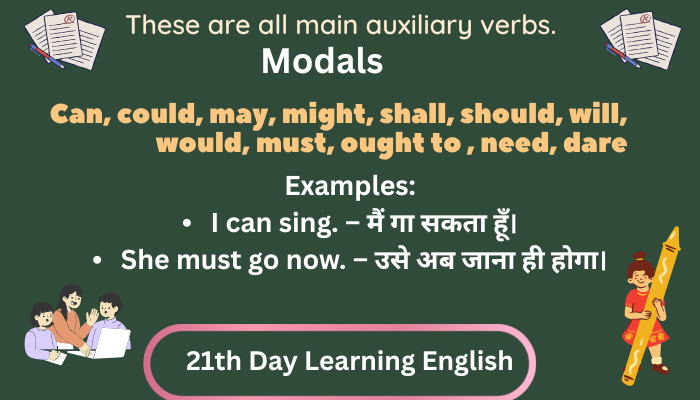
• Modal verbs are helping verbs (auxiliary verbs) used with the base form of the main verb.
• ये क्रियाएँ सहायक क्रियाएँ होती है।
• They show ability, possibility, necessity, permission, certainty, obligation, or probability.
• ये मुख्य क्रिया के साथ मिलकर क्षमता, संभावना, आवश्यकता, अनुमति, कर्तव्य, निश्चितता आदि को व्यक्त करती हैं।
• They are always used with the base form of the main verb (V1 form).
Examples:
• I can sing. – मैं गा सकता हूँ।
• She must go now. – उसे अब जाना ही होगा।
Modals :
These are all main auxiliary verbs. We will learn how to use them in sentences today, learning each one through conversations, so that you can now use them in your everyday speech.
ये सभी मुख्य सहायक क्रियाएं होती है।जिनकी वाक्य प्रयोग करना आज हम सीखेंगे, एक एक करके सभी का कन्वर्सेशन्स को सीखेंगे, ताकि आप अब इनको अपने बोलचाल में प्रयोग कर पाए।
Read Also
• Model Verb
• Use of Can & Could
• Use of Dare to
• Use of May & Might
• Use of Must & Ought
• Use of Shall & Will
• Use of Should & Would
• Use of Used to
• Use of Need to
CAN
Can का हिंदी अर्थ - सकना होता है। वाक्यों के क्रियाओं के अंत में - सकता है, सकती है, सकते हैं, सकता हूँ, आदि शब्द आते हैं।
Read More About Use of Can
1. Nikita: Can you help me with my homework, Anisha?
निकिता: अनिशा, क्या तुम मेरी होमवर्क में मदद कर सकती हो?
Anisha: Yes, I can help you after school.
अनिशा: हाँ, मैं स्कूल के बाद तुम्हारी मदद कर सकती हूँ।
The first sentence is, "Anisha, can you help me with my homework?" The answer is, "Yes, I can help you with schoolwork." The word "can" is used, meaning "to be able to," and the word " means "can.
2. Anisha: Can we go to the library together today?
अनिशा: क्या हम आज साथ में लाइब्रेरी जा सकते हैं?
Nikita: Yes, we can go after lunch.
निकिता: हाँ, हम लंच के बाद जा सकते हैं।
3. Nikita: Can you explain this chapter to me?
निकिता: क्या तुम मुझे यह अध्याय समझा सकती हो?
Anisha: Yes, I can explain it easily.
अनिशा: हाँ, मैं इसे आसानी से समझा सकती हूँ।
4. Anisha: Can you come to my house this evening?
अनिशा: क्या तुम आज शाम मेरे घर आ सकती हो?
Nikita: Yes, I can come after 6 p.m.
निकिता: हाँ, मैं 6 बजे के बाद आ सकती हूँ।
5. Nikita: Can we prepare for the test together tomorrow?
निकिता: क्या हम कल साथ में टेस्ट की तैयारी कर सकते हैं?
Anisha: Yes, we can study together.
अनिशा: हाँ, हम साथ में पढ़ सकते हैं।
• Read More About Use of Can
COULD
Could Meaning In Hindi
Could का हिंदी अर्थ - सका है, सकी है, सके हैं, सकती थे, सकते थे, कर सकता था, कर सकते थे, होता है।
SENTENCES
1. Rohit: Could you explain this science experiment to me, Mohit?
रोहित: मोहित, क्या तुम मुझे यह साइंस एक्सपेरिमेंट समझा सकते हो?
Mohit: Yes, I could explain it easily.
मोहित: हाँ, मैं इसे आसानी से समझा सकता हूँ।
In the first sentence, Rohit is receiving a Question. Mohit, can you explain this science experiment to me here? Reply: Yes, I could easily explain it. The phrase "could" is used here, meaning "I Could."
पहले वाक्य में रोहित Question कर रहा है। मोहित क्या तुम मुझे यहाँ साइंस एक्सपेरिमेंट समझा सकते हो?रिप्लाइ हाँ, मैं इसे आसानी से समझा सकता हूँ।इसमें सकता हूँ का प्रयोग हुआ है अथार्त सकता हूँ मैं could का प्रयोग हुआ है।
2. Mohit: Could we use this formula to solve the problem?
मोहित: क्या हम इस फ़ॉर्मूला का उपयोग समस्या हल करने के लिए कर सकते हैं?
Rohit: Yes, we could use it in this case.
रोहित: हाँ, हम इसे इस स्थिति में उपयोग कर सकते हैं।
3. Rohit: Could this machine save electricity?
रोहित: क्या यह मशीन बिजली बचा सकती है?
Mohit: Yes, it could reduce power consumption.
मोहित: हाँ, यह बिजली की खपत कम कर सकती है।
4. Mohit: Could we perform this experiment in the lab tomorrow?
मोहित: क्या हम यह प्रयोग कल लैब में कर सकते हैं?
Rohit: Yes, we could do it with the teacher’s permission.
रोहित: हाँ, हम टीचर की अनुमति से कर सकते हैं।
5. Rohit: Could this discovery change our future?
रोहित: क्या यह खोज हमारा भविष्य बदल सकती है?
Mohit: Yes, it could help science grow.
मोहित: हाँ, यह विज्ञान को आगे बढ़ा सकती है।
• Read More About Use of Could
MAY
Meaning of May in Hindi
May का हिंदी अर्थ - ‘सकता है, सकती है, सकते हैं,सकता हूँ, शायद हो, सकूँ, सकें’, होता है। ये शब्द हिंदी वाक्य के अंत में आते हैं।
SENTENCES
1. Brother: May I use your notebook for a while?
भाई: क्या मैं थोड़ी देर के लिए तुम्हारी कॉपी इस्तेमाल कर सकता हूँ?
Sister: Yes, you may use it.
बहन: हाँ, तुम इसे इस्तेमाल कर सकते हो।
2. Sister: May we go to the park this evening?
बहन: क्या हम आज शाम पार्क जा सकते हैं?
Brother: Yes, we may go after homework.
भाई: हाँ, होमवर्क के बाद हम जा सकते हैं।
3. Brother: May I help you with the cooking?
भाई: क्या मैं खाना बनाने में तुम्हारी मदद कर सकता हूँ?
Sister: Yes, you may help me.
बहन: हाँ, तुम मेरी मदद कर सकते हो।
4. Sister: May I borrow your phone for a call?
बहन: क्या मैं एक कॉल करने के लिए तुम्हारा फोन ले सकती हूँ?
Brother: Yes, you may take it.
भाई: हाँ, तुम ले सकती हो।
5. Brother: May we watch a movie tonight?
भाई: क्या हम आज रात कोई फिल्म देख सकते हैं?
Sister: Yes, we may watch it after dinner.
बहन: हाँ, डिनर के बाद हम देख सकते हैं।
• Read More About Use of May
MIGHT
Meaning Of Might In Hindi
ऐसे वाक्यों में अतं में सकता है, सकती है, सकते हैं, सकता था, सकती थी, सका, सकी आदि शब्द आते हैं।
SENTENCES
1. Mom: It might rain in the evening. Should we carry an umbrella?
माँ: शाम को बारिश हो सकती है। क्या हमें छाता ले जाना चाहिए?
Dad: Yes, it might be useful.
पापा: हाँ, यह काम आ सकता है।
2. Dad: We might reach late today because of traffic.
पापा: ट्रैफिक की वजह से हम आज देर से पहुँच सकते हैं।
Mom: That’s fine. I might start dinner a little late.
माँ: ठीक है। मैं भी खाना थोड़ा देर से शुरू कर सकती हूँ।
3. Mom: The guests might come early today.
माँ: मेहमान आज जल्दी आ सकते हैं।
Dad: Then I might finish my work soon.
पापा: तब मैं अपना काम जल्दी खत्म कर सकता हूँ।
4. Dad: We might go to the market after lunch.
पापा: हम लंच के बाद बाज़ार जा सकते हैं।
Mom: Okay, I might make a shopping list.
माँ: ठीक है, मैं खरीदारी की सूची बना सकती हूँ।
5. Mom: The children might need help with homework.
माँ: बच्चों को होमवर्क में मदद की ज़रूरत पड़ सकती है।
Dad: Yes, I might help them in the evening.
पापा: हाँ, मैं शाम को उनकी मदद कर सकता हूँ।
• Read More About Use of Might
SHALL
Shall Meaning in Hindi
वाक्य के अंत में गा, गी, गे , होगा, होगी, रहेगा, रहेगी, बनेगा, बनेगी आदि आता है।
SENTENCES
1. Chef A: Shall I start cooking the main dish?
शेफ A: क्या मैं मुख्य डिश बनाना शुरू करूँ?
Chef B: Yes, I shall start now.
शेफ B: हाँ, मैं अभी शुरू करूँगा।
2. Chef A: Shall we prepare the dessert first?
शेफ A: क्या हम पहले डेज़र्ट तैयार करें?
Chef B: Yes, we shall prepare it before dinner.
शेफ B: हाँ, हम डिनर से पहले इसे तैयार करेंगे।
3. Chef A: Shall I cut the vegetables?
शेफ A: क्या मैं सब्ज़ियाँ काटूँ?
Chef B: Yes, you shall cut them finely.
शेफ B: हाँ, तुम इन्हें बारीक काटोगे।
4. Chef A: Shall we serve the food at 8 o’clock?
शेफ A: क्या हम 8 बजे खाना परोसें?
Chef B: Yes, we shall serve it on time.
शेफ B: हाँ, हम समय पर खाना परोसेंगे।
5. Chef A: Shall I check the taste before serving?
शेफ A: क्या मैं परोसने से पहले स्वाद जाँचूँ?
Chef B: Yes, you shall check it carefully.
शेफ B: हाँ, तुम इसे ध्यान से जाँचोगे।
• Read More About Use of Shall
WILL
Meaning of will of hindi
इसके अंत में गा गी गे, ( होगा) भविष्यकाल सूचक क्रिया होती है।
SENTENCES
1. Dancer A: I will practice harder for the competition.
डांसर A: मैं प्रतियोगिता के लिए और ज़्यादा अभ्यास करूँगा/करूँगी।
Dancer B: I will practice with you every day.
डांसर B: मैं रोज़ तुम्हारे साथ अभ्यास करूँगा/करूँगी।
2. Dancer A: Will you help me improve my footwork?
डांसर A: क्या तुम मेरी फुटवर्क सुधारने में मदद करोगे/करोगी?
Dancer B: Yes, I will help you.
डांसर B: हाँ, मैं तुम्हारी मदद करूँगा/करूँगी।
3. Dancer A: I will try a new dance style this time.
डांसर A: मैं इस बार एक नया डांस स्टाइल आज़माऊँगा/आज़माऊँगी।
Dancer B: That’s great. I will support you.
डांसर B: यह बढ़िया है। मैं तुम्हें सपोर्ट करूँगा/करूँगी।
4. Dancer A: Will we perform together on stage?
डांसर A: क्या हम स्टेज पर साथ में परफॉर्म करेंगे?
Dancer B: Yes, we will perform together.
डांसर B: हाँ, हम साथ में परफॉर्म करेंगे।
5. Dancer A: I will not give up easily.
डांसर A: मैं आसानी से हार नहीं मानूँगा/मानूँगी।
Dancer B: I will motivate you always.
डांसर B: मैं हमेशा तुम्हें प्रोत्साहित करूँगा/करूँगी।
• Read More About Use of Will
SHOULD
Meaning of Should in hindi
• Should का प्रयोग उन वाक्यों में होता है, जिसके अंत में ‘चाहिए’, ‘करना चाहिए’, ‘करूँ’ आदि शब्द आते हैं।
SENTENCES
1. Doctor: The patient should take this medicine twice a day.
डॉक्टर: मरीज को यह दवा दिन में दो बार लेनी चाहिए।
Nurse: Yes doctor, I will make sure he takes it on time.
नर्स: जी डॉक्टर, मैं सुनिश्चित करूँगी कि वह समय पर दवा ले।
2. Nurse: Should the patient rest completely today?
नर्स: क्या मरीज को आज पूरा आराम करना चाहिए?
Doctor: Yes, he should rest and avoid any work.
डॉक्टर: हाँ, उसे आराम करना चाहिए और कोई काम नहीं करना चाहिए।
3. Doctor: The patient should drink plenty of water.
डॉक्टर: मरीज को ज़्यादा पानी पीना चाहिए।
Nurse: Okay doctor, I will remind him regularly.
नर्स: ठीक है डॉक्टर, मैं उसे बार-बार याद दिलाऊँगी।
4. Nurse: Should we check his temperature again?
नर्स: क्या हमें उसका तापमान फिर से जाँचना चाहिए?
Doctor: Yes, we should check it every four hours.
डॉक्टर: हाँ, हमें हर चार घंटे में जाँचना चाहिए।
5. Doctor: He should not eat oily food for a few days.
डॉक्टर: उसे कुछ दिनों तक तैलीय खाना नहीं खाना चाहिए।
Nurse: I will inform the patient about it.
नर्स: मैं मरीज को इसके बारे में बता दूँगी।
• Read More About Use of Should
WOULD
Meaning of Would in Hindi
Would का प्रयोग उन वाक्यों के अंत के लिए होता है जिनके अंत में किया करता था,करती थी, क्या करते थे, चाहूंगा, चाहेगी, चाहेंगे, करेंगे, करूँगा, करेगी, लगेगा, लगेगी, लगेगें, ता रहा होता, आती रही होती, रहे होते, आदि शब्द आने वाले होता है।
SENTENCES
1. Nurse: Would you like to sit or lie down?
नर्स: क्या आप बैठना चाहेंगे या लेटना चाहेंगे?
Patient: I would like to lie down, please.
मरीज: मैं लेटना चाहूँगा, कृपया।
2. Nurse: Would you please take this medicine now?
नर्स: क्या आप कृपया यह दवा अभी लेंगे?
Patient: Yes, I would take it now.
मरीज: हाँ, मैं इसे अभी ले लूँगा।
3. Patient: Would you help me walk to the bed?
मरीज: क्या आप मुझे बिस्तर तक चलने में मदद करेंगी?
Nurse: Yes, I would help you carefully.
नर्स: हाँ, मैं आपको सावधानी से मदद करूँगी।
4. Nurse: Would you feel comfortable if I open the window?
नर्स: अगर मैं खिड़की खोल दूँ तो क्या आपको आराम लगेगा?
Patient: Yes, that would be better.
मरीज: हाँ, वह बेहतर होगा।
5. Patient: Would it be okay if I rest for some time?
मरीज: क्या थोड़ी देर आराम करना ठीक रहेगा?
Nurse: Yes, you would feel better after resting.
नर्स: हाँ, आराम करने के बाद आप बेहतर महसूस करेंगे।
• Read More About Use of Would
MUST / OUGHT TO/ NEED/ DARE
Must Meaning in Hindi
इसके वाक्य के अंत में, चाहिये, अवश्य चलाएं, जरूर चाहिए, होगा, अवश्य होगा, जरूरी होगा, जैसे शब्द आते हैं।
1. We must keep our environment clean.
हमें अपने पर्यावरण को साफ रखना चाहिए।
2. Students must complete their homework on time.
छात्रों को अपना होमवर्क समय पर पूरा करना ही चाहिए।
Ought meaning in Hindi
इसका प्रयोग करना चाहिए, रखना चाहिए, रूप में होता है।
1. You ought to help people in need.
तुम्हें ज़रूरतमंद लोगों की मदद करनी चाहिए।
2. We ought to respect our elders.
हमें अपने बड़ों का सम्मान करना चाहिए।
Hindi Meaning Of Need
Need का हिंदी अर्थ - आवश्यकता होना, चाहना / चाहिये, आवश्यक होना, जरूरत होता है।
1. You need to work hard to succeed.
सफल होने के लिए तुम्हें मेहनत करने की ज़रूरत है।
2. I need some rest after the journey.
यात्रा के बाद मुझे थोड़े आराम की ज़रूरत है।
Hindi Meaning of Dare
Dare का हिंदी अर्थ - हिम्मत करना / साहस करना/ चुनौती देना
1. He does not dare to speak the truth.
वह सच बोलने की हिम्मत नहीं करता।
2. She doesn’t dare to enter the dark room alone.
वह अकेले अँधेरे कमरे में जाने की हिम्मत नहीं करती।
These are all examples of main auxiliary verbs, illustrated with sentence examples. All of them end with "सकना" but their meanings are different. Some people use "may" in the sense of " can," but while this is acceptable in informal conversation, it's not grammatically correct. The meaning should be understood clearly by using the words in sentences. Only then will you be able to understand all of them through their usage.
ये सभी मुख्य सहायक क्रिया के उदाहरण है जो कि वाक्य प्रयोग करके बताए गए हैं।सभी के अंत में, सकना आ रहा है।परंतु सभी के अर्थ अलग अलग है।कुछ लोग may के अर्थ में can का प्रयोग करते हैं।परन्तु यह बोलचाल में तो चलता है परंतु grammar से यह उचित नहीं होता है। इनके अर्थ को वाक्य में प्रयोग करके अच्छी तरह समझ लेना चाहिए तभी आप सभी को उन के प्रयोग द्वारा समझ पाएंगे।
If you have understood all the models and know how to form sentences using them, then an exercise is provided below. Solve that exercise on your own.
Read Also
• Use of Must & Ought
• Use of Need to
• Use of Dare to
Exercise-1
Fill in the blanks with the correct modal verb
1. You _ be careful while crossing the road.
2. I _ help you with your homework.
3. She _ come to the party tonight.
4. He _ finish the work by tomorrow.
5. _ I borrow your pen?
6. We _ attend the meeting on time.
7. You _ respect your elders.
8. He _ speak three languages fluently.
9. They _ not go outside in this storm.
10. She _ call her mother right now.
11. _ we go for a walk in the evening?
12. I _ be wrong, but I think it’s correct.
13. He _ not tell a lie.
14. You _ work hard to succeed.
15. She _ visit her grandparents next week.
16. _ you please help me with this task?
17. They _ have left already; I am not sure.
18. We _ take care of our environment.
19. He _ not eat junk food regularly.
20. She _ study more to pass the exam.
21. I _ stay at home tonight because it’s raining.
22. You _ try this new recipe; it’s delicious.
23. He _ be sleeping now.
24. We _ help the poor and needy people.
25. She _ not dare to lie to her teacher.
26. _ I open the window?
27. They _ have been playing since morning.
28. He _ take rest after his long journey.
29. You _ not waste water.
30. She _ join the dance class if she wants.
ANSWER KEY
1. must
2. can
3. may
4. must
5. may
6. shall
7. ought to
8. can
9. should
10. can
11. shall
12. might
13. must
14. must
15. will
16. could
17. might
18. must
19. should
20. should
21. may
22. should
23. might
24. must
25. dare not / should not dare
26. may
27. might
28. should
29. must not
30. may