Definition (पऱिभाषा)
A pronoun is a word used in place of a Noun to avoid its repetition.
संज्ञा के स्थान पर प्रयोग होने वाले शब्द को सर्वनाम कहते है।
Pronoun का हिंदी अर्थ सर्वनाम है, सर्वनाम वह शब्द है जो संज्ञा(noun) के स्थान पर प्रयोग होता है ताकि बार- बार दोहराना न पड़े और वाक्य छोटा, सरल और सुगम बने।सर्वनाम के अलग अलग प्रकार हैं और हर प्रकार का एक विशेष कार्य को अच्छे से समझाया गया है।इस पोस्ट में सर्वनाम का अर्थ, सर्वनाम की परिभाषा, सर्वनाम के प्रकार , उदाहरण, मुख्य बिंदु तथा सर्वनाम के प्रकारों को विस्तार से समझाया गया है। इस पोस्ट में आप हिंदी व अंग्रेजी में सर्वनाम(pronoun) को आसानी से सीख पाएंगे।
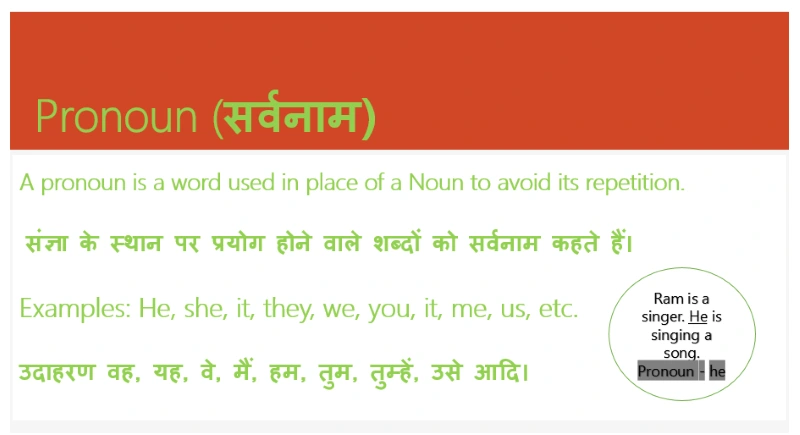
A pronoun is a word used in place of a Noun to avoid its repetition.
संज्ञा के स्थान पर प्रयोग होने वाले शब्द को सर्वनाम कहते है।
1. Ankit is my friend. Heis very honest.
अंकित मेरा दोस्त है। वह बहुत ईमानदार है।
2. Aanchal is singing a song. She has a sweet voice.
आँचल गाना गा रही है। उसकी आवाज़ बहुत प्यारी है।
3. The dog is barking. It is hungry.
कुत्ता भौंक रहा है। वहाँ भूखा है।
4. Ramesh and I are going to market. We will buy fruits.
रमेश और मैं बाजार जा रहे हैं।हम फल खरीदेंगे।
5. Radha and Meena are dancing. Theyare happy.
राधा और मीना नाच रही है। वे खुश है।
6. This book is very interesting. It is mine.
यह किताब बहुत रोचक है। यह मेरी है।
7. Mohan is a good player. He plays cricket.
मोहन अच्छा खिलाड़ी है। वह रोज़ क्रिकेट खेलता है।
8. The teacher is teaching . he is strict.
अध्यापक पढ़ा रहे हैं। वह सख्त है।
9. Neha is my sister. She studies in class 8.
नेहा मेरी बहन है, वह आठवीं कक्षा में पढ़ती है।
10. The sun rises in the east. It gives us light.
सूरज पूरब में निकलता है, वह हमें रोशनी देता है।
11. My father is a doctor. He helps poor people.
मेरे पिताजी डॉक्टर है, वह गरीब लोगों की मदद करते हैं।
12. The boys are playing in the ground. They are making noise.
लड़के मैदान में खेल रहे है। वे शोर मचा रहे हैं।
13. The girl is very intelligent. She always gets good marks.
लड़की बहुत होशियार है। वह हमेशा अच्छे अंक लाती है।
14. The book is on the table. It is new .
किताब मेज पर है। यह नई है।
15. Ankit is in park. He is playing football.
अंकित पार्क में है। वह फुटबॉल खेल रहा है।
16. Rani is cooking food. She is happy.
रानी खाना बना रही है। वह खुश है।
17. The cat is on the roof. It is drinking milk.
बिल्ली छत पर है। वह दूध पी रही है।
18. Meenu and I are friends. We study together.
मीनू और मैं दोस्त हैं। हम साथ पढ़ते है।
19. The children are in the garden. They are playing.
बच्चे बगीचे में हैं। वह खेल रहे हैं।
20. The pen is very costly. It is mine.
पेन बहुत महंगा है। यह मेरा है।
उपर्युक्त वाक्यों में संज्ञा के स्थान पर he, she, it, we, they, सर्वनाम(pronouns) हैं।
NOTE: हर बार Noun को repeat करने की जरुरत नहीं है, Pronoun use करने से sentences छोटा और clear हो जाता है। भाषा को सुंदर व सुलभ बनाने के लिए हम English Grammar में Pronoun प्रयोग करते हैं।
• Noun • Verb
• Adverb
• Tense
• Present Tense
• Past Tense
• Future tense Tense
These are 9 types of Pronoun.
सर्वनाम के नौ प्रकार होते हैं।
1.Personal Pronoun (पुरुषवाचक सर्वनाम)
2. Possessive Pronouns (सम्बंधवाचक सर्वनाम)
3. Reflexive Pronouns (निजवाचक सर्वनाम )
4. Demonstrative Pronoun (संकेतवाचक सर्वनाम )
5. Interrogative Pronouns (प्रश्नवाचक सर्वनाम)
6. Relative Pronouns (सम्बन्धवाचक सर्वनाम )
7. Indefinite Pronouns (अनिश्चयवाचक सर्वनाम)
8. Reciprocal Pronouns (परस्परवाचक सर्वनाम )
9. Distributive Pronouns (वितरणवाचक सर्वनाम )
• Present Indefinite Tense
• Present Perfect Tense
• Present Continuous Tense
• Present Perfect Continuous Tense
A personal pronoun is a pronoun that is used to refer to a specific person or thing. It replaces the Noun to avoid repetition.
पुरुषवाचक सर्वनाम वह शब्द है जो किसी व्यक्ति, वस्तु या जीव के नाम की जगह प्रयोग किया जाता है। यह संज्ञा की जगह लेकर वाक्य को छोटा और सरल बनाता है।
1. I am happy.
मैं खुश हूँ।
2. You are very kind.
तुम बहुत दयालु हो।
3. He is my brother.
वह मेरा भाई है।
4. She is my sister.
वह मेरी बहन है।
5. It is my dog.
यह मेरा कुत्ता है।
6. We are going to market.
हम बाजार जा रहे हैं।
7. They are playing cricket.
वे क्रिकेट खेल रहे हैं।
8. I saw him yesterday.
मैंने उसे कल देखा।
उपर्युक्त वाक्यों में I, You, He, She, It, We, They, I Personal Pronouns हैं।
• Past Indefinite Tense
• Past Perfect Tense
• Past Continuous Tense
• Past Perfect Continuous Tense
Personal pronouns को तीन प्रकार में बांटा जाता है-
• Singular : I, me
• Plural : We, us
• I am a student.
मैं छात्र हूँ।
• We are going to school.
हमें स्कूल जा रहे हैं।
• Singular and Plural : You
• You are my friend.
तुम मेरे दोस्त हो।
• You all are welcome.
आप सभी का स्वागत है।
• Singular : He, she, it
• Plural : They , Them
• He is a teacher. वह शिक्षक हैं।
• She is reading a book. वह किताब पढ़ रही है।
• It is raining. बारिश हो रही है।
1.Personal pronoun हमेशा noun के number, person और gender के अनुसार बदलता है।
• He – masculine singular
• She – feminine singular
• It – neutral singular
• They – plural
2.Subject और Object के अनुसार form बदलती है।
| Subject (कर्ता) | Object (कर्म) |
|---|---|
| I | Me |
| We | Us |
| You | Your |
| He | him |
| She | her |
| It | It |
| They | them |
1.She (subject) likes him (object).
2.We (subject) saw them (object).
जैसे – मैं, हम (वक्ता द्वारा खुद के लिए), तुम और आप (सुनने वाले के लिए ) और यह, वह, ये, वे (किसी और के बारे में बात करने के लिए) आदि
Pronouns that show ownership or possession.
It replace a noun to indicate that something belongs to someone.
जिन सर्वनाम शब्दों का प्रयोग किसी वस्तु या व्यक्ति का सम्बन्ध बताने के लिए किया जाए वे शब्द सम्बन्धवाचक सर्वनाम कहलाते हैं।
Mine, Yours, His, Hers, Ours, Theirs
1. This book is mine.
यह किताब मेरी है।
2.That pen is yours.
वह पेन तुम्हारा है।
3. The bag is hers.
यह बैग उसकी है।
4. This House is his.
यह घर उसका है।
5. The toys are ours.
ये खिलौने हमारे है।
6. The chairs are theirs.
ये कुर्सियां उनकी है।
7. The book is mine.
वह किताब मेरी हैं।
8. The car outside is yours.
बाहर की गाड़ी तुम्हारी है।
9. The problem is here.
वह समस्या उसकी है।
10. The laptop on the table is his.
मेज पर रखा लैपटॉप उसका हैं।
उपर्युक्त वाक्यों में mine, yours, hers, his, ours, theirs Possessive pronouns हैं।
| Person | Singular | Plural |
|---|---|---|
| 1st Person | Mine | Ours |
| 2nd Person | Yours | Yours |
| 3rd Person | His | Their |
| 4th Person | Here | Their |
| 5th Person | Its | Their |
ध्यान दें - Possessive Pronoun के पीछे noun नहीं आता ।
Wrong: This is mine book.
Right : This book is Mine.
• Models
• Active & Passive voice
1. Possessive Pronoun हमेशा ownership बताता है।
• This is my book. – my is possessive adjective
• This book is mine. – mine is possessive pronoun.
2. Possessive pronoun के साथ noun नहीं आता ।
3. Singular और Plural forms में फर्क होता है।
4. Gender (male, female, neutral) का ध्यान रखना जरूरी है।
• Future Indefinite Tense
• Future Perfect Tense
• Future Continuous Tense
• Future Perfect Continuous Tense
Pronouns that refer back to the subject of the sentence and end with- self or selves.
जिन शब्दों का प्रयोग वक्ता स्वयं के लिए करता है, वे निजवाचक सर्वनाम कहलाते हैं। इसके अंतर्गत आप, स्वयं, खुद, स्वतः आदि।
Myself, Yourself, Himself, Themselves Subject = Object
1. You all must behave yourselves.
तुम सब को अपने आप अच्छा व्यवहार करना चाहिए।
2. I cut myself while cooking.
खाना बनाते समय मैंने खुद को काट लिया।
3. She introduced herself to the new teacher.
उसने नए अध्यापक से अपना परिचय दिया।
4. He hurt himself while playing football.
फुटबॉल खेलते समय उसने खुद को चोट पहुंचाई।
5. They enjoyed themselves at the party.
उन्होंने पार्टी में खूब मज़ा लिया।
6. We prepared the food by ourselves.
हमने खाना खुद से बनाया।
7. The cat cleaned itself.
बिल्ली ने खुद को साफ किया।
8. You should take care of yourself.
तुम्हें अपनी देखभाल करनी चाहिए।
उपर्युक्त वाक्यों में Yourself, myself, herself, himself, themselves, ourselves, itself, yourself Reflexive pronouns हैँ।
• Reflexive Pronouns = Personal pronoun + self / selves
| Person | Reflexive pronoun |
|---|---|
| I | Myself |
| You (Singular) | Yourself |
| He | Himself |
| She | Herself |
| It | Itsself |
| We | ourself |
| You (Plural) | Yourselves |
| They | Themselves |
1.जब Subject और Object एक ही हों – reflexive pronoun का प्रयोग होता है।
• I hurt myself.
• She blamed herself.
2.जोर देने (emphasis) के लिए reflexive pronoun का प्रयोग होता है।
• I did it myself.
• The teacher himself taught us.
3.Reflexive pronoun को subject के बाद या object के बाद रखा जाता है।
• Affirmative Sentence
• Negative Sentence
• Interrogative Sentence
• Conditional Sentence
A demonstrative pronoun is a pronoun that is used to point out specific persons, places, things, or ideas instead of repeating their names.
यानी जब हम किसी वस्तु, व्यक्ति, स्थान या विचार की ओर इशारा करते हैं और संख्या की जगह सर्वनाम का प्रयोग करते हैं तो उसे demonstrative pronoun कहते हैं।
किसी वस्तु या व्यक्ति की ओर संकेत करना, संकेतवाचक सर्वनाम कहते है। जैसे- यह, वह, ये, वे
जब कोई सर्वनाम किसी व्यक्ति, वस्तु, स्थान या विचार की ओर संकेत करता है, और संख्या की पुनरावृत्ति (बार- बार नाम लेने से बचाता है), तो उसे निश्यवाचक सर्वनाम नाम कहते हैं।
• This (यह) – नज़दीक की वस्तु/व्यक्ति (singular) के लिए
• That (वह)– दूर की वस्तु/ व्यक्ति (singular) के लिए
• These (ये) – नज़दीक की वस्तुएं/ व्यक्ति (plural) के लिए
• Those (वे) - दूर की वस्तु/ व्यक्ति (plural) के लिए
1. This is my school. (यह मेरा पेन है।)
2.This is delicious. (यह स्वादिष्ट है।)
3. That is your house. (वह तुम्हारा घर है।)
4. That is very expensive. (वह बहुत महंगा है।)
5. These are my friends. (ये मेरे दोस्त हैं।)
6. These are very useful. (ये बहुत उपयोगी है।)
7. Those are my shoes. (वे मेरे जूते हैं।)
8. Those are not yours. (वह तुम्हारे नहीं हैं।)
उपर्युक्त वाक्यों में This, That, These, Those Demonstrative Pronoun हैं।
1.This/That का प्रयोग singular noun के लिए होता है।
2.These/those का प्रयोग plural noun के लिए होता है।
3.Demonstrative Pronouns noun की जगह प्रयोग होते हैं, जबकि demonstrative adjectives noun के साथ खड़े होते हैं।
• Example (Pronoun) : This is mine.
• Example (Adjective) : This book is mine.
4.वाक्य में अक्सर subject या object के रुप में प्रयोग होते हैं।
An interrogative pronoun is a pronoun used to ask questions about persons, things, or choices.
यानी जब कोई pronoun प्रश्न पूछने के लिए प्रयोग होता है, तब उसे Interrogative Pronoun कहते हैं।
जब कोई सर्वनाम किसी व्यक्ति, वस्तु, स्थान या विचार के बारे में प्रश्न पूछने के लिए प्रयुक्त होता है, तो उसे प्रश्नवाचक सर्वनाम कहते हैं।
1.Who is your teacher?
तुम्हारे अध्यापक कौन हैं?
2.Who told you this?
तुम्हें यह किसने बताया?
3.Whom do you trust?
तुम किस पर भरोसा करते हो?
4.Whom are they calling?
वे किसे बुला रहे हैं?
5.Whose pen is this?
यह पेन किसका है?
6.Whose house is near the park?
पार्क के पास किसका घर है?
7.What is your name?
तुम्हारा नाम क्या है?
8.What do you want?
तुम क्या चाहते हो?
9.Which is your favorite subject?
तुम्हारा पसंदीदा विषय कौन सा है?
10.Which of these is correct?
इनमें से कौन सा सही है?
• Affirmative Sentence
• Negative Sentence
• Interrogative Sentence
• Conditional Sentence
1. Who (कौन) – व्यक्ति के लिए(subject के रुप में)
2. Whom (किसे /किसको) – व्यक्ति के लिए(object के रुप में)
3. Whose (किसका/किसकी/किसके)- अधिकार स्वामित्व
4. What (क्या /कौन सा)- वस्तु या विचार के लिए
5. Which (कौन सा /कौन सी/ कौन से) – विशेष विकल्प (choice) के लिए
1.Interrogative Pronoun + Verb मिलकार हमेशा प्रश्न वाचक वाक्य बनाता हैं।
Example: Who is knocking? कौन दस्तक दे रहा है?
2.Interrogative pronouns कभी – कभी preposition के साथ प्रयोग होते हैं।
Example: To whom are you talking?
आप किसके साथ बात कर रहे हैं?
3.इनका प्रयोग केवल प्रश्नवाचक वाक्यों में होता है ना कि साधारण वाक्य में।
4.ध्यान दें –
• जब Noun के बारे में सीधे प्रश्न पूछे जाते हैं, तो वह Interrogative Pronoun होता है।
• जब Noun के साथ खड़े होकर प्रश्न पूछते हैं, तो वह Interrogative Adjective कहलाता है।
• Use of Do&Does
• Use of Is/am/are
• Use of Has&Have
• Use of Had
A relative pronoun is a pronoun that introduces a clause (called a relative clause) and relates it to a noun or pronoun already mentioned in the sentence. यानी , जब कोई Pronoun किसी noun/pronoun से जुड़कर उसके बारे में extra information देता है और relative clause शुरु करता है, तो उसे Relative Pronoun कहते हैं।
जब कोई सर्वनाम किसी वाक्य में पहले आए हुए संज्ञा या सर्वनाम के बारे में अतिरिक्त जानकारी देने के लिए सम्बन्धसूचक उपवाक्य(relative clause) की शुरुआत करता है, तो उसे सम्बन्धवाचक सर्वनाम कहते हैं।
जिन सर्वनाम शब्दों का प्रयोग किसी वस्तु या व्यक्ति का सम्बन्ध बताने के लिए किया जाए वे शब्द सम्बन्धवाचक सर्वनाम कहलाते हैं।
Who, Whom, Whose, Which, That
1.The teacher who taught us is very kind.
वहाँ अध्यापक जिसने हमें पढ़ाया, बहुत दयालु हैं।
2.The boy whom you invited is my cousin.
वह लड़का जिसे तुमने बुलाया, मेरा चचेरा भाई है।
3.The girls whose bag was lost is crying.
वह लड़की जिसका बैग खो गया था, रो रही है।
4.This is the book which I was serching for.
यह वही किताब है जिसे मैं खोज रहा था।
5.The dress that she bought is beautiful.
वह ड्रेस जो उसने खरीदी, बहुत सुंदर है।
1. Who (जो /कौन) – व्यक्ति के लिए (subject)
2. Whom (जिसे /जिसको)- व्यक्ति के लिए (object)
3. Whose (जिसका /जिसकी/ जिसके)- स्वामित्व /अधिकार के लिए
4. Which (जो/ कौन सा)- वस्तु /जानवर /विकल्प के लिए
5. That (जो /वह)- व्यक्ति + वस्तु दोनों के लिए
1.Who हमेशा person (व्यक्ति) के लिए subject की तरह प्रयोग होता है।
Example: The boy who is standing there is my friend.
2.Whom व्यक्ति के लिए object की तरह प्रयोग होता है।
Example: The girl whom you met yesterday is my sister.
3.Whose स्वामित्व बताता है।
Example: The man whose car is parked outside is our teacher.
4.Which वस्तु या जानवर के लिए प्रयोग होता है।
Example: The book which I bought yesterday is very useful.
5.That बहुमुखी relative pronoun हैं - व्यक्ति, वस्तु, जानवर तीनों के लिए प्रयोग होता है।
Example:The dog that barked at night is mine.
• Use of This&That
• Use of These&Those
• Use of Is/am/are
• Use of Was&Were
An indefinite pronoun is a pronoun that refers to persons, things, or places in a general or indefinite way , without specifying exactly who or what.
जिन सर्वनाम शब्दों से वस्तु, व्यक्ति, स्थान आदि की निश्चितता का बोध नही होता वे अनिश्चयवाचक सर्वनाम कहलाते हैं। इसके सर्वनाम के अंतर्गत ‘कोई’ और ‘कुछ’ आते हैं।
जब कोई सर्वनाम किसी व्यक्ति, वस्तु या स्थान का निश्चित नाम बताए बिना सामान्य या अनिश्चित रूप से संकेत करता है, तो उसे अनिश्चित सर्वनाम कहते हैं।
Someone, Anyone, Everyone, Nobody, Everthing etc.
1.Someone knocked at the door.
किसी ने दरवाजा खटखटाया।
2.Nobody helped me.
किसी ने मेरी मदद नहीं की।
3.Everybody was laughing.
सब लोग हंस रहे थे।।
4.Anyone can solve this problem.
कोई भी इस समस्या को हल कर सकता है।
5.Everything is fine. सब कुछ ठीक है।
6.Each of the boys was given a prize.
हर लड़के को इनाम दिया गया।
7.I want to go somewhere peaceful.
मैं कहीं शांत जगह पर जाना चाहता हूँ।
8.One must be honest.
मनुष्य को ईमानदार होना चाहिए।
1.For persons (व्यक्ति के लिए)
• Someone (कोई व्यक्ति)
• Somebody (कोई व्यक्ति)
• Anyone (कोई भी व्यक्ति)
• Anybody (कोई भी व्यक्ति)
• Everyone (हर कोई)
• Everybody (सब लोग)
• No one (कोई नहीं)
• Nobody (कोई नहीं)
2.For Things (वस्तुओं के लिए)
• Something (कुछ)
• Anything (कुछ भी)
• Everything (सब कुछ)
• Nothing (कुछ भी नहीं)
3.For Place (स्थान के लिए)
• Somewhere (कहीं)
• Anywhere (कहीं भी)
• Everywhere (हर जगह)
• Nowhere (कहीं नहीं)
4.For Quantity (संख्या / मात्रा के लिए)
• All (सब)
• Some (कुछ)
• Any (कोई)
• Many (अनेक)
• Several (कई)
• Few (कुछ)
• None (कोई नहीं)
• Each (प्रत्येक)
• Either (कोई एक)
• Neither (न कोई)
• One (एक)
1.Indefinite Pronouns किसी specific noun को point नहीं करते।
Example: Someone is waiting for you.
2.ये Singular और plural दोनों हो सकते हैं।
3.Negative indefinite pronouns(nobody, nothing, none, no one) हमेशा नकारात्मक अर्थ देते हैं।
4.ये Noun का exact नाम नहीं बताते।
• Noun
• Verb
• Singular & Plural
• Sentence- Types of Sentence
A recriprocal pronoun is used when two or more people or things do the same action to each other, showing a mutal relationship.
जो एक – दूसरे के लिए होता है, परस्परवाचक सर्वनाम कहलाता है।
जब दो या दो से अधिक व्यक्ति या वस्तुएँ परस्पर (एक – दूसरे) के लिए कार्य करती है, तब उनके संबद्ध को व्यक्त करने वाले सर्वनाम को परस्पर वाचक सर्वनाम कहते हैं।
1. Each other(एक- दूसरे) – दो व्यक्तियो/ वस्तुओं के लिए प्रयोग होता है।
2. One another (एक – दूसरे) -दो से अधिक व्यक्ति/ वस्तुओं के लिए प्रयोग होता है।
1.Ram and Mohan love each other.
राम और मोहन एक दूसरे से प्यार करते हैं।
2.The two brothers help each other.
दोनों भाई एक दूसरे की मदद करते हैं।
3.We should trust looking at each other.
हमें एक दूसरे पर विश्वास करना चाहिए।
4.All the friends hugged one another.
सभी दोस्तों ने एक दूसरे को गले लगा लिया।
5.The students in the class were talking to one another.
कक्षा में विद्यार्थी एक दूसरे से बात कर रहे थे।
6.We should never fight with one another.
हमें कभी भी आपस में नहीं लड़ना चाहिए।
1.Reciprocal pronoun हमेशा plural subject के साथ प्रयोग होता है।
2.इनके साथ Possessive form भी प्रयोग होता है।
• Each other’s (एक – दूसरे का)
• One another’s (एक – दूसरे का, अधिक लोंगों के लिए)
A distributive pronoun is a pronoun that refers to persons or things one at a time, showing that they are considered individually rather than collectively.
समूह में से हर एक को अलग-अलग दर्शाना ।
जब कोई सर्वनाम किसी समूह के प्रत्येक सदस्य /वस्तु को अलग अलग दर्शाता है, न कि पूरे समूह को एक साथ, उसे वितरणवाचक सर्वनाम कहते हैं।
Example: Each, Either, Neither
1. Each (प्रत्येक हर एक) –हर व्यक्ति/ वस्तु को अलग अलग दर्शाता है।
2. Either (कोई एक) –दो में से एक को दर्शाता है।
3. Neither (न कोई)- दो में से किसी को भी नहीं दर्शाता।
1. Each of us must work hard.
हम में से प्रत्येक को मेहनत करनी चाहिए।
2. Each of the girls is intelligent.
हर लड़की होशियार है।
3. Yoy may choose either of the two shirts.
तुम दोनों में से कोई एक शर्ट चुन सकते हो।
4. Either of the roads leads to the market.
दोनों में से कोई भी रास्ता बाजार की ओर जाता है।
5. Neither answer is acceptable.
कोई भी उत्तर स्वीकार्य नहीं है।
6. Neither of the teachers was angery.
दोनों में से कोई भी अध्यापक गुस्से में नहीं है।
1.ये pronouns individual sense को दर्शाते हैं ना की group को।
2.ये हमेशा singular noun और singular verb के साथ प्रयोग होते हैं।
3.Persons of Pronoun (पुरुष)
1.First Person – I, We ( मैं, हम)
2.Second Person – You (तुम, आम)
3.Third Persone – He, She, It, They (वह, वे)
4. Number (वचन)
Singular – I, He, She, It
Plural – We, They
5. Gender (लिंग)
Masculine – He, His, Himself
Feminine – She, Her, Herself
Neuter – It, Its
6. Case (कारक)
Nominative Case : He is my husband.
Objective Case: I know him.
Possessive Case : This is his copy.
सर्वनाम भाषा को सुगम संक्षिप्त और प्रभावशाली बनाते हैं।अगर सर्वनाम न हो तो हमें हर बार संज्ञा का प्रयोग करना पड़ेगा, जिससे वाक्य भारी और अटपटा लगेगा, जो कि उचित नहीं है।सर्वनाम संज्ञा के स्थान पर प्रयोग किया जाता है, जिससे वाक्य सरल तथा प्रभावशाली लगता है।सर्वनाम न केवल noun की जगह लेते हैं, बल्कि अधिकारों, प्रश्न, संबद्ध, परस्परता और वितरण जैसे भाव भी प्रकट करते हैं। इस पोस्ट में आपको pronoun की पूर्ण जानकारी दी गयी है, जिससे आपको समझने में आसानी होगी।Thanks