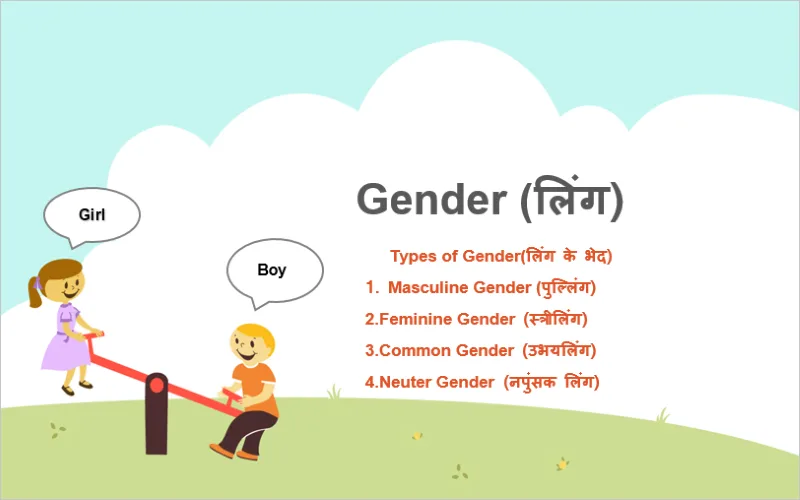
Gender – लिगं
Definition (परिभाषा)
Gender is the classification of nouns or pronouns as Masculine , Feminine, Common, or Neuter, based on sex or the absense of sex.
➢ It tells whether a noun refers to male, female, both, or none (object).
लिंग वह व्याकरणिक भेद है जिसके द्वारा किसी संज्ञा या सर्वनाम को पुरुष, स्त्री, दोनों या निर्जीव वस्तु के रूप में पहचाना जाता है।
अर्थात लिंग से यह पता चलता है कि शब्द नर, नारी, दोनों या निर्जीव वस्तुओं को सूचित करता है।
Types of Genders (लिंग के प्रकार)
1. Masculine Gender (पुल्लिंग)
2. Feminine Gender (स्त्रीलिंग)
3. Common Gender (उभयलिंग)
4. Neuter Gender (नपुंसक लिंग)
Read Also
• Parts of speech • Noun
• Pronoun • Preposition
• Verb • Adverb
• Adjective • conjunction
• Interjection • Sentence Parts of Sentence
1.Masculine Gender(पुल्लिंग)
Definition:
Masculine Gender is the gender that denotes a male person or an animal.
➢ It refers to the words used for men or male animals.
परिभाषा:
पुल्लिंग वह लिंग है जो पुरुष या नर जीव को दर्शाता है। अर्थात् - जिन शब्दों से नर जाति का बोध होता है, वे पुल्लिंग कहलाते हैं।
Examples of Masculine Gender Words -
may, boy, father, king, uncle,brother, husband, lion, bull, cock, prince, actor, god, hero
Examples in Sentences-
1. The boy is playing football.
लड़का फुटब़ॉल खेल रहा है।
2. The king ruled the kingdom wisly.
राजा ने राज्य को समझदारी से चलाया।
3. The man is very strong.
वह आदमी बहुत ताकतवर है।
4. The father loves his children.
पिता अपने बच्चों से प्यार करते हैं।
5. The lion lives in the jungle.
शेर जंगल में रहता है।
6. The actor performed very well.
उस अभिनेता ने बहुत अच्छा प्रदर्शन किया।
7. The uncle came from Delhi.
चाचा दिल्ली से आए।
8. The prince will become a king one day.
राजकुमार एक दिन राजा बनेगा।
9. The brother helped his sister.
भाई ने अपनी बहन की मदद की।
10. The hero saved the village.
नायक ने गाँव को बचाया।
*Important Note:
• Masculine Gender शब्दों का प्रयोग केवल नर (Male) के लिए किया जाता है।
• जब किसी वाक्य में he, his, him आदि सर्वनाम आएँ, तो वे भी Masculine Gender को दर्शाते हैं।
Read Also
• Modal verbs • Use of Can & Could
• Use of Shall & Will • Use of Is/am/are
• Use of Dare • Use of May & Might
• Use of Must & Ought
2. Feminine Gender (स्त्रीलिंग)
Definition:
Feminine Gender is the gender that denotes a female person or a female animal.
➢ It refers to words used for women or female animals.
परिभाषा:
स्त्रीलिंग वह लिंग है जो स्त्री या मादा जीव को दर्शाता है।
अर्थात जिन शब्दों से स्त्री का बोध होता है, वे स्त्रीलिंग कहलाते हैं।
Examples of Feminine Gender Words-
Woman, girl, queen, mother, aunt, sister, wife, lioness, cow, hen, princess, actress, goddess, heroine
Examples in Sentences-
1. The girls is singing a song.
लड़की गाना गा रही है।
2. The queen lives in a big palce.
रानी एक बड़े महल में रहती है।
3. The woman is cooking food.
वह महिला खाना पका रही है।
4. The mother loves her child.
माँ अपने बच्चे से प्यार करती है।
5. The lioness is hunting in the jungle.
शेरनी जंगल में शिकार कर रही है।
6. The actress performed beautifully.
उस अभिनेत्री ने सुंदर अभिनय किया।
7. The aunt came to visit us.
चाची हमसे मिलने आई।
8. The princess is very kind.
राजकुमारी बहुत दयालु है।
9. The sister helped her brother.
बहन ने अपने भाई की मदद की।
10. The heroine saved the village.
नायिका ने गाँव बचाया।
🞴 Important Rules:
1. By adding -ess –
Actor – actress, waiter – waitress
2. By changing the word –
King – queen, man – woman
3. By chnaging part of the word-
Landlord – landlady, godfather – godmother
4. By using an entirely different word-
Bull – cow, nephew- niece
Read Also
• Tense
• Present Tense
• Past tense
• Future tense
•Gender Change Rules
(Masculine-feminine)
(पुल्लिंग का स्त्रीलिंग में परिवर्तन)
➢ Rule 1 : By adding -ess
Masculine शब्दों में -ess जोड़कर Feminine बनाया जाता है।
| Masculine |
Feminine |
| Actor |
Actress |
| Waiter |
Waitress |
| Host |
Hostess |
| Lion |
Lioness |
| Tiger |
Tigeress |
➢ Rule 2 : By Changing the word itself (अलग शब्द का प्रयोग)
कुछ शब्दों के Masculine और Feminine पूरी तरह भिन्न होते हैं।
| Masculine |
Feminine |
| Man |
Woman |
| Boy |
Girl |
| Father |
Mother |
| Brother |
Sister |
| Husband |
Wife |
➢ Rule 3 : By adding a word before or after(शब्द जोड़कर परिवर्तन)
कुछ शब्दों में man / woman, male/ female, he/she जोड़कर लिंग बनाया जाता है।
| Masculine |
Feminine |
| Milkman |
Milkmaid |
| Gentleman |
Lady |
| He -goat |
She -gaot |
| Policeman |
Policewoman |
| Salesman |
Saleswoman |
➢ Rule 4 : By replacing the ending part (अंत का शब्द बदलकर)
| Masculine |
Feminine |
| Emperor |
Empress |
| Prince |
Princess |
| Duke |
Duchess |
| God |
Goddess |
| Master |
Mistress |
3.Common Gender (उभयलिंग)
Definition:
Common Gender is the gender that is used for both male and female persons or animals.
➢ It does not specify whether the noun refers to a male or a female.
परिभाषा:
उभयलिंग वह लिंग है जो पुरुष और स्त्री दोनों के लिए समान रुप से प्रयोग किया जाता है।
अर्थात ऐसे शब्द जिनसे यह नहीं पता चलता कि व्यक्ति नर है या मादा , वे उभयलिंग कहलाते हैं।
Examples Of Common gender Words-
Teacher, student, doctor, child, baby, friend, cousin, enemy, neighbour, parent, pupil, singer, servant, artist, student, dancer
Examples in Sentences-
1. The teacher is very kind.
वह अध्यापक बहुत दयालु हैं।
2. The doctor saved the patient’s life.
डॉक्टर ने मरीज की जान बचाई।
3. The child is playing outside.
बच्चा बाहर खेल रहा है।
4. My friend came to meet me.
मेरा मित्र मुझसे मिलने आया।
5. The student is reading a book.
विद्यार्थी किताब पढ़ रहे हैं।
6. The neighbour is very helpful.
पड़ोसी बहुत मददगार है।
7. The cousion is coming from Delhi.
मेरी चचेरा भाई /बहन दिल्ली से आ रहा /रही है।
8. The baby is sleeping.
शिशु सो रहा है।
9. The parent loves the child.
माता पिता बच्चे से प्यार करते हैं।
10. The singer sang a lovely song.
गायक /गायिका ने सुंदर गाना गाया।
Read Also
• Use of Used to • Use of Need to
• Active & Passive Voice • Use of Has & Have
• Use of Is/am/are • Number- Singular & Plural
🞴 Important Note:
1. Common Gender शब्दों से केवल व्यक्ति या प्राणी का पता चलता है,
लेकिन उनका लिंग, पुरुष या स्त्री स्पष्ट नहीं होता।
2. इस प्रकार के शब्दों के साथ या अन्य संकेत शब्दों से लिंग का पता चलता है।
• He is my friend. - वह मेरा मित्र है।
• She is my friend. -वह मेरी मित्र हैं।
3.Common Gender nouns में किसी प्रकार का रूप परिवर्तन नहीं होता, यानी शब्द वही रहता है, चाहे वह पुरुष हो या स्त्री।
4.Neuter Gender (नपुसंक लिंग)
Definition:
Neuter Gender is the gender that denotes non- living things – which have no life, no sex(neither male nor female).
➢ It refers to objects, materials, or ideas that are lifeless.
परिभाषा:
नपुंसक लिंग वह लिंग है जो निर्जीव वस्तुओं, पदार्थों या विचारों को दर्शाता है।
अर्थात - ऐसे शब्द जो न तो नर है ना मादा, वह नपुंसकलिंग कहलाते हैं।
Examples of Neuter Gender Words-
Table, chair, pen, book, car, door, school, house, tree, bag, mobile, water, sun, moon, air, road
Examples in Sentences-
1. The book is on the table.
किताब मेज पर है।
2. The car is very fast.
गाड़ी बहुत तेज है।
>3. The pen is in my bag.
कलम मेरे बैग में है।
4. The door is open.
दरवाजा खुला है।
5. The table is made of wood.
मेज लकड़ी की बनी है।
6. The school is near my house.
स्कूल मेरे घर के पास है।
7. The sun gives us light.
सूरज हमें रोशनी देता है।
8. The water is cold.
पानी ठंडा है।
9. The road is very long.
सड़क बहुत लंबी है।
10. The computer is on the table.
कंप्यूटर मेज पर है।
🞴 Important Note:
1. Neuter Gender nouns never denote living beings.
( यह कभी भी जीवित प्राणी को नहीं दर्शाता।)
2. इसके लिए प्रायः सर्वनाम it और its का प्रयोग किया जाता है।
Examples:
• It is a pen. यह एक कलम है।
• It is very useful. यह बहुत उपयोगी है।
• Its color is blue. इनका रंग नीला है।
Read Also
• Use of Do & Does • Use of Had
• Use of These & Those • Use of This & That
• Use of Was & Were
जल्द याद करने योग्य उदाहरण-
| Mascu - line |
Femi - nine |
Common |
Neuter |
| King |
Queen |
Teacher |
Book |
| Boy |
Girl |
Doctor |
Pen |
| Actor |
Actress |
Student |
Chair |
| Father |
Mother |
Friend |
Table |
| Lion |
Lioness |
Child |
Car |
Pronouns Used with Each Gender (हर लिंग के साथ प्रयुक्त सर्वनाम)
| Gender |
Pronoun |
| Masculine |
He/His/Him |
| Feminine |
She / Her / Here |
| Common |
He of She |
| Neuter |
It / Its |
🞴 Important points
1.Collective , Material and Abstract Nouns – Neuter gender की श्रेणी में रखा गया है।
Read Also
• Tense • Present Tense
• Present-indefinite-Tense • Present - Perfect Tense
• Present- continuous - Tense • Present - perfect - continuous -Tense
• Past Tense • Past Indefinite Tense
• Past Perfect Tense • Past continuous Tense
• Past- Perfect- continuous- Tense • Future Tense
• Future- Perfect- Tense • Future- Indefinite- Tense
• Future- continuous- Tense • Future- Perfect- continuous- Tense