Use Of ‘’IS’’ ‘’AM’’ “ARE” in Hindi
• ‘’Is’’, ‘’Am’’, ‘’Are’’ Verbs ‘to be’ verb के Present tense (Present Indefinite / Simple Present )के रुप हैं।
• इनका प्रयोग मुख्यतः Present time(वर्तमान काल) में subject की स्थिति (state), पहचान(identity), गुण (quality), या ongoing action (continuous tense) दिखाने के लिए होता है।
•Forms:
1. Is – Singular Subject (he, she , it, singular noun)
2. Am – केवल ‘’I’’ (मैं) के साथ
3. Are – Plural subject (you, we, they, plural noun)
Meaning
• Is का अर्थ – ‘है’
• Am का अर्थ – ‘हूँ’
• Are का अर्थ – ‘हो या हैं’
Use of is, am, are – Table
| Person |
Singular |
Plural |
| First Person |
I , am |
We are |
| Second Person |
You are |
You are |
| Third Person |
He is, She is, It is |
They are |
किस person के साथ कौन - सा शब्द प्रयोग होगा, इसके लिए तरीका दिया गया है। आगे हम जीतने भी उदाहरण देखेंगे सब में इसी नियम के अनुसार is, am, are का इस्तेमाल किया गया है।
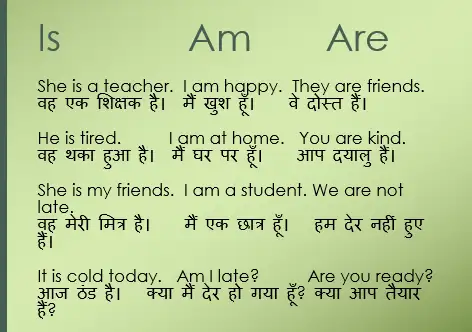
| Is |
Am |
Are |
She is a teacher.
वह एक शिक्षक हैं। |
I am happy.
मैं खुश हूँ। |
They are Friends.
वे दोस्त हैं। |
He is tired.
वह थका हुआ है। |
I am at home.
मैं घर पर हूँ। |
You are kind.
आप दयालु हैं। |
She is my friend.
वह मेरी मित्र है। |
I am a student.
मैं एक छात्र हूँ। |
We are not late.
हम देर नहीं हुए हैं। |
It is cold today.
आज ठंड है। |
Am I late?
क्या मैं देर हो गया हूँ? |
Are you ready?
क्या आप तैयार हैं? |
इसके अनुसार आप सभी ने सीख लिया होगा कि is, am, are का प्रयोग किस प्रकार किया जाता है आगे दिए गए उदाहरणों को ध्यान से समझिए और सीखिए।
◕ Rules Use of ‘’IS’’ ‘’AM’’ “ARE”
Rule 1 : As a Main Verb (Linking Verb)
Rule 2 : In Negative Sentences (नकारात्मक वाक्य)
Rule 3 : Interrogative Sentences (प्रश्नवाचक वाक्य)
Rule 4 : In Present Continous Tense
Rule 5 : Short Answer / Tag Questions
Rule 1 : As a Main Verb (Linking Verb)
जब ‘’is/am.are का प्रयोग subject को noun, pronoun, adjective या prepositional phrase से जोड़ने में होता है।
Example:
1.He is a Teacher. (वह एक शिक्षक है।)
2.I am happy.
(मैं खुश हूँ।)
3.They are in the park.
(वे पार्क में हैं।)
4.She is my friend.
(वह मेरी मित्र है।)
5.She is a nurse.
(वह एक नर्स है।)
6.My brother is very tall.
(मेरा भाई बहुत लंबा है।)
7.This pen is mine.
(यह पेन मेरा है।)
8.He is honest.
(वह ईमानदार है।)
9.The sky is blue.
(आसमान नीला है।)
10.The book is interesting.
(यह किताब रोचक है।)
11.I am a students of English.
(मैं अंग्रेजी का छात्र हूँ।)
12.I am your best friend.
(मैं तुम्हारा सबसे अच्छा दोस्त हूँ)
13.You are very kind.
(तुम बहुत दयालु हो।)
14.They are good singers.
(वे अच्छे गायक हैं।)
15.My parents are very supportive.
(मेरे माता -पिता बहुत सहायक हैं।)
16.They are at the station.
(वे स्टेशन पर हैं।)
17.We are from India.
(हम भारत से हैं।)
18.You are my neighbour.
(तुम मेरे पड़ोसी हो।)
19.I am a driver.
(मैं एक ड्राइवर हूँ।)
20.He is a Doctor.
(वह एक डॉकटर है।)
➢ यह सभी उदाहरण केवल स्थिति, पहचान या गुण बताते हैं, इनमें verb (जैसे –play, eat, go) का use नहीं हुआ।
Read Also
Read Also
• Parts of Speech
• Noun
• Pronoun
• Preposition
• Verb
• Adverb
• Adjective
• conjunction
Rule 2 : In Negative Sentences (नकारात्मक वाक्य)
‘’not’’ जोड़कर नकारात्मक वाक्य बनाए जाते हैं।
Examples:
1. He is not a doctor.
(वह डॉक्टर नहीं है।)
2. She is not my sister.
(वह मेरी बहन नहीं है।)
3. This bag is not heavy.
(यह बैग भारी नहीं है।)
4. The boy is not clever.
(लड़का चालाक नहीं है।)
5. The room is not clean.
(कमरा साफ नहीं है।)
6. My father is not at home.
(मेरे पिताजी घर पर नहीं है।)
7. I am not tired.
(मैं थका हुआ नहीं हूँ।)
8. I am not your enemy.
(मैं तुम्हारा दुश्मन नहीं हूँ।)
9. You are not my classmate.
(तुम मेरे सहपाठी नहीं हो।)
10. They are not my relatives.
(वे मेरे रिश्तेदार नहीं हैं।)
11. He is not my best friend.
(वह मेरा सबसे अच्छा दोस्त नहीं है।)
12. She is not very tall.
(वह बहुत लंबी नहीं है।)
13. The train is not on time.
(ट्रेन समय पर नहीं है।)
14. This phone is not expensive.
(यह फोन महंगा नहीं है।)
15. The students are not in the classroom.
(छात्र कक्षा में नहीं है।)
16. You are not late today.
(तुम आज लेट नहीं हो।)
17. I am not a lazy person.
(मैं आलसी व्यक्ति नहीं हूँ।)
18. They are not ready for the exam.
(वे परीक्षा के लिए तैयार नहीं है।)
19. My brother is not in Delhi.
(मेरा भाई दिल्ली में नहीं है।)
20. We are not busy right now.
(हम अभी व्यस्त हैं।)
Read Also
• Affirmative Sentence • Moda Verb
• Interrogative Sentence • Imperative Sentence
• Conditional Sentence • Exclamatory Sentence
• Present Tense
• Present-indefinite-Tense • Present - Perfect Tense
• Present- continuous - Tense • Present - perfect - continuous -Tense
Rule 3 : Interrogative Sentences (प्रश्नवाचक वाक्य)
जब सवाल पूछना हो तो ‘’is/am/are को subject से पहले लगाया जाता है।
Examples:
1. Is he your brother?
(क्या वह तुम्हारा भाई है?)
2. Is she a teacher?
(क्या वह अध्यापिका है?)
3. Is this your pen?
(क्या यह तुम्हारा पेन है?)
4. Is the bag heavy?
(क्या बैग भारी है?)
5. Is the sky blue?
(क्या आसमान नीला है?)
6. Is the room clean?
(क्या कमरा साफ है?)
7. Am I your friend?
(क्या मैं तुम्हारा दोस्त हूँ?)
8. Am I late?
(क्या मैं लेट हूँ?)
9. Are you happy?
(क्या तुम खुश हो?)
10. Are they good players?
(क्या वे अच्छे खिलाड़ी है?)
11. Is your father at home?
(क्या आपके पिताजी घर पर है?)
12. Is this book interesting ?
(क्या यह किताब रोचक है?)
13. Is the teacher in the class?
(क्या अध्यापक कक्षा में है?)
14. Is she your best friend?
(क्या वह आपकी सबसे अच्छी दोस्त हैं?)
15. Is there any problem?
(क्या कोई समस्या है?)
16. Am I in the right place?
(क्या मैं तुम्हारा सबसे अच्छा विद्यार्थी हूँ?)
17. Am I your best student?
(क्या मैं तुम्हारा सबसे अच्छा विद्यार्थी हूँ?)
18. Are you from Tehri?
(क्या तुम टिहरी से हो?)
19. Are they your neighbours?
(क्या वह तुम्हारे पड़ोसी है?)
20. Are we late for the meeting?
(क्या हम मीटिंग के लिए लेट है?)
Read Also
• Article-A • Moda Verb
• Interrogative Sentence • Active & Passive voice
• Singular & Plural Number • Use of Was & Were
• Past Tense • Past Indefinite Tense
• Past Perfect Tense • Past continuous Tense
• Past- Perfect- continuous- Tense
Rule 4 : In Present Continous Tense
किसी काम के इस समय चल रहे होने को दर्शाने के लिए ।
Examples:
1. He is playing Football.
(वह फुटबॉल खेल रहा है।)
2. I am reading a book.
(मैं किताब पढ़ रहा हूँ।)
3. They are going to school.
(वे स्कूल जा रहे हैं।)
4. She is singing a song.
(वह गाना गा रही है।)
5. She is reading a book.
(वह एक किताब पढ़ रही है।)
6. It is raining heavily.
(तेज़ बारिश हो रही है।)
7. The students are writing in their notebooks.
(छात्र अपनी कॉपियों में लिख रहे हैं।)
8. They are singing a song.
(वे गाना गा रहे हैं।)
9. He is playing a cricket.
(वह क्रिकेट खेल रहा है।)
10. The baby is crying.
(बच्चा रो रहा है।)
11. The father is watching TV.
(मेरे पिताजी टीवी देख रहे हैं।)
12. The dog is barking loudly.
(कुत्ता ज़ोर से भौंक रहा है।)
13. I am writing a letter.
(मैं एक पत्र लिख रहा हूँ।)
14. I am learning English.
(मैं अंग्रेजी सीख रहा हूँ।)
15. You are dancing beautifully.
(तुम सुन्दरता से नाच रहे हो।)
16. You are talking to much.
(तुम बहुत ज़्यादा बात कर रहे हो।)
17. We are studying for the exam.
(हम परीक्षा की तैयारी कर रहे हैं।)
18. We are playing in the park.
(हम पार्क में खेल रहे हैं।)
19. I am serching you.
(मैं तुम्हें ढूँढ रहा हूँ।)
20. He is laughing at this time.
(वह इस समय हंस रहा है।)
Rule 5 : Short Answer / Tag Questions
जब छोटे जवाब देने हों।
Examples:
1. Are you ready ? – Yes, I am.
क्या तुम तैयार हो – हाँ, मैं हूँ।
2. Is he your brother ? – Yes, he is.
क्या वह तुम्हारा भाई है – हाँ , वह है।
3. Is this your pen ? – No, it is not.
क्या यह तुम्हारा पेन है – नहीं , यह नहीं है।
4. Am I late ? – No, you are not.
क्या मैं लेट हूँ – नहीं, तुम नहीं हो।
5. Are they in the park? – Yes, they are.
क्या वह पार्क में है? - हाँ, वे हैं।
6. Is she a doctor? – No, she is not.
क्या वह डॉक्टर है – नहीं, वह नहीं है।
7. Are we friends? – Yes , we are.
क्या मैं सही हूँ – हाँ, तुम हो।
8. Am I right ? – Yes, you are.
क्या मैं सही हूँ – हाँ, तुम हो।
9. Is the baby sleeping? – Yes, it is.
क्या बच्चा सो रहा है – हाँ , सो रहा है।
10. Are you tired ? – No, I am not.
क्या तुम थके हुए हो – नहीं, मै नहीं हूँ।
Affirmative Sentences of ‘’Is’’,’’Am’’, ‘’Are’’ (सकारात्मक वाक्य)
Is, am, are का प्रयोग Affirmative Sentences में करना बहुत आसान है।
Examples:
1. The car is new. – गाड़ी नई है।
2. My house is big. – मेरा घर बड़ा है।
3. The girl is beautiful. -लड़की सूदंर है।
4. The sun is hot today. – आज सूरज गरम है।
5. The baby is cute. – बच्चा प्यारा है।
6. This room is clean. – यह कमरा साफ है।
7. His bag is heavy. – उसका बैग भारी है।
8. I am hungry. – मुझे भूख लगी है।
9. I am a good player. – मैं एक अच्छा खिलाडी हूँ।
10. I am very busy today. – मैं आज बहुत व्यस्त हूँ।
11. I am from India. – मैं भारत से हूँ।
12. I am your classmate. – मैं तुम्हारा सहपाठी हूँ।
13. I am honest. – मैं ईमानदार हूँ।
14. We are ready for the trip. – हम यात्रा के लिए तैयार हैं।
15. They are in the park. - वे पार्क में हैं।
16. You are late today.- तुम आज देर से हो।
17. The shop are open.- दुकानें खुली हैं।
18. My parents are kind. – मेरे माता-पिता दयालु हैं।
19. The boys are strong. – लड़के ताकतवर हैं।
20. These flowers are fresh. – य़े फल ताज़ा हैं।
Read Also
• Affirmative Sentence • Negative Sentence
• Pronoun • Preposition
• Verb • Adverb
• Future Tense
• Future- Perfect- Tense • Future- Indefinite- Tense
• Future- continuous- Tense • Future- Perfect- continuous- Tense
Negative Sentences of ‘’Is’’, ‘’Am’’ and ‘’Are’’ (नकारात्मक वाक्य)
Examples:
1. He is not a doctor. -वह डॉक्टर नहीं हैं।
2. She is not my mother. – वह मेरी माँ नहीं है।
3. It is not a pen. – यह पेन नहीं है।
4. The boy is not lazy. – लड़का आलसी नही है।
5. This room is not small. -यह कमरा छोटा नही है।
6. The girl is not tall. – लड़की लंबी नहीं है।
7. His book is not old. – उसकी किताब पुरानी नहीं है।
8. I am not a teacher. – मैं शिक्षक नहीं हूँ।
9. I am not sad. – मैं उदास नहीं हूँ।
10. I am not late. – मैं देर से नहीं हूँ।
11. I am not your enemy.- मैं तुम्हारा दुश्मन नहीं हूँ।
12. I am not very tired. – मैं बहुत थका हुआ नहीं हूँ।
13. I am not at home. -मैं घर पर नहीं हूँ।
14. We are not busy. – हम व्यस्त नहीं हैं।
15. They are not in school. – वे स्कूल में नहीं हैं।
16. You are not my brother. – तुम मेरे भाई नहीं हो।
17. The boys are not weak. – लड़के कमजोर नहीं हैं।
18. These fruits are not fresh. – ये फल ताजा नहीं हैं।
19. The shops are not closed. – दुकानें बंद नहीं हैं।
20. Children are not silent. – बच्चे चुप नहीं हैं।
Interrogative Sentences (Yes – No Type Questions) of ‘Is’, ‘Am’ and ‘Are’
Examples:
1. Is he your best friend? -क्या वह तुम्हारा सबसे अच्छा दोस्त है?
2. Is she at home now? -क्या वह अभी घर पर है?
3. Is it a holiday today? -क्या आज छुट्टी है?
4. Is the baby sleeping? -क्या बच्चा सो रहा है?
5. Is this your mobile phone? -क्या यह तुम्हारा मोबाइल फोन है?
6. Is the train late today? -क्या ट्रेन आज लेट है?
7. Is his father a doctor? -क्या उसके पिताजी डॉक्टर है?
8. Am I disturbing you? -क्या मैं तुम्हें परेशान कर रहा हूँ?
9. Am I your best student? -क्या मैं तुम्हारा सबसे अच्छा छात्र हूँ?
10. Am I welcome here? -क्या मेरा यहाँ स्वागत है?
11. Am I on the right way?- क्या मैं सही रास्ते पर हूँ?
12. Am I your true friend? -क्या मैं तुम्हारा सच्चा दोस्त हूँ?
13. Am I too late? -क्या मैं बहुत देर से हूँ?
14. Are we in the right class? -क्या हम सही कक्षा में है?
15. Are they your cousins? - क्या वे तुम्हारे चचेरे भाई बहन हैं?
16. Are you free now? -क्या तुम अभी खाली हो?
17. Are these students intelligent? - क्या ये छात्र बुद्धिमान है?
18. Are the girls ready for dance? - क्या लड़कियां नृत्य के लिए तैयार है?
19. Are the doors open? – क्या दरवाज़े खुले हैं?
20. Are my parents at home? – क्या मेरे माता – पिता घर पर हैं?
Read Also
• Use of Used to • Use of Need to
• Active & Passive Voice • Use of Has & Have
• Use of Is/am/are • Number- Singular & Plural
Interrogative Negative Sentences of ‘Is’, ‘Am’ and ‘Are’
Examples:
1. Is he not a doctor? - क्या वह डॉक्टर नहीं है?
2. Is she not your sister? -क्या वह तुम्हारी बहन नहीं है?
3. Is it not Sunday today? -क्या आज रविवार नहीं है?
4. Is the child not clever? -क्या बच्चा होशियार नहीं है?
5. Is this not my bag?- क्या यह मेरा बैग नहीं है?
6. Is the train not late?- क्या ट्रेन देर से ही नहीं है?
7. Is his father not rich? -क्या उसके पिता अमीर नहीं है?
8. Am I not your best friend? -क्या मैं तुम्हारा सबसे अच्छा दोस्त नहीं हूँ?
9. Am I not your students? -क्या मैं तुम्हारा छात्र नहीं हूँ?
10. Am I not hungary now? -क्या मुझे अभी भूख नहीं लगी है?
11. Am I not welcome here? -क्या मेरा यहाँ स्वागत नहीं है?
12. Am I not too young? -क्या मैं बहुत छोटा नहीं हूँ?
13. Am I not honest? - क्या मैं ईमानदार नहीं हूँ?
14. Are we not ready for the party? -क्या हम पार्टी के लिये तैयार नहीं है?
15. Are they not at home now? -क्या वे अभी घर पर नहीं है?
16. Are you not free today? - क्या तुम आज खाली नहीं हो?
17. Are the boys not playing cricket? - क्या लड़के क्रिकेट नहीं खेल रहे हैं?
18. Are the girls not beautiful? – क्या लड़कियाँ सुंदर नहीं है?
19. Are the shops not closed yet? – क्या दुकानें अभी तक बंद नहीं हैं?
20. Are these flowers not fresh? – क्या ये फूल ताजा हैं?
Wh – Word Interrogative Sentences of ‘Is’, ‘Am’ and ‘Are’
1. What is your name? -तुम्हारा नाम क्या है?
2. Who is your teacher? -तुम्हारे शिक्षक कौन है?
3. Where is my book? -मेरी किताब कहाँ है?
4. When is the meeting? -बैठक कब है?
5. Why is he sad? -वह उदास क्यों है?
6. Which is your bag? -तुम्हारा बैग कौन सा है?
7. How is your father? -तुम्हारे पिताजी कैसे है?
8. Where am I now? -मैं अभी कहाँ हूँ?
9. Why am I late? -मैं देर से क्यों हूँ?
10. Who am I to you? - मैं तुम्हारे लिए कौन हूँ
11. How am I wrong? -मैं गलत कैसी हूँ?
12. What am I doing here? -मैं यहाँ क्या कर रहा हूँ?
13. When am I free? -मैं कब खाली हूँ?
14. Where Are you from? -तुम कहाँ से हो?
15. Why are they absent? -वे अनुपस्थित क्यों है?
16. Who are your best friends? -तुम्हारे सबसे अच्छे दोस्त कौन है?
17. When are we ready? -हम कब तैयार है?
18. How are the children? -बच्चे कैसे है?
19. Which are your books? -तुम्हारी किताबें कौन सी है?
20. What are those things? -वे चीजें क्या है?
Wh- Word Interrogative Negative Sentences of ‘Is’, ‘Am’ and ‘Are’
Examples:
1. Why is he not at school? -वह स्कूल में क्यों नहीं है?
2. Where is she not going?- वह कहाँ नहीं जा रहे हैं?
3. Who is not coming to the party? -कौन पार्टी में नहीं आ रहा है?
4. When is the teacher not available?- शिक्षक कब उपलब्ध नहीं है?
5. How is he not feeling well? -वह अच्छा महसूस क्यों नहीं कर रहा है?
6. Which is not your bag? -कौन सा तुम्हारा बैग नहीं है?
7. What is not allowed here? -यहाँ क्या अनुमति नहीं है?
8. Why am I not ready yet? -मैं अभी तक तैयार क्यों नहीं हूँ?
9. Where am I not supposed to go? -मुझे कहाँ नहीं जाना चाहिए?
10. How am I not correct? -मैं सही कैसे नहीं हूँ?
11. Who am I not supposed to meet? -मुझे किससे से नहीं मिलना चाहिए?
12. When am I not free? -मैं कब खाली नहीं हूँ?
13. What am I not doing properly? -मैं क्या सही तरीके से नहीं कर रहा हूँ?
14. Why are we not on time? -हम समय पर क्यों नहीं है?
15. Where are they not going? -वे कहाँ नहीं जा रहे हैं?
16. Who are not invited to the functon? -किसे सामारोह में आमंत्रित नहीं किया गया है?
17. When are the shops not open? -दुकान कब खुली नहीं होती है?
18. How are the children not performing well? -बच्चे अच्छा प्रदर्शन क्यों नहीं कर रहे हैं?
19. Which are not your books? -कौनसी तुम्हारी किताबें नहीं हैं?
20. What are the students not understanding? - छात्र क्या नहीं समझ रहे हैं?
Use of ‘Is’, ‘Am’ and ‘Are’ in Passive Voice
Formula:
Active Voice (Present Simple/Continuous):
Subject + is/am/are + Verb + Object
Passive Voice:
Object + is/am/are + Past participle + (by + Subject)
Examples:
1.Active:
She writes a letter.
वह एक पत्र लिखती है।
Passive :
A letter is written by her.
पत्र उसके द्वारा लिखा जाता है।
2.Active:
I am reading a book.
मैं एक किताब पढ़ रहा हूँ।
Passive :
A book is being read by me.
किताब मेरे द्वारा पढ़ी जा रही है।
3.Active:
He is cleaning the room.
वह कमरा साफ कर रहा है।
Passive :
The room is being cleaned by him.
कमरा उसके द्वारा साफ किया जा रहा है।
4.Active:
They play football.
वे फुटबॉल खेलते हैं।
Passive :
Football is played by them.
फुटबॉल उनके द्वारा खेला जाता है।
5.Active:
We are doing our homework.
हम अपना होमवर्क कर रहे हैं।
Passive :
Our homework is being done by us.
हमारा होमवर्क हमारे द्वारा किया जा रहा है।
6.Active:
She teaches English.
वह अंग्रेजी पढ़ाती है।
Passive :
English is taught by her.
अंग्रेजी उसके द्वारा पढ़ाई जाती है।
7.Active:
I am cooking food.
मैं खाना बना रहा हूँ।
Passive :
Food is being cooked by me.
खाना मेरे द्वारा बनाया जा रहा है।
8.Active:
The gardener waters the plants.
माली पौधों को पानी देता है।
Passive :
The plants are watered by the garderner.
पौधों को माली द्वारा पानी दिया जाता है।
9.Active:
He repairs the car.
वह गाड़ी ठीक करता है।
Passive :
The car is repaired by him.
गाड़ी उसके द्वारा ठीक की जाती है।
10.Active:
They are cleaning the streets.
वे सड़कों को साफ कर रहे हैं।
Passive :
The streets are being cleaned by them.
उनके द्वारा सड़कें साफ की जा रही हैं।
Read Also
• Use of Do & Does • Use of Had
• Use of These & Those • Use of This & That
• Use of Was & Were