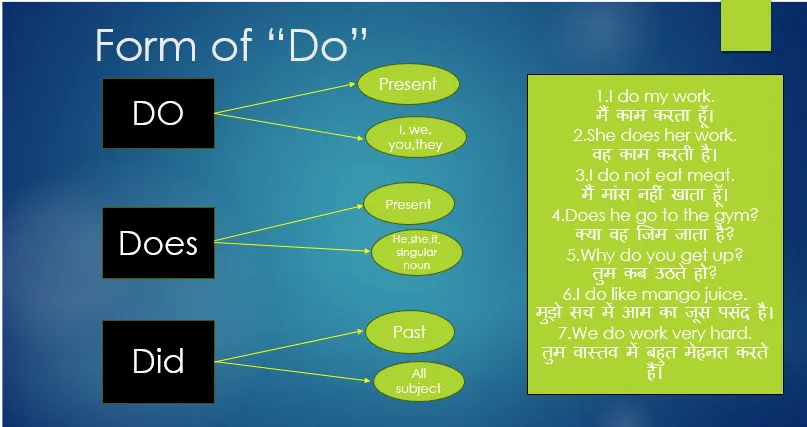
Definition
“Do” and “Does” are auxiliary (helping ) verbs used in the Present Indefinite Tense (Present Simple Tense ) to form negative and Interrogative sentences.
They are also used as main verb meaning to perform an action.
परिभाषा
“Do और “Does” दोनों सहायक क्रियाएं(Helping verbs) हैं। जिनका प्रयोग Present Indefinite Tense (साधारण वर्तमान काल) में किया जाता है। इन का उपयोग नकारात्मक, प्रश्नवाचक वाक्य बनाने में होता है। कभी कभी ये मुख्य क्रिया(Main verb) के रूप में भी प्रयोग होते हैं जिनका अर्थ होता है “करना”।
Examples:
1. I do not like tea.
मुझे चाय पसंद नहीं है।
2. He does not play cricket.
वह क्रिकेट नहीं खेलता है।
3. Do you read books?
क्या तुम किताबें पढ़ते हो?
4. Does she go to market?
क्या वह बाजार जाती है?
5. Do you eat rice?
क्या तुम चावल नहीं खाते हो?
6. Does he not go to school?
क्या वह स्कूल नहीं जाता है?
7. What do you do every morning?
तुम हर सुबह क्या करते हो?
8. Where does he live?
वह कहाँ रहता है?
Use of Do in Hindi
Definition
“Do” is a helping verb (auxiliary verb) and also a main verb.
It used in the Present Indefinite Tense with subjects I, We, You, They.
“Do” helps to form negative and interrogative sentences.
It can also be used to emphasize an action or to express real work (as a main verb).
परिभाषा
“Do” एक सहायक क्रिया(helping verb) और मुख्य क्रिया(Main verb) दोनों के रूप में प्रयोग होती है। इनका प्रयोग साधारण वर्तमान काल (Present Indefinite Tense) में I, We, You, They जैसे Subjects के साथ किया जाता है। यह नकारात्मक और प्रश्न वाचक वाक्य में सहायक क्रिया के रूप में उपयोग होती है, और जब “do” खुद किसी काम को दर्शाता है तो यह मुख्य क्रिया के रूप में प्रयुक्त होती है।
| Form |
Usage |
| Do |
Present (I , We, You, They) |
| Does |
Present (He, She, It, SingularNoun) |
| Did |
Past (All subjects) |
Used to Present Indefinite Tense to make negative and Interrogative Sentences.
Examples:
1. I do not read this book.
मैं यह किताब नहीं पढ़ता हूँ।
2. Do you play cricket?
क्या तुम क्रिकेट खेलते हो?
3. I do not like milk.
मुझे दूध पसंद नहीं है।
4. We do not go to school on Sunday.
हम रविवार को स्कूल नहीं जाते हैं।
5. Do they live here?
क्या वे यहाँ रहते हैं?
Use of “Do” as a Main Verb (मुख्य क्रिया के रूप में)
When “do” itself shows an action – like काम करना, अंजाम देना, पूरा करना आदि।
Examples:
1. They do exercise in the morning.
वे सुबह व्यायाम करते हैं।
2. I do household work daily.
मैं रोज़ घर का काम करता हूँ।
3. You do your best to win.
तुम जीतने के लिए पूरी कोशिश करते हो।
4. They do great work for society.
वे समाज के लिए महान काम करते हैं।
5. I do painting as a hobby.
मैं शौक से पेंटिंग करता हूँ।
Use of Does in Hindi
Definition
“Does” is the helping verb used in the Present Indefinite Tense with He, She, It, or Singular Noun (like Sita, Ram, Cat, Doctor, Etc).
It is used to form negative and interrogative sentences in present tense.
It also used for emphasis or as a main verb in some cases.
परिभाषा
“Does” एक सहायक क्रिया है जो साधारण वर्तमान काल में He, she, it और एकवचन संज्ञा(singular noun) के साथ प्रयोग की जाती है। इसका प्रयोग सकारात्मक और प्रश्नवाचक वाक्य बनाने में किया जाता है। कभी - कभी इसे ज़ोर देने(emphasis) या मुख्य क्रिया के रूप में भी प्रयोग किया जाता है।
1. Use of “Does” as a helping verb (सहायक क्रिया के रूप में)
इसका प्रयोग Present Indefinite Tense में Negative और Interrogative वाक्य बनाने में होता है। Positive वाक्य में “Does” नहीं लिखा जाता बल्कि verb में s/es जोड़ दिया जाता है।
Examples:
1. It does not rain in winter.
सर्दियों में बारिश नहीं होती है।
2. My father does not not smoke.
मेरे पिता धूम्रपान नहीं करते हैं।
3. Does your brother read books?
क्या तुम्हारा भाई किताबें पढ़ता है?
4. Does the dog bark at night?
क्या कुत्ता रात में भौंकता है?
5. Does your father not drive?
क्या तुम्हारे पिता गाड़ी नहीं चलाते हैं?
Emphatic Use of “Do” and “Does” (जोर देने वाला प्रयोग)
जब कोई काम कुछ समय तक पहले से चल रहा था, तब भूतकाल पूर्ण निरंतर काल में होता है।
definition
The emphatic use of “Do’’ and “Does” is made to emphasize or stress the truth or importance of an action in the Present Indefinite Tense.
It is used to show that we really mean what we are saying – like truly, actually, indeed.
It adds emotion, confirmation, or insistence to the sentence.
परिभाषा
“Do” और “Does” का जोर देने वाला प्रयोग तब किया जाता है जब हम किसी बात को ज़ोर देकर सच्चाई से या भावनात्मक रूप से कहना चाहते हैं। इसका अर्थ होता है -वास्तव में, सच में, निश्चित रूप से, वाकई में आदि। इसका प्रयोग Present indefinite Tense में किया जाता है।
Examples:
1. I do like mango juice.
मुझे सच में आम का जूस पसंद है।
2. You do work very hard.
तुम वास्तव में बहुत मेहनत करते हो।
3. We do believe in honesty.
हम सच में ईमानदारी पर विश्वास करते हैं।
4. They do want to help you.
वे वाकई में तुम्हारी मदद करना चाहते हैं।
5. I do understand your problem.
मैं वास्तव में तुम्हारी समस्या समझता हूँ।
6. He does respect his parents.
वह सच में अपने माता पिता का सम्मान करता है।
7. She does love her family.
वह वास्तव में अपने परिवार से प्यार करती है।
8. It does look beautiful.
यह वाकई सुन्दर दिखता है।
9. My brother does care for me.
मेरा भाई सच में मेरी परवाह करता है।
10. The teacher does teach well.
अध्यापक वास्तव में अच्छी तरह पढ़ाते हैं।
•Sentences Structure
1. Affirmative Sentences (सकारात्मक वाक्य)
Positive Sentence Do and does का प्रयोग आम तौर पर नहीं किया जाता - क्योंकि यह helping verb है और verb खुद simple form में आता है।
Read Also
• Affirmative Sentence
• Conditional Sentence
• Imperative Sentence
• Use of is/am/are
• Article-A
2. Negative Sentences(नकारात्मक वाक्य)
1. I do not eat meat.
मैं मांस नहीं खाता हूँ।
2. We do not watch TV daily.
हम रोज़ टीवी नहीं देखते हैं।
3. You do not work hard.
आप कड़ी मेहनत नहीं करते.
4. They do not help poor.
वे गरीब लोगों की मदद नहीं करते हैं।
5. We do not study at night.
हम रात में नहीं पढ़ते हैं।
6. She does not sing songs.
वह गाने नहीं गाती है।
7. Aman does not study hard.
अमन मन लगाकर नहीं पढ़ता है।
8. He does not drive a car.
वह कार नहीं चलाता है।
9. My mother does not cook in the morning.
मेरी माँ सुबह खाना नहीं बनाती है।
10. It does not look nice.
यह अच्छा नहीं दिखता है।
Read Also
• Negative Sentence
• Modal auxiliary Verb
• Active & Passive Voice
• Exclamatory Sentence
• Parts of Speech
3. Interrogative Sentences (प्रश्नवाचक वाक्य)
1. Do you play guitar?
क्या तुम गिटार बजाते हो?
2. Do I need your help?
क्या मुझे तुम्हारी मदद की जरूरत है?
3. Do we live in the same city?
क्या हम एक ही शहर में रहते हैं?
4. Do you like spicy food?
क्या तुम्हें तीखा खाना पसंद है?
5. Do they visit their grandparents often?
क्या वे अक्सर अपने दादा दादी से मिलने जाते हैं?
6. Does he go to the gym?
क्या वह जिम जाता है?
7. Does she like chocolate?
क्या उसे चॉकलेट पसंद है?
8. Does it work properly?
क्या यह ठीक से काम करता है?
9. Does this shop sell books?
क्या यह दुकान किताबें बेचती है?
10. Does she know your brother?
क्या वह तुम्हारे भाई को जानती है?
Read Also
• Interrogative Sentence
• Use of Can & Could
• Use of Dare
• Conditional Sentence
• Adverb
4. Interrogative Negative Sentences (प्रश्नवाचक नकारात्मक वाक्य)
1. Don’t they visit the temple on Sundays?
क्या वे रविवार को मंदिर नहीं जाते हैं?
2. Don’t you read newspapers?
क्या तुम अखबार नहीं पढ़ते हो?
3. Don’t I look fine today?
क्या मैं आज अच्छा नहीं दिख रहा हूँ?
4. Don’t they love their parents?
क्या वे अपने माता पिता से प्यार नहीं करते हैं?
5. Don’t they live in Chamba ?
क्या वे चंबा में नहीं रहते हैं?
6. Doesn’t she go to college?
क्या वह कॉलेज नहीं जाती है?
7. Does it not make sense?
क्या यह समझ में नहीं आता है?
8. Doesn’t your friend call you?
क्या तुम्हारा दोस्त तुम्हें फ़ोन नहीं करता है?
9. Does your cat not eat fish?
क्या तुम्हारी बिल्ली मछली नहीं खाती है?
10. Doesn’t she work in an office?
क्या वह ऑफिस में काम नहीं करती है?
Read Also
• Parts of Sentence
• Use of May & Might
• Pronoun
• Numbers- Singular & Plural
• Gender
5. Wh – Word Interrogative Sentences (Wh – Word प्रश्नवाचक वाक्य)
1. What do you do every morning?
तुम हर सुबह क्या करते हो?
2. Where do they live?
वे कहाँ रहते हैं?
3. When do you get up?
तुम कब उठते हो?
4. Why do we study English?
हम अंग्रेजी क्यों पढ़ते है?
5. How do you go to school?
तुम स्कूल कैसे जाते हो?
6. What does he do?
वह क्या करता है?
7. Where does she live?
वह कहाँ रहती है?
8. Why does it rain in July?
जुलाई में बारिश क्यों होती है?
9. Wh does your mother cook food?
तुम्हारी माँ खाना कब बनाती है?
10. How does the computer work?
कंप्यूटर कैसे काम करता है?
Read Also
• Use of Must & Ought
• Modal auxiliary Verb
• Use of Shall & Will
• Use of Was & Were
• Use of This & That
6. Wh-Word Interrogative Negative Sentences (Wh – Wordप्रश्नवाचक वाक्य)
1. Why don’t you study regularly?
तुम नियमित रूप से पढ़ाई क्यों नहीं करते हो?
2. Where don’t they go on weekends?
वह सप्ताहांत पर कहाँ नहीं जाते हैं?
3. When don’t we meet each other?
हम एक दूसरे से कब नहीं मिलते हैं?
4. Why don’t you eat fruits?
तुम फल क्यों नहीं खाते हो?
5. What don’t they like to do?
उन्हें क्या करना पसंद नहीं है?
6. Why doesn’t he go to school?
वह स्कूल क्यों नहीं जाता है?
7. Where doesn’t she work?
वह कहाँ काम नहीं करती है?
8. When doesn’t rain here?
यहाँ कब बारिश नहीं होती है?
9. How doesn’t it work?
यह कैसे काम नहीं करता है?
10. Why doesn’t it look clean?
यह साफ क्यों नहीं दिखता है?
Read Tenses & there Types
• Tense • Present Tense
• Present-indefinite-Tense • Present - Perfect Tense
• Present- continuous - Tense • Present - perfect - continuous -Tense
• Past Tense • Past Indefinite Tense
• Past Perfect Tense • Past continuous Tense
• Past- Perfect- continuous- Tense • Future Tense
• Future- Perfect- Tense • Future- Indefinite- Tense
• Future- continuous- Tense • Future- Perfect- continuous- Tense