Uses of Article “A, An and The” In English and Hindi - “A , An, and The” के प्रयोग

In this post you will learn about Article “A, An, and The’’ in English and Hindi – What is Articles?, Types of Article – A, An, and The – Definition , Rules, Uses, Table, Examples English and Hindi. इस पोस्ट में आपको के बारे में और में बताया गया है – परिभाषा, नियम, प्रयोग, उदाहरण को वाक्य प्रयोग करके अंग्रेजी और हिंदी दोनों भाषाओं में विस्तारपूर्ण बताया गया है।

Articles a, an, and the are small but very important words in English grammar. They help us speak and write clearly by telling whether we are talking about something in general or something specific. “A” is used before words beginning with a consonant sound, “An” is used before words beginning with a vowel sound, and “The” is used when we talk about a particular or known person, place, or thing.

Articles a, an और the छोटे शब्द हैं लेकिन अंग्रेजी भाषा में इनका उपयोग बहुत महत्वपूर्ण है। ये बताते हैं कि हम किसी चीज़ के बारे में सामान्य रूप से बात कर रहे हैं या किसी खास चीज़ का ज़िक्र कर रहे हैं। “A” व्यंजन ध्वनि वाले शब्दों से पहले, “An” स्वर ध्वनि वाले शब्दों से पहले, और “The” किसी विशेष या पहचानी हुई वस्तु, व्यक्ति या स्थान से पहले लगाया जाता है।

a-an-the-front

1. What are Articles?

Articles are small words used before nouns.
They tell whether we talk generally or specifically.
लेख छोटे शब्द होते हैं जो संज्ञा से पहले लगाए जाते हैं।
ये बताते हैं कि हम सामान्य बात कर रहे हैं या किसी खास चीज़ की।

2. Types of Articles

There are two types of articles.
लेख दो प्रकार के होते हैं।

1. Indefinite Articles → A, An
अनिश्चयवाचक लेख → ए, एन

2. Definite Article → The
निश्चित वाचक लेख → द

A Article – Use

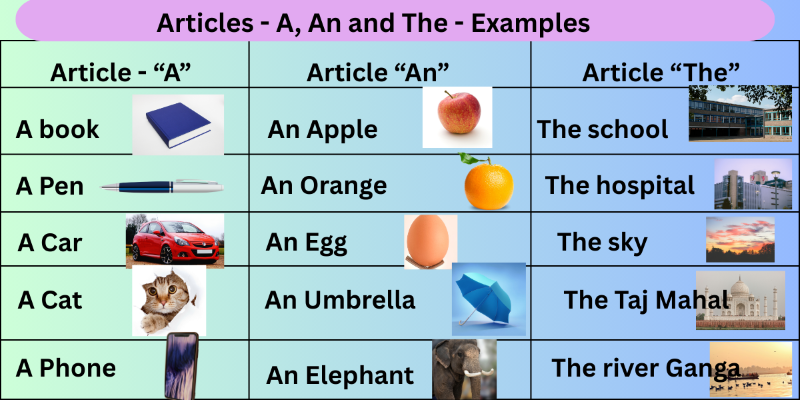
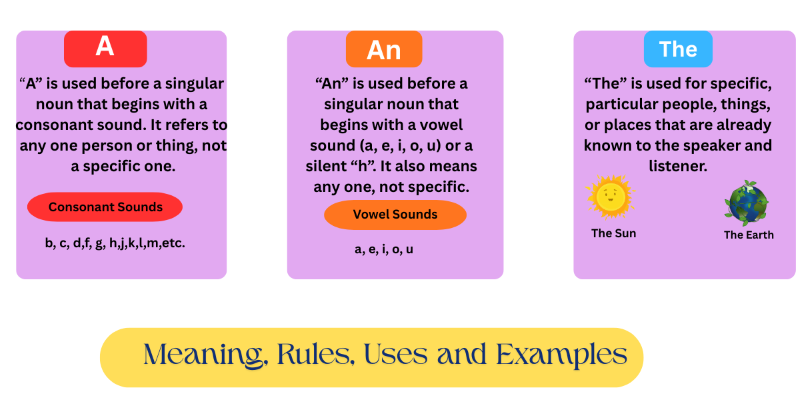
Use “A” before a word beginning with a consonant sound.
“ए” का प्रयोग तब होता है जब शब्द की शुरुआत व्यंजन ध्वनि से हो।

Examples / उदाहरण-

English: a boy
Hindi: ए लड़का

English: a pen
Hindi: ए कलम

English: a car
Hindi: ए गाड़ी

AN Article – Use

Use “An” before a word beginning with a vowel sound.
“एन” का प्रयोग तब होता है जब शब्द की शुरुआत स्वर ध्वनि से हो।

Examples / उदाहरण-

English: an apple
Hindi: एन आम

English: an egg
Hindi: एन अंडा

English: an umbrella
Hindi: एन छाता

THE Article – Use

“The” is used for special, known, or unique things.
“द” का प्रयोग किसी खास, पहचानी हुई या एकमात्र चीज़ के लिए होता है।

1. Unique things / एकमात्र वस्तुएँ

English: the sun
Hindi: द सूरज

English: the moon
Hindi: द चाँद

2. Rivers, mountains / नदियाँ, पर्वत

English: the Ganga
Hindi: द गंगा

English: the Himalayas
Hindi: द हिमालय

3. Famous buildings / प्रसिद्ध इमारतें

English: the Taj Mahal
Hindi: द ताजमहल

4. Known things / पहले से बताई हुई चीज़ें

English: the boy you met
Hindi: द वही लड़का जिससे तुम मिले थे

Use of Article – “A” English and Hindi

A अंग्रेजी भाषा का पहला letter है। A का प्रयोग Grammar में आर्टिकल article के रूप में करते हैं।
Article “A” अंग्रेजी व्याकरण के एक indefinite article हैं, जिनका प्रयोग किसी एक अनजान या सामान्य वस्तु व्यक्ति या स्थान के लिए किया जाता है। A का प्रयोग हमेशा एकवचन(singular) noun के पहले किया जाता है और उन शब्दों के साथ आता है जिनकी आवाज व्यंजन से start होती है।

“A” (Article- A) Meaning in Hindi

Definition

“A” is an indefinite article used before singular countable nouns that begin with a consonant sound to talk about something non- specific or general.

परिभाषा

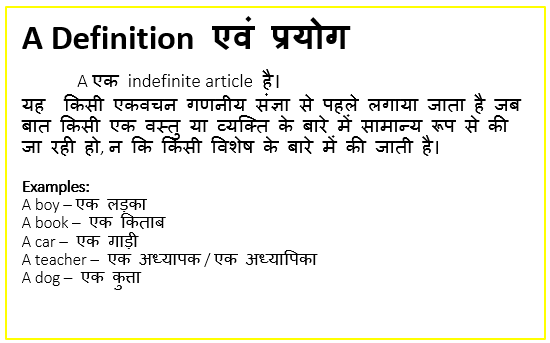
A एक indefinite article है।
यह किसी एकवचन गणनीय संज्ञा से पहले लगाया जाता है जब बात किसी एक वस्तु या व्यक्ति के बारे में सामान्य रूप से की जा रही हो, न कि किसी विशेष के बारे में की जाती है।

Read More About Article - A

Use of “A” when we talk about any one thing in general, not a specific one.
हम “A” का प्रयोग तब करते हैं जब हम किसी एक वस्तु या व्यक्ति के बारे में सामान्य रूप से बात करते हैं, न कि किसी विशेष के बारे में बात करते हैं।

Examples:

1. I saw a dog in the garden.
मैंने बगीचे में एक कुत्ता देखा।

2. She is a doctor.
वह एक डॉक्टर है।

3. He bought a car.
उसने एक कार खरीदी।

4. I need a pen.
मुझे एक पेन चाहिए।

5. That is a beautiful flower.
वह एक सुंदर फूल है।

Read Also

Sentence & There TypesParts of Sentence
Affirmative SentenceNegative Sentence
Imperative SentenceInterrogative Sentence
Conditional SentenceExclamatory Sentence

A Meaning in Hindi (a का अर्थ हिंदी में)

A का अर्थ हिंदी में – एक (one), कोई एक(any one)

Examples:

1. A boy – एक लड़का
2. A book – एक किताब
3. A car – एक गाड़ी
4. A teacher – एक अध्यापक / एक अध्यापिका
5. A dog – एक कुत्ता

a-def

A as a Article

Article वह शब्द होते हैं जो किसी संज्ञा (noun) के पहले लगाए जाते हैं ताकि यह बताया जा सके कि वह noun विशेष (specific) है या सामान्य (general) है।

Types of Article ( Articles के प्रकार)

Article दो प्रकार के होते हैं –

1. Definite Article – The
2. Indefinite Articles – A and An

“A” sound rule (ध्वनि का नियम)

हम “A” and “An” का प्रयोग ध्वनि (sound) के अनुसार करते हैं, ना कि अक्षर (spelling) के अनुसार।
अंग्रेजी वर्णमाला में 26 अक्षर होते हैं, इनमें से 5 स्वर(Vowels) और 21 व्यंजन (consonants) होते हैं। यदि शब्द व्यंजन से शुरु होता है तो a प्रयोग होता है, जबकि स्वर से शुरू होने पर an का प्रयोग होता है।
कभी भी vowels से पहले a का प्रयोग नहीं करना चाहिए क्योंकि यह उचित नहीं माना जाता है।

Examples:

× A apple
• An apple
× A umbrella
• An umbrella

Read Tenses & there Types

TensePresent Tense
Present-indefinite-TensePresent - Perfect Tense
Present- continuous - TensePresent - perfect - continuous -Tense
Past TensePast Indefinite Tense
Past Perfect TensePast continuous Tense
Past- Perfect- continuous- TenseFuture Tense
Future- Perfect- TenseFuture- Indefinite- Tense
Future- continuous- TenseFuture- Perfect- continuous- Tense

a-a-an-th

Basic Difference between a and an (मूल अंतर)

इस table में आपको a and an के बारे में पूर्ण रूप से बताया गया है ताकि आपको a and an का प्रयोग करना आसानी से समझ आ जाए। ताकि आप a and an के बारे में details में समझ पाएं कि हमें an and an का प्रयोग आपको कहाँ कहाँ और कैसे - कैसे करना चाहिए।
इस table को ध्यान से पढ़ें और सीखें।

Point A An
Type Indefinite Article Indefinite Article
Meaning one(एक)
Any one(कोई एक)
one(एक)
Any one(कोई एक)
Used Before Words beginning with consonant Sound Words beginning with vowel Sound
Vowel Letters a,e,I,o,u (नहीं लगाते जब consonant sound हो) a,e,I,o,u (लगाते जब vowel sound हो)
Examples a boy, a cat, a car an apple, an hour
Pronun - ciation Rule Sound matters, not spelling Sound matters, not spelling
Hindi Meaning कोई एक, पर व्यंजन ध्वनि से शुरु होने वाले शब्द के साथ कोई एक, पर स्वर ध्वनि से शुरु होने वाले शब्द के साथ

Special uses of “A” (A के विशेष प्रयोग)

1. Before professions

• She is a doctor.
• He is a teacher.

2. Before numbers meaning “one”

• I have a hundred rupees. (means one hundred)

3. Before expressions of price, speed, or frequency

• Apples are $100 a kilo.
• He drives 60km an hour.

4. Before certain phrases

• In a hurry
• Take a rest
• Once a week

5. To show a kind or class

• A cat is an animal.
• A student should study hard.

Read Also

Parts of speechNoun
PronounPreposition
VerbAdverb
Adjectiveconjunction
InterjectionSentence Parts of Sentence

Use “A” before consonant sound:

• A boy (b = consonant sound)
• A dog ( d = consonant sound)
• A university (“yu” sound – consonant sound)

Examples of ‘a’ in Sentences :

1. I saw a dog in the park.
मैंने बगीचे में एक कुत्ता देखा।

2. He is a teacher.
वह एक शिक्षक है।

3. She bought a car yesterday.
उसने कल एक कार खरीदी।

4. I need a pencil to write.
मुझे लिखने के लिए एक पेंसिल चाहिए।

5. It is a bad day.
यह एक बेकार दिन है।

6. He lives in a small village.
वह एक छोटे गांव में रहता है।

7. She has a blue dress.
उसके पास एक नीली ड्रेस है।

8. He met a friend at the market.
उसने बाजार में एक दोस्त मुलाकात की।

9. I saw a bird on the tree.
मैंने पेड़ पर एक पक्षी देखा।

10. He wants to be a army man.
वह सेना में भर्ती होना चाहता है।

11. She gave me a gift.
उसने मुझे एक उपहार दिया।

12. There is a pen on the table.
मेज पर एक पेन है।

13. I have a question.
मेरे पास एक सवाल है।

14. He found a wallet on the road.
उसे सड़क पर एक बटुआ मिला।

15. She is a good singer.
वह एक अच्छी गायिका है।

16. He opened a shop in the city.
उसने शहर में एक दुकान खोली।

17. I ate a banana.
मैंने एक केला खाया।

18. She bought a pair of shoes.
उसने एक जोड़ी जूते खरीदे ।

19. He saw a movie last night.
उसने कल रात एक फ़िल्म देखी।

20. They built a house near the lake.
उन्होंने झील के पास एक घर बनाया।

21. He is a brave soldier.
वह एक बहादुर सिपाही है।

22. She wrote a letter to her brother.
उसने अपने भाई को एक पत्र लिखा।

23. There was a dog outside the gate.
गेट के बाहर एक कुत्ता था।

24. I saw a rainbow in the sky.
मैंने आसमान में एक इंद्रधनुष देखा।

25. He is a smart boy.
वह एक होशियार लड़का है।

26. She wore a beautiful saree.
उसने एक सुन्दर साड़ी पहनी।

27. He bought a laptop for work.
उसने काम के लिए एक लैपटॉप खरीदा।

28. I found a coin on the floor.
मुझे फर्श पर एक सिक्का मिला।

29. She has a pet dog.
उसके पास एक पालतू कुत्ता है।

30. He gave me a smile.
उसने मुझे एक मुस्कान दी।

Note:

• “A” का प्रयोग सिर्फ singular countable nouns से पहले होता है।
• हमेशा consonant sound वाले शब्दों के साथ प्रयोग करें।

Read Also

Modal verbsUse of Can & Could
Use of Shall & WillUse of Is/am/are
Use of DareUse of May & Might
Use of Must & Ought

Use Of Article “AN” English and Hindi

Definition

An” is an article used before a singular noun that begins with a vowel sound (a, e, i, o, u).

“An” एक लेख (article) है जो किसी एकवचन संज्ञा (singular noun) से पहले लगाया जाता है, जब वह शब्द स्वर ध्वनि (a, e, i, o, u जैसी आवाज़) से शुरू होता है।

WHERE TO USE “AN”

Rule 1: Use “an” before vowel sounds

Use “an” before words starting with a, e, i, o, u sound.

जो शब्द स्वर की ध्वनि से शुरू हों, उनके पहले an लगता है।

Examples:

• an apple – एन सेब
• an egg – एन अंडा
• an umbrella – एन छाता

Rule 2: Sound matters, spelling does NOT

Even if a word starts with a consonant letter, if it sounds like a vowel, we use “an”.

कभी–कभी शब्द व्यंजन से शुरू होते हैं, पर आवाज़ स्वर जैसी आती है—तब भी “an” लगता है।

Examples:

• an hour (क्योंकि “hour” की आवाज़ “आवर” जैसी आती है)
• an honest boy (क्योंकि “h” की ध्वनि नहीं आती – “ऑनेस्ट”)

Rule 3: Use “an” before abbreviations with vowel sound.

If abbreviation starts with vowel sound, use “an”.
संक्षेप (short forms) की शुरुआत स्वर ध्वनि से हो तो “an” लगता है।

Examples:

• an MBA (उच्चारण: “एम बी ए”)
• an MLA (उच्चारण: “एम एल ए”)

Rule 4: Use “an” before singular countable nouns.

We use “an” only before singular countable “An” केवल एकवचन (single) गिनने योग्य संज्ञाओं के साथ लगता है।

Examples:

• an idea
• an umbrella

WHERE NOT TO USE “AN”

❌ Do NOT use “an” before plural nouns

बहुवचन शब्दों के साथ “an” नहीं लगता।
• ❌ an apples
• ✔ apples

❌ Do NOT use “an” before consonant sounds

व्यंजन ध्वनि से शुरू होने वाले शब्दों के साथ “an” नहीं लगता।
• ❌ an ball
• ✔ a ball

❌ Do NOT use “an” before uncountable nouns

अगणनीय संज्ञाओं के साथ “an” नहीं लगता।
• ❌ an milk
• ✔ milk

USES OF “AN”

Use 1: To show only one thing

“An” shows one item.
“An” किसी एक वस्तु को दर्शाता है।

Use 2: To introduce something for the first time

Used when talking about something for the first time.
किसी चीज़ का पहली बार परिचय देने में “an” लगता है।

Use 3: To talk about a profession

Use “an” before job names starting with vowel sound.
जिन पेशों की शुरुआत स्वर ध्वनि से हो, उनके पहले “an” लगता है।

Example:

• an engineer – एन इंजीनियर

Examples:

1. I ate an apple yesterday.
मैंने कल एक सेब खाया।

2. She found an egg in the basket.
उसने टोकरी में एक अंडा पाया।

3. He bought an umbrella for the rain.
उसने बारिश के लिए एक छाता खरीदा।

4. We saw an elephant at the zoo.
हमने चिड़ियाघर में एक हाथी देखा।

5. There is an ant on the table.
मेज़ पर एक चींटी है।

6. She wants an ice-cream after lunch.
वह दोपहर के भोजन के बाद एक आइसक्रीम चाहती है।

7. He shared an idea with the team.
उसने टीम के साथ एक विचार साझा किया।

8. I met an old man in the park.
मैं पार्क में एक बूढ़ा आदमी मिला।

9. English: He is an engineer by profession.
वह पेशे से एक इंजीनियर है।

10. She is an honest girl.
वह एक ईमानदार लड़की है।

11. The meeting will start in an hour.
बैठक एक घंटे में शुरू होगी।

12. I bought an orange from the market.
मैंने बाजार से एक संतरा खरीदा।

13. There is an eagle flying in the sky.
आसमान में एक गरुड़ उड़ रहा है।

14. He travels by an aeroplane.
वह एक हवाई जहाज से यात्रा करता है।

15. He is an MLA from our city.
वह हमारे शहर का एक विधायक है।

16. She completed an MBA last year.
उसने पिछले साल एक एमबीए पूरा किया।

17. There is an oven in the kitchen.
रसोई में एक ओवन है।

18. I read an article in the newspaper.
मैंने अख़बार में एक लेख पढ़ा।

19. He picked up an object from the floor.
उसने फर्श से एक वस्तु उठाई।

20. The box is one an inch thick.
बॉक्स की मोटाई एक इंच है।

a-define

Use of Article “THE” In English and Hindi
आर्टिकल “THE” का प्रयोग

The Article “The”

The is called the definite article. It is used when we are talking about a specific person, place, or thing that is already known or has been mentioned before.

Meaning of “The”:

It means “specific” or “particular”.

Examples:

1. The sun is shining. - We are talking about the specific sun in the sky.

2. I met the teacher yesterday. - We are talking about a particular teacher.

3. The book on the table is mine. - A specific book is being referred to.

Read More About Article - The

लेख “The”

“The” को निश्चित लेख (Definite Article) कहा जाता है। यह तब प्रयोग होता है जब हम किसी विशेष व्यक्ति, स्थान या वस्तु के बारे में बात कर रहे हों, जो पहले से जाना-पहचाना हो या उल्लेखित हो।

“The” का मतलब:

यह विशेष या परिचित को दर्शाता है।

उदाहरण:

1. The sun is shining. - हम विशेष सूरज की बात कर रहे हैं।

2. I met the teacher yesterday. - हम किसी विशेष शिक्षक की बात कर रहे हैं।

3. The book on the table is mine. - यह विशेष किताब है।

Use of “THE” – “THE” का प्रयोग

Rule 1: Specific Person, Place, or Thing (विशेष व्यक्ति, स्थान या वस्तु)

1. The boy is playing in the park.
लड़का पार्क में खेल रहा है।

2. I met the teacher yesterday.
मैं कल शिक्षक से मिला।

3. The dog is sleeping under the tree.
कुत्ता पेड़ के नीचे सो रहा है।

4. The car is parked outside.
कार बाहर खड़ी है।

5. The girl is reading a book.
लड़की किताब पढ़ रही है।

6. The phone is on the table.
फोन मेज पर है।

7. The building is very tall.
इमारत बहुत ऊँची है।

8. The man is talking to his friend.
आदमी अपने दोस्त से बात कर रहा है।

9. The food is delicious.
खाना स्वादिष्ट है।

10. The baby is crying loudly.
बच्चा जोर से रो रहा है।

Rule 2: Unique Objects (अद्वितीय वस्तुएँ)

1. The sun is shining brightly.
सूरज तेज़ चमक रहा है।

2. The moon looks beautiful tonight.
चाँद आज रात सुंदर दिख रहा है।

3. The earth revolves around the sun.
पृथ्वी सूरज के चारों ओर घूमती है।

4. The sky is very clear today.
आज आकाश बहुत साफ़ है।

5. The stars are twinkling.
सितारे टिमटिमा रहे हैं।

6. The ocean is very deep.
महासागर बहुत गहरा है।

7. The wind is very strong.
हवा बहुत तेज़ है।

8. The rain has stopped.
बारिश रुक गई है।

9. The fire is dangerous.
आग खतरनाक है।

10. The universe is vast.
ब्रह्मांड विशाल है।

Rule 3: Specific Group or Class (विशेष समूह या वर्ग)

1. The students in our class are hardworking.
हमारी कक्षा के विद्यार्थी मेहनती हैं।

2. The workers in this factory are skilled.
इस फैक्ट्री के मजदूर कुशल हैं।

3. The doctors in the hospital are busy.
अस्पताल के डॉक्टर व्यस्त हैं।

4. The birds in the garden are singing.
बगीचे के पक्षी गा रहे हैं।

5. The players on the team are strong.
टीम के खिलाड़ी मजबूत हैं।

6. The teachers in my school are friendly.
मेरे स्कूल के शिक्षक मित्रवत हैं।

7. The animals in the zoo are well-fed.
चिड़ियाघर के जानवर अच्छी तरह से खिलाए जाते हैं।

8. The children in the park are playing.
पार्क के बच्चे खेल रहे हैं।

9. The passengers in the bus are tired.
बस के यात्री थके हुए हैं।

10. The men in the army are brave.
सेना के लोग बहादुर हैं।

Rule 4: Superlatives (सर्वश्रेष्ठ या उच्चतम)

1. She is the best singer in our school.
वह हमारे स्कूल की सबसे अच्छी गायिका है।

2. This is the tallest building in the city.
यह शहर की सबसे ऊँची इमारत है।

3. He is the fastest runner in the team.
वह टीम का सबसे तेज़ धावक है।

4. That is the most beautiful painting.
वह सबसे सुंदर चित्रकला है।

5. This is the coldest day of the year.
यह साल का सबसे ठंडा दिन है।

6. She is the smartest student in the class.
वह कक्षा की सबसे होशियार छात्रा है।

7. This is the oldest tree in the park.
यह पार्क का सबसे पुराना पेड़ है।

8. He is the richest man in the town.
वह शहर का सबसे अमीर आदमी है।

9. This is the cleanest street in the city.
यह शहर की सबसे साफ सड़क है।

10. That was the most exciting match.
वह सबसे रोमांचक मैच था।

Rule 5: Ordinals (क्रमवाचक संख्याएँ)

1. He is the first person to arrive.
वह आने वाला पहला व्यक्ति है।

2. She won the second prize in the competition.
उसने प्रतियोगिता में दूसरा पुरस्कार जीता।

3. This is the third time I am visiting this place.
मैं इस जगह तीसरी बार आ रहा हूँ।

4. He came in the fourth position.
वह चौथे स्थान पर आया।

5. The fifth student answered correctly.
पाँचवें छात्र ने सही उत्तर दिया।

6. She is the sixth child in her family.
वह अपने परिवार की छठी बच्ची है।

7. This is the seventh chapter of the book.
यह किताब का सातवां अध्याय है।

8. He scored in the eighth round.
उसने आठवें राउंड में स्कोर किया।

9. The ninth question was difficult.
नौवाँ प्रश्न कठिन था।

10. She celebrated her tenth birthday yesterday.
उसने कल अपना दसवां जन्मदिन मनाया।

Rule 6: Geographical Names (भूगोल संबंधी नाम)

1. The Amazon is a long river.
अमेज़न एक लंबी नदी है।

2. The Himalayas are very high.
हिमालय बहुत ऊँचे हैं।

3. The Sahara is the largest desert.
सहारा सबसे बड़ा रेगिस्तान है।

4. The Pacific Ocean is vast.
प्रशांत महासागर विशाल है।

5. The Nile is in Africa.
नील नदी अफ्रीका में है।

6. The Alps are in Europe.
आल्प्स यूरोप में हैं।

7. The Ganges flows through India.
गंगा भारत से होकर बहती है।

8. The Rockies are in North America.
रॉकीज़ उत्तर अमेरिका में हैं।

9. The Maldives are a group of islands.
मालदीव द्वीपों का समूह है।

10. The Caribbean is famous for beaches.
कैरिबियन समुद्र तटों के लिए प्रसिद्ध है।

Rule 7: Newspapers and Magazines (अख़बार और पत्रिकाएँ)

1. I read the Times every morning.
मैं हर सुबह टाइम्स पढ़ता हूँ।

2. The Hindu is a popular newspaper.
हिन्दू एक लोकप्रिय अख़बार है।

3. She subscribes to the National Geographic.
वह नेशनल ज्योग्राफिक की सदस्यता लेती है।

4. I like reading the Economist.
मुझे इकॉनॉमिस्ट पढ़ना पसंद है।

5. The Tribune publishes daily news.
ट्रिब्यून दैनिक समाचार प्रकाशित करता है।

6. He bought the Reader’s Digest.
उसने रीडर्स डाइजेस्ट खरीदा।

7. The Guardian is famous in England.
द गार्जियन इंग्लैंड में प्रसिद्ध है।

8. She reads the magazine every week.
वह हर हफ्ते पत्रिका पढ़ती है।

9. The Times of India is very popular.
टाइम्स ऑफ इंडिया बहुत प्रसिद्ध है।

10. I follow the news in the BBC.
मैं बीबीसी में समाचार देखता हूँ।

Rule 8: Musical Instruments (संगीत वाद्ययंत्र)

1. She plays the piano beautifully.
वह पियानो बहुत सुंदर बजाती है।

2. He can play the guitar.
वह गिटार बजा सकता है।

3. The violin is her favorite instrument.
वायलिन उसका पसंदीदा वाद्ययंत्र है।

4. He practices the drums daily.
वह रोज़ ड्रम का अभ्यास करता है।

5. She learned the flute.
उसने बांसुरी सीखी।

6. He is playing the trumpet.
वह ट्रम्पेट बजा रहा है।

7. The cello sounds amazing.
सेलो का ध्वनि अद्भुत है।

8. She can play the harmonium.
वह हारमोनियम बजा सकती है।

9. He bought the saxophone.
उसने सैक्सोफोन खरीदा।

10. The piano in the hall is old.
हॉल में पियानो पुराना है।

Rule 9: Points of the Compass (दिशाएँ)

1. The north is colder than the south.
उत्तर दक्षिण से ठंडा है।

2. The east receives the sunrise first.
पूर्व में सूर्योदय पहले होता है।

3. The west is famous for sunsets.
पश्चिम सूर्यास्त के लिए प्रसिद्ध है।

4. The south has warm climate.
दक्षिण का मौसम गर्म है।

5. The north-east is hilly.
उत्तर-पूर्व पहाड़ी है।

6. The north-west is dry.
उत्तर-पश्चिम शुष्क है।

7. The south-east receives heavy rain.
दक्षिण-पूर्व में भारी बारिश होती है।

8. The south-west has beaches.
दक्षिण-पश्चिम में समुद्र तट हैं।

9. The east of the city is industrial.
शहर का पूर्व औद्योगिक है।

10. The west side is residential.
पश्चिम की ओर आवासीय क्षेत्र है।

Rule 10: Unique Buildings, Organizations, Monuments (विशेष भवन, संगठन, स्मारक)

1. We visited the Taj Mahal.
हमने ताज महल देखा।

2. The Eiffel Tower is in Paris.
एफिल टॉवर पेरिस में है।

3. The Red Fort is famous in India.
लाल किला भारत में प्रसिद्ध है।

4. The White House is in Washington.
व्हाइट हाउस वॉशिंगटन में है।

5. The Parliament House is large.
संसद भवन बड़ा है।

6. The Statue of Liberty is in New York.
स्टैच्यू ऑफ़ लिबर्टी न्यूयॉर्क में है।

7. The London Bridge is historic.
लंदन ब्रिज ऐतिहासिक है।

8. The Colosseum is in Rome.
कोलोसियम रोम में है।

9. The Pyramids are in Egypt.
पिरामिड मिस्र में हैं।

10. The Golden Temple is in Amritsar.
स्वर्ण मंदिर अमृतसर में है।

Rule 11: Historical events (ऐतिहासिक घटनाएँ)

1. The World War II started in 1939.
द्वितीय विश्व युद्ध 1939 में शुरू हुआ।

2. The French Revolution changed France.
फ्रांसीसी क्रांति ने फ्रांस को बदल दिया।

3. The Industrial Revolution began in England.
औद्योगिक क्रांति इंग्लैंड में शुरू हुई।

4. The Renaissance was a period of art.
पुनर्जागरण कला का समय था।

5. The Great Fire of London happened in 1666.
लंदन की महान आग 1666 में हुई।

6. The Cold War lasted for decades.
शीत युद्ध दशकों तक चला।

7. The American Revolution led to independence.
अमेरिकी क्रांति से स्वतंत्रता मिली।

8. The Black Death spread in Europe.
ब्लैक डेथ यूरोप में फैल गई।

9. The Civil Rights Movement was important.
नागरिक अधिकार आंदोलन महत्वपूर्ण था।

10. The moon landing was in 1969.
चाँद पर उतरना 1969 में हुआ।

Rule 12: Oceans (महासागर)

1. The Pacific Ocean is vast.
प्रशांत महासागर विशाल है।

2. The Atlantic Ocean is large.
अटलांटिक महासागर बड़ा है।

3. The Indian Ocean is warm.
हिन्द महासागर गर्म है।

4. The Arctic Ocean is cold.
आर्कटिक महासागर ठंडा है।

5. The Southern Ocean surrounds Antarctica.
साउदर्न ओशियन अंटार्कटिका को घेरे हुए है।

6. The Caribbean Sea is tropical.
कैरिबियन सागर उष्णकटिबंधीय है।

7. The Red Sea is between Africa and Asia.
लाल सागर अफ्रीका और एशिया के बीच है।

8. The Mediterranean Sea is beautiful.
भूमध्य सागर सुंदर है।

9. The North Sea is in Europe.
उत्तर सागर यूरोप में है।

10. The Baltic Sea is famous for trade.
बाल्टिक सागर व्यापार के लिए प्रसिद्ध है।

Rule 13: Ships, Trains, Planes (जहाज, ट्रेन, विमान)

1. The Titanic sank in 1912.
टाइटैनिक 1912 में डूब गया।

2. The Queen Mary is a famous ship.
क्वीन मैरी प्रसिद्ध जहाज है।

3. The Orient Express travels across Europe.
ओरिएंट एक्सप्रेस यूरोप में चलता है।

4. The Concorde was a supersonic plane.
कॉनकॉर्ड एक सुपरसोनिक विमान था।

5. The Titanic is still remembered.
टाइटैनिक आज भी याद किया जाता है।

6. The Mallard is a fast train.
मल्लार्ड तेज़ ट्रेन है।

7. The Emirates airline flies worldwide.
एमिरेट्स एयरलाइन दुनिया भर में उड़ान भरती है।

8. The Lusitania was sunk during WWI.
लुसिटानिया प्रथम विश्व युद्ध में डूबा।

9. The Queen Elizabeth II is a royal ship.
क्वीन एलिज़ाबेथ द्वितीय एक शाही जहाज है।

10. The Boeing 747 is huge.
बोइंग 747 बहुत बड़ा है।

Rule 14: Communities / Religious Groups (समुदाय / धार्मिक समूह)

1. The Hindus celebrate Diwali every year.
हिन्दू हर साल दिवाली मनाते हैं।

2. The Muslims observe Ramadan with fasting.
मुसलमान रोज़ा रखकर रमजान मनाते हैं।

3. The Christians celebrate Christmas in December.
ईसाई दिसंबर में क्रिसमस मनाते हैं।

4. The Sikhs celebrate Gurpurab with devotion.
सिख बड़ी श्रद्धा के साथ गुरुपरब मनाते हैं।

5. The Buddhists meditate daily.
बौद्ध रोज़ ध्यान करते हैं।

6. The Jains follow strict non-violence.
जैन कड़ाई से अहिंसा का पालन करते हैं।

7. The Jews celebrate Hanukkah.
यहूदी हनुक्का मनाते हैं।

8. The Parsis celebrate Nowruz.
पारसी नवरोज़ मनाते हैं।

9. The Christians and Hindus live peacefully in the town.
शहर में ईसाई और हिन्दू शांति से रहते हैं।

10. The Muslims and Sikhs participated in the festival together.
मुसलमान और सिख ने त्योहार में साथ भाग लिया।

Rule 15: Parts of the Body

1. He hurt the arm while playing.
उसने खेलते समय बाज़ू चोटिल कर ली।

2. She washed the hands before eating.
उसने खाने से पहले हाथ धोए।

3. The doctor checked the eyes carefully.
डॉक्टर ने आँखों की ध्यान से जाँच की।

4. He covered the head with a cap.
उसने टोपी से सिर ढक लिया।

5. The cold wind touched the face.
ठंडी हवा ने चेहरे को छुआ।

6. She injured the leg during the match.
मैच के दौरान उसने टांग चोटिल कर ली।

7. The teacher asked him to raise the hand.
शिक्षक ने उसे हाथ उठाने के लिए कहा।

8. The boy cleaned the teeth in the morning.
लड़के ने सुबह दाँत साफ किए।

9. He rubbed the eyes because he was sleepy.
वह नींद में था, इसलिए उसने आँखें मलीं।

10. The nurse bandaged the foot carefully.
नर्स ने ध्यान से पैर पर पट्टी बांधी।
Where “THE” is NOT Used
(“The” का प्रयोग कहाँ नहीं होता है)

लेख “the” का प्रयोग तब नहीं किया जाता जब हम चीज़ों की सामान्य रूप से, यानी बिना किसी विशेष पहचान के बात करते हैं। जैसे– व्यक्तियों के नाम, भाषाएँ, विषय, दिन, महीने, त्योहार, खेल और भावनात्मक शब्दों के साथ “the” नहीं लगता। यह सामान्य बहुवचन शब्दों, अगणनीय वस्तुओं, भोजन के नामों और एकवचन देश–नामों के साथ भी प्रयोग नहीं होता। आसान शब्दों में, जब संज्ञा विशेष नहीं, पहले बताई नहीं, या पूरी श्रेणी को दर्शाती हो, तब “the” का प्रयोग नहीं किया जाता।

1. Person’s Names (व्यक्तियों के नाम)

Eng: Rohan is my friend.
❌ The Rohan (गलत)
Hindi: रोहन मेरा दोस्त है।

2. Country Names (देशों के नाम)

(जिनके नाम plural नहीं हैं)

Eng: India is a big country.
❌ The India (गलत)
Hindi: भारत एक बड़ा देश है।

✔ BUT “The” ऐसे देशों के साथ लगता है जिनका नाम plural है
जैसे:
The United States, The Netherlands

3. Languages (भाषाओं के नाम)

Eng: I am learning English.
❌ I am learning the English. (गलत)
Hindi: मैं अंग्रेज़ी सीख रहा हूँ।

4. Subjects (विषय)

Eng: Maths is easy.
❌ The maths is easy. (गलत)
Hindi: गणित आसान है।

5. Meals (भोजन के नाम)

Eng: I eat breakfast at 8.
❌ I eat the breakfast. (गलत)
Hindi: मैं 8 बजे नाश्ता करता हूँ।

6. Days & Months (दिन और महीनों के नाम)

Eng: Monday is a holiday.
❌ The Monday is a holiday. (गलत)
Hindi: सोमवार छुट्टी है।

7. Festivals (त्योहार)

Eng: Diwali is a festival.
❌ The Diwali (गलत)
Hindi: दिवाली एक त्योहार है।

8. Sports (खेलों के नाम)

Eng: He plays cricket.
❌ He plays the cricket. (गलत)
Hindi: वह क्रिकेट खेलता है।

9. Abstract Nouns (अमूर्त / भावनात्मक शब्द)

Love, honesty, happiness, freedom, courage

Eng: Honesty is important.
❌ The honesty is important.
Hindi: ईमानदारी महत्वपूर्ण है।

10. General Plural Nouns (सामान्य बहुवचन शब्द)

जब चीज़ किसी खास की बात नहीं कर रही हो

Eng: Books are useful.
❌ The books are useful. (गलत जब खास किताबें न हों)
Hindi: किताबें उपयोगी होती हैं।

11. Uncountable Things (अगणनीय चीजें)

अगर वो general हों

Eng: Water is essential.
❌ The water is essential. (गलत)
Hindi: पानी जरूरी है।

BUT ✔ अगर specific हो तो लगेगा:
Eng: The water in this bottle is cold.
Hindi: इस बोतल का पानी ठंडा है।

12. Street Names (गली/सड़क के नाम)

Eng: I live on MG Road.
❌ I live on the MG Road.
Hindi: मैं एमजी रोड पर रहता हूँ।

13. School, College, Prison, Hospital (जब general purpose हो)

Eng: He is in school.
❌ He is in the school. (गलत — जब पढ़ने के लिए गया हो)
Hindi: वह स्कूल में है।

BUT ✔ अगर building की बात हो तो लगेगा:
Eng: I visited the school yesterday.
Hindi: मैं कल स्कूल की इमारत देखने गया था।

Conclusion -निष्कर्ष

इस पोस्ट में आपने पढ़ लिया होगा कि Articles छोटे शब्द होते हैं जो संज्ञा से पहले लगाए जाते हैं।
• A उस शब्द से पहले लगता है जिसकी शुरुआत व्यंजन ध्वनि से हो।
• An उस शब्द से पहले लगता है जिसकी शुरुआत स्वर ध्वनि से हो।
• The तब लगाया जाता है जब हम किसी खास या पहले से जानी हुई चीज़ की बात कर रहे हों।
Articles वाक्यों को साफ, सरल और समझने योग्य बनाते हैं।

Thanks For Reading this Article by Edu Tehri.