Class 12 Maths Chapter 12 – Linear Programming NCERT Solutions – FREE PDF Download | Hand – Written Notes
Chapter 12 Linear Programming (LPP) deals with optimization problems, where the goal is to maximize or minimize a quantity subject to certain constraints. Linear programming is widely used in business, economics, production planning, and resource management.
This chapter is very important because:
• It is highly scoring if methods are clear
• Exam questions follow a fixed pattern
• It connects algebra with real-life applications
At Edu Tehri, Chapter 12 is explained with step-by-step methods, graphical solutions, solved examples, hand-written notes, and free PDFs.
What Is Linear Programming?
Linear Programming is a mathematical technique to find the maximum or minimum value of a linear function subject to certain linear constraints.
Key Terms:
1. Objective Function:
The function to be maximized or minimized. Example:
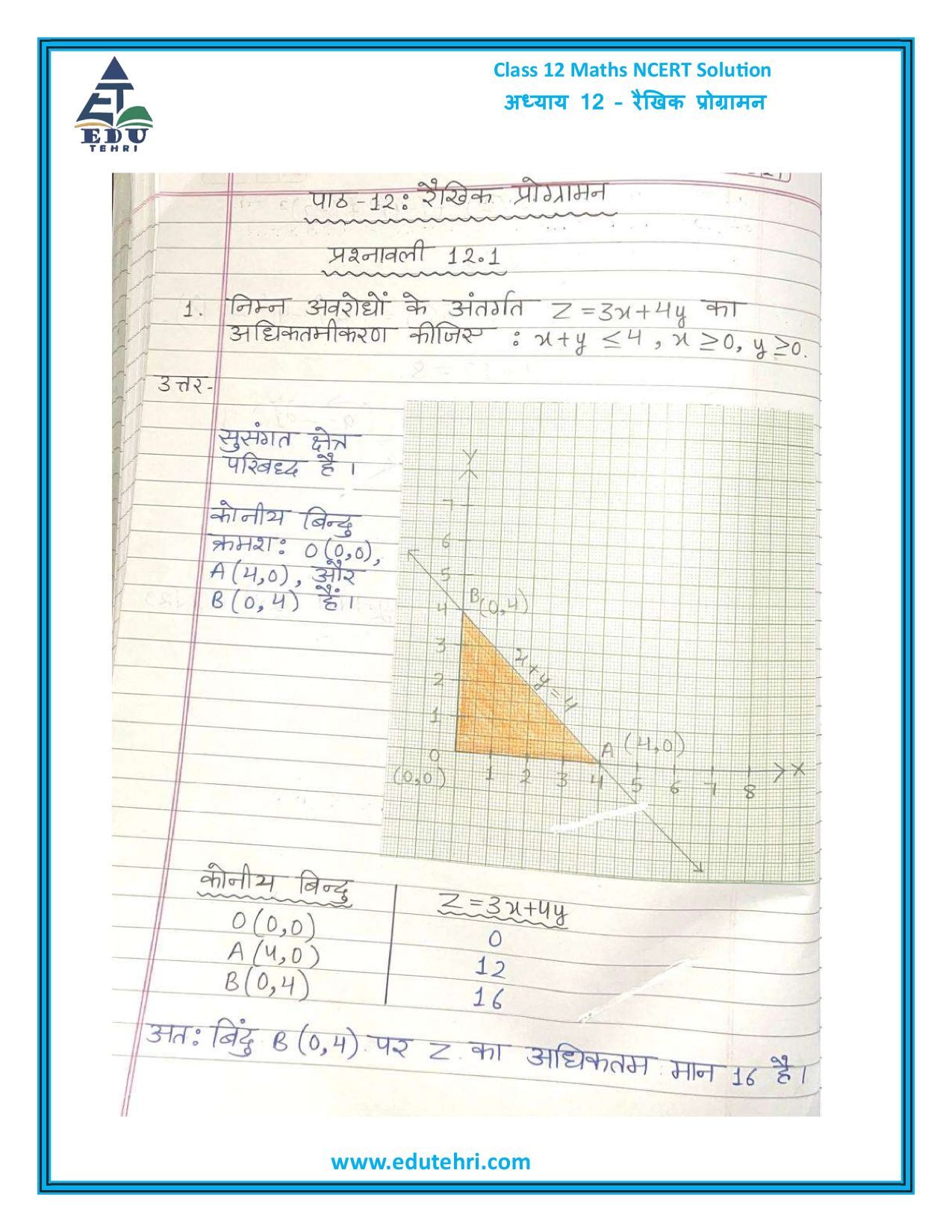
Z = 3x + 4y
2. Constraints:
The inequalities that restrict the values of variables. Example:
x + 2y \le 8, \quad x \ge 0, \quad y \ge 0
3. Feasible Region:
The region satisfying all constraints.
4. Corner Points (Vertices):
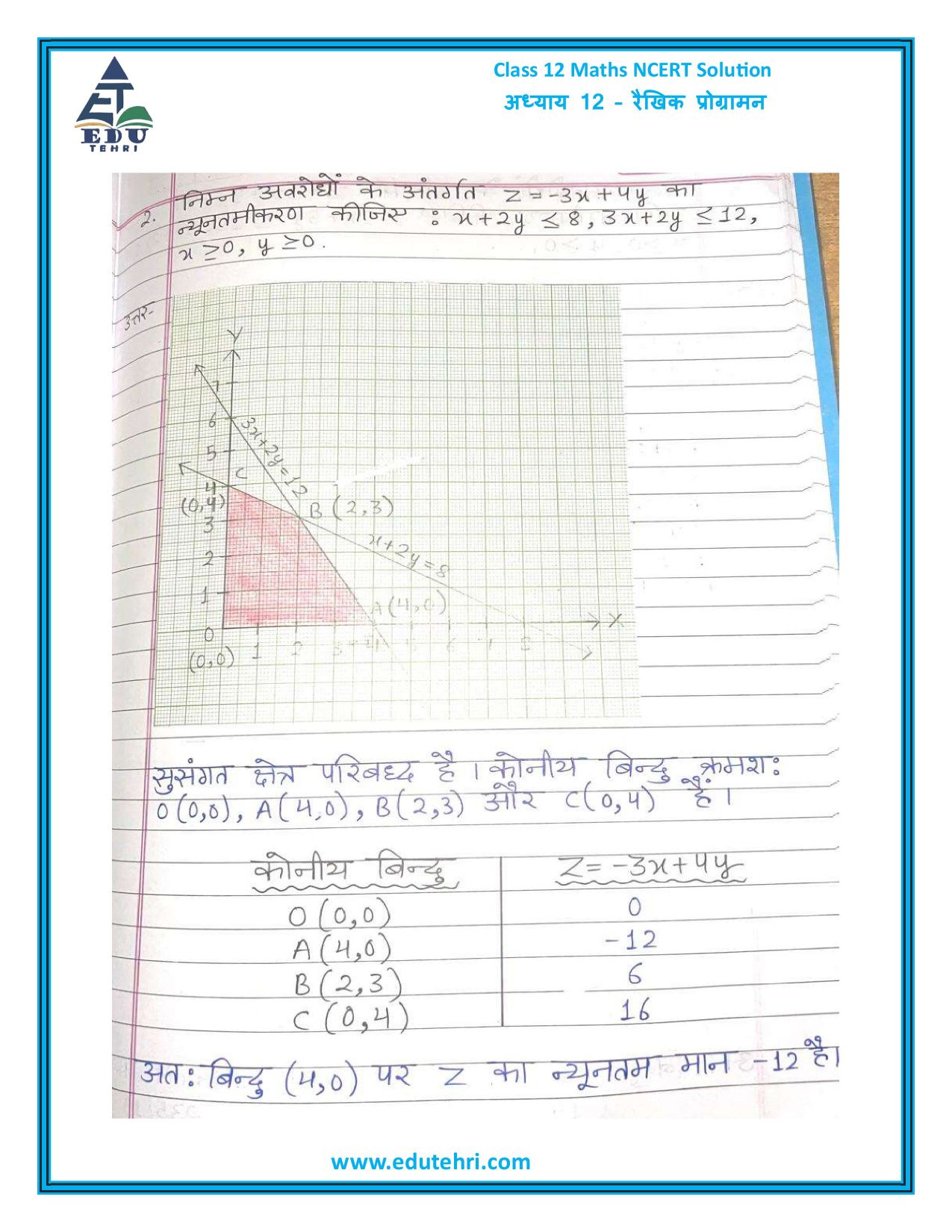
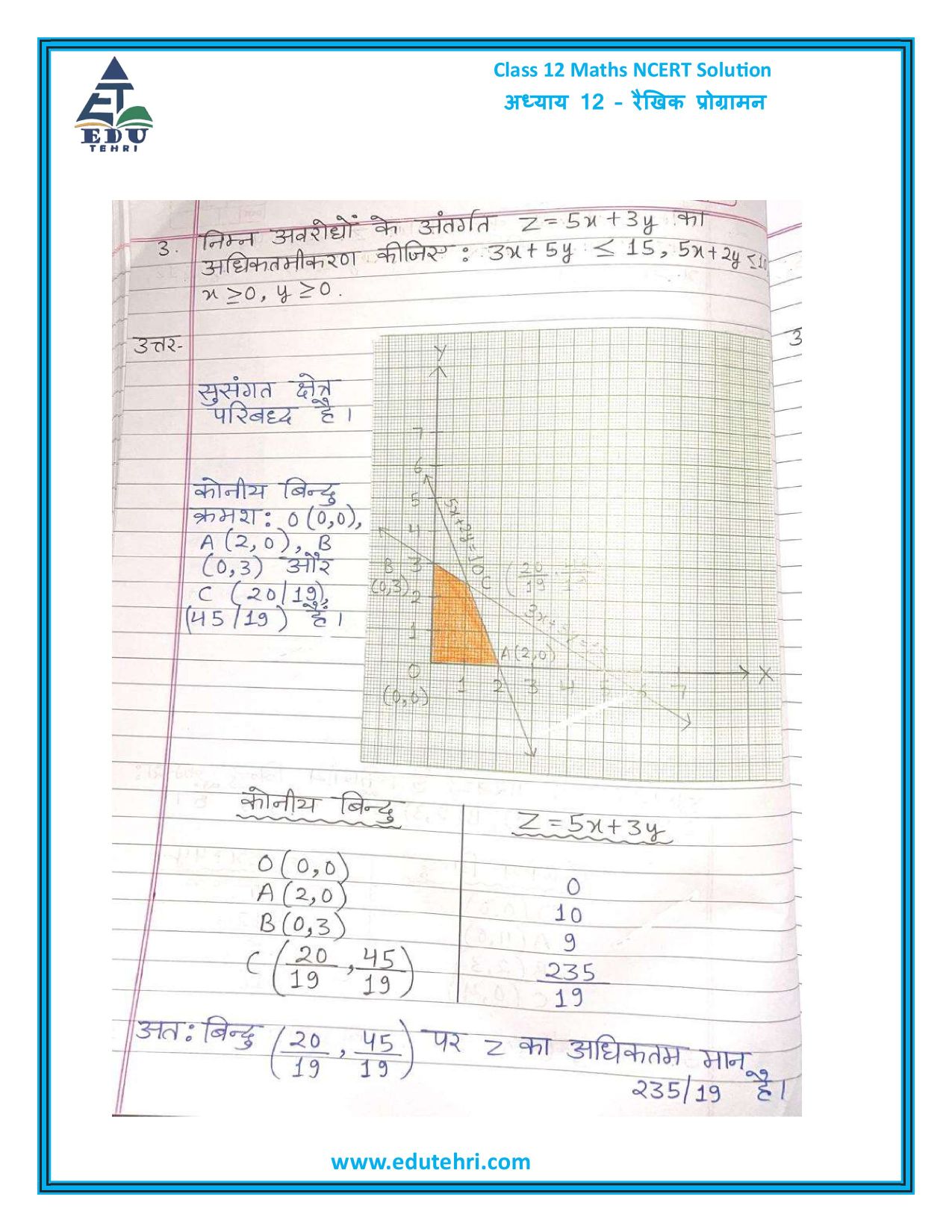
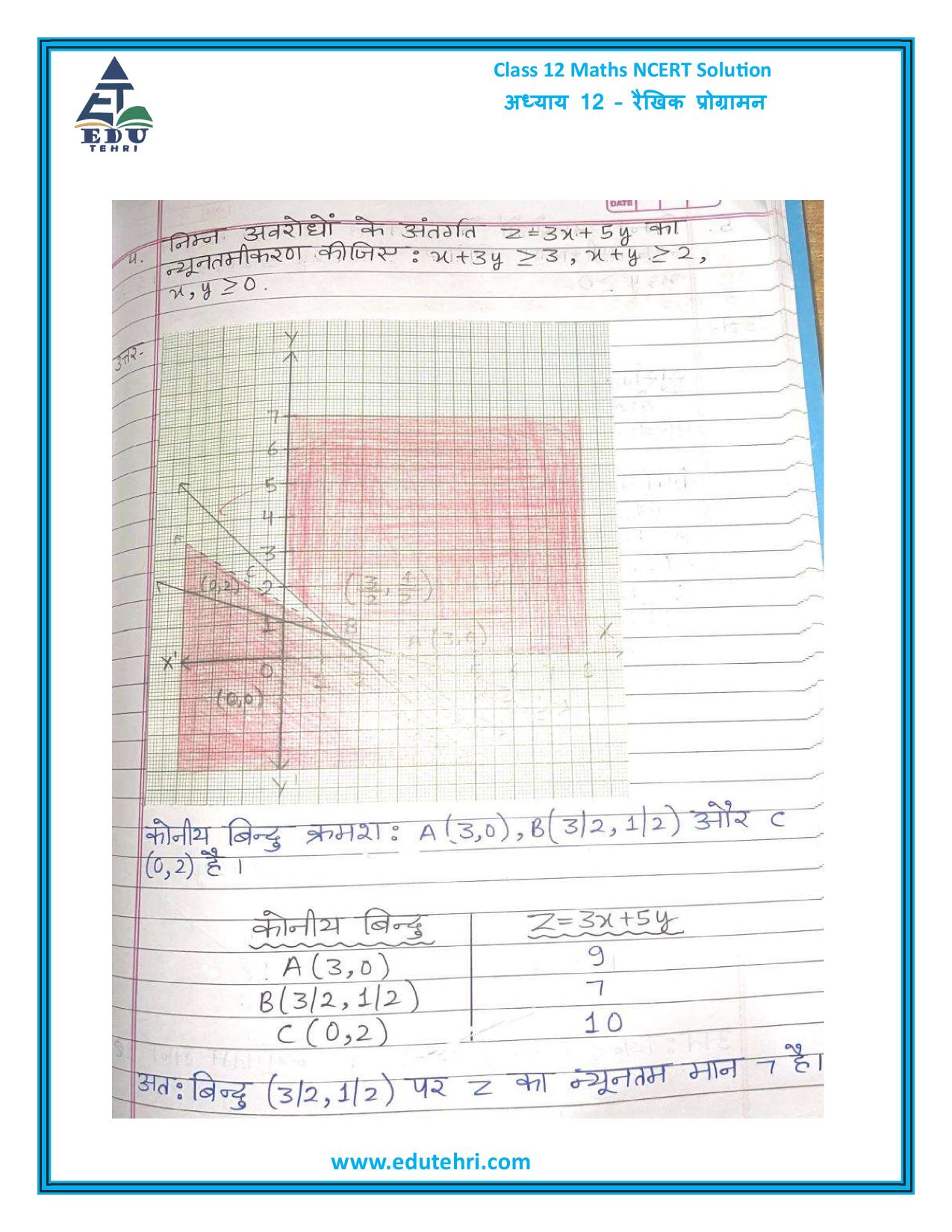
Points where two or more constraints intersect. Maximum or minimum value occurs at a corner point.
Scroll through the pages below to view the Chapter-12
Steps to Solve a Linear Programming Problem
Step 1: Identify the variables
• Assign variables to unknown quantities (x, y, etc.)
Step 2: Formulate the objective function
• Usually given as maximize Z or minimize Z.
Step 3: Formulate the constraints
• Write inequalities for all restrictions.
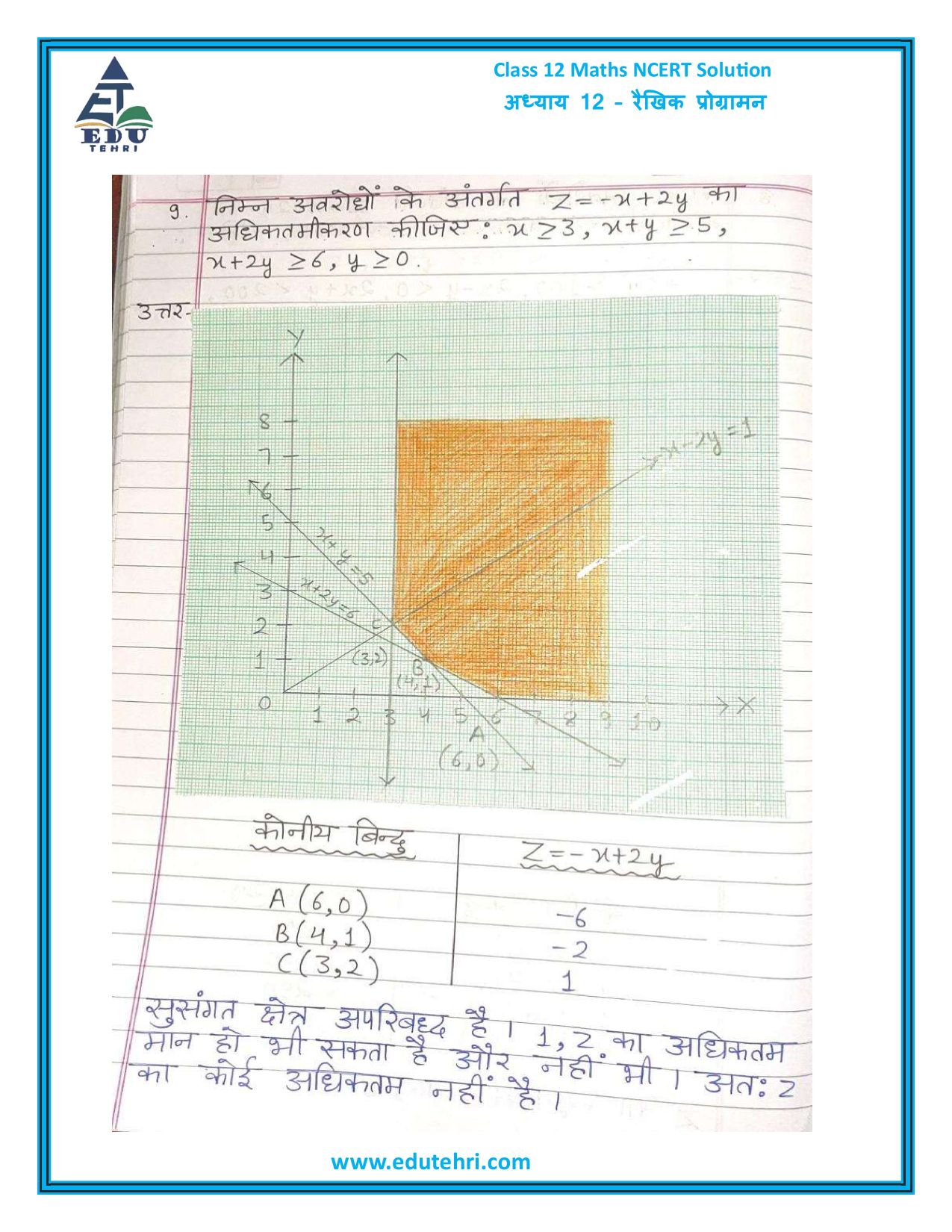
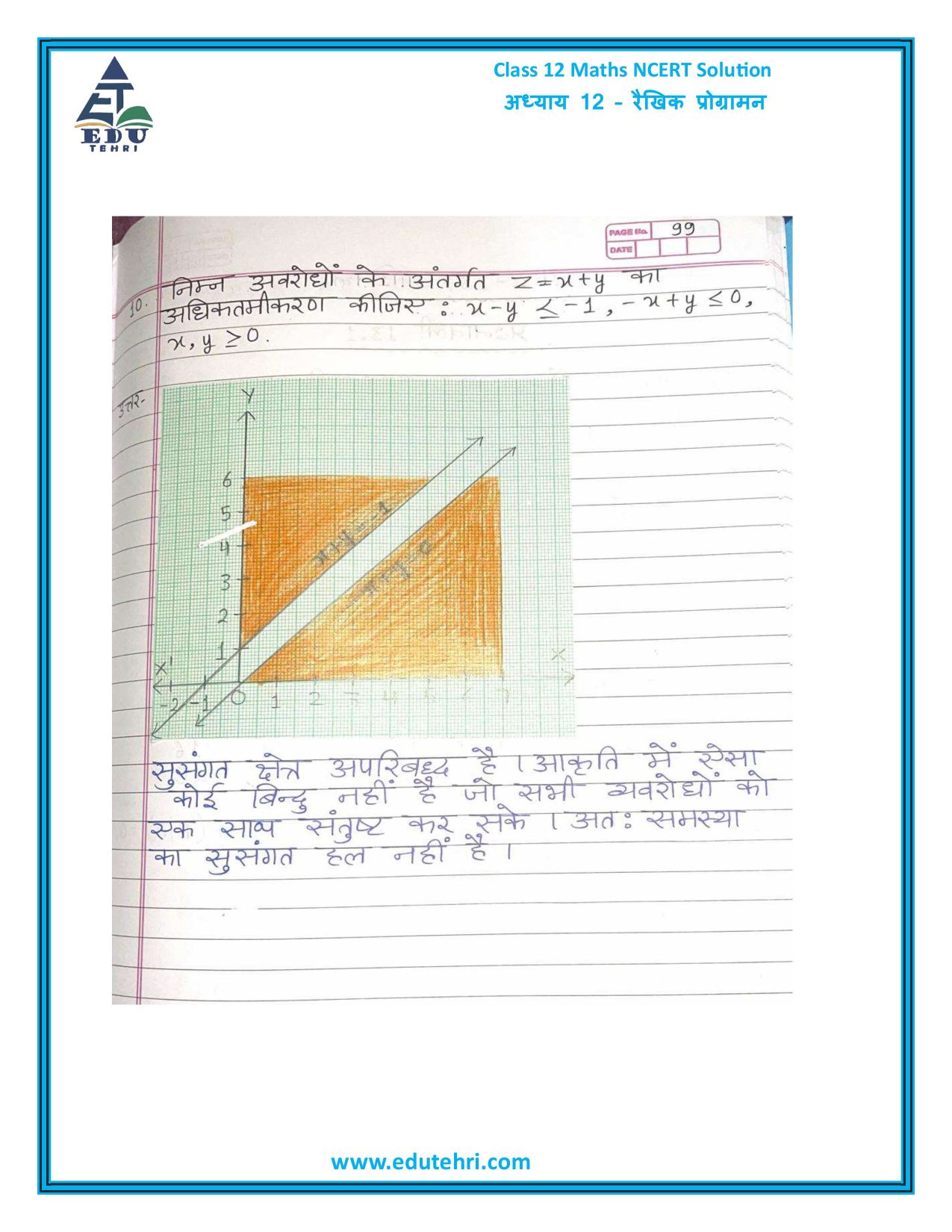
Step 4: Graphical Representation
• Plot all inequalities on graph paper.
• Determine the feasible region.
Step 5: Determine corner points
• Find points of intersection of lines.
Step 6: Evaluate the objective function
• Calculate Z at all corner points.
• Maximum or minimum occurs at one of the corner points.
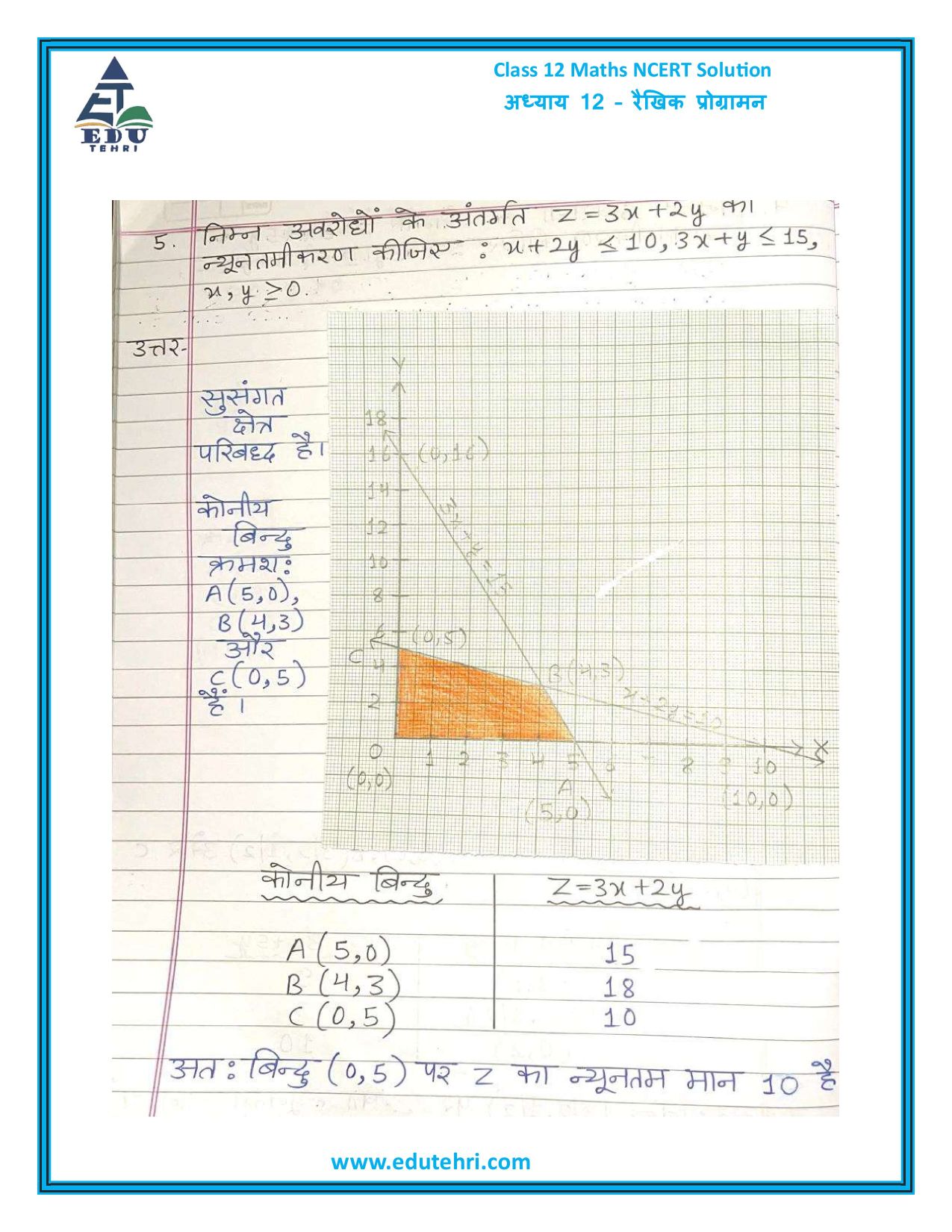
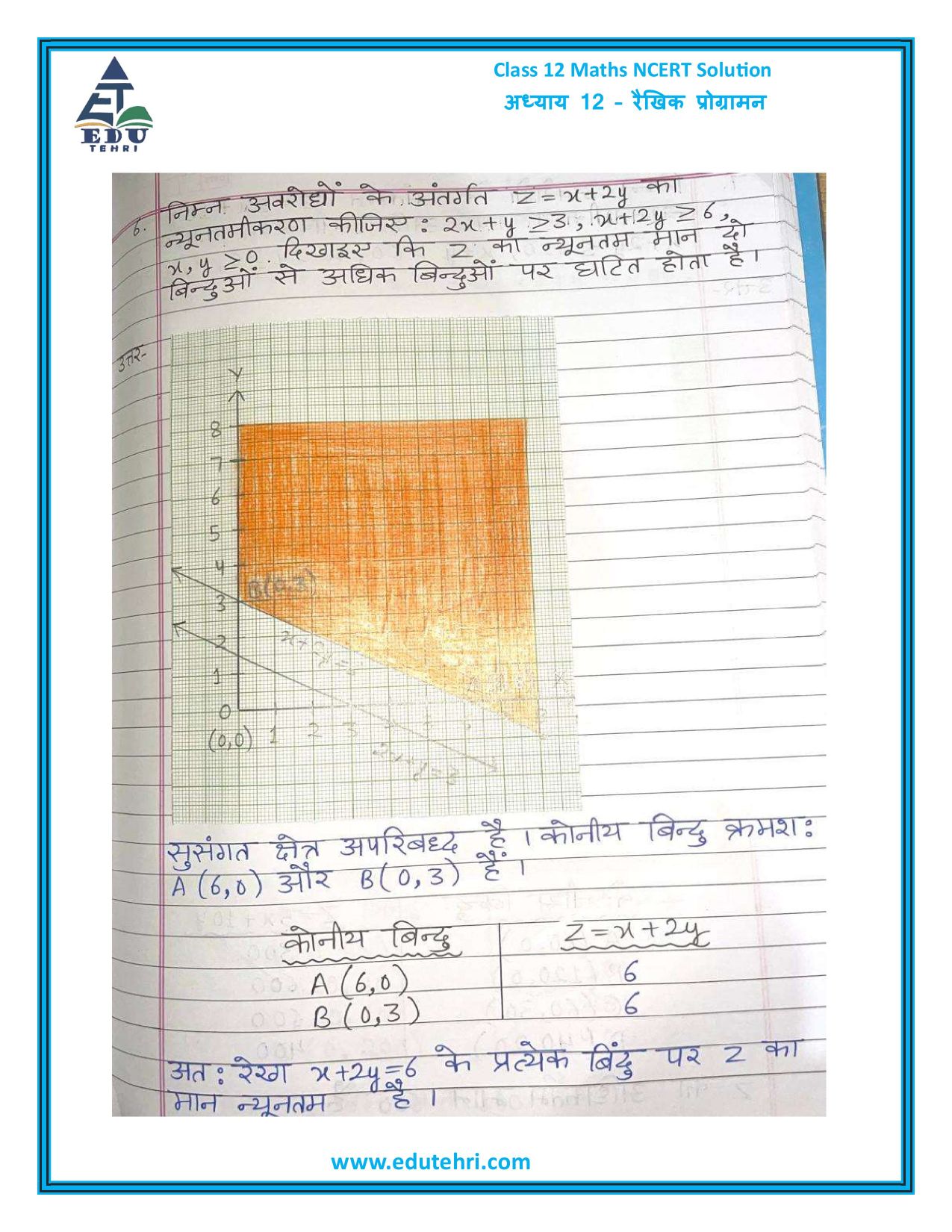
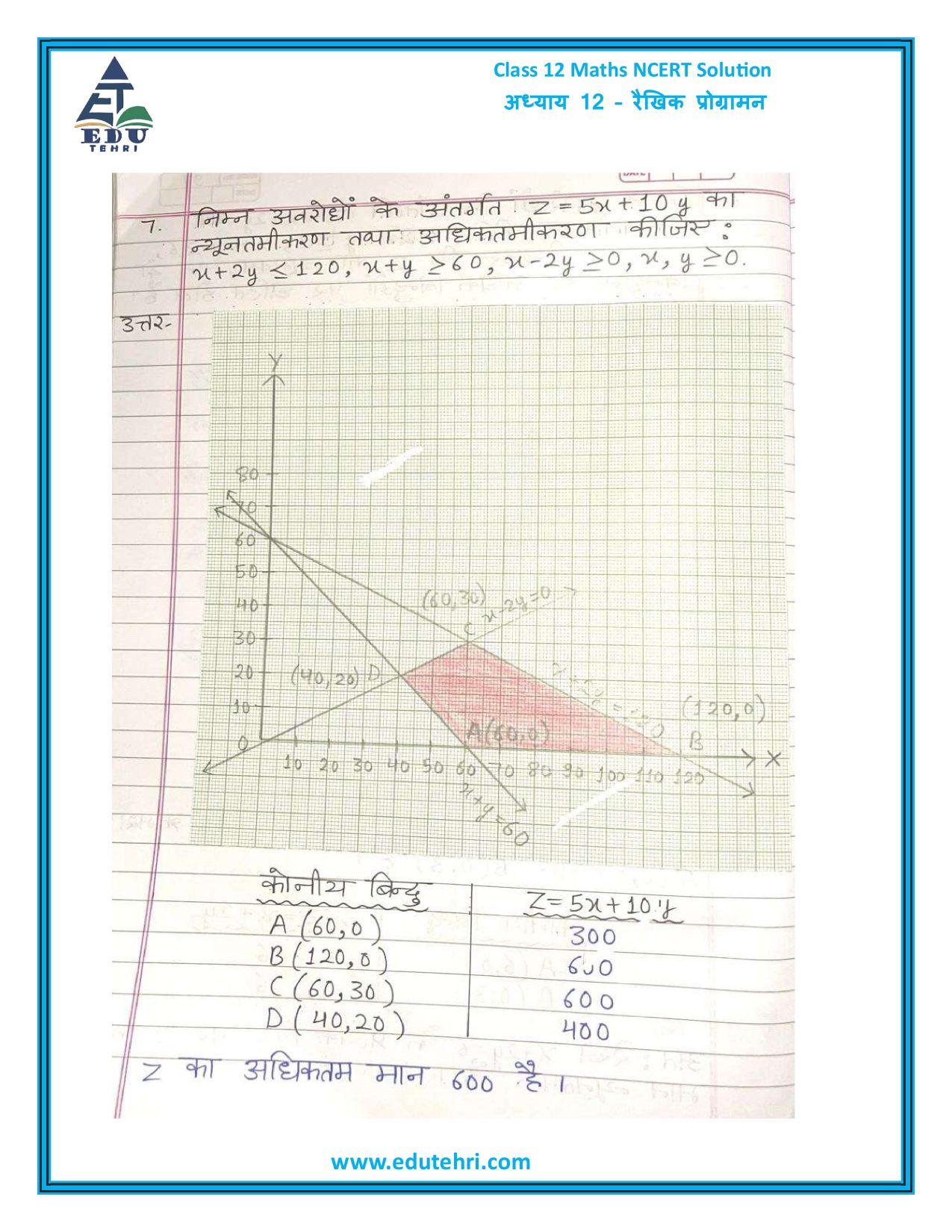
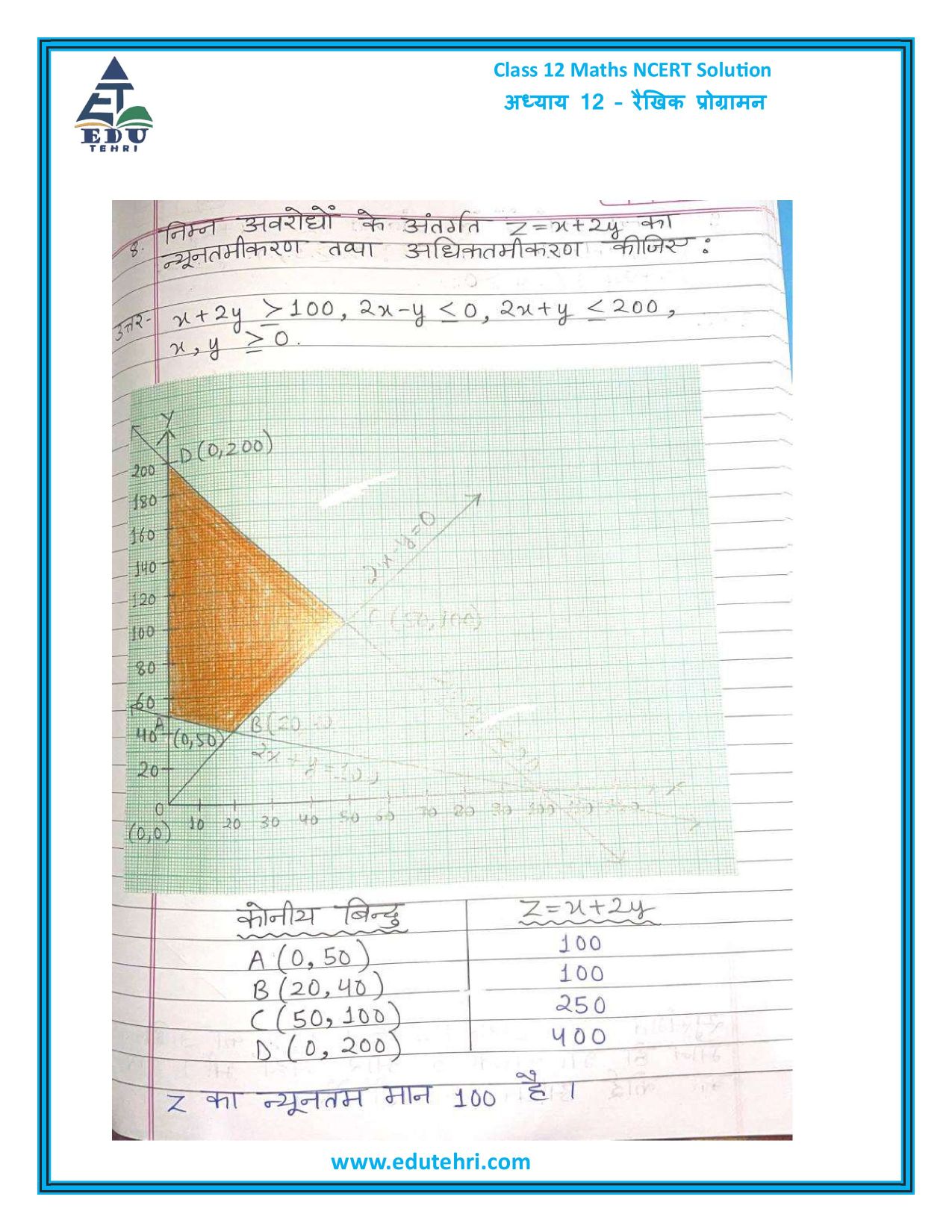
Graphical Method of Solution (Most Important)
Graphical method is used when there are two variables (x and y).
Steps:
1. Convert inequalities into equations
2. Draw lines on the graph
3. Identify feasible region
4. Calculate coordinates of vertices
5. Substitute in objective function
This method is highly scoring in boards.
Types of Linear Programming Problems
1. Maximization Problems:
Goal: maximize Z
Example: Profit maximization
2. Minimization Problems:
Goal: minimize Z
Example: Cost minimization
3. Problems with Non-Negative
Constraints: Variables x, y ≥ 0
Examples of Real-Life Applications
• Business: Maximize profit or minimize cost
• Industry: Optimize production with limited resources
• Diet Planning: Minimize cost with nutrition constraints
• Transportation: Optimize routes and schedules
Important Formulas / Concepts
Download Important Formula - Free PDF
1. Objective function: Z = ax + by
2. Constraints: px + qy \le r
3. Non-negativity: x \ge 0, y \ge 0
4. Feasible region: Intersection of all constraints
5. Corner point method: Evaluate Z at vertices
Corner Point Theorem
In a linear programming problem, the maximum or minimum value of the objective function occurs at a corner point (vertex) of the feasible region.
This theorem is very important for board exams.
Exercises in Chapter 12
NCERT Chapter 12 contains 1 exercises.
Exercise Details:
• Exercise 12.1 – Formulating linear programming problems
Common Mistakes Students Make
• Incorrect plotting of inequalities
• Confusing ≤ with ≥
• Missing corner points
• Not evaluating Z at all vertices
• Ignoring non-negativity conditions
Edu Tehri explains these mistakes with examples and diagrams.
Graphical Representation Tips
• Always label axes and scale properly
• Shade the feasible region
• Identify all intersection points
• Check each vertex for max or min Z
Advantages of Linear Programming
• Optimizes resources
• Saves time and money
• Applicable to multiple fields like business, manufacturing, and transport
• Easy to solve graphically for two variables
Important Points to Remember
• Linear functions only
• Constraints are linear inequalities
• Non-negative variables
• Maximum/minimum occurs at a corner point
• Graphical method works only for two variables
Edu Tehri – Free PDFs & Handwritten Notes
Edu Tehri provides complete Chapter 12 support, including:
• Free NCERT solution PDFs
• Handwritten notes for step-by-step learning
• Formula sheets
• Board-oriented practice questions
• Clear explanation of graphical solutions
Key Features of Chapter 12
• Connects algebra with real-life applications
• Graphical method is highly scoring
• Covers both maximization and minimization problems
• Formula-based and easy if practiced
• Frequently repeated in board exams
Frequently Asked Questions
Q1. Why is Linear Programming important in Class 12 Maths?
Because it has high weightage, practical applications, and is scoring if done step-by-step.
Q2. Is NCERT enough for Chapter 12?
Yes, NCERT questions cover almost all board questions. Practicing all exercises is enough.
Q3. Which type of problem is most important?
Graphical method problems with two variables and word problems from real-life scenarios.
Q4. How to avoid mistakes in linear programming?
• Always check the feasible region
• Include all constraints
• Label axes and scale properly
• Evaluate Z at all corner points
Q5. Can LPP be solved algebraically instead of graphically?
Yes, for more than two variables, algebraic methods are used, but board exams focus only on graphical method (2 variables)
Classs- 12th Mathematics NCERT Solutions All Chapters - Hand Written Notes | Free download PDF's | 2026-2027