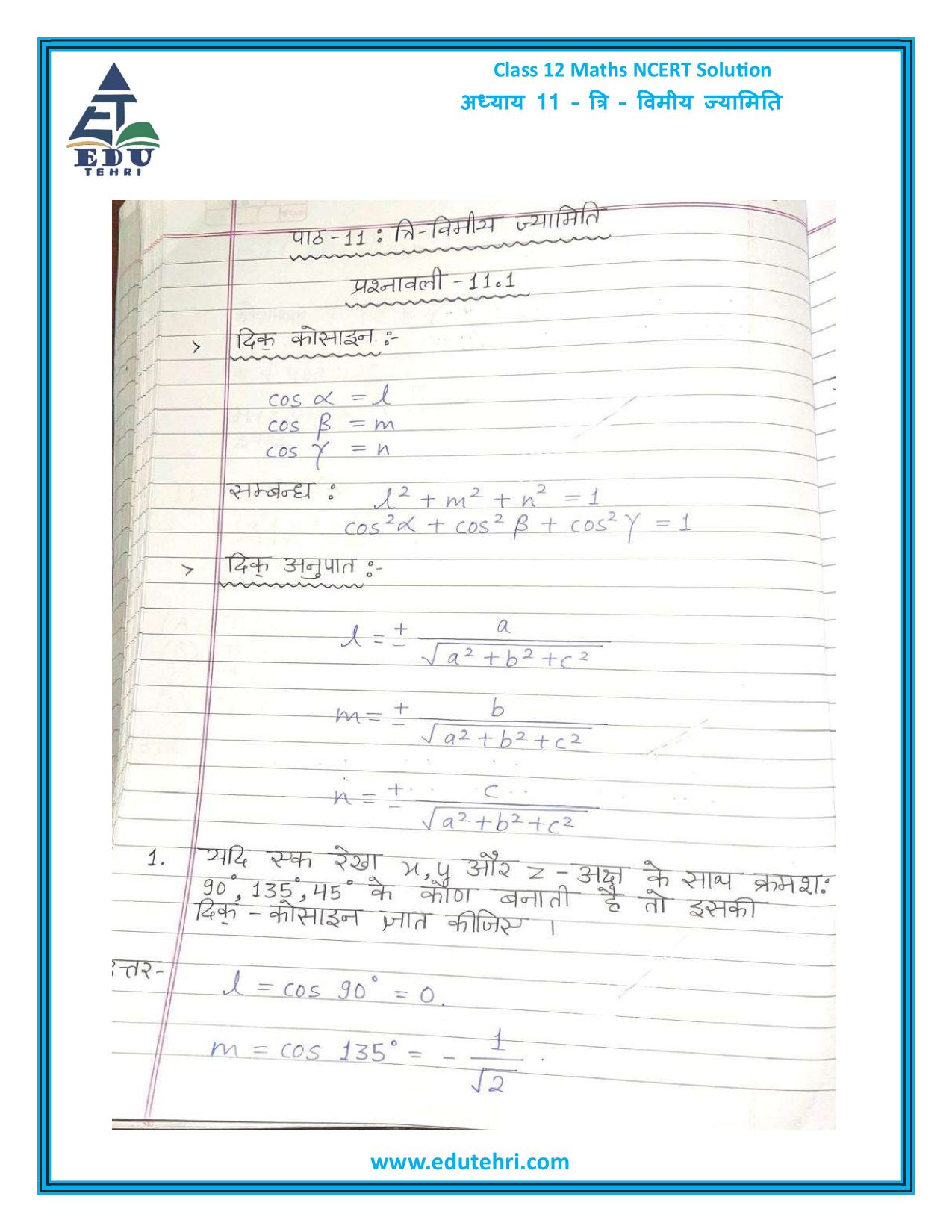
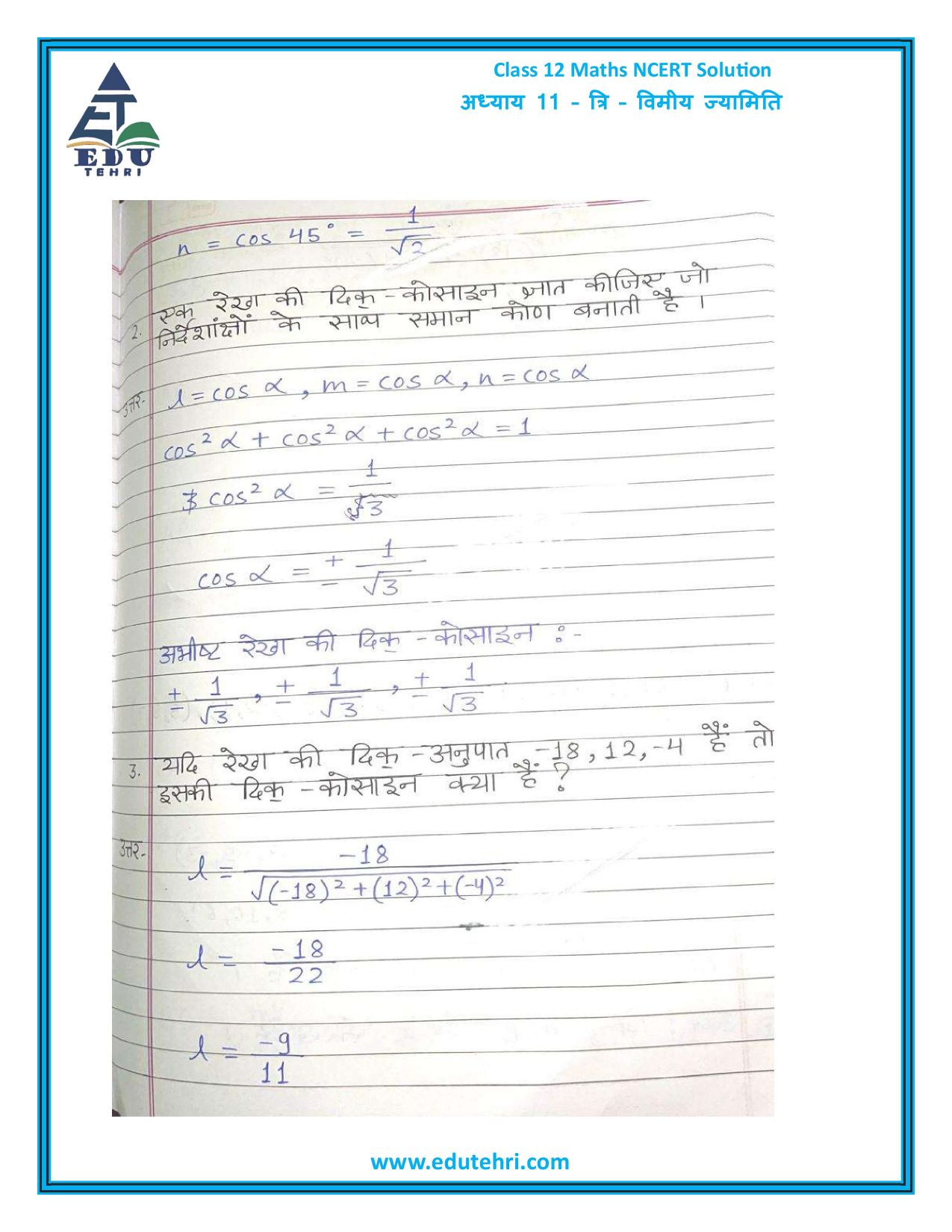
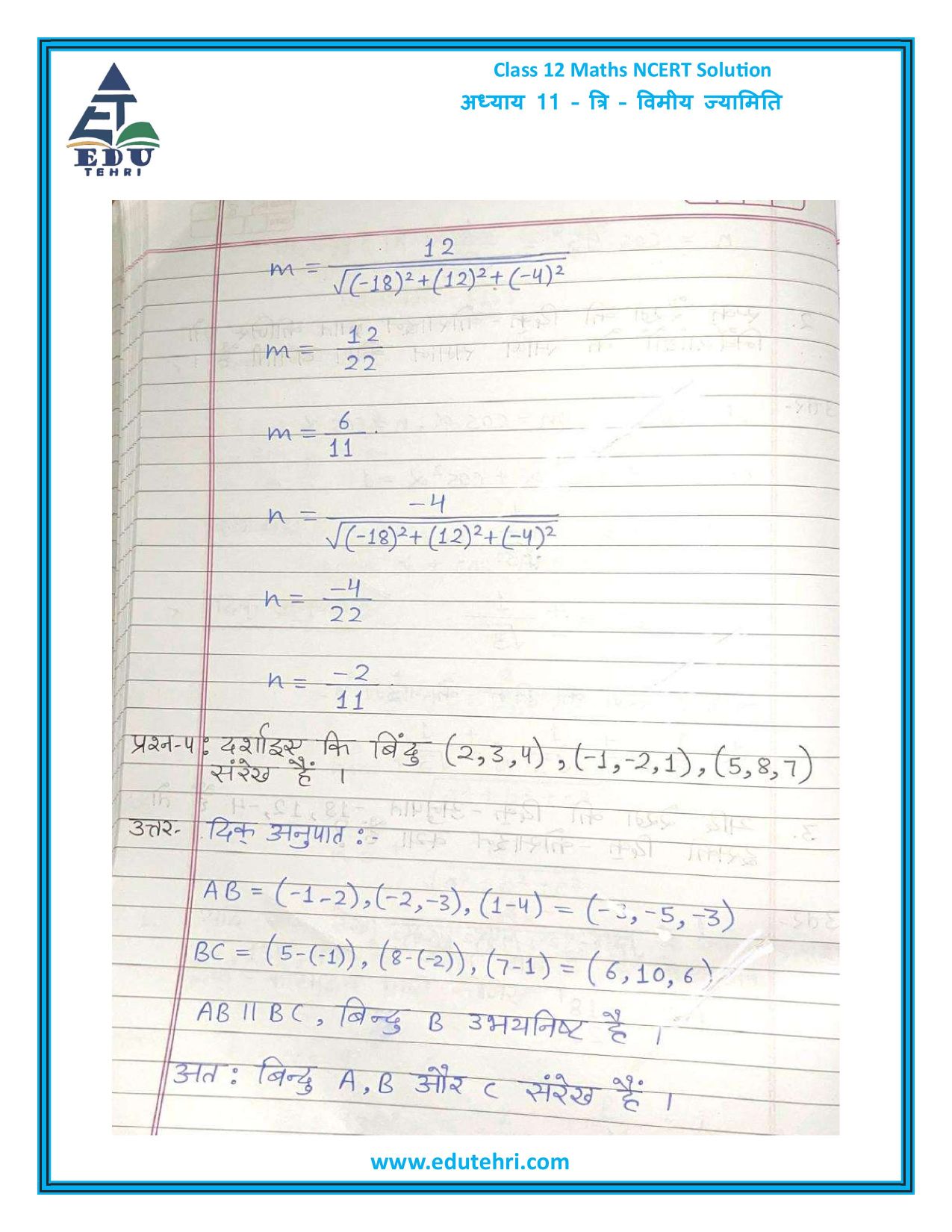
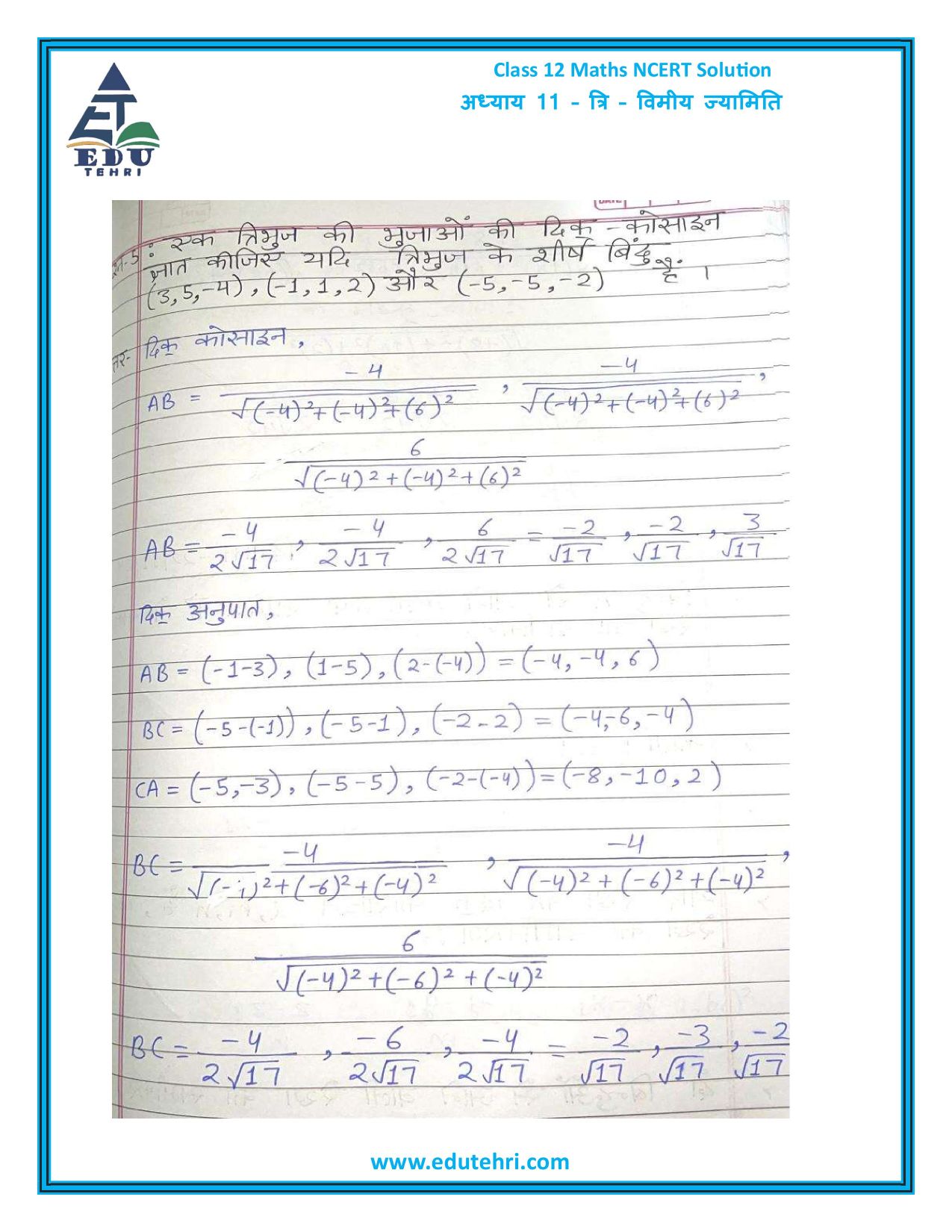
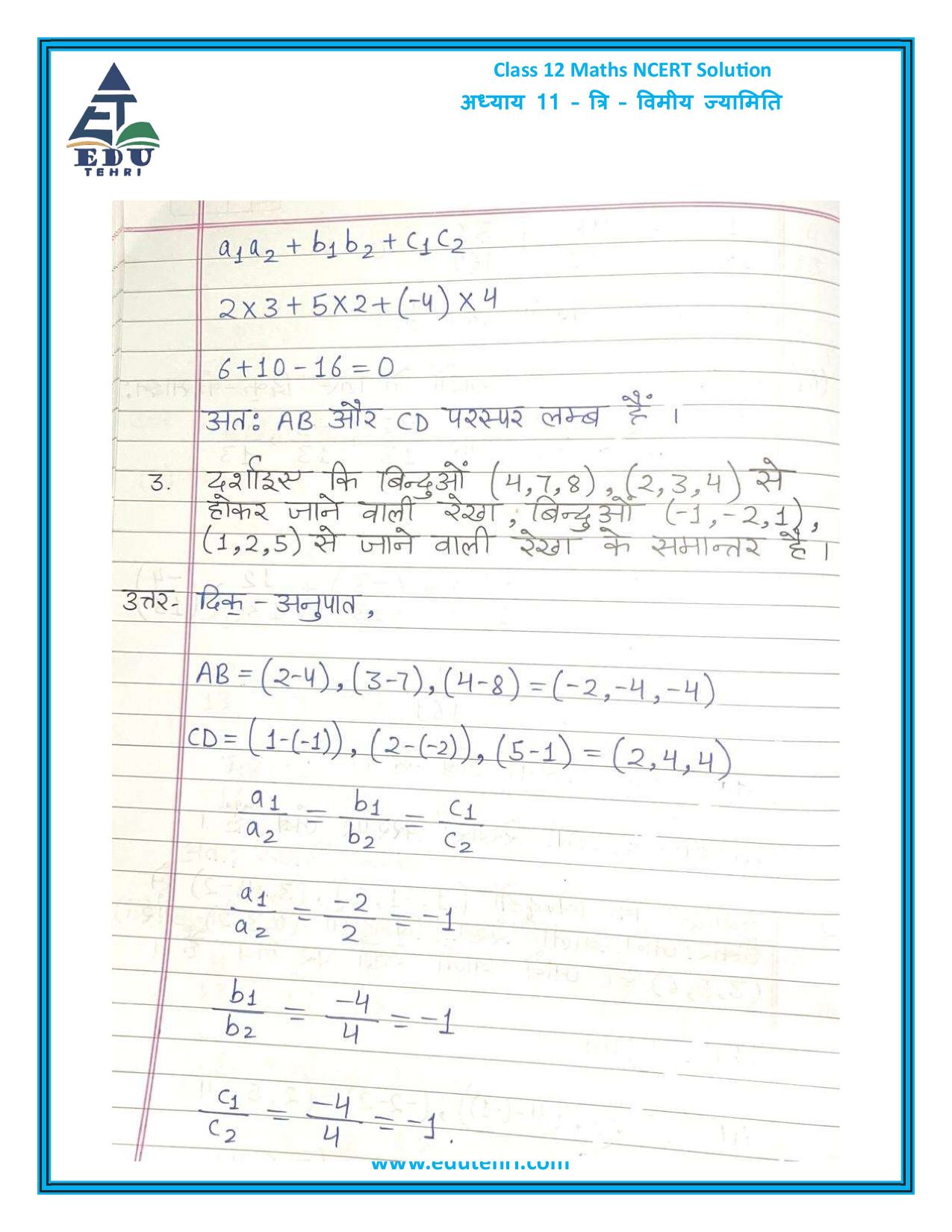
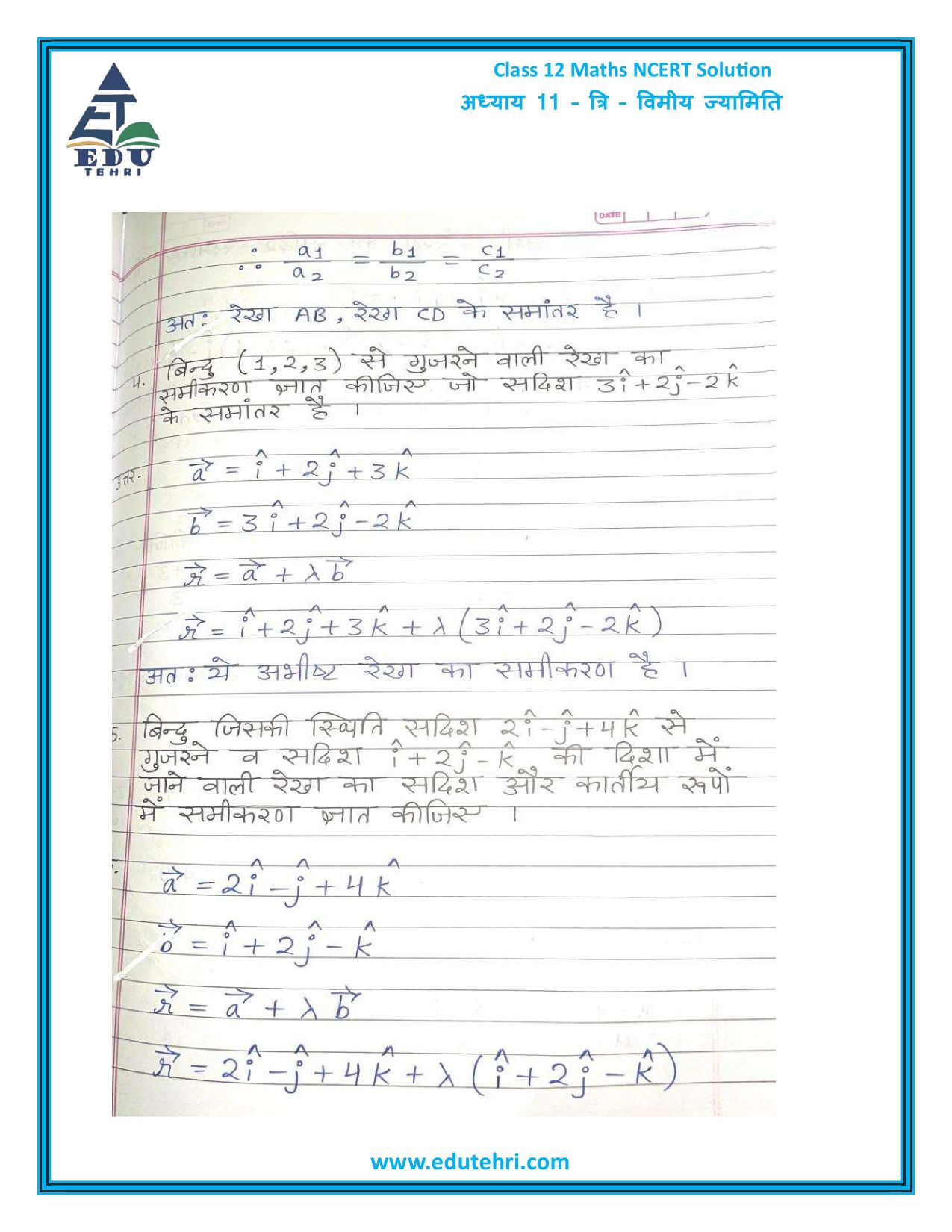
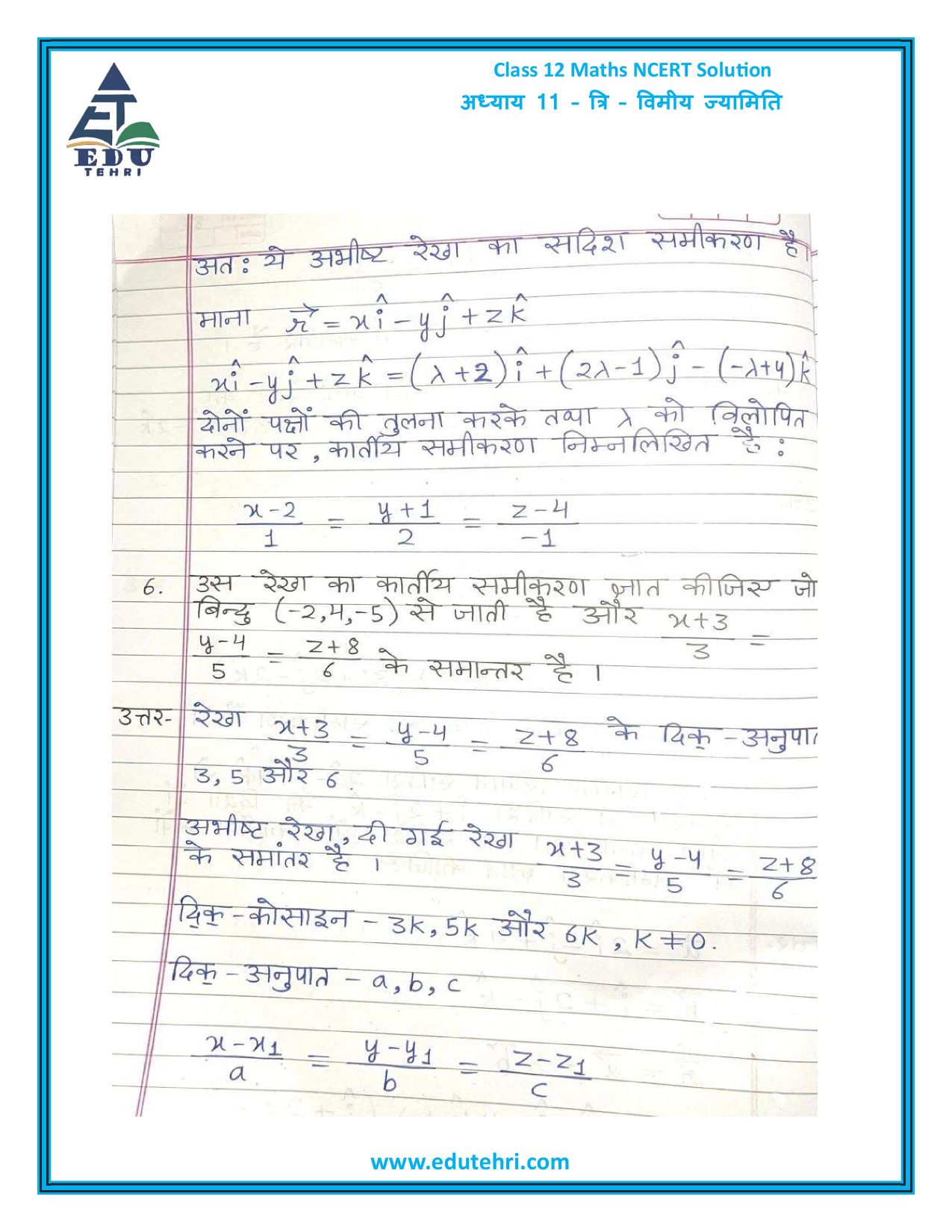
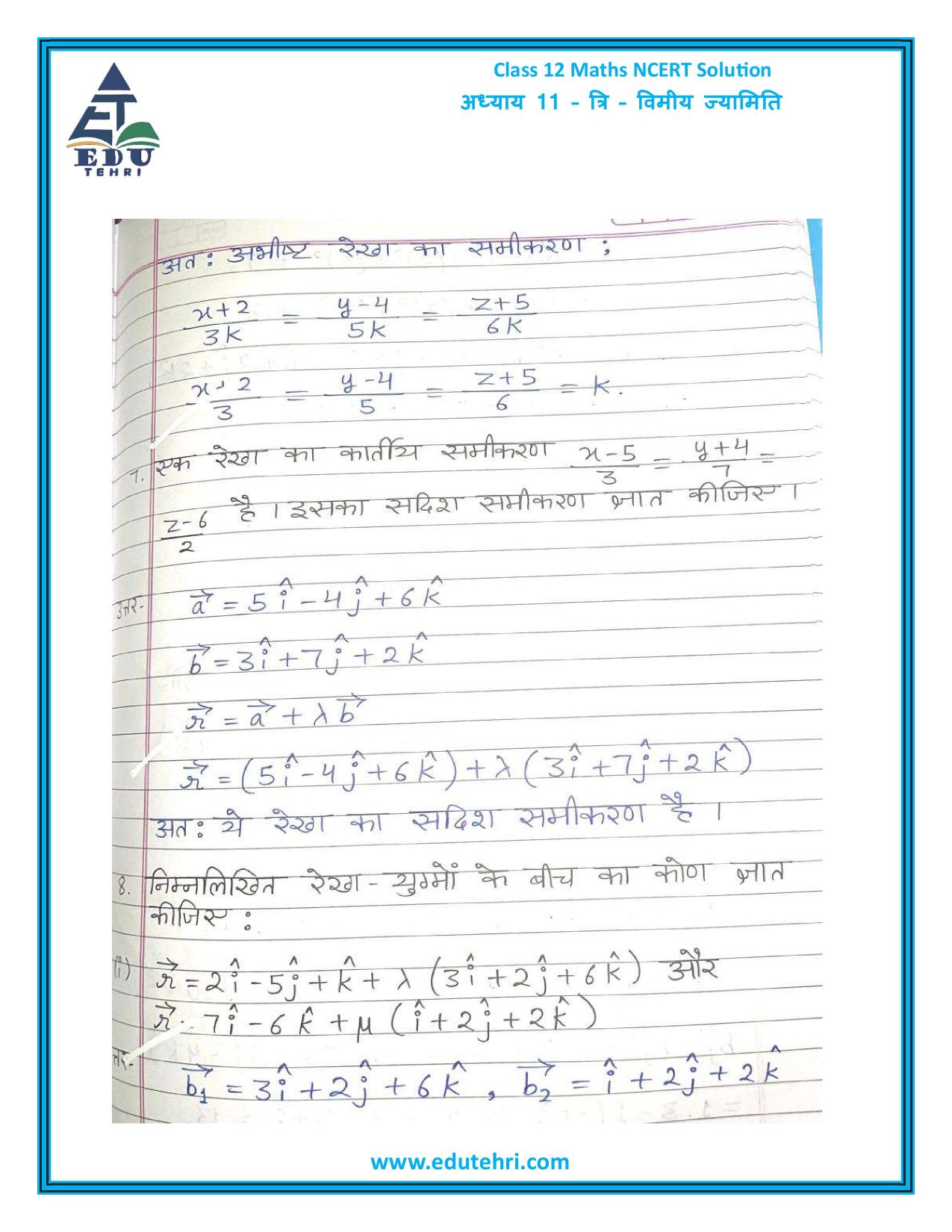
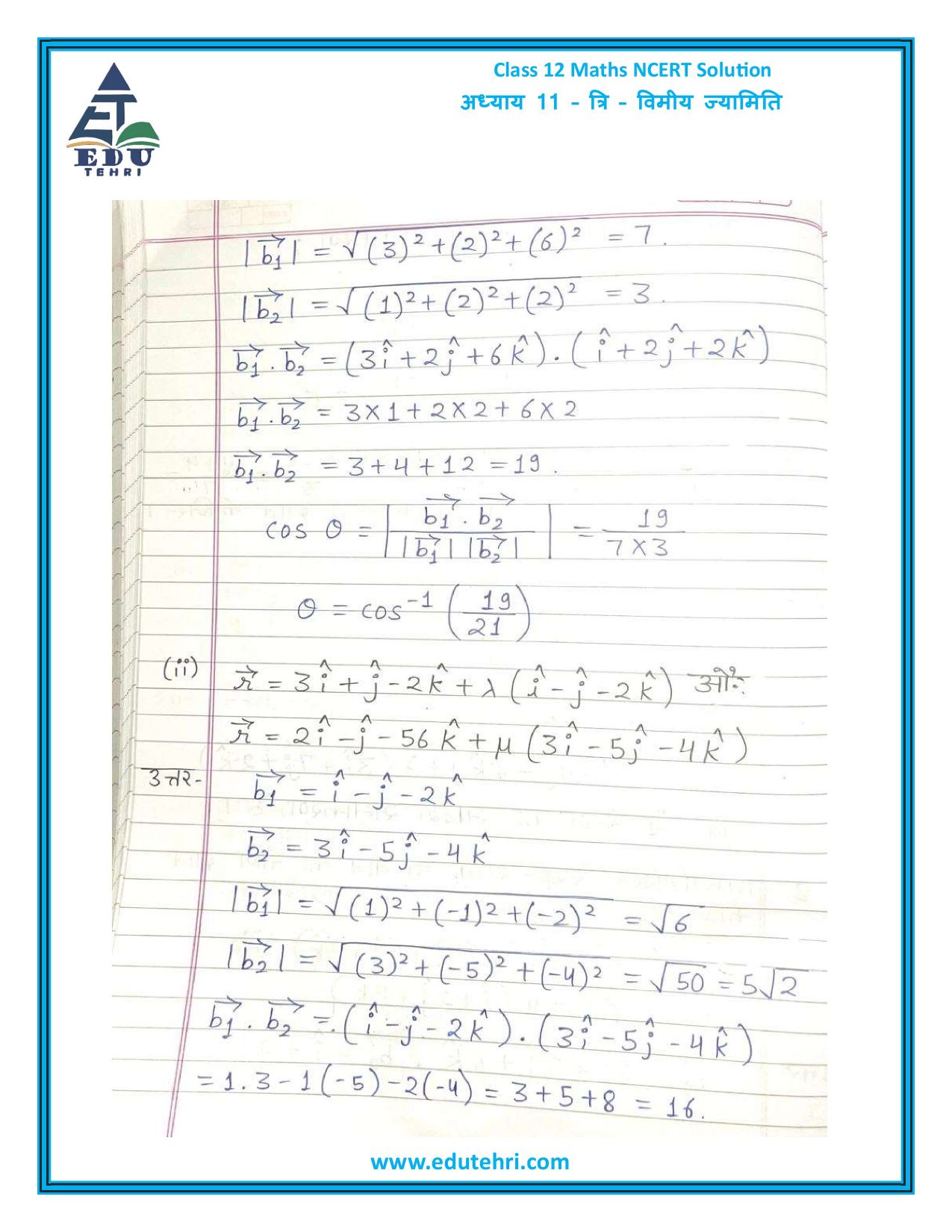
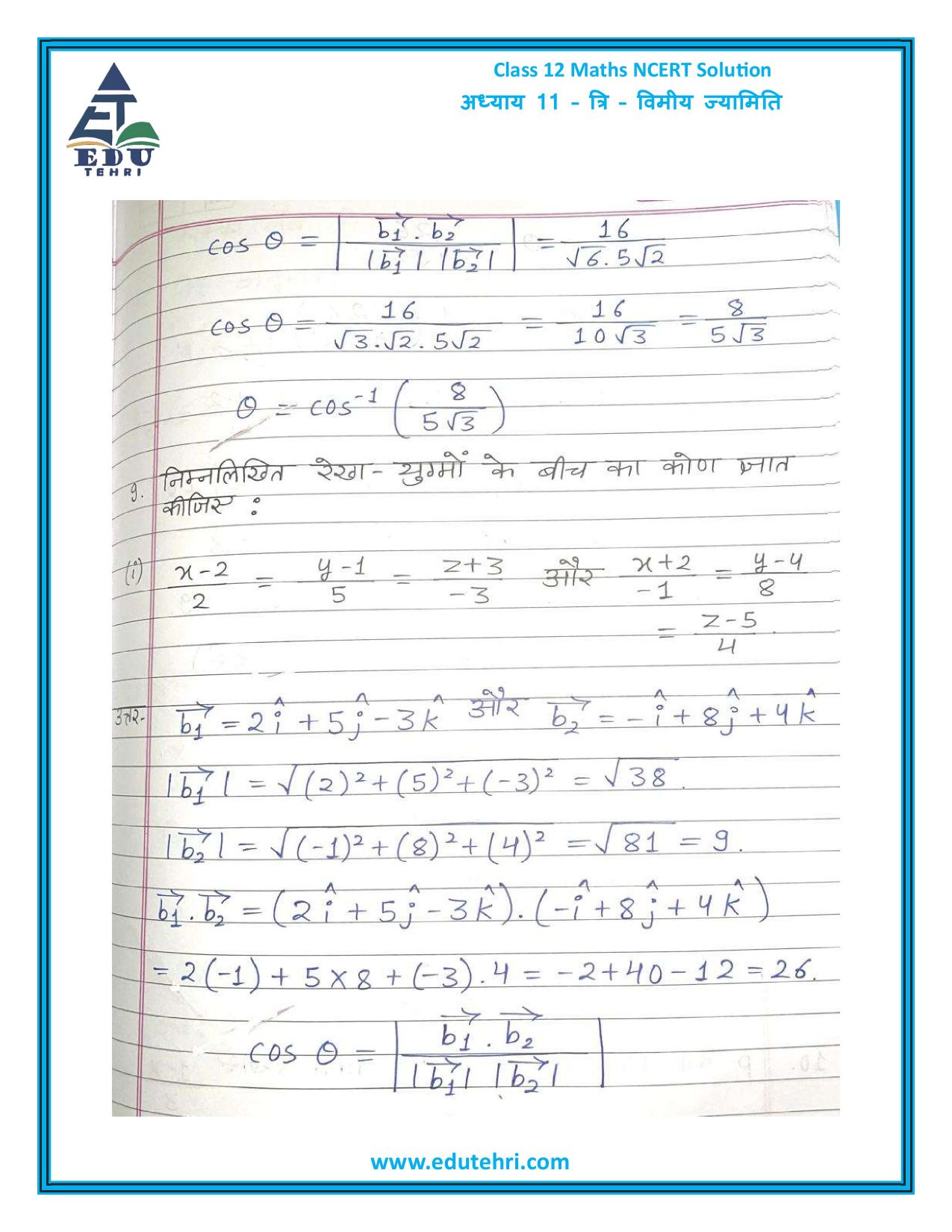
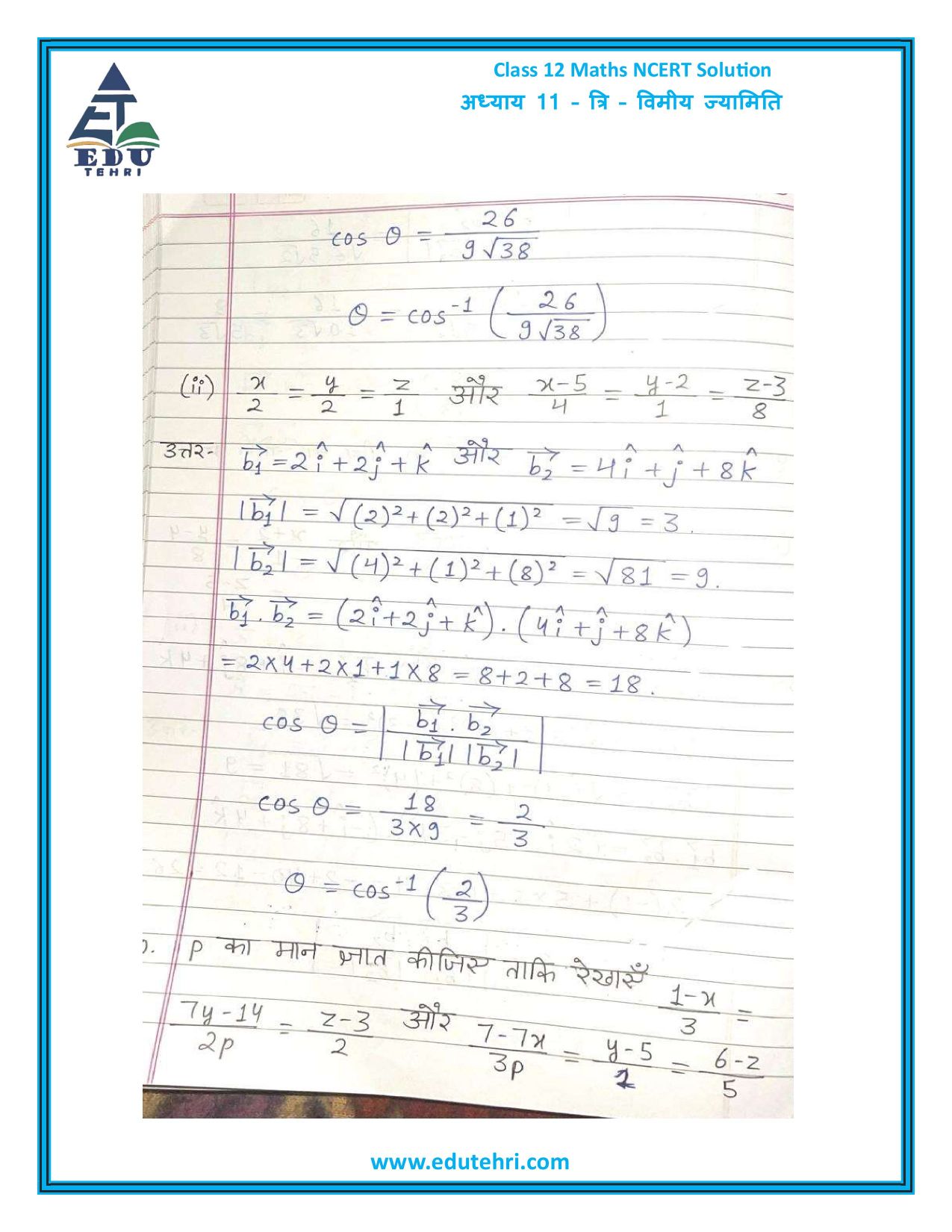
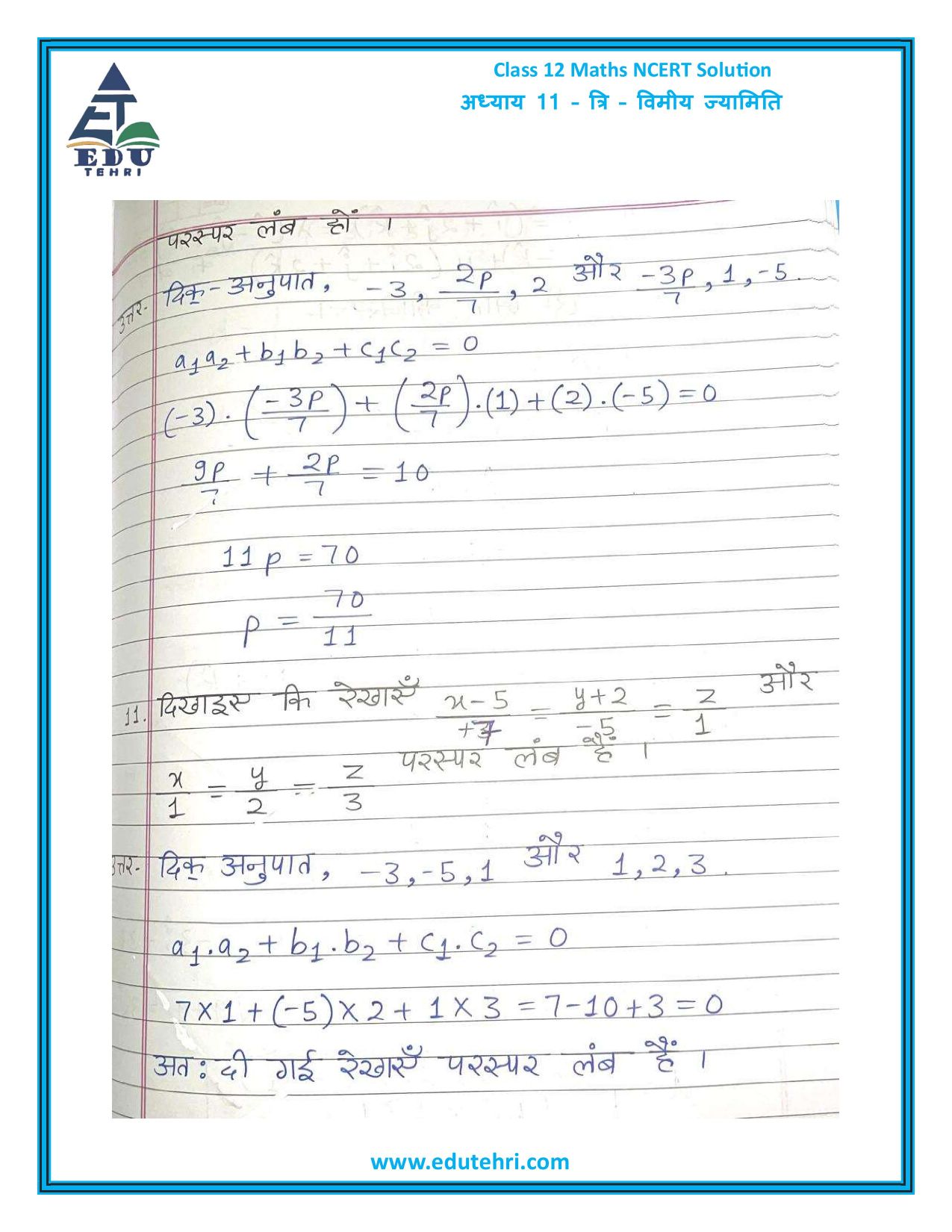
Class 12 Maths Chapter 11 – Three Dimensional Geometry NCERT Solutions – FREE PDF Download | Hand – Written Notes
Chapter 11 Three-Dimensional Geometry (3D Geometry) deals with the geometry of space. In earlier classes, students studied points and lines on a plane (2D), but this chapter extends the concept to three dimensions using x, y, and z coordinates.
This chapter is very important because:
• It has direct formula-based questions
• It carries high weightage in board exams
• It is closely connected with Vector
At Edu Tehri, Chapter 11 is explained using clear concepts, step-by-step derivations, formulas, examples, handwritten notes, and free PDFs.
Coordinate System in Three Dimensions
In three-dimensional geometry, the position of a point is described using three coordinates instead of two.
A point is written as:
(x, y, z)
Where:
• x = distance from YZ-plane
• y = distance from XZ-plane
• z = distance from XY-plane
The three axes are:
• X-axis
• Y-axis
• Z-axis
These axes are mutually perpendicular.
Scroll through the pages below to view the Chapter-11
Distance Between Two Points in 3D
If two points are:
A(x_1, y_1, z_1), \quad B(x_2, y_2, z_2)
Then distance AB is given by:
AB = \sqrt {(x_2 - x_1)^2 + (y_2 - y_1)^2 + (z_2 - z_1)^2}
This formula is an extension of the distance formula in 2D.
This is one of the most frequently used formulas in this chapter.
Section Formula in Three Dimensions
The section formula is used to find the coordinates of a point that divides a line segment joining two points in a given ratio.
(A) Internal Division
If a point P divides AB internally in the ratio m : n, where:
A(x_1, y_1, z_1), \quad B(x_2, y_2, z_2)
Then coordinates of P are:
\left( \frac{mx_2 + nx_1}{m+n}, \frac{my_2 + ny_1}{m+n}, \frac{mz_2 + nz_1}{m+n} \right)
(B) External Division
For external division, the formula is:
\left( \frac{mx_2 - nx_1}{m-n}, \frac{my_2 - ny_1}{m-n}, \frac{mz_2 - nz_1}{m-n} \right)
Coordinates of the Mid-Point
The mid-point is a special case of section formula where ratio is 1 : 1.
If:
A(x_1, y_1, z_1), \quad B(x_2, y_2, z_2)
Mid-point M is:
\left( \frac{x_1 + x_2}{2}, \frac{y_1 + y_2}{2}, \frac{z_1 + z_2}{2} \right)
This formula is easy and very scoring.
Area of a Triangle in 3D
The area of a triangle formed by three points A, B, and C is found using vector method.
If:
\vec{AB} \text{ and } \vec{AC}
Then area of triangle ABC is:
\text{Area} = \frac{1}{2} |\vec{AB} \times \vec{AC}|
This topic connects Vector Algebra (Chapter 10) with 3D Geometry.
Direction Cosines and Direction Ratios
If a line makes angles α, β, γ with x, y, z axes respectively, then:
• cosα, cosβ, cosγ are called direction cosines
Important relation:
\cos^2 \alpha + \cos^2 \beta + \cos^2 \gamma = 1
Direction ratios are any three numbers proportional to direction cosines.
Equation of a Line in 3D (Very Important)
The equation of a line in 3D can be written in different forms.
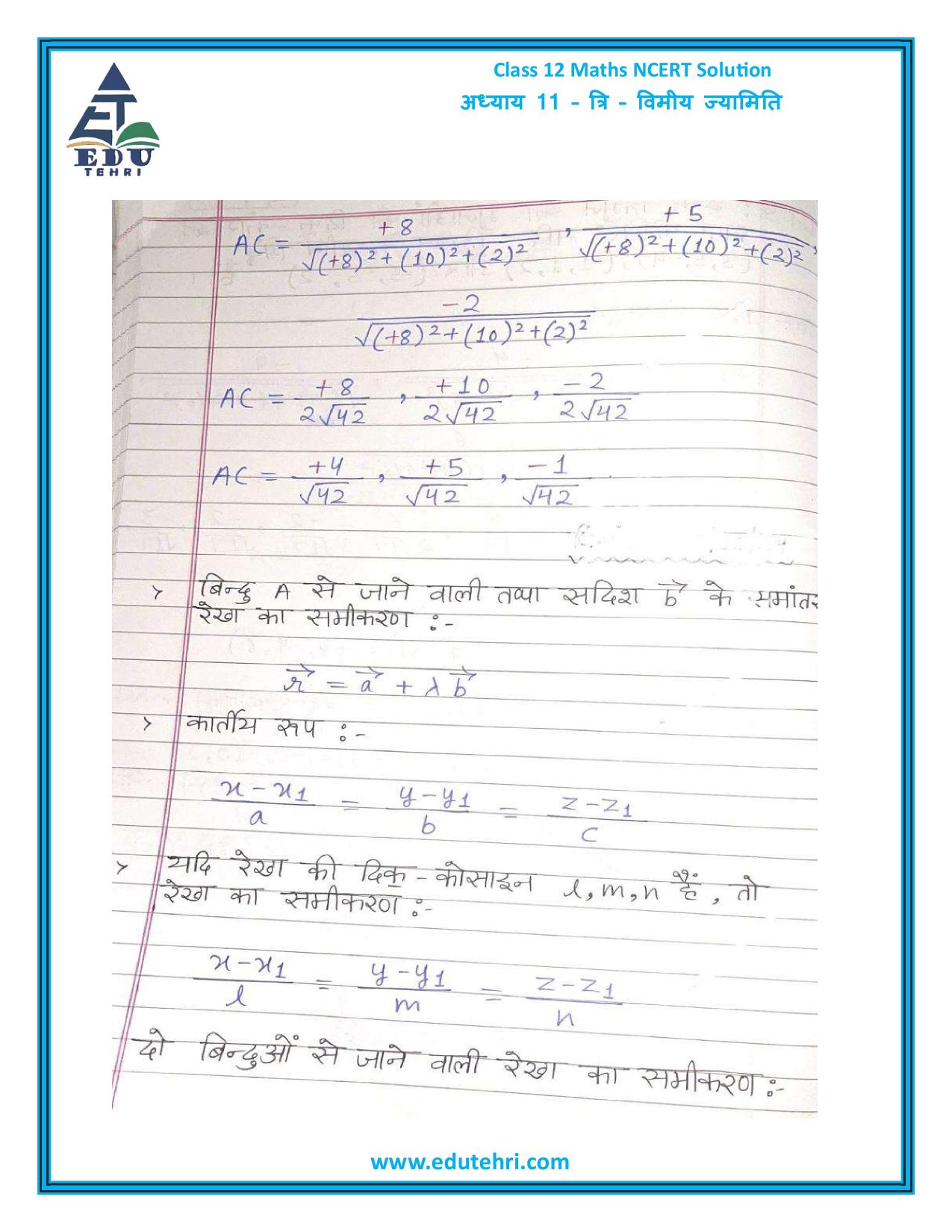
(A) Vector Form of Line
If a line passes through a point with position vector \vec{a} and has direction vector \vec{b}, then:
\vec{r} = \vec{a} + \lambda \vec{b}
Where λ is a scalar.
(B) Cartesian Form of Line
If a line passes through point (x_1, y_1, z_1) and has direction ratios (a, b, c), then:
\frac{x - x_1}{a} = \frac{y - y_1}{b} = \frac{z - z_1}{c}
This form is most commonly used in board exams.
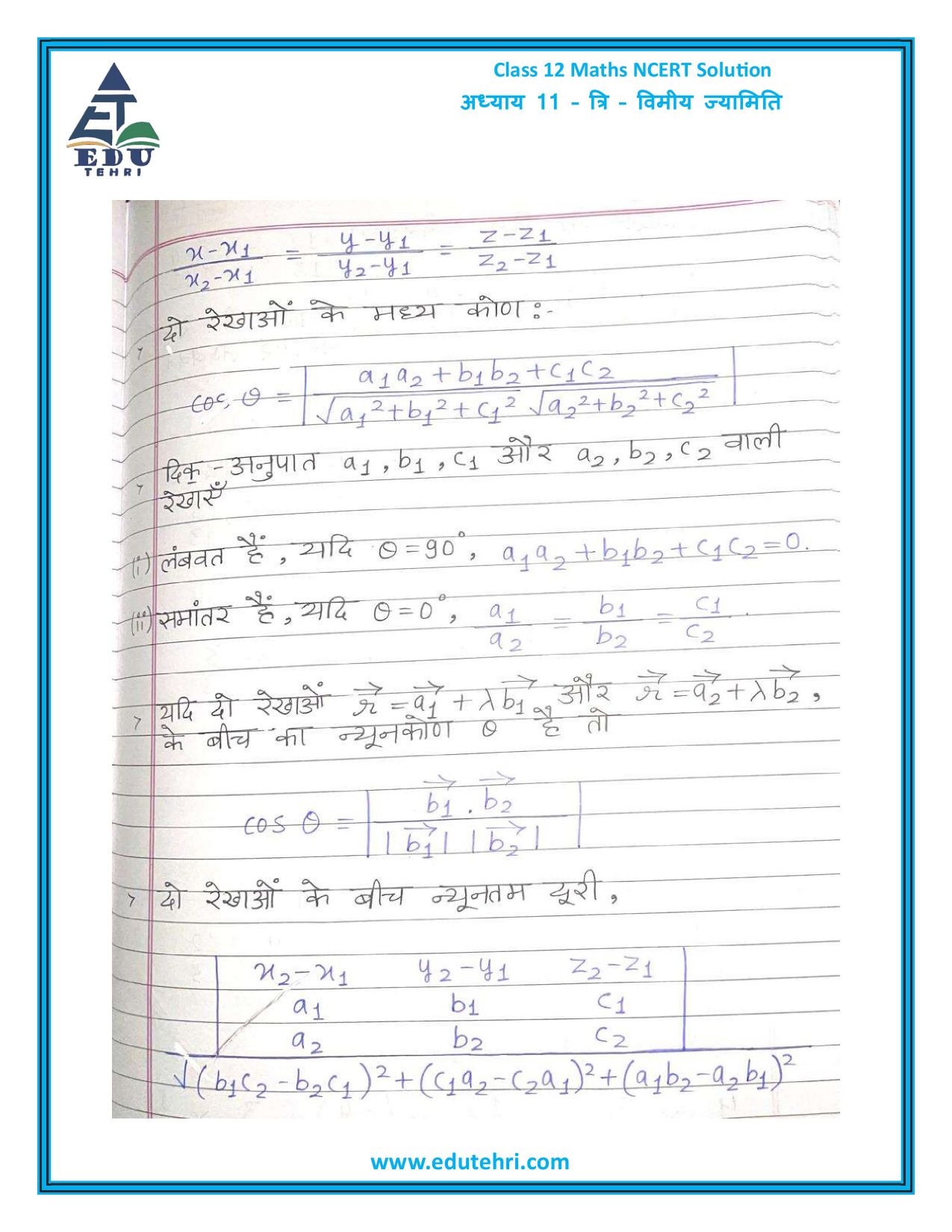
Equation of a Line Through Two Points
If a line passes through two points:
A(x_1, y_1, z_1), \quad B(x_2, y_2, z_2)
Then direction ratios are:
(x_2 - x_1, y_2 - y_1, z_2 - z_1)
Equation of the line:
\frac{x - x_1} {x_2 - x_1} = \frac{y - y_1} {y_2 - y_1} = \frac{z - z_1} {z_2 - z_1}
Angle Between Two Lines
If direction ratios of two lines are:
• Line 1: (a₁, b₁, c₁)
• Line 2: (a₂, b₂, c₂)
Then angle θ between them is given by:
\cos \theta = \frac{a_1a_2 + b_1b_2 + c_1c_2}{\sqrt{a_1^2 + b_1^2 + c_1^2}\sqrt{a_2^2 + b_2^2 + c_2^2}}
Skew Lines (Conceptual Topic)
Two lines are called skew lines if:
• They are not parallel
• They do not intersect
• They are not in the same plane
This topic is mostly asked as a theory-based or MCQ question.
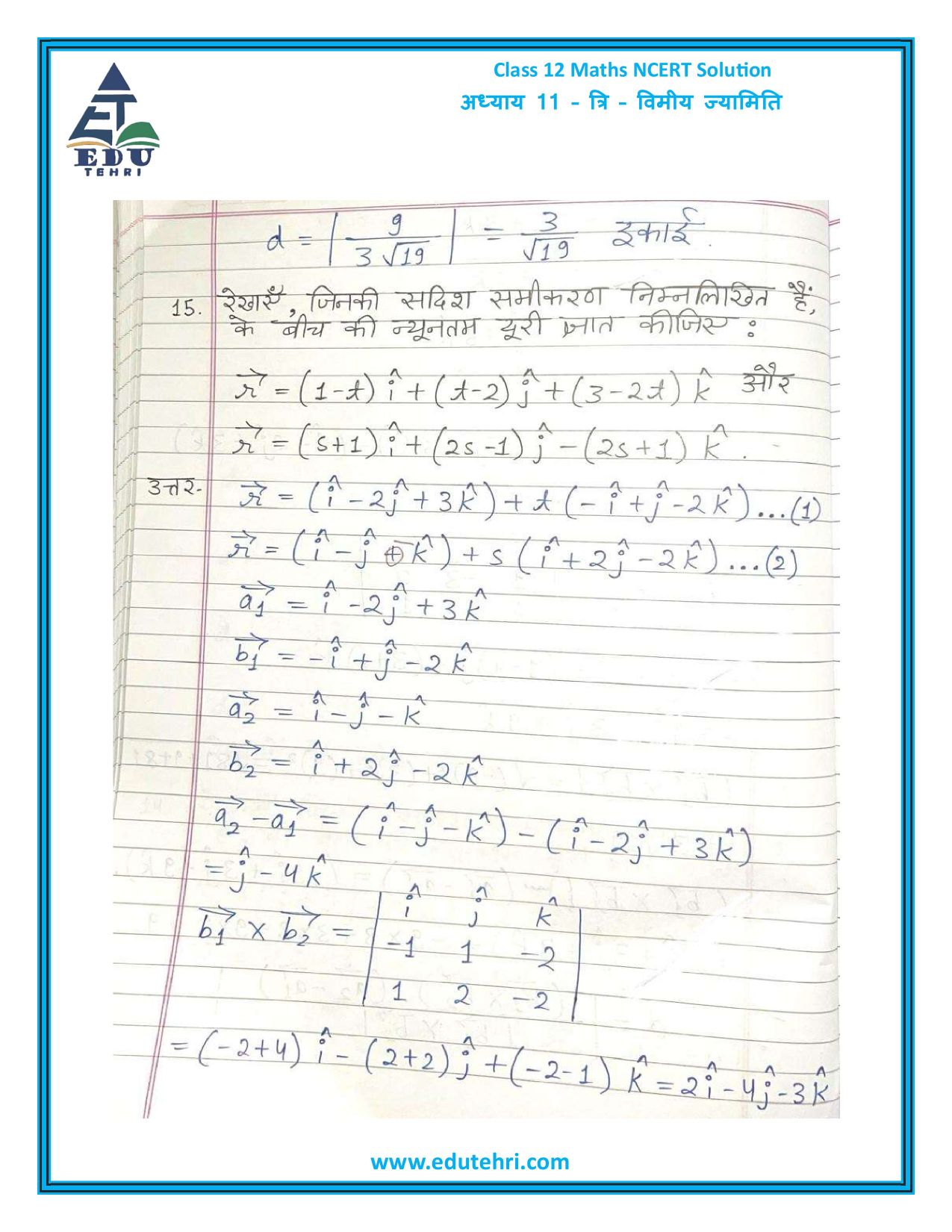
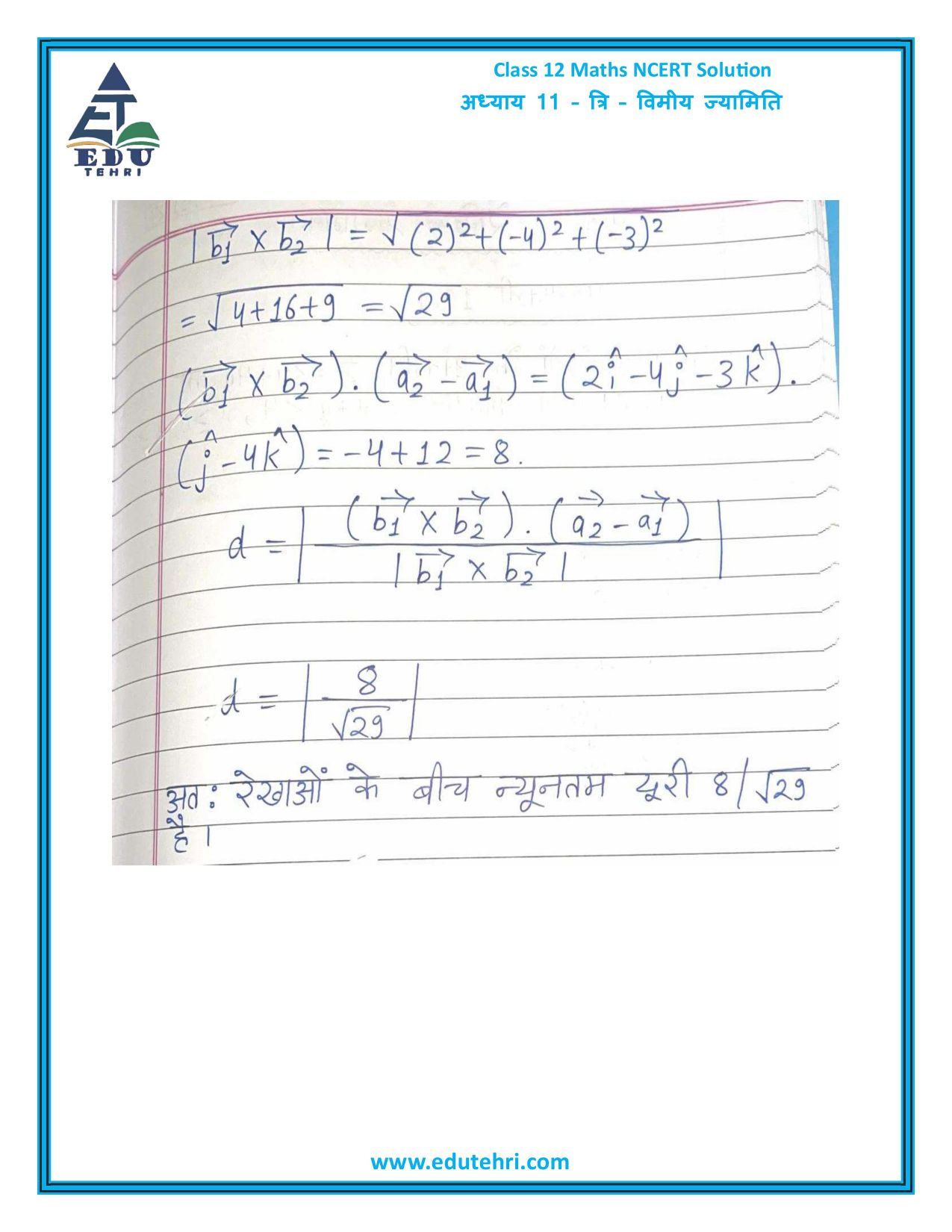
Shortest Distance Between Two Lines
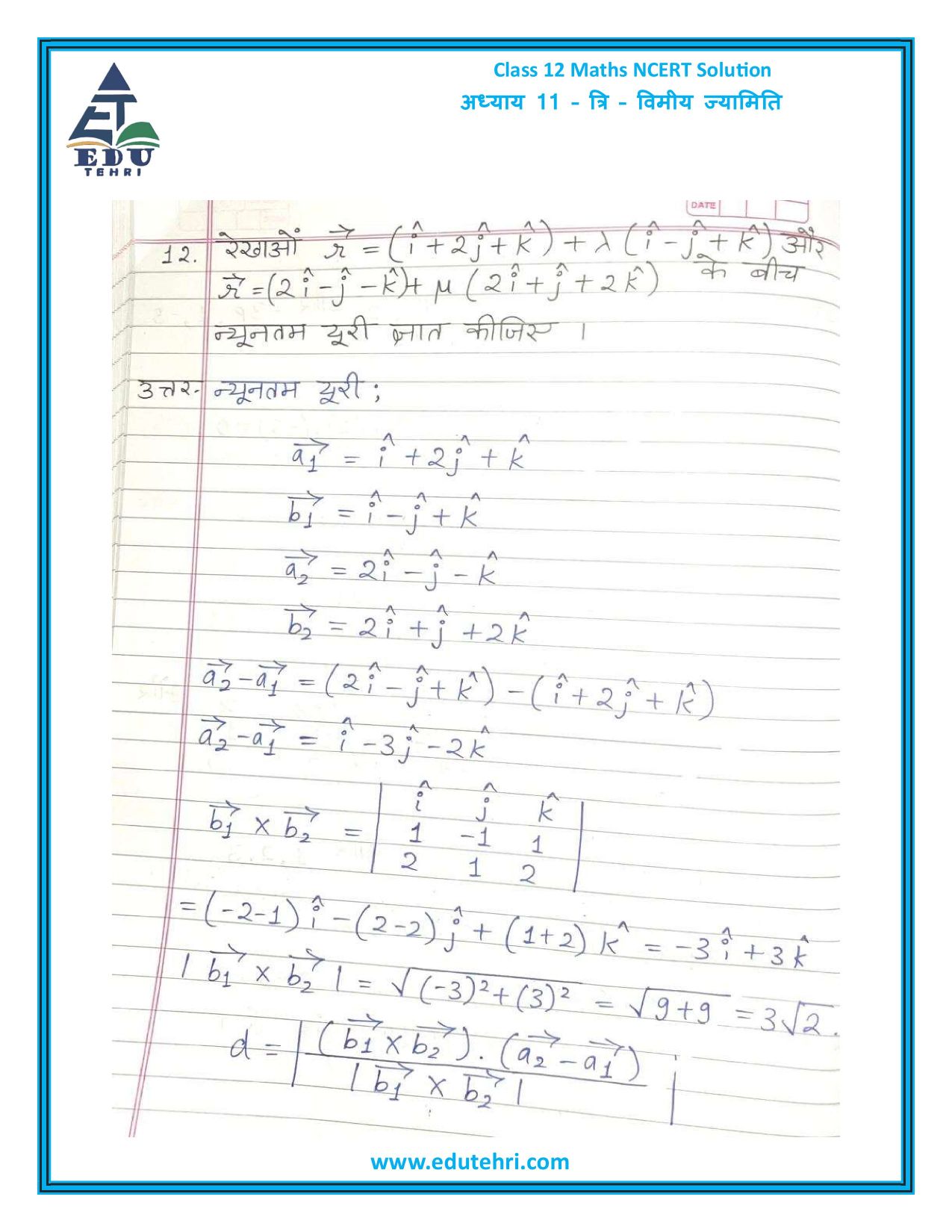
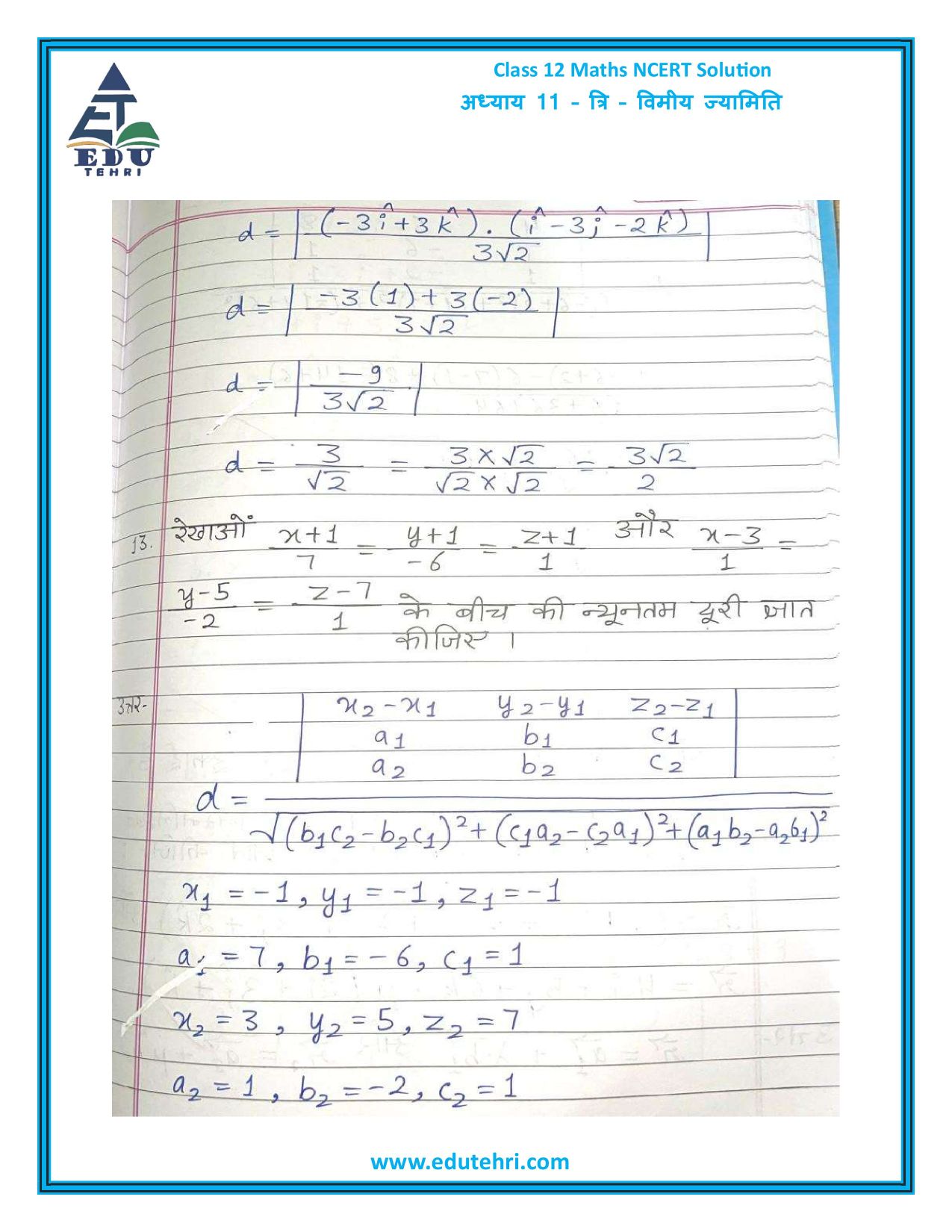
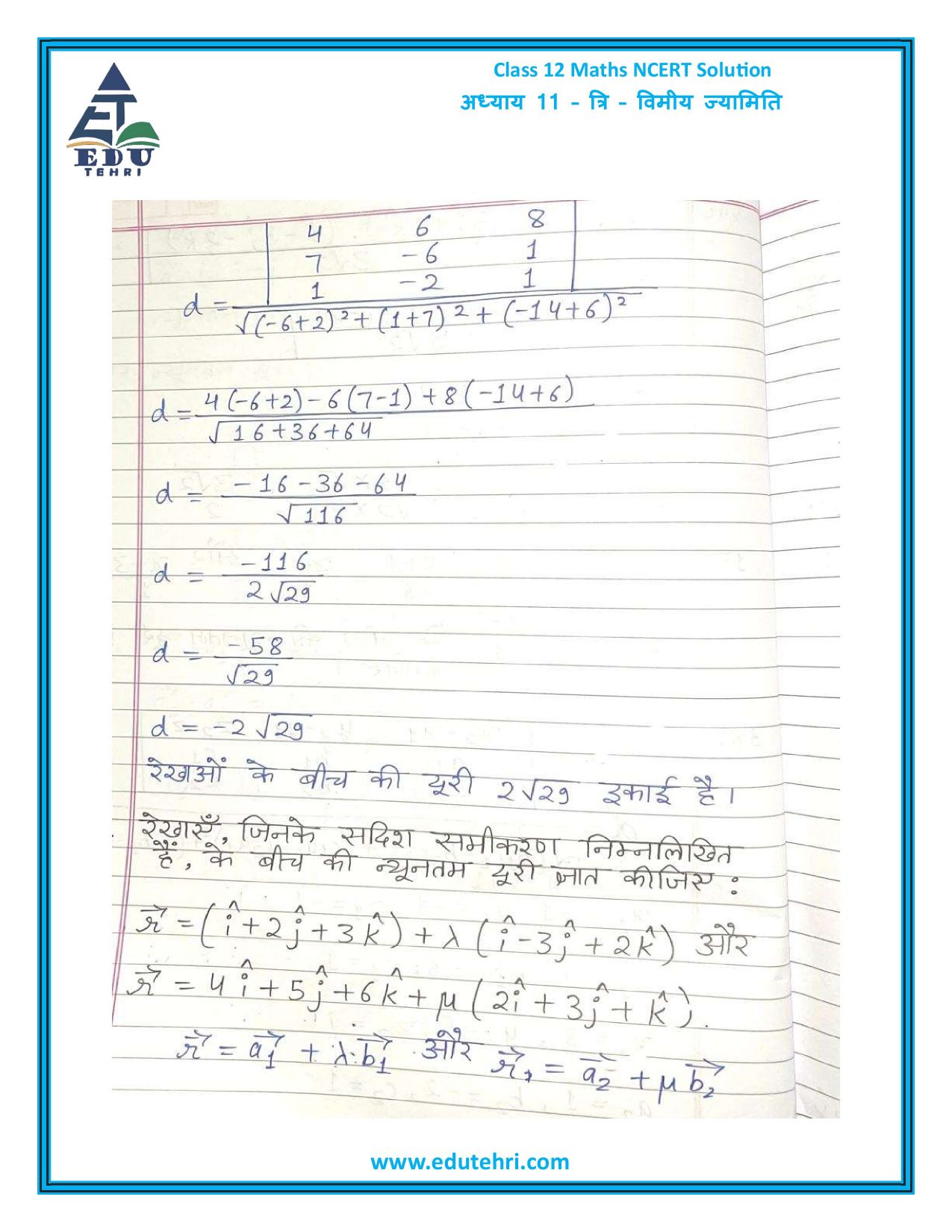
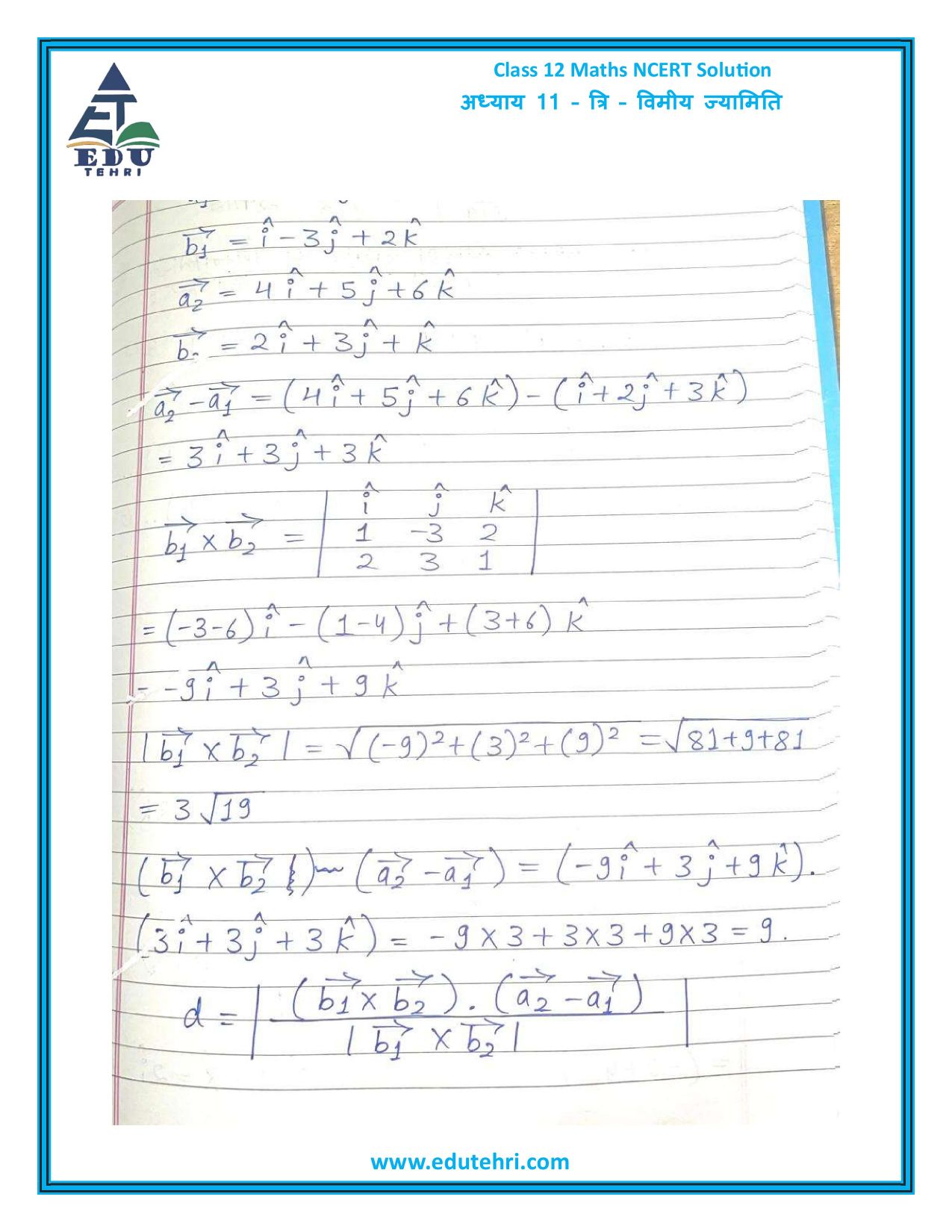
The shortest distance between two skew lines is given by:
\text{SD} = \frac{ | (\vec{b_1} - \vec{b_2}) \cdot (\vec{d_1} \times \vec{d_2}) | } {|\vec{d_1} \times \vec{d_2}|}
This formula is usually asked as a long answer (5 marks).
Important Formulas – Chapter 11
Download Important Formula - Free PDF
1. Distance between two points
2. Section formula (internal & external)
3. Mid-point formula
4. Vector and Cartesian form of line
5. Angle between two lines
6. Area of triangle using vectors
Learning formulas is very important for scoring.
Exercises in Chapter 11
NCERT Chapter 11 contains 2 exercises.
Exercise Details:
• Exercise 11.1 – Distance & section formula
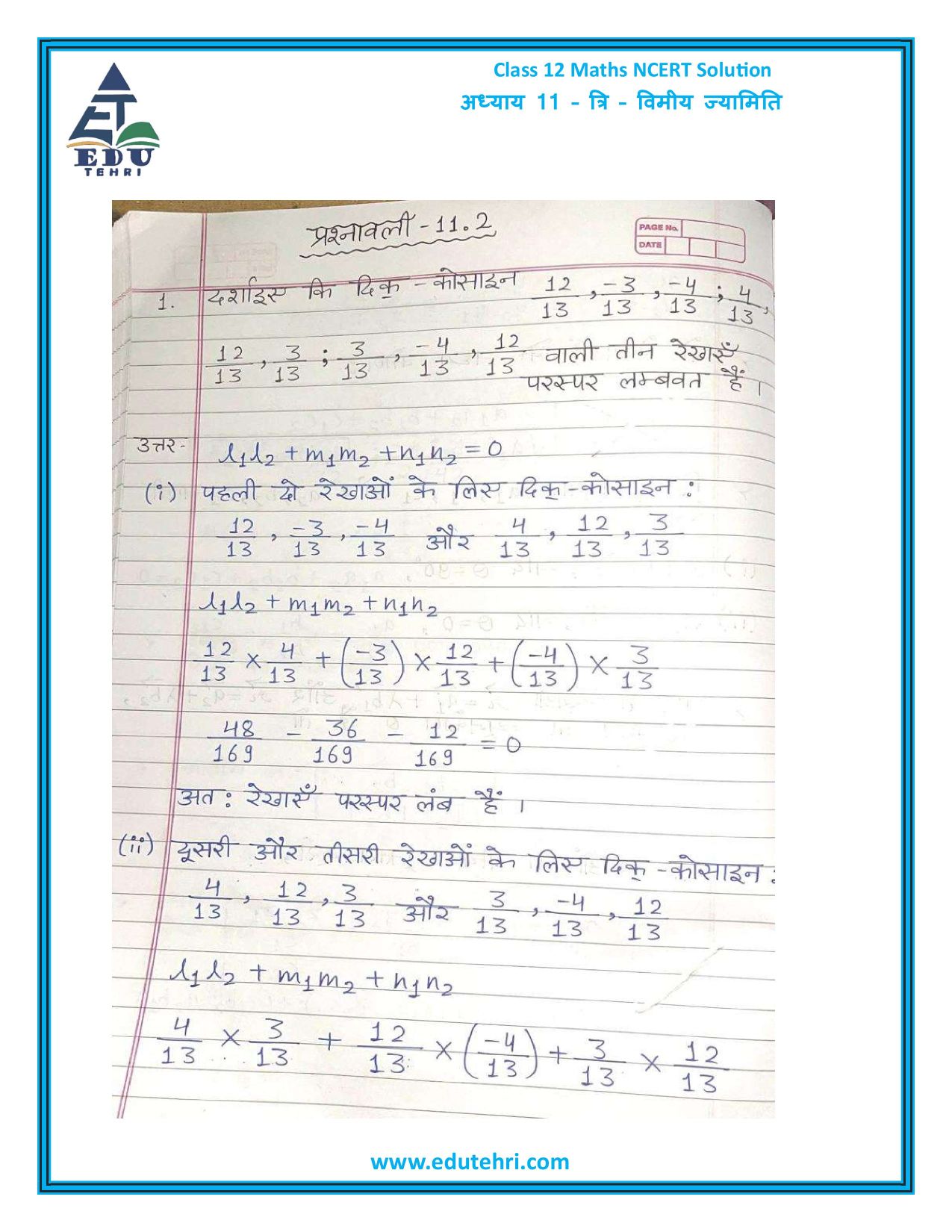
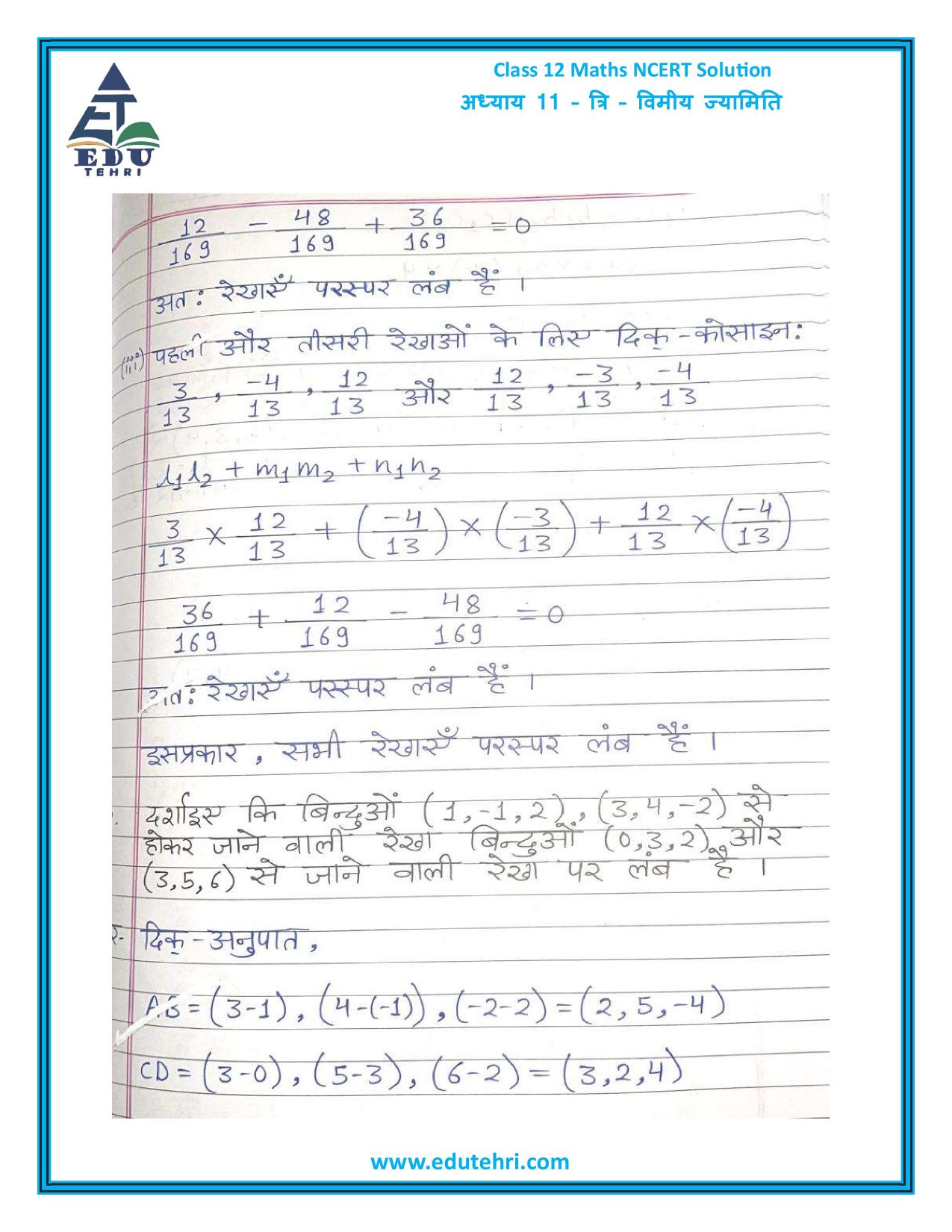
• Exercise 11.2 – Direction cosines & ratios
Exercises 10.3 and 10.4 are most important for boards.
Exam Weightage & Importance
• Usually 6–8 marks in board exams
• Repeated question patterns
• Highly scoring chapter
Edu Tehri – Free PDFs & Handwritten Notes
Edu Tehri provides complete Chapter 11 support, including:
• Free NCERT solution PDFs
• Handwritten notes
• Formula sheets
• Board-oriented practice questions
• Step-by-step explanations
Key Features of Chapter 11
• Formula-based chapter
• Closely linked with vectors
• Very scoring if practiced
• Important for competitive exams
Frequently Asked Questions
Q1. Why is 3D Geometry important in Class 12?
Because it has high weightage and direct formula-based questions.
Q2. Is NCERT enough for Chapter 11?
Yes, NCERT questions are fully sufficient for board exams.
Q3. Which topic is most important?
Equation of a line and shortest distance between lines.
Q4. How to score full marks?
Learn formulas, practice NCERT, and avoid calculation errors
Classs- 12th Mathematics NCERT Solutions All Chapters - Hand Written Notes | Free download PDF's | 2026-2027