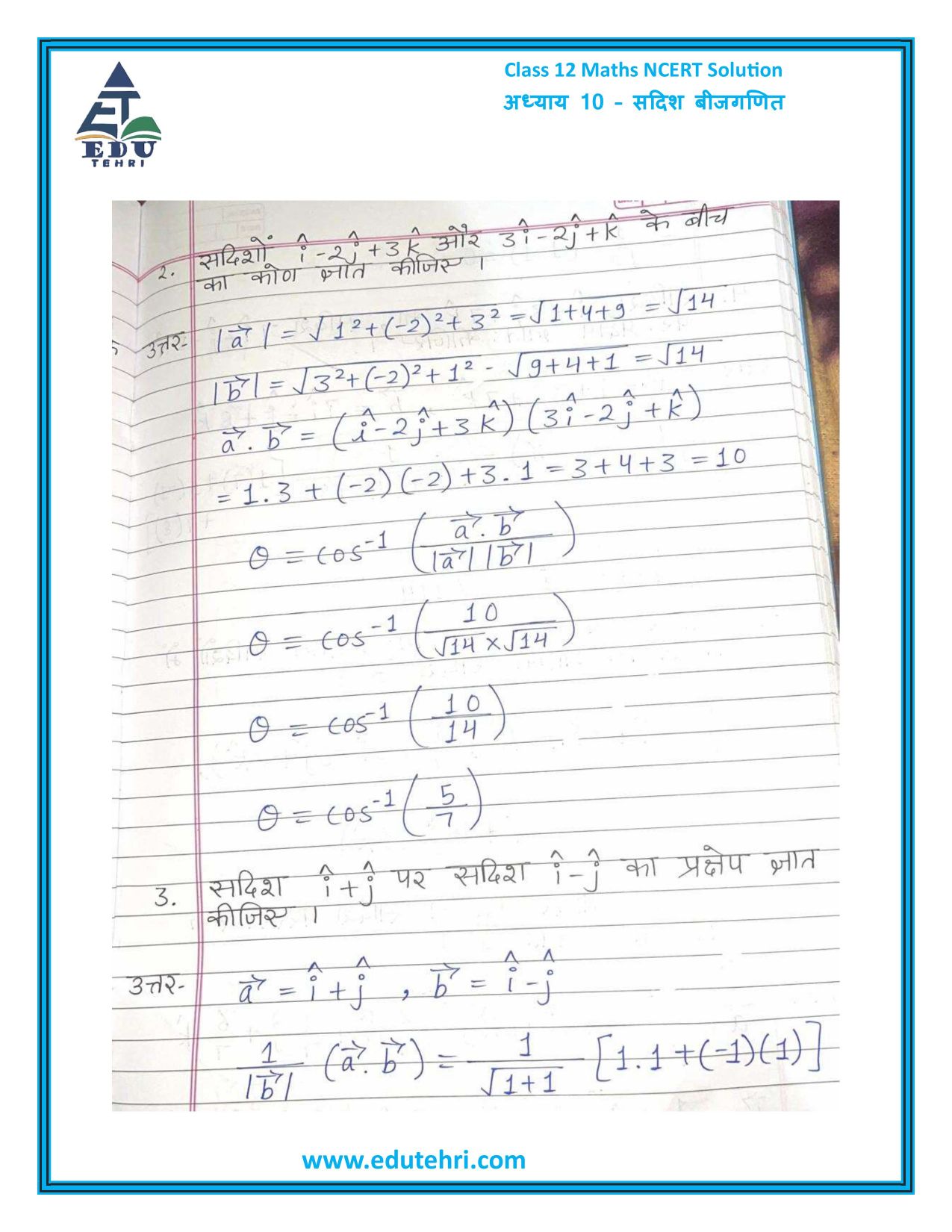
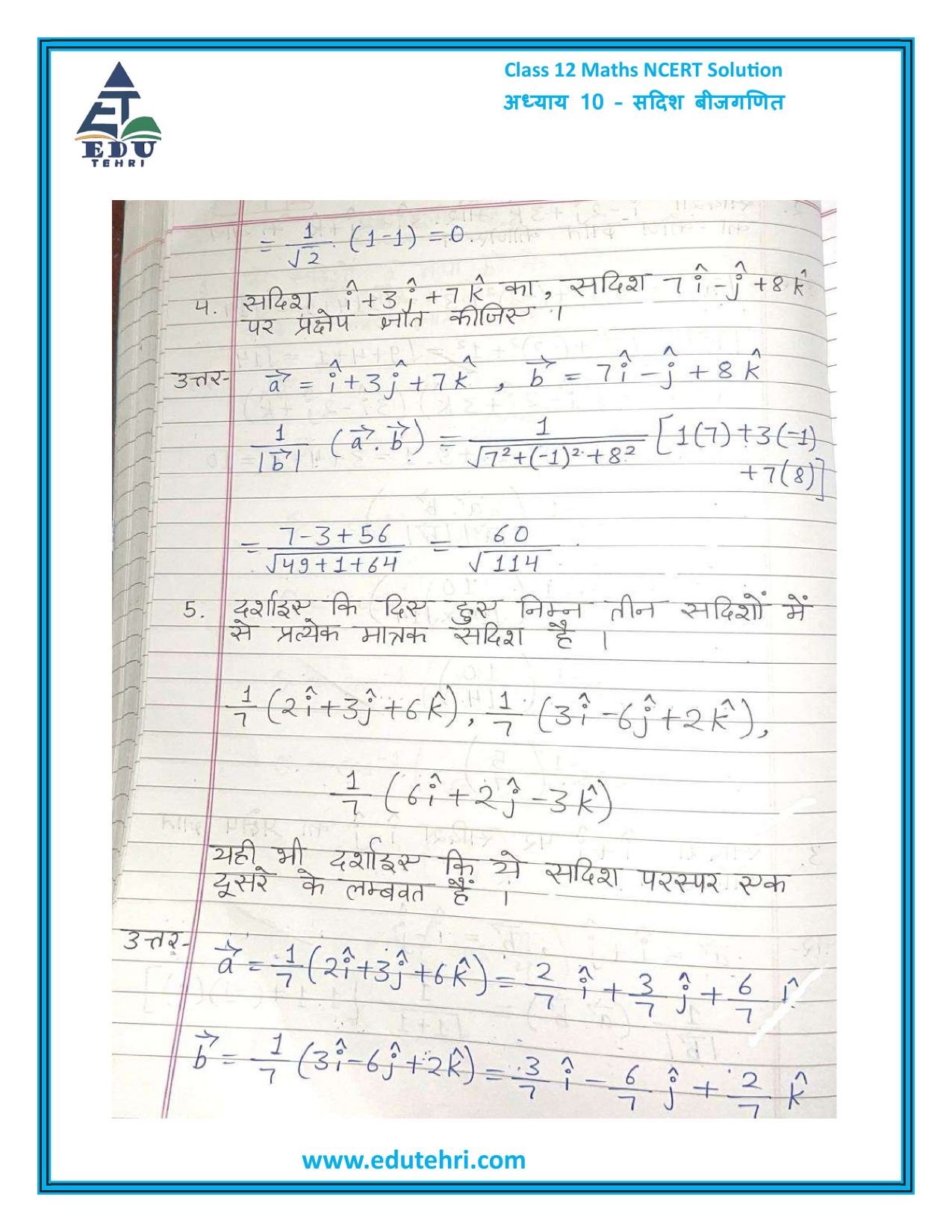
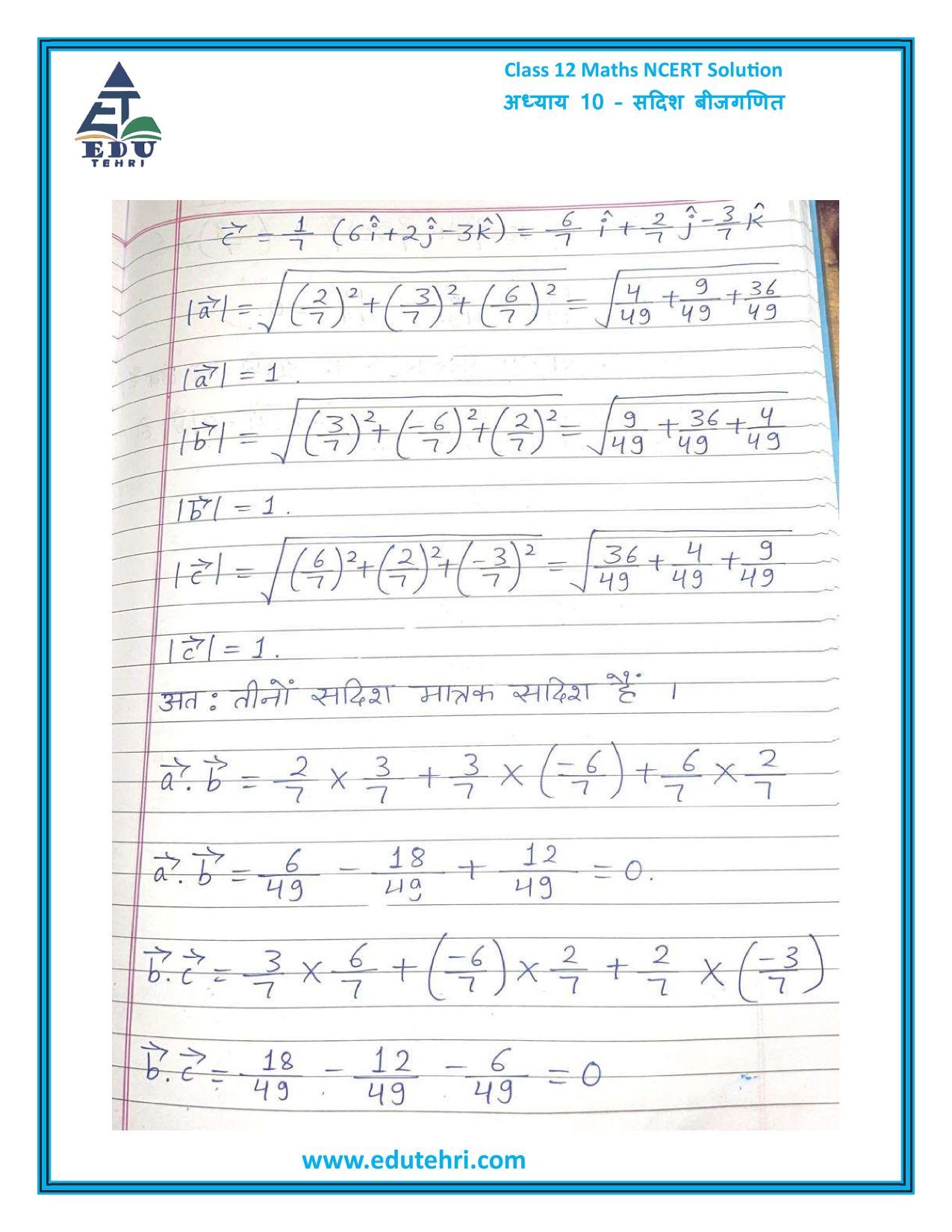
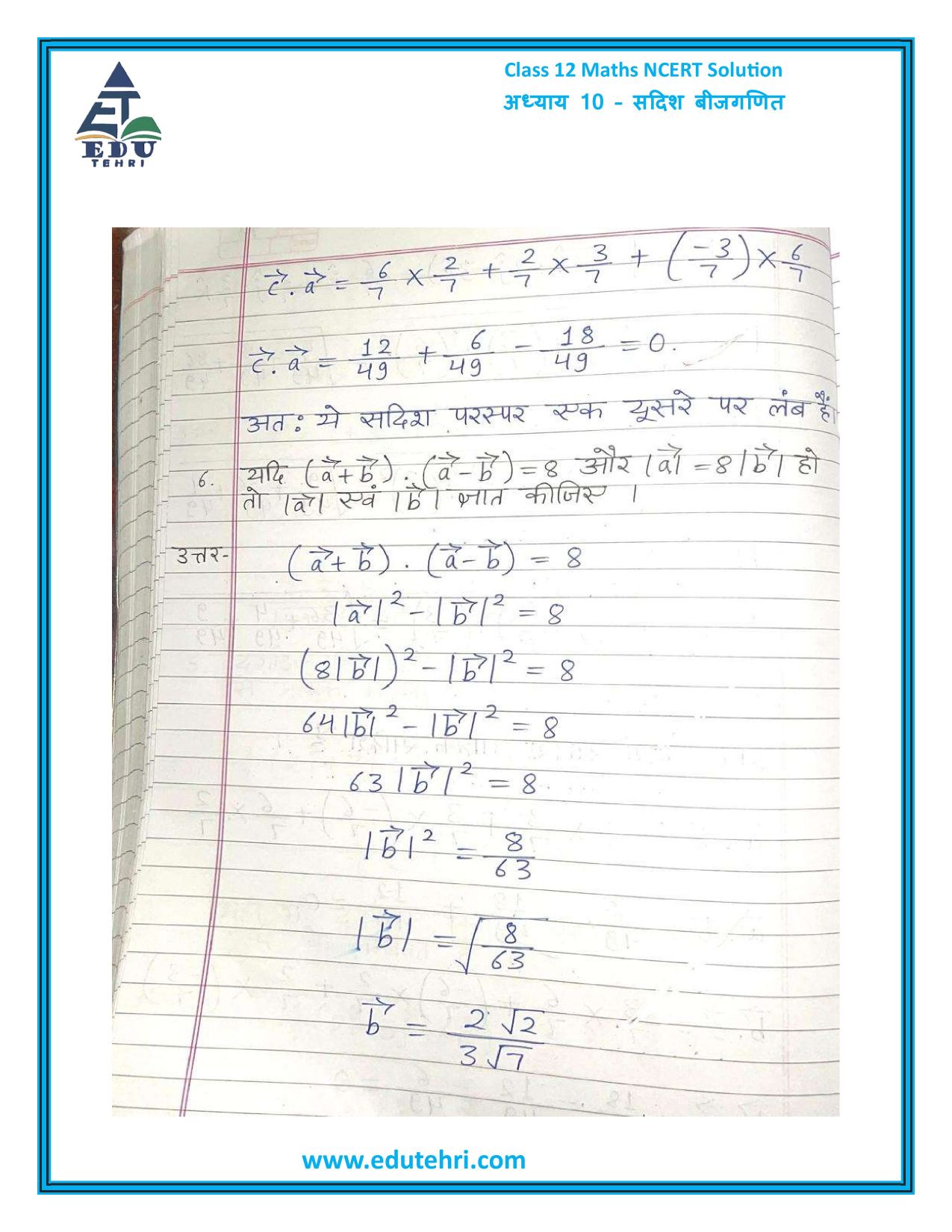
Class 12 Maths Chapter 10 – Vector Algebra NCERT Solutions – FREE PDF Download| Hand – Written Notes
Chapter 10 Vector Algebra is one of the most important chapters of Class 12 Mathematics. This chapter introduces vectors, which are quantities having both magnitude and direction. Vector algebra is widely used in physics, engineering, mechanics, and higher mathematics.
This chapter builds the foundation for Chapter 11 (Three-Dimensional Geometry), so understanding vectors clearly is very important. At Edu Tehri, this chapter is explained with easy language, diagrams, formulas, solved examples, handwritten notes, and free PDFs.
What Is a Vector?
A vector is a quantity that has:
• Magnitude (size or value)
• Direction
Examples of vector quantities:
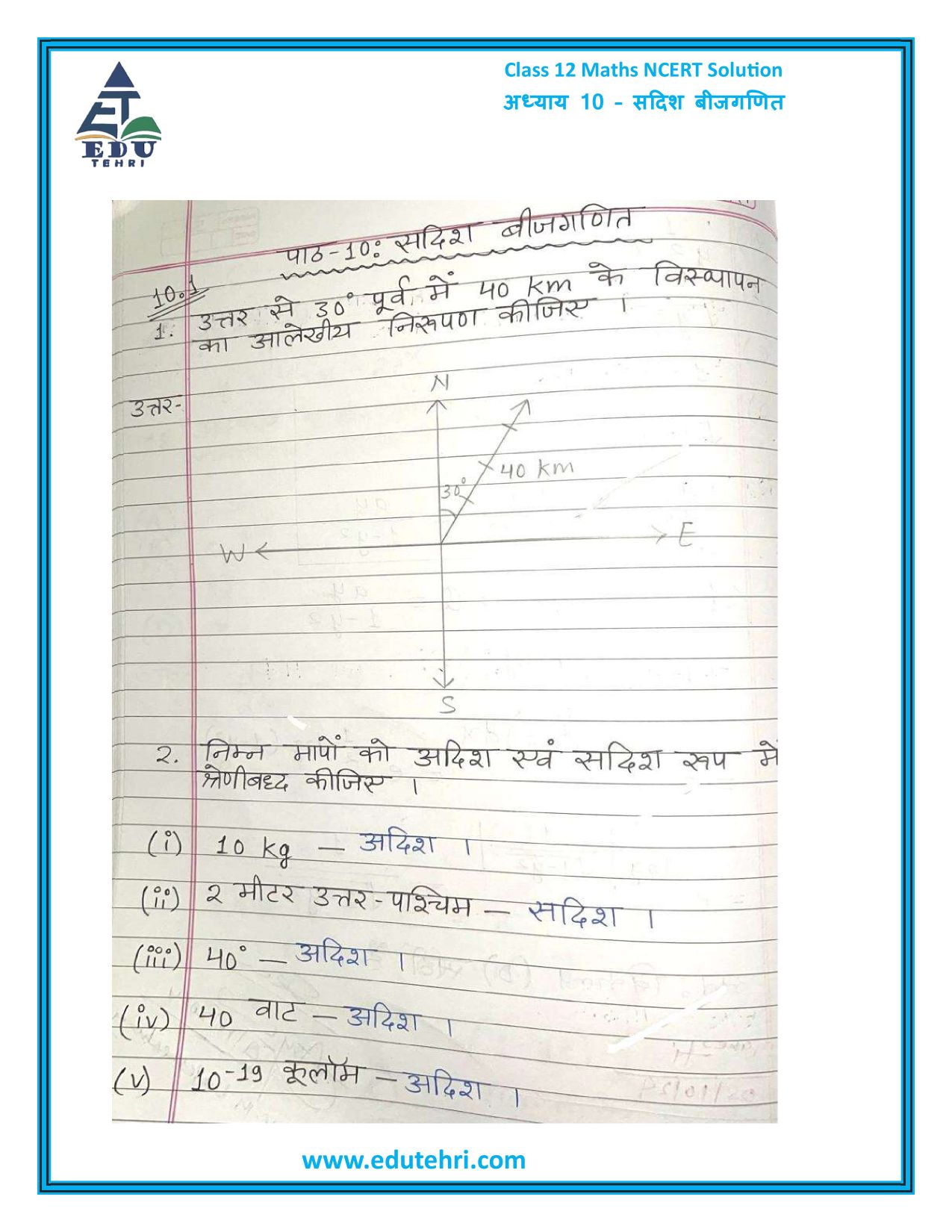
• Displacement
• Velocity
• Force
Examples of scalar quantities (only magnitude):
• Distance
• Speed
• Mass
Scalars have no direction, but vectors always have direction.
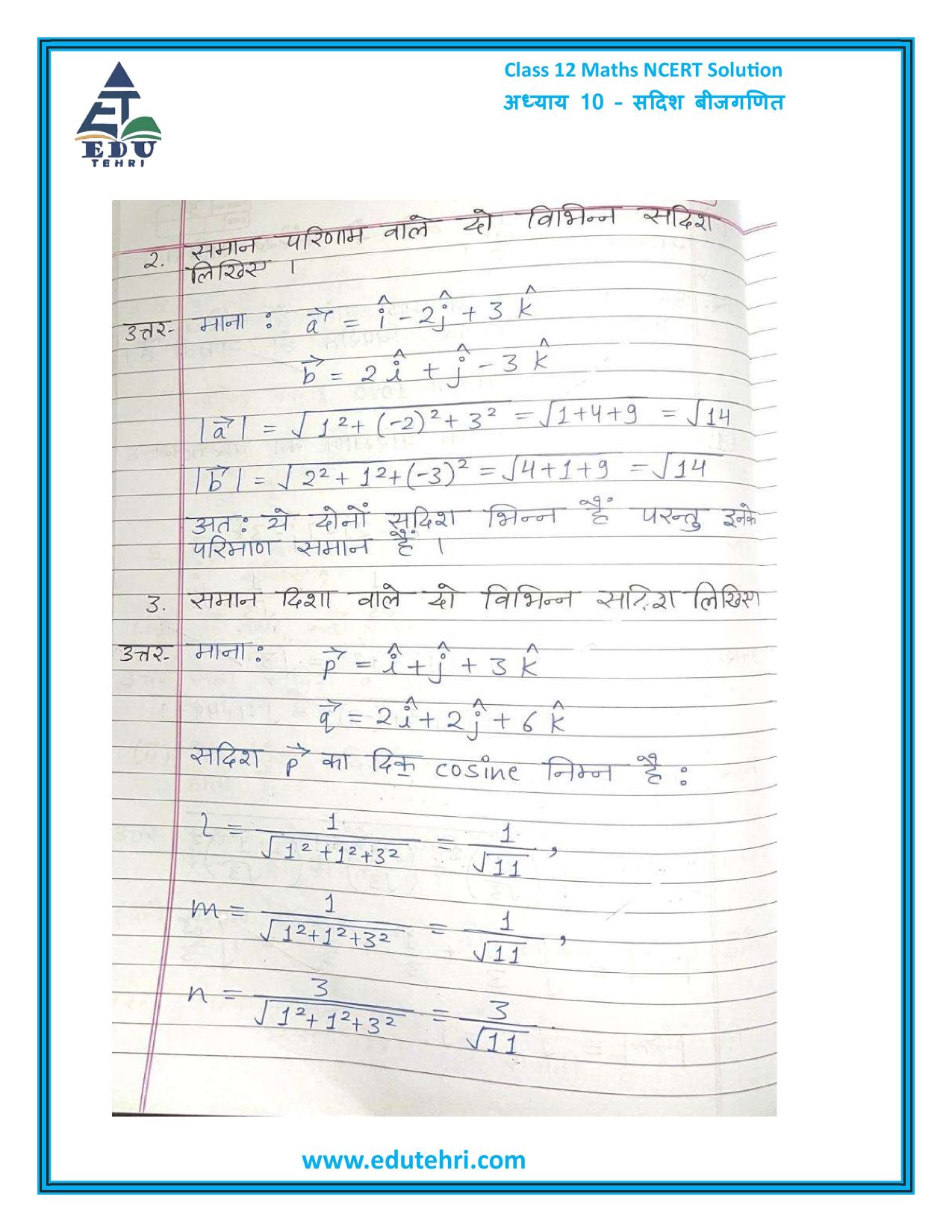
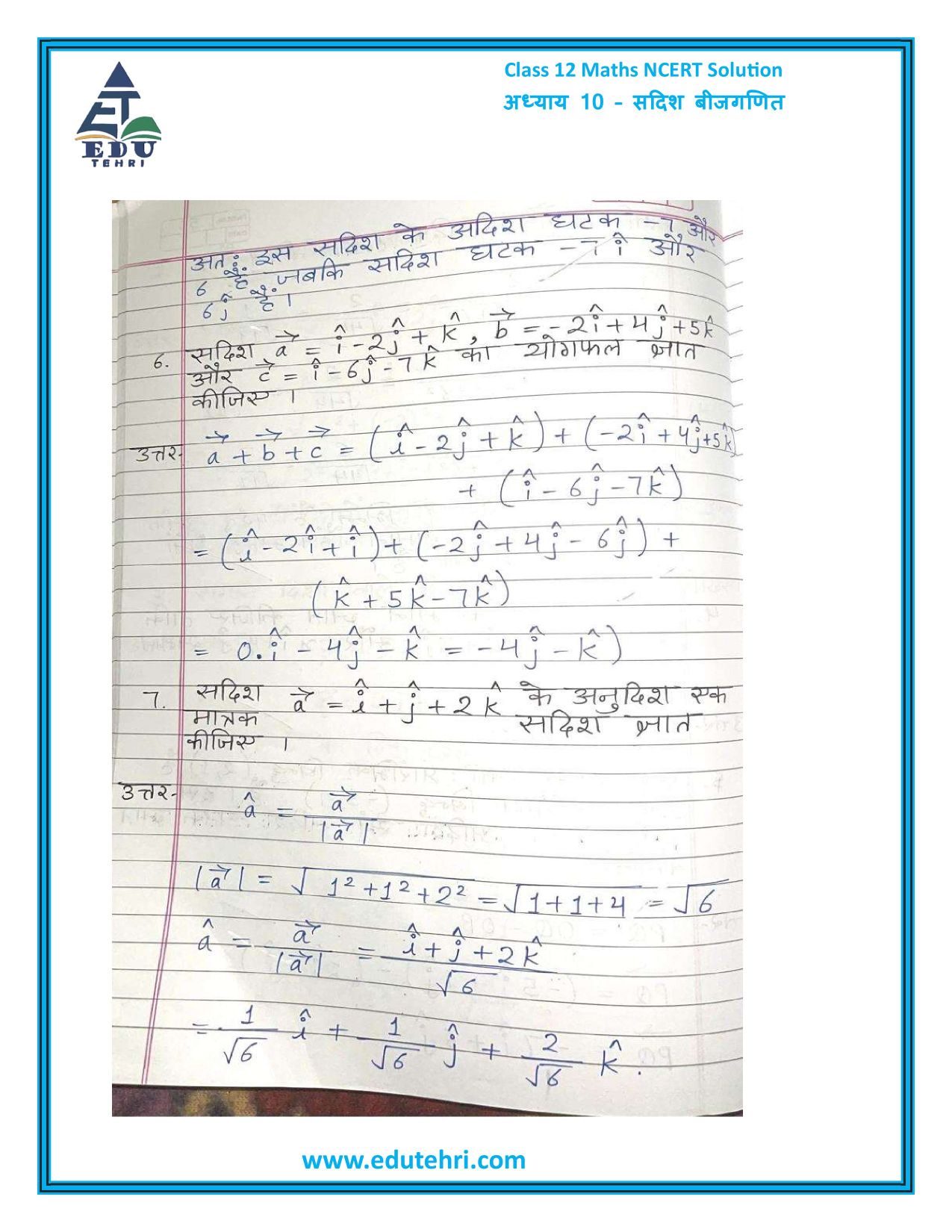
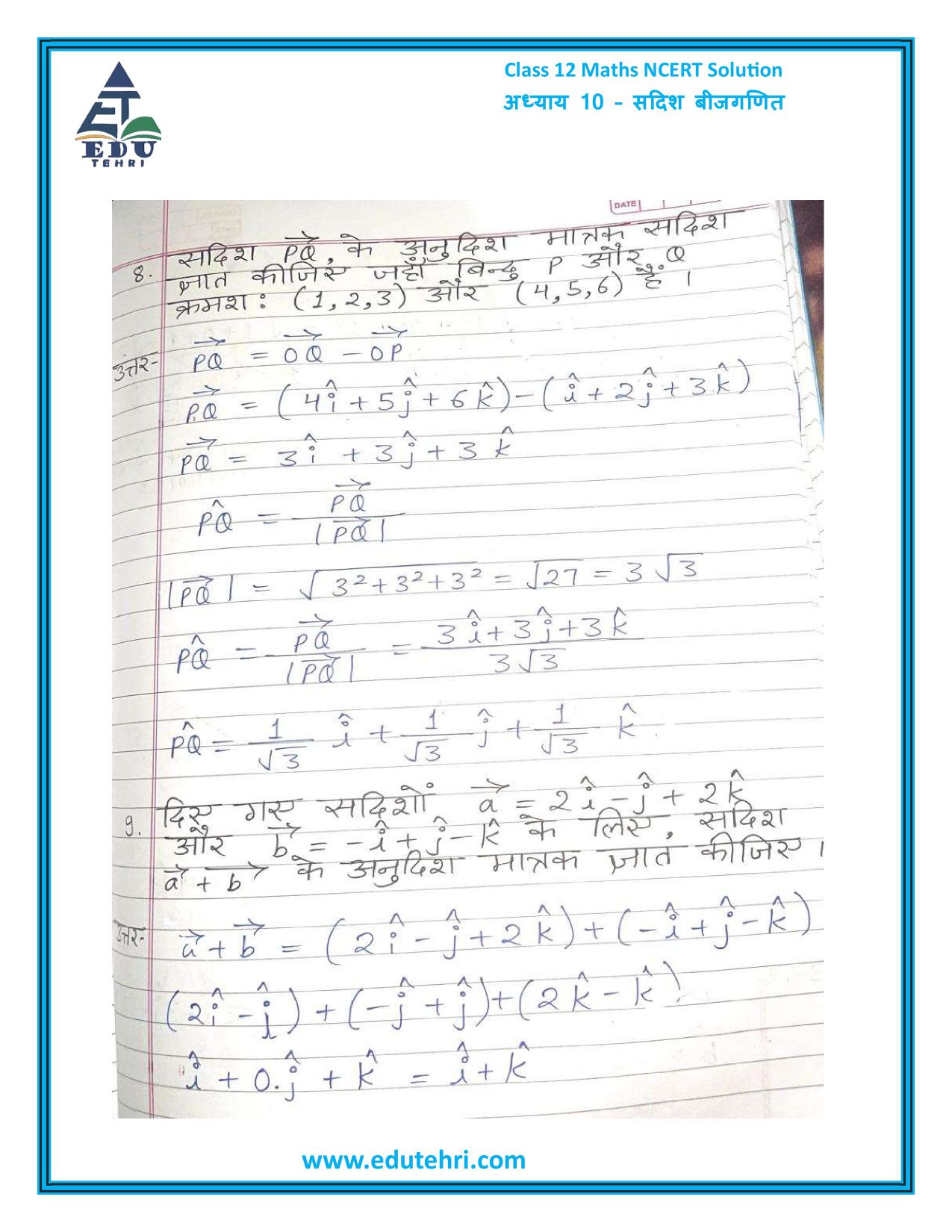
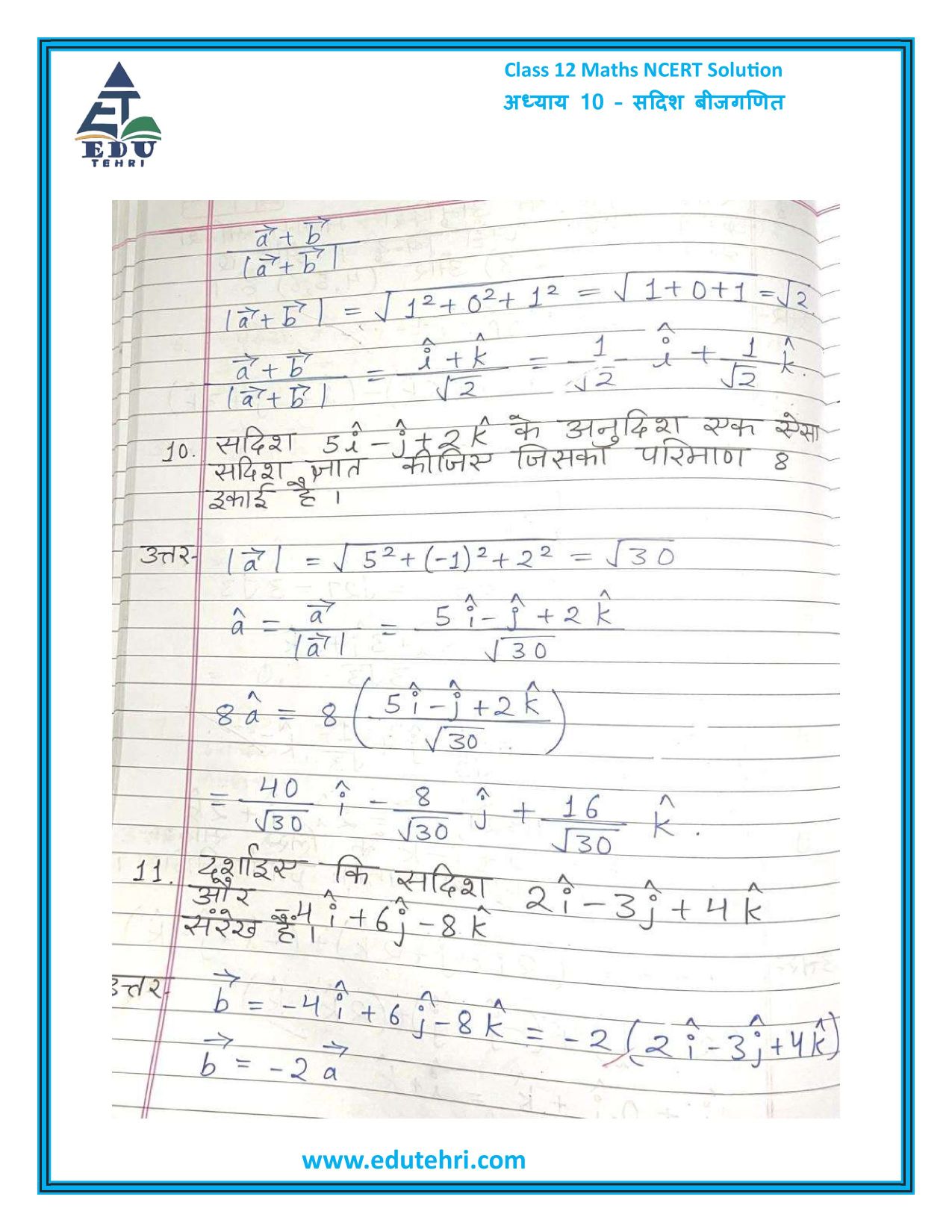
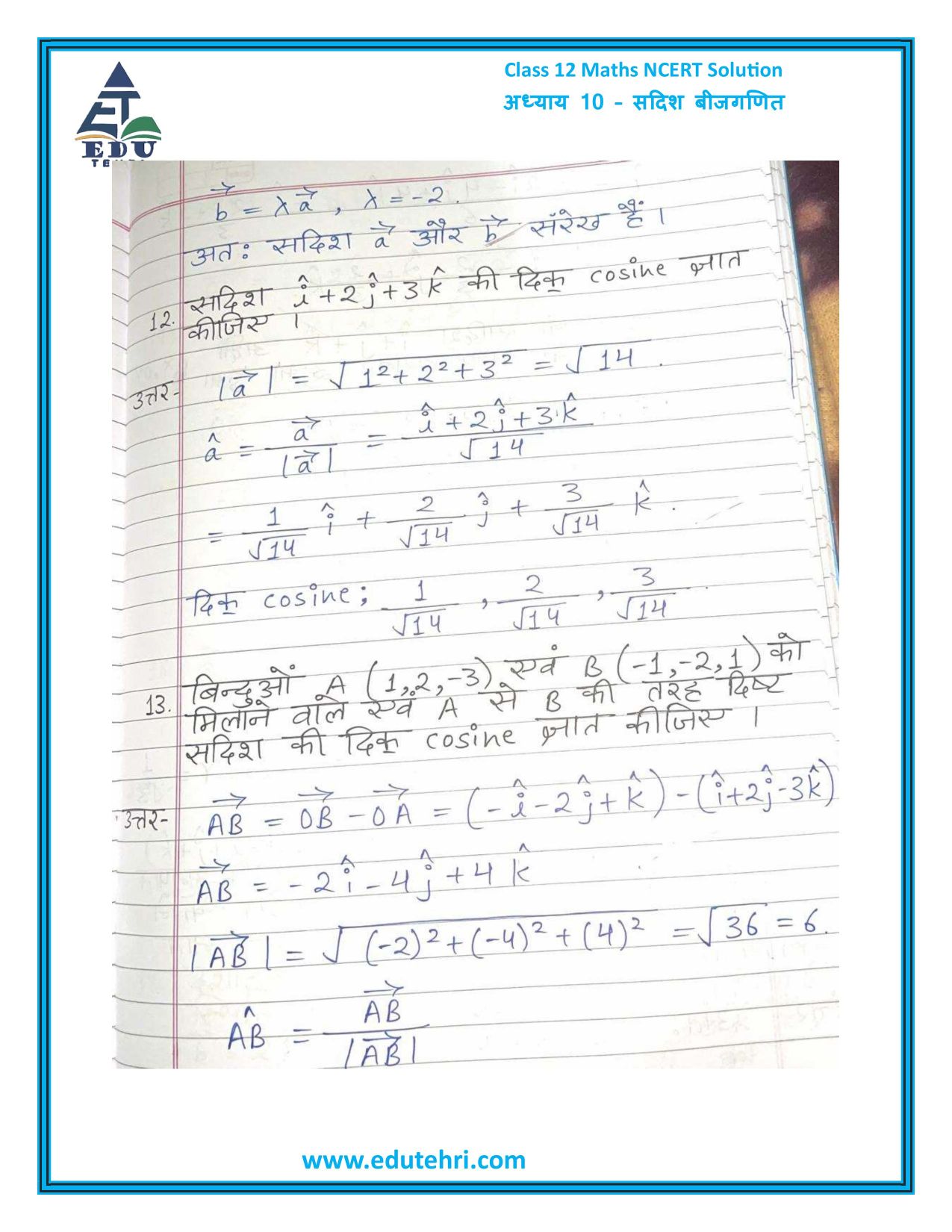
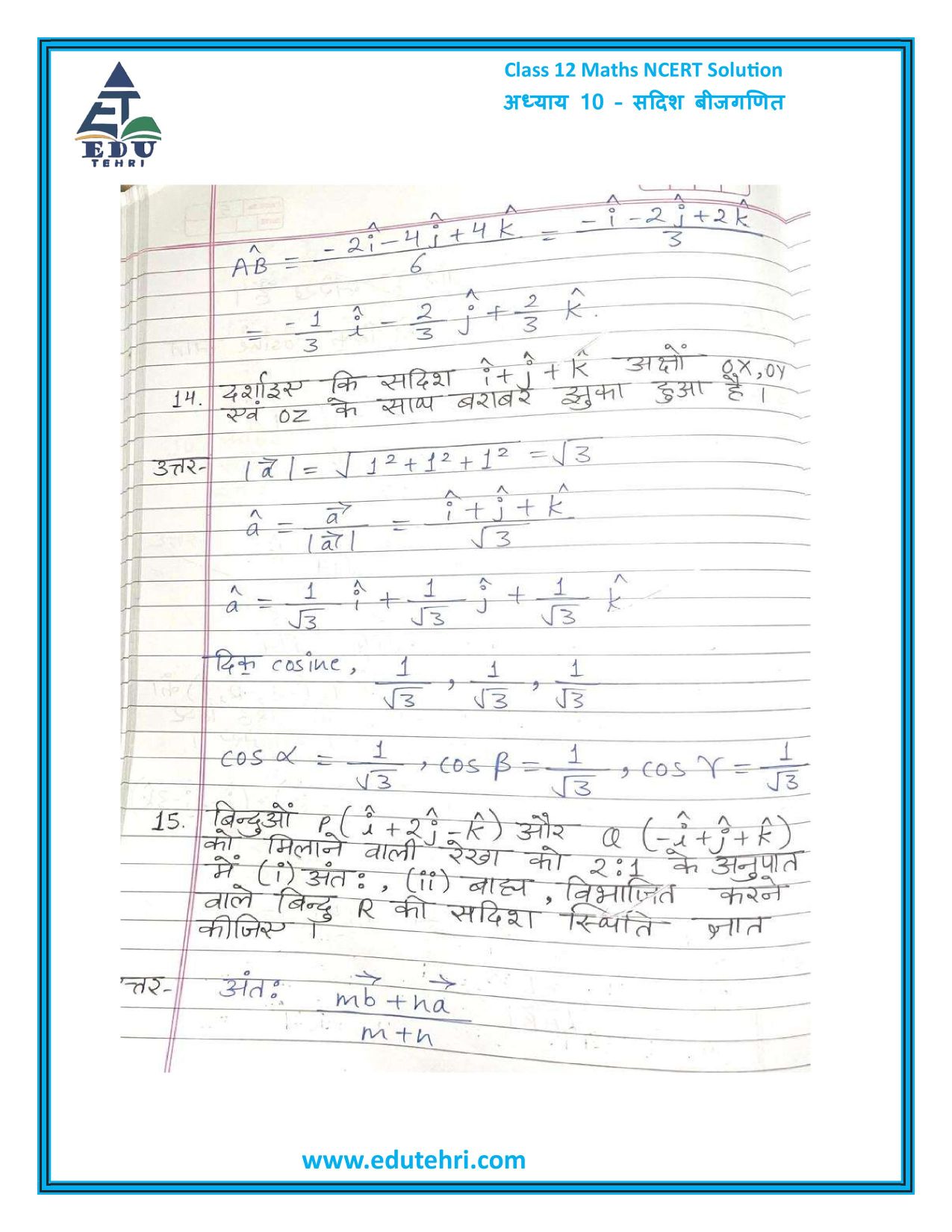
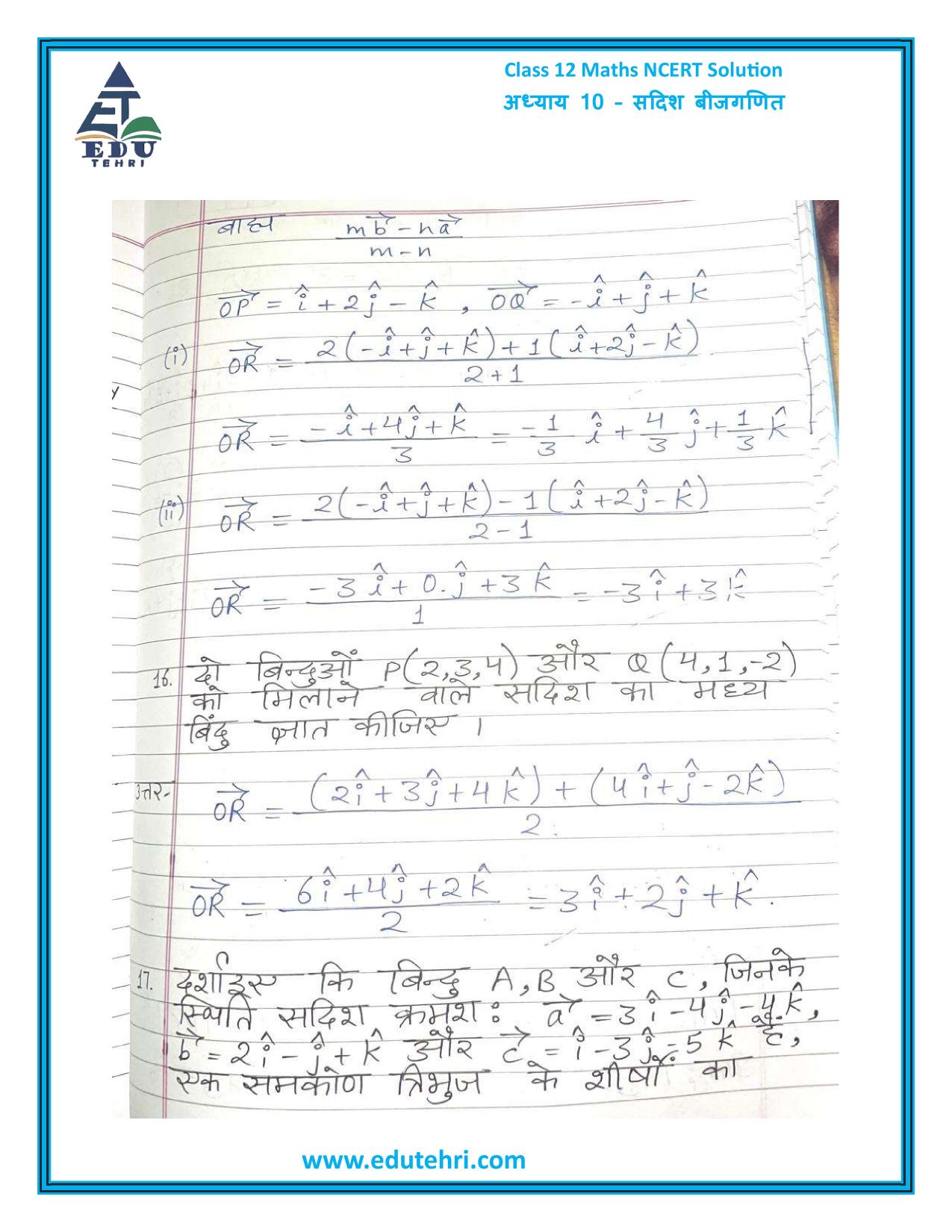
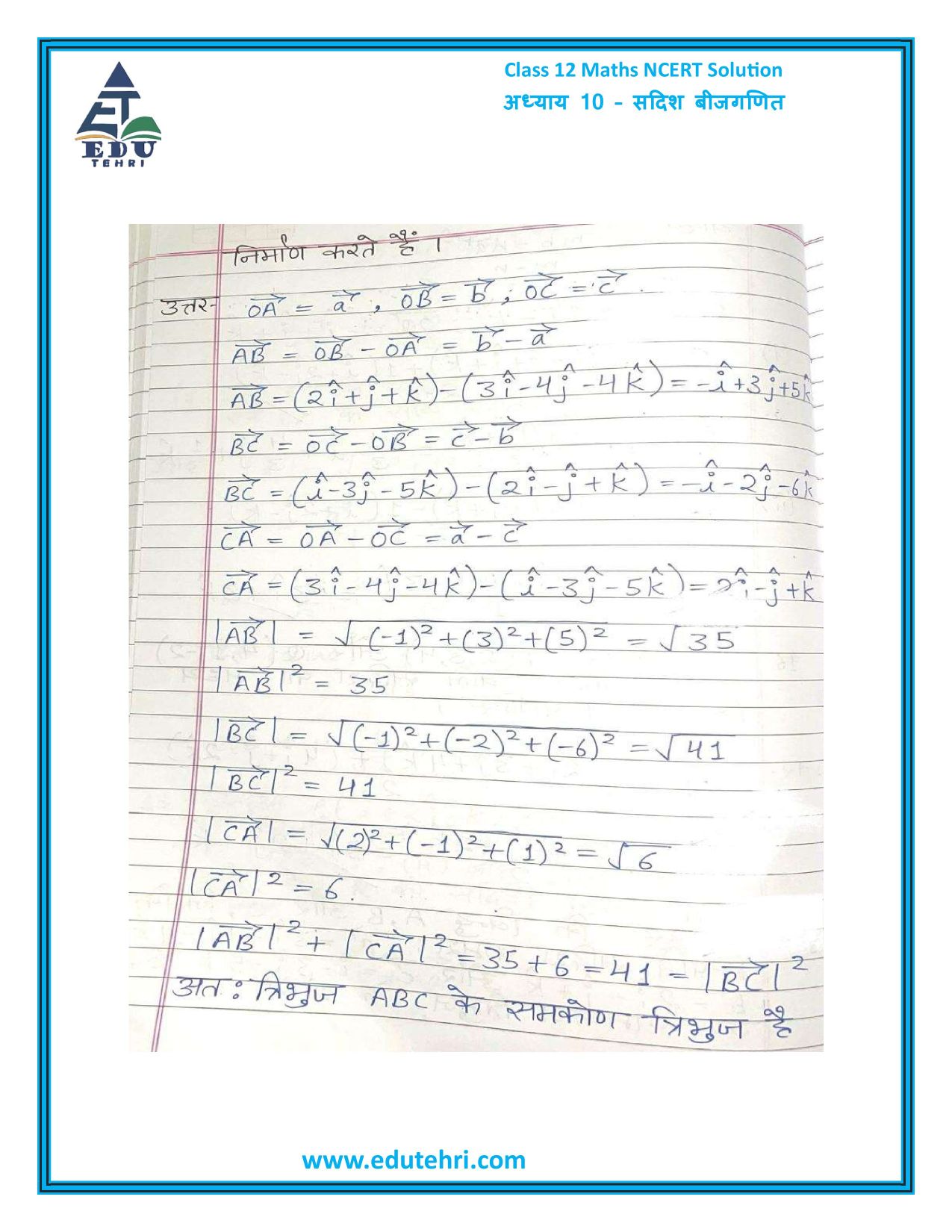
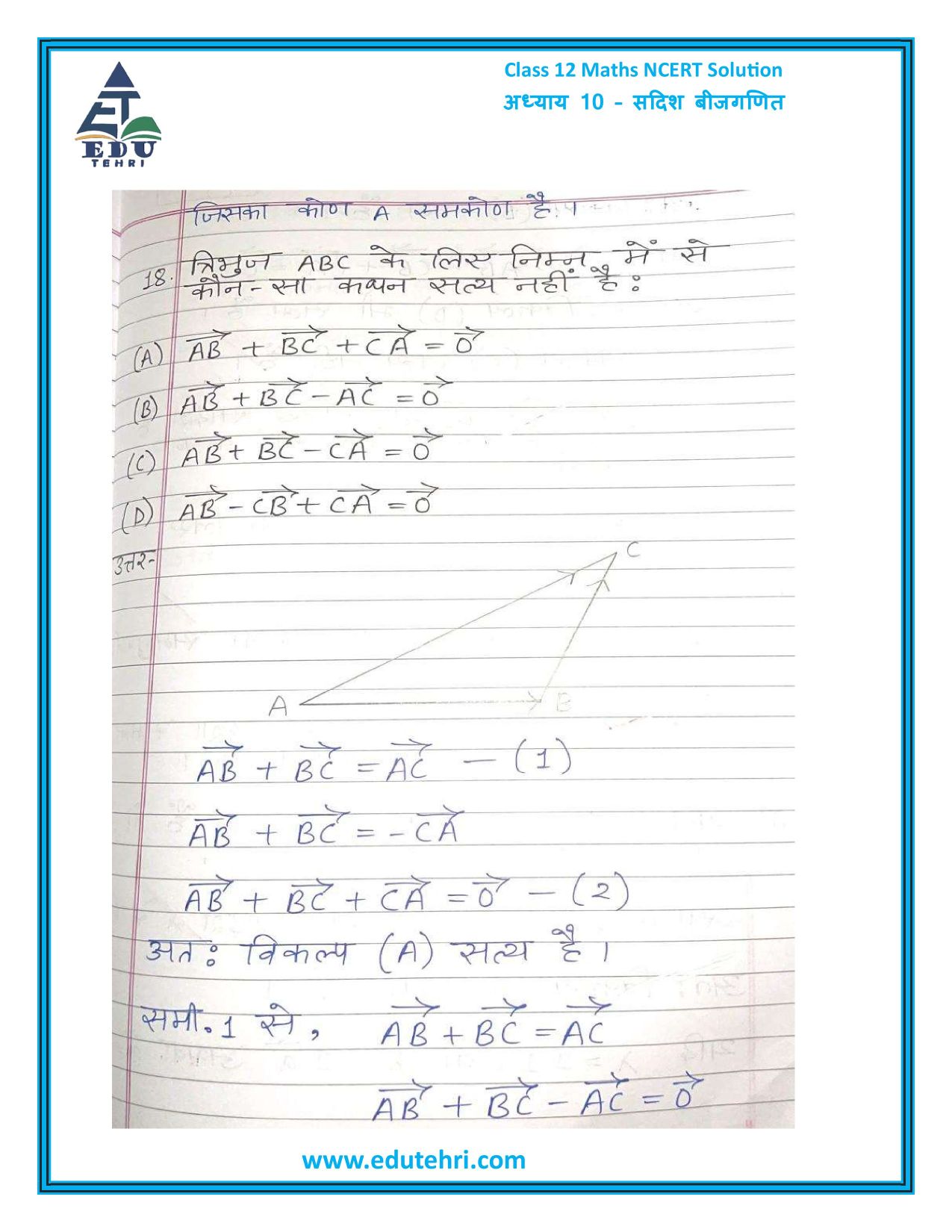
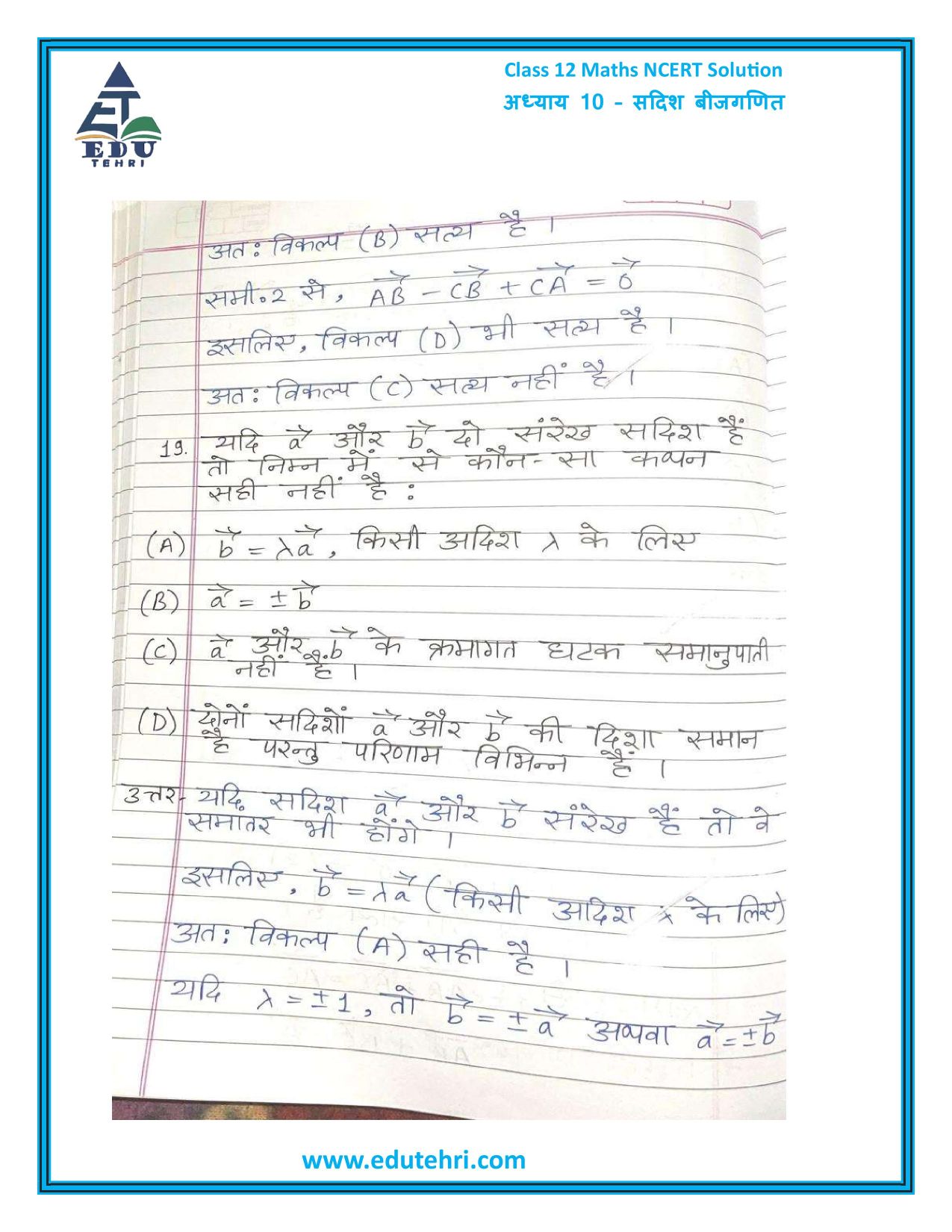
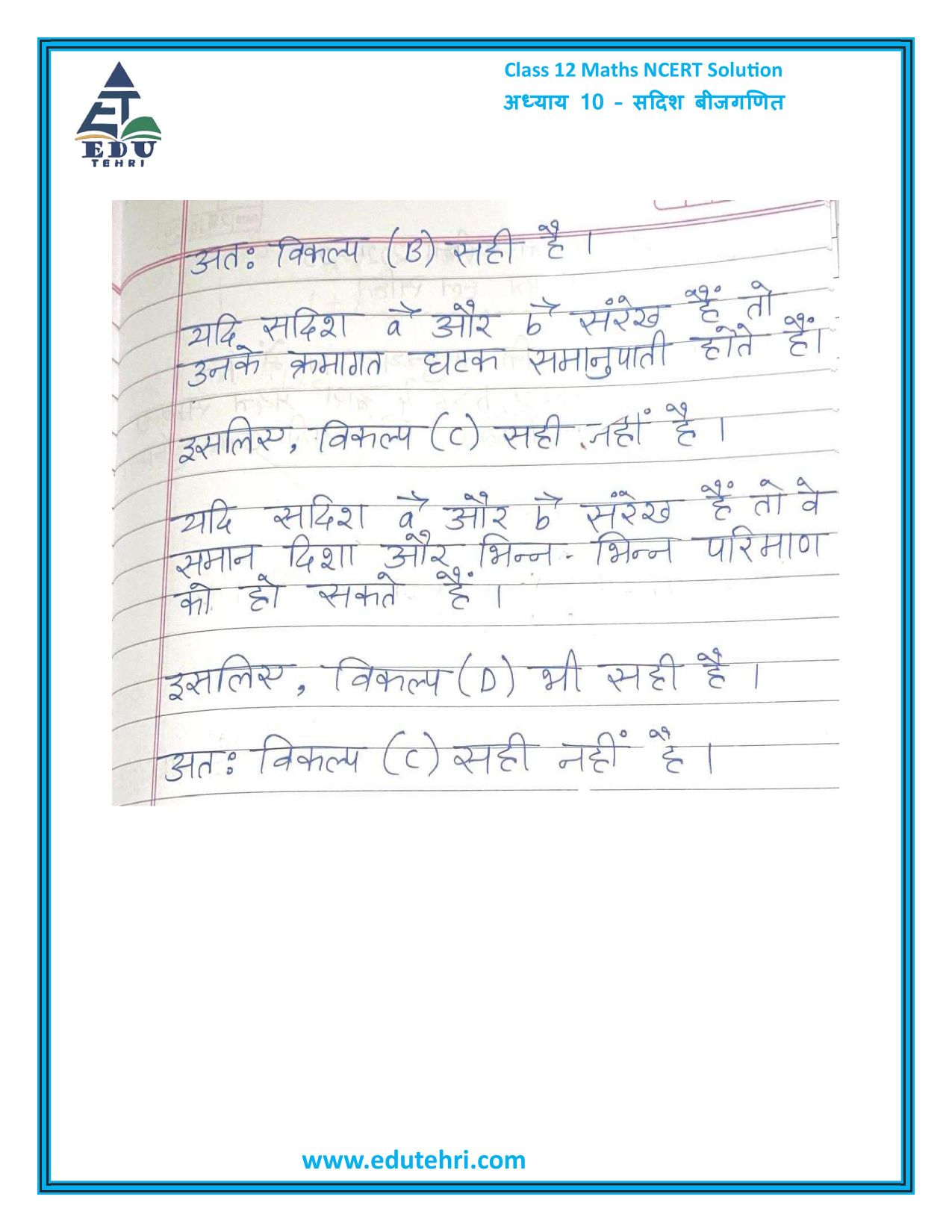
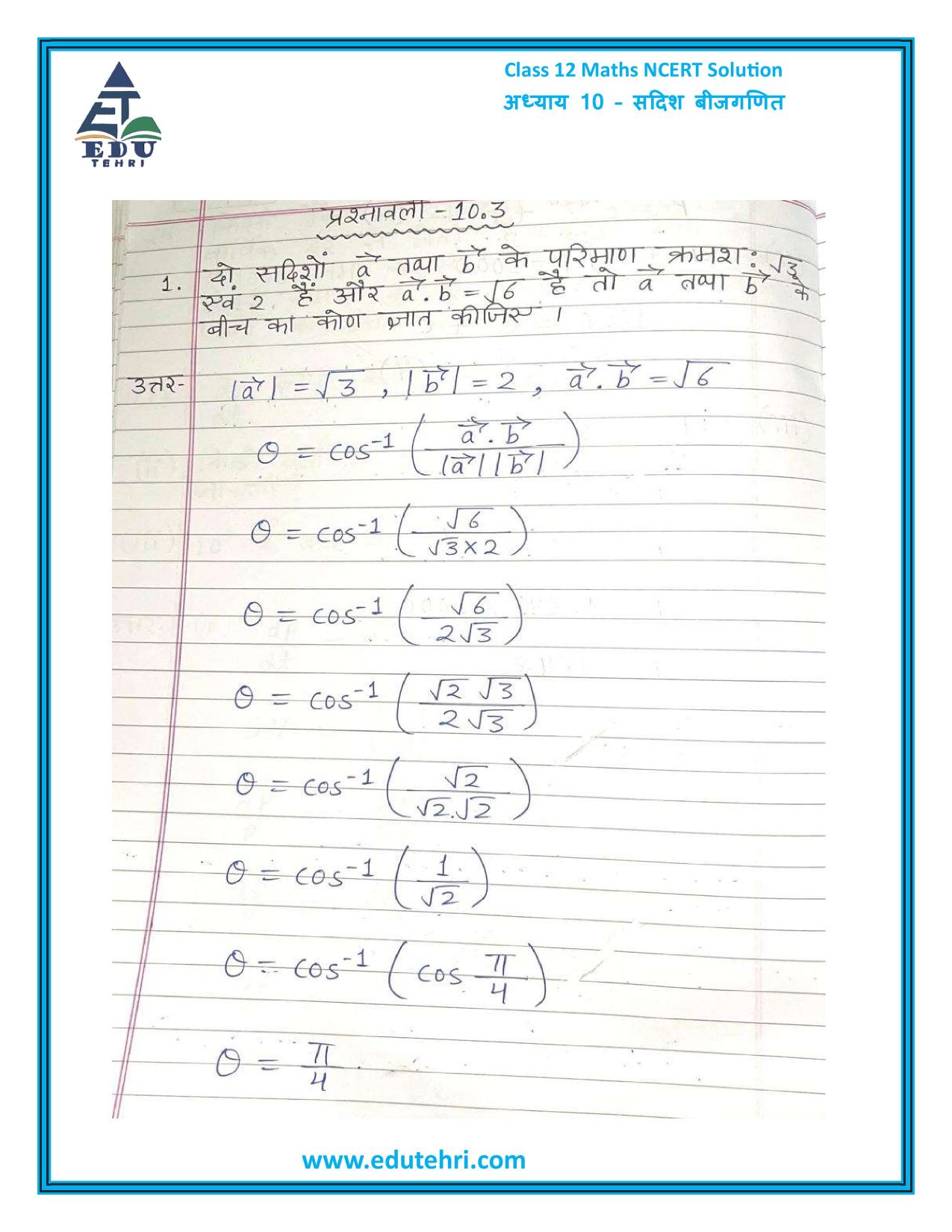
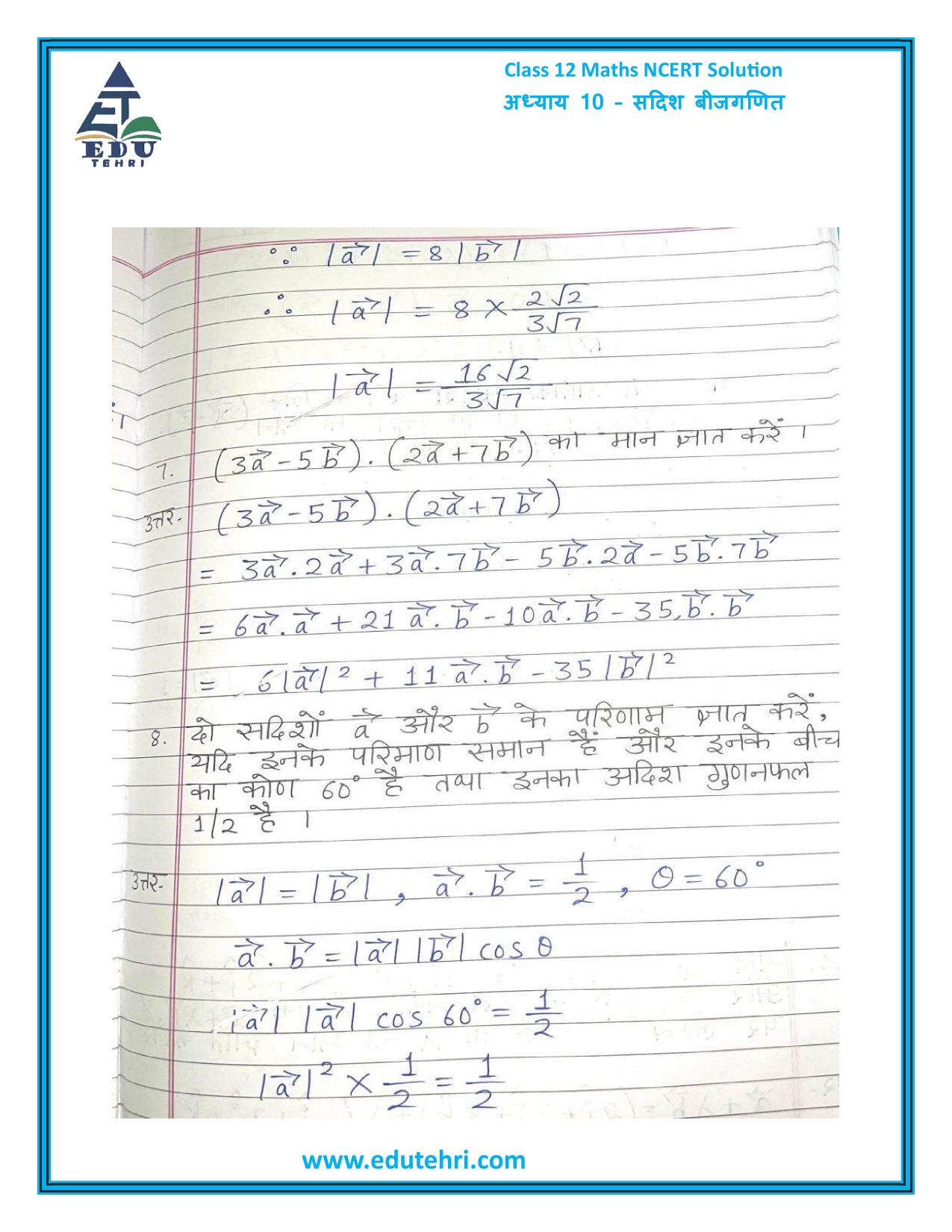
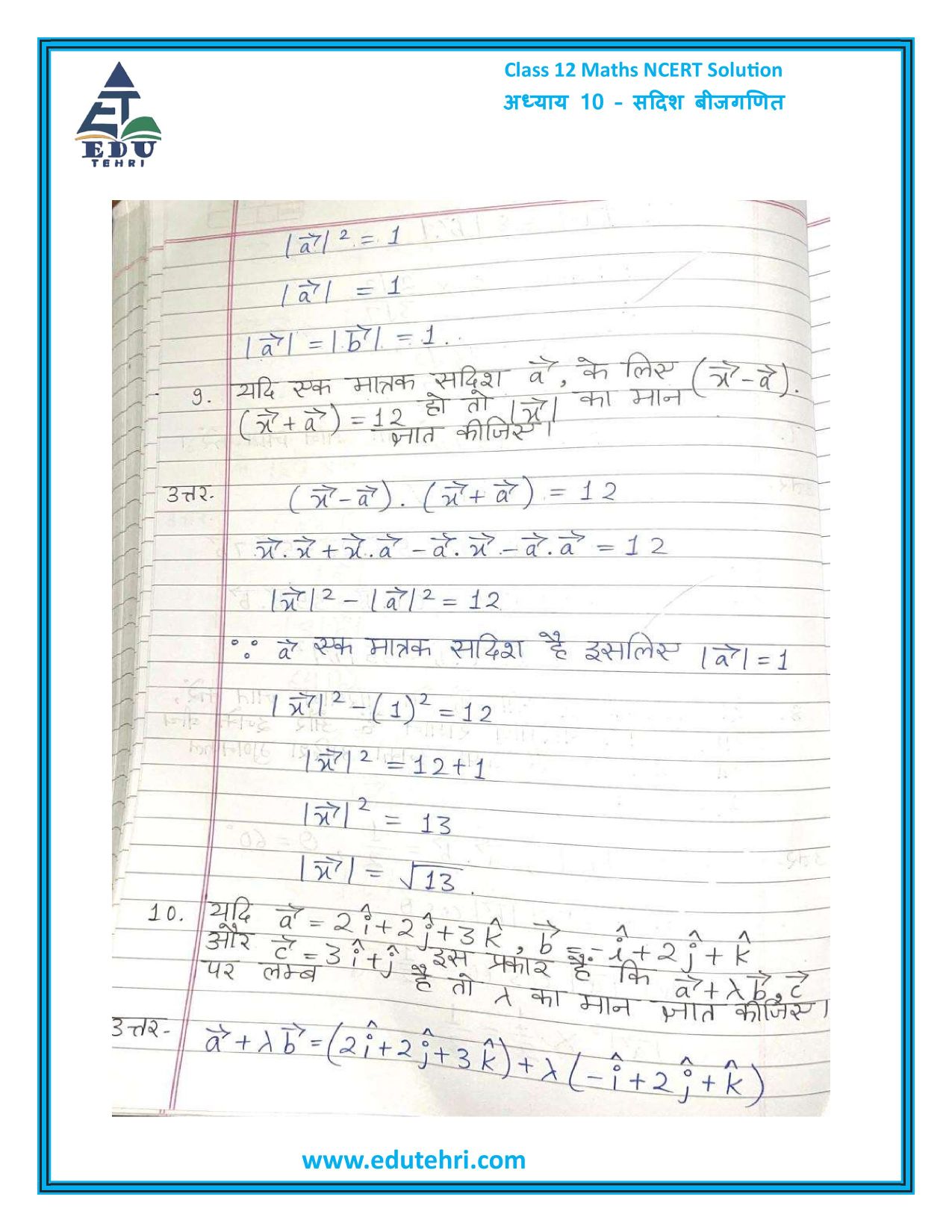
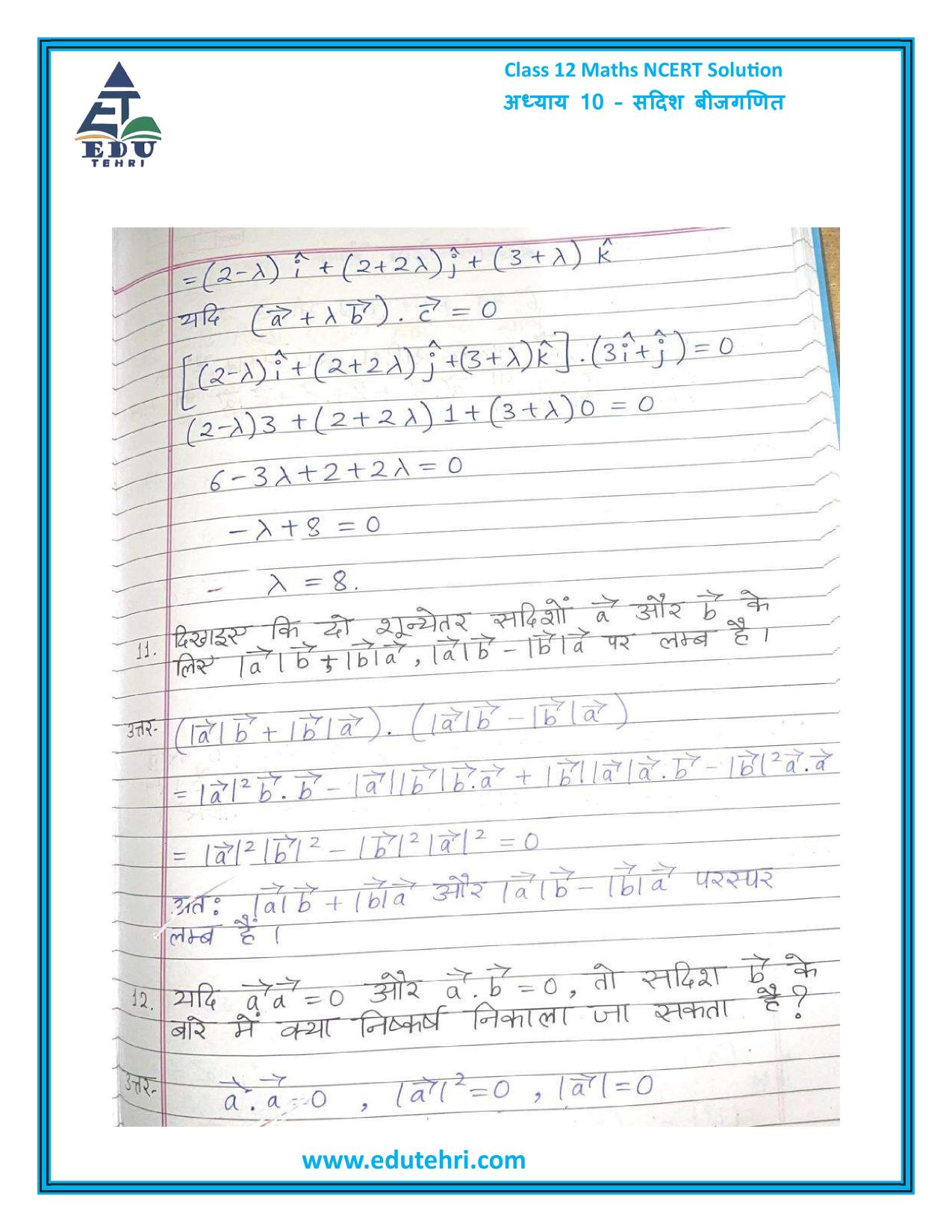
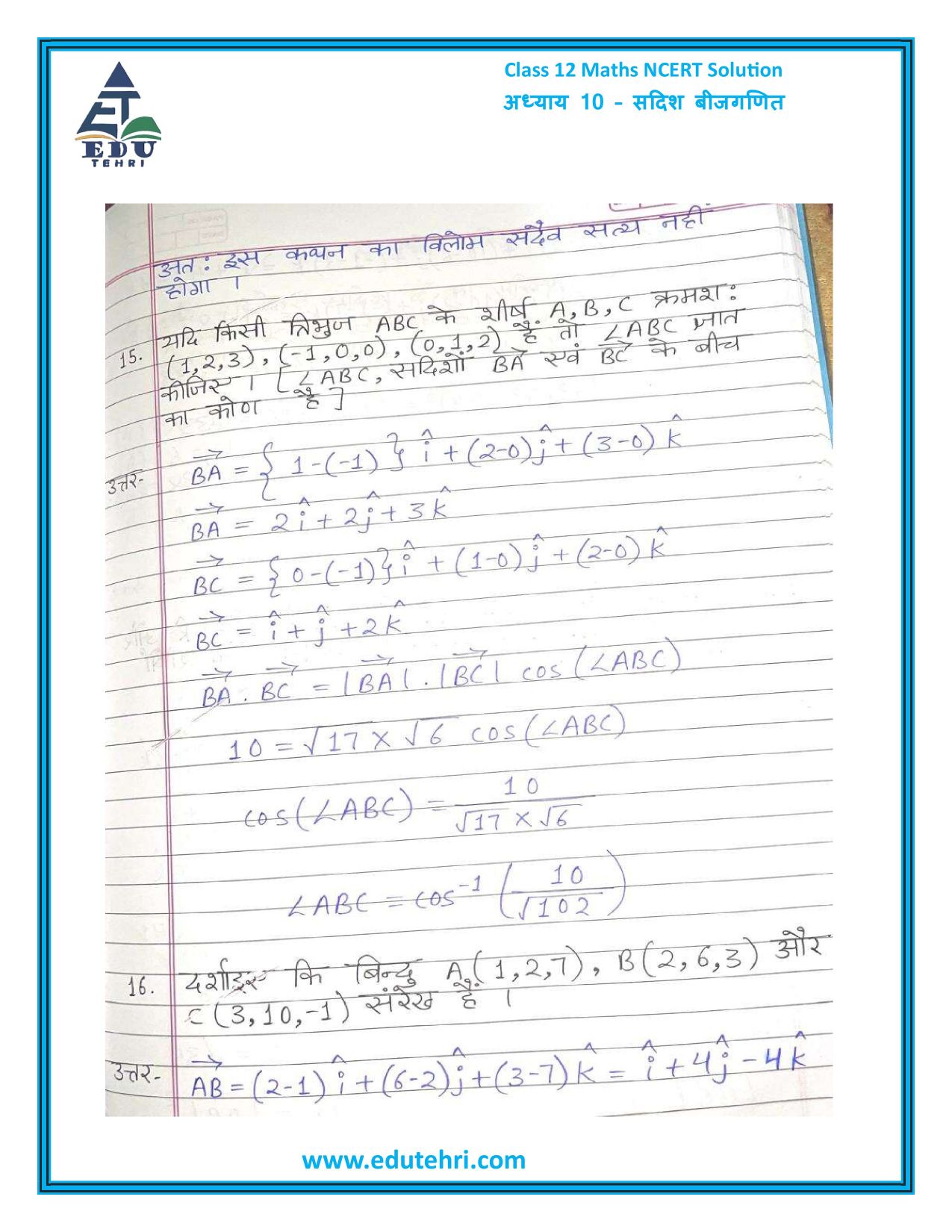
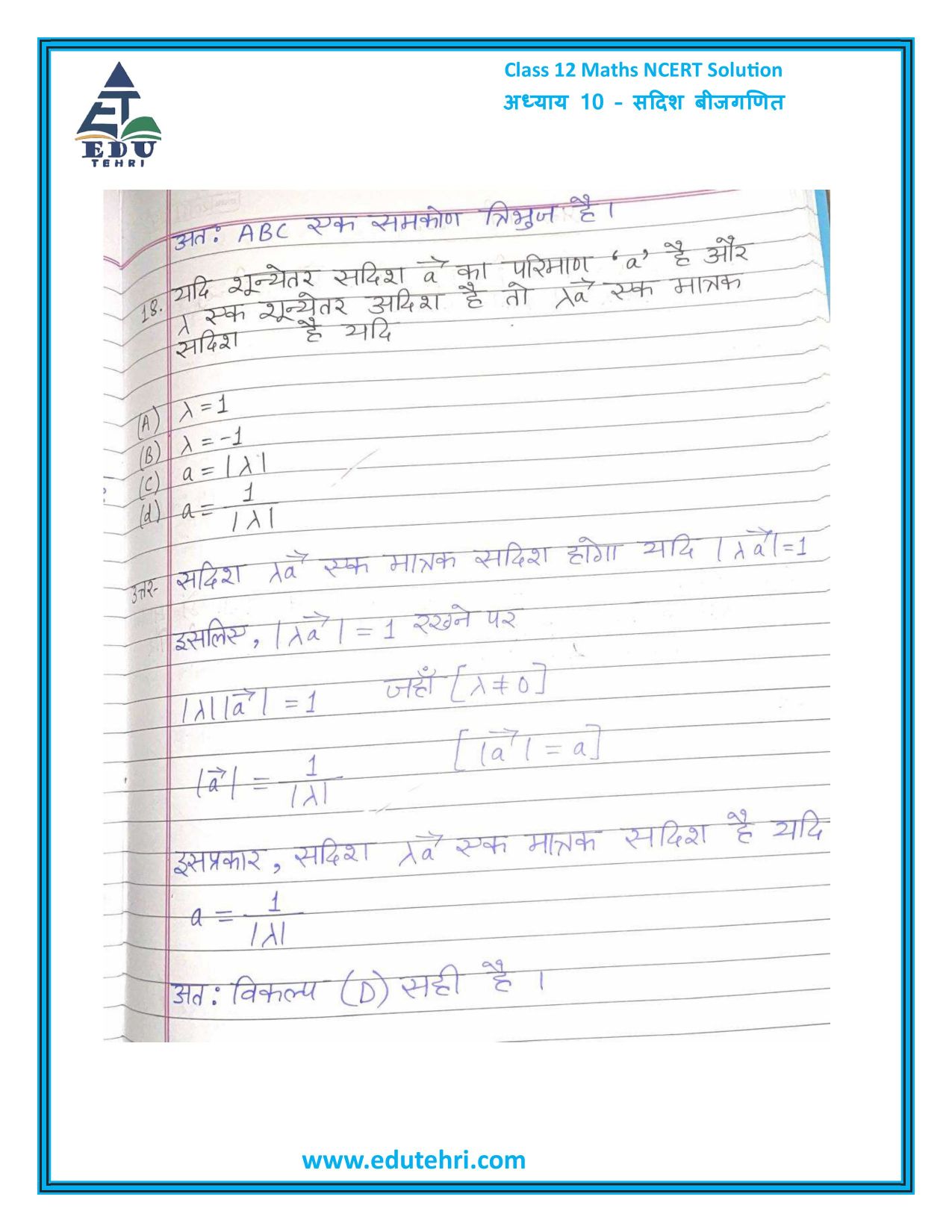
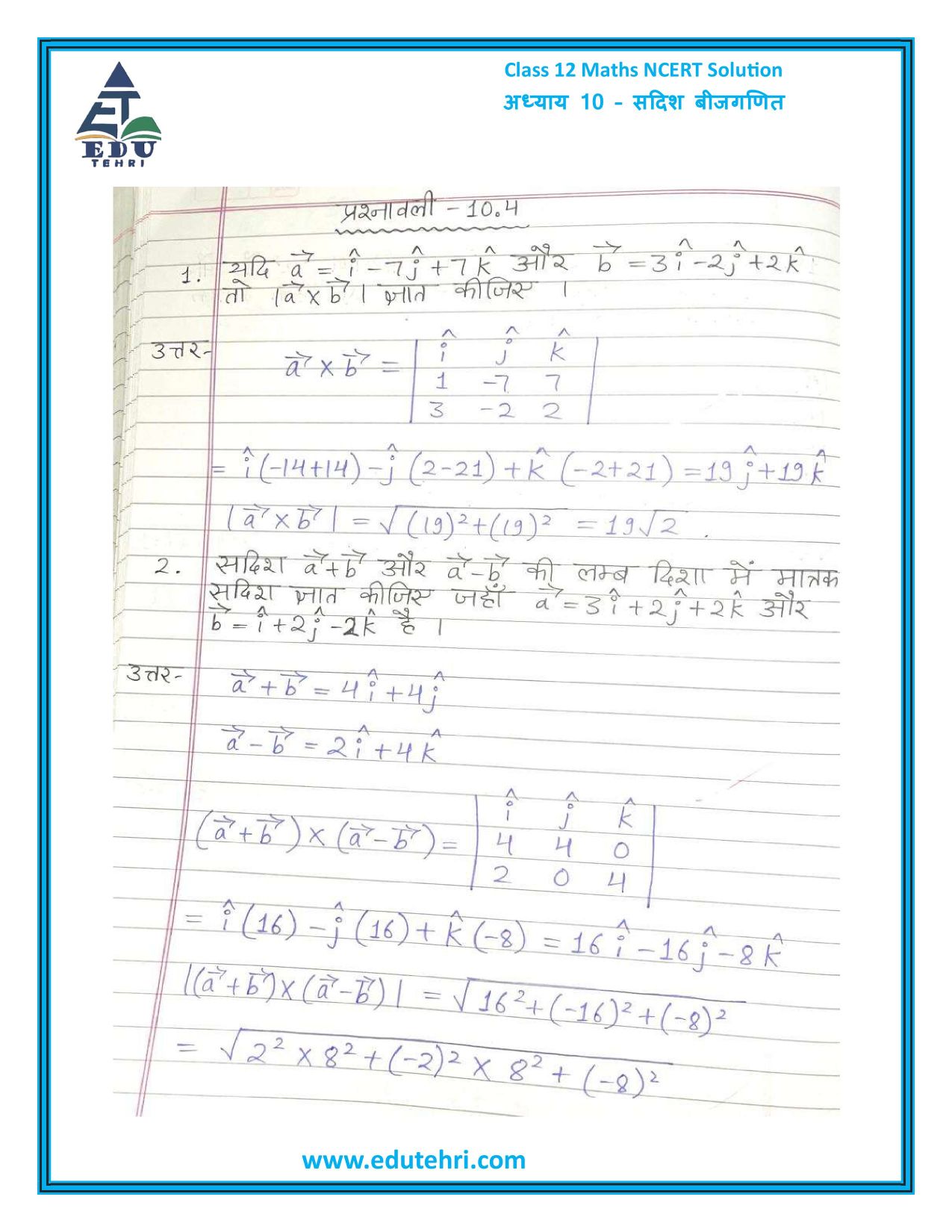
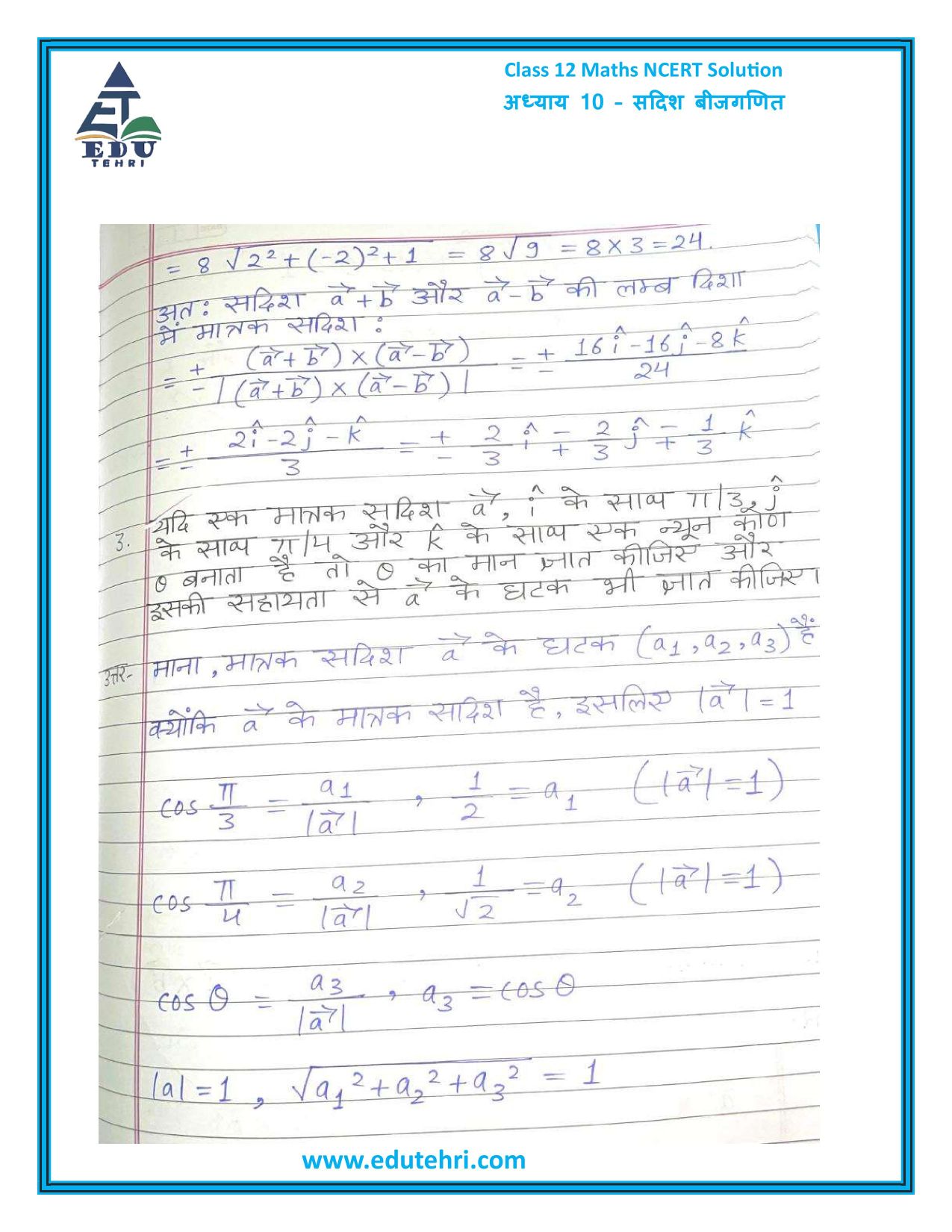
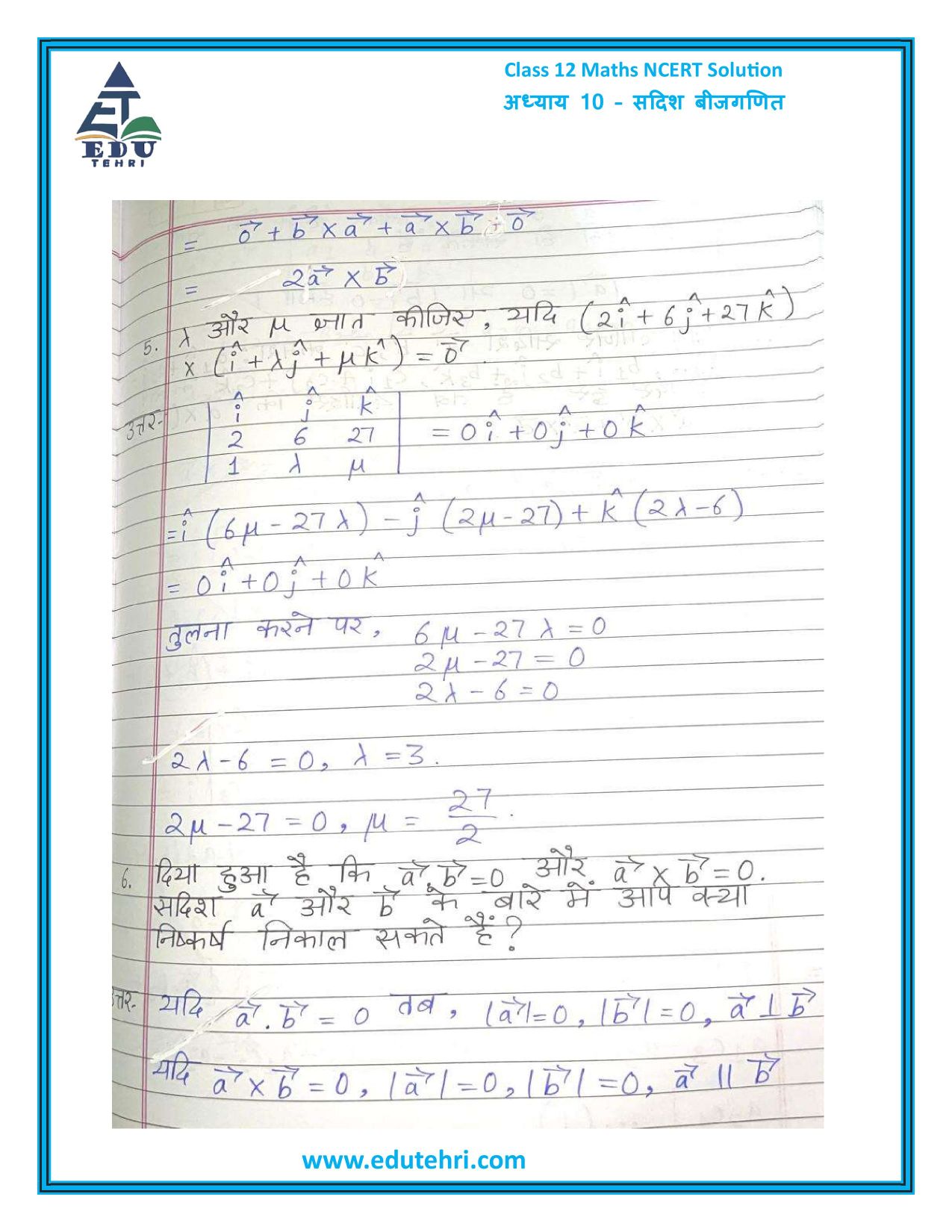
Scroll through the pages below to view the Chapter-10
Representation of a Vector
A vector is represented by:
• A directed line segment
• An arrow pointing in the direction of the vector
If a vector starts from point A and ends at point B, it is written as:
\vec {AB}
The length of the vector represents its magnitude.
Magnitude of a Vector
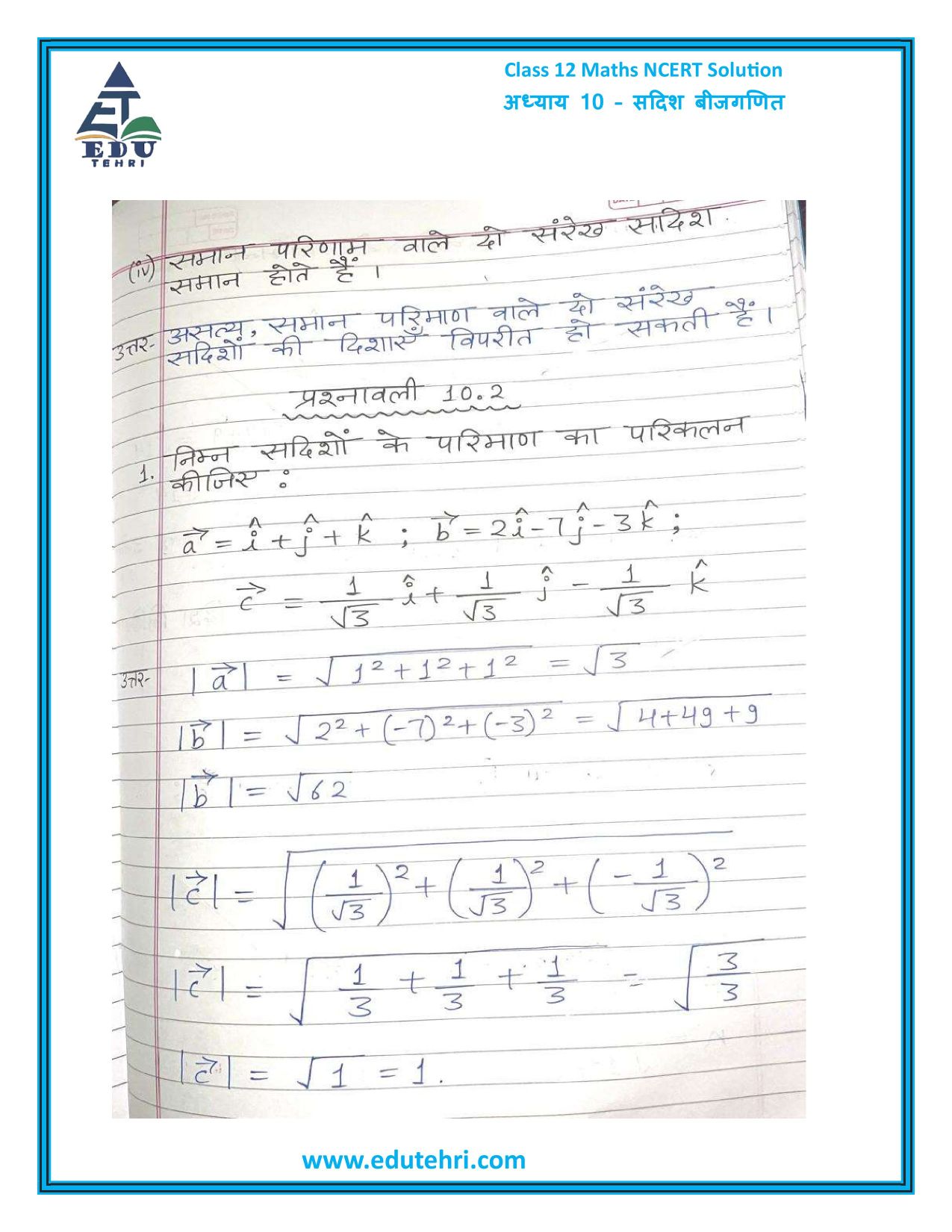
The magnitude (length) of a vector \vec{a} is written as:
|\vec{a}|
If:
\vec{a} = ai + bj + ck
Then magnitude is:
|\vec{a}| = \sqrt {a^2 + b^2 + c^2}
This formula is very important for exams.
Types of Vectors
1. Zero Vector
A vector with zero magnitude is called a zero vector.
\vec{0}
2. Unit Vector
A vector with magnitude 1 is called a unit vector.
Unit vector in direction of \vec{a}:
\hat {a} = \frac {\vec {a}} {|\vec {a}|}
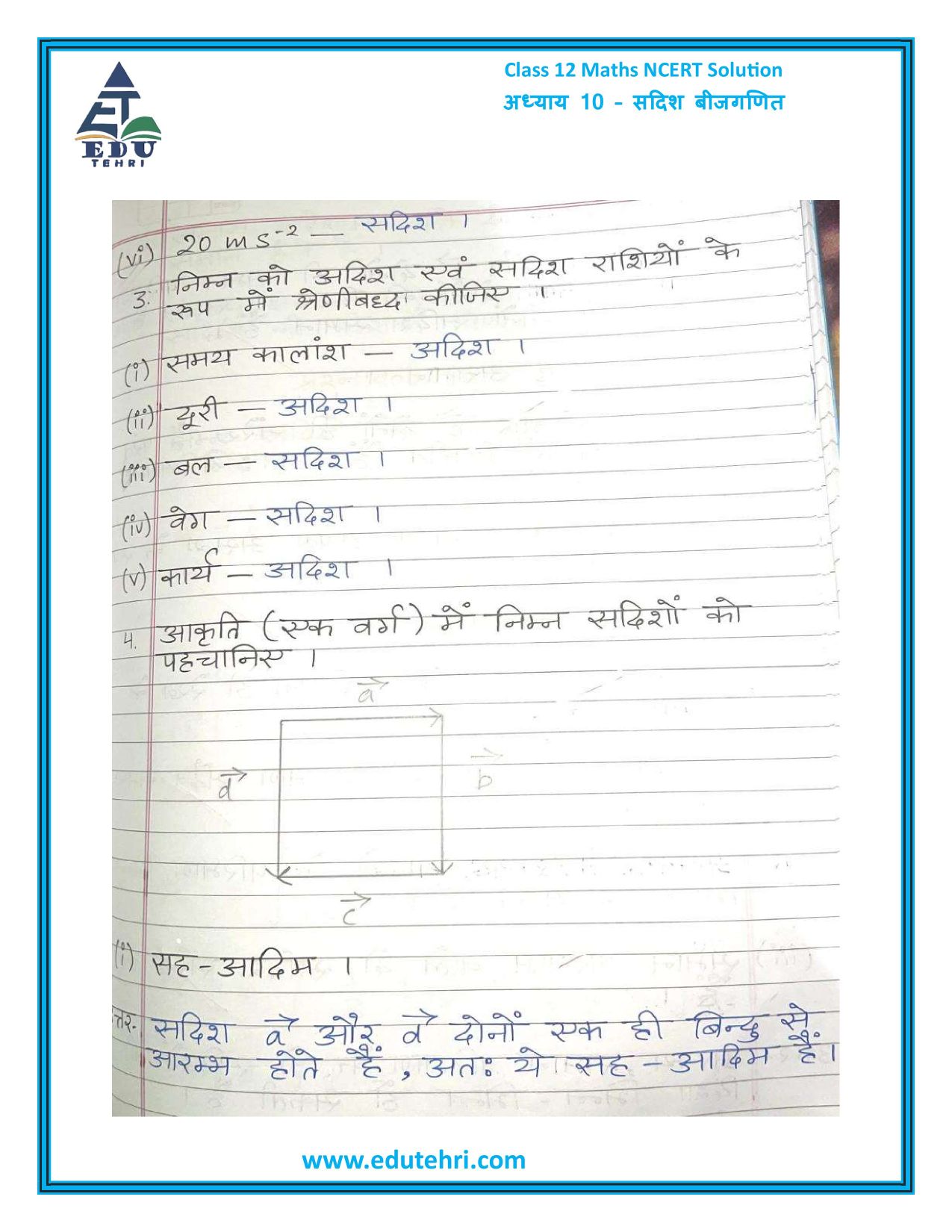
3. Equal Vectors
Two vectors are equal if they have:
• Same magnitude
• Same direction
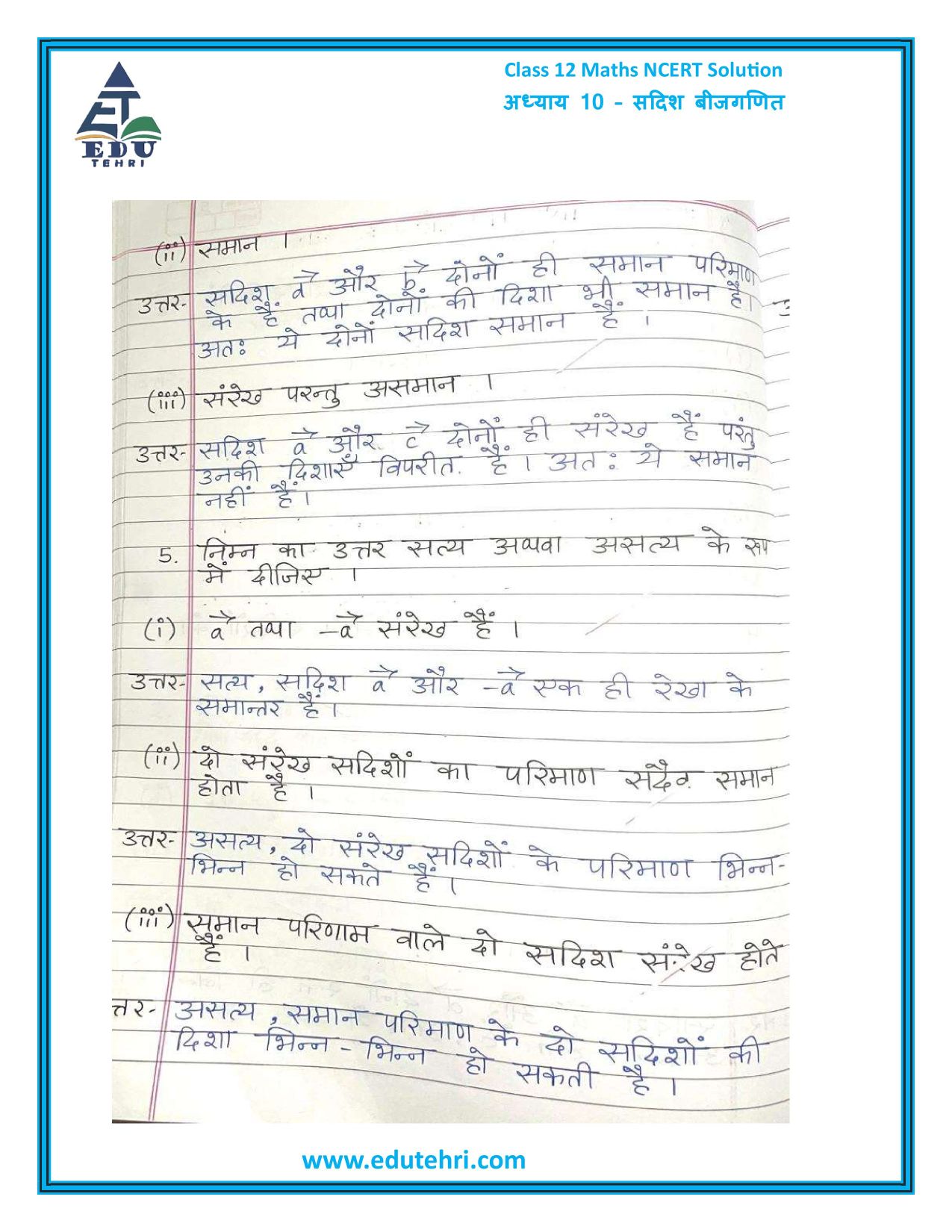
4. Negative Vectors
A vector having same magnitude but opposite direction.
5. Collinear Vectors
Vectors lying along the same or parallel line.
6. Direction Cosines and Direction Ratios
If a vector makes angles α, β, γ with x, y, z axes respectively, then:
• cosα, cosβ, cosγ are called direction cosines
Important relation:
\cos^2 \alpha + \cos^2 \beta + \cos^2 \gamma = 1
Direction ratios are proportional values of direction cosines.
7. Vector Components
A vector can be resolved into components along x, y, and z axes.
If:
\vec{a} = ai + bj + ck
Then:
• a, b, c are components
• i, j, k are unit vectors along x, y, z axes
8. Vector Addition
Triangle Law of Vector Addition
If two vectors are represented by two sides of a triangle taken in order, then their resultant is represented by the third side.
Parallelogram Law of Vector Addition
If two vectors act at a point and form adjacent sides of a parallelogram, then the diagonal through the point gives the resultant vector.
Algebraic Addition
\vec{a} + \vec{b} = (a_1 + b_1)i + (a_2 + b_2)j + (a_3 + b_3)k
9. Scalar (Dot) Product of Vectors
The scalar product of two vectors \vec{a} and \vec{b} is defined as:
\vec{a} \cdot \vec{b} = |\vec{a}||\vec{b}|\cos \theta
Where θ is the angle between the vectors.
Properties of Dot Product
1. \vec{a} \cdot \vec{b} is a scalar
2. \vec{a} \cdot \vec{a} = |\vec{a}|^2
3. If vectors are perpendicular, dot product = 0
Dot Product in Component Form
If :
\vec{a} = a_1i + a_2j + a_3k
\vec{b} = b_1i + b_2j + b_3k
Then:
\vec{a} \cdot \vec{b} = a_1b_1 + a_2b_2 + a_3b_3
10. Applications of Dot Product
Dot product is used to find:
• Angle between two vectors
• Projection of one vector on another
• Whether vectors are perpendicular
Angle formula:
\cos \theta = \frac {\vec{a} \cdot \vec{b}} {|\vec{a}||\vec{b}|}
11. Vector (Cross) Product of Vectors
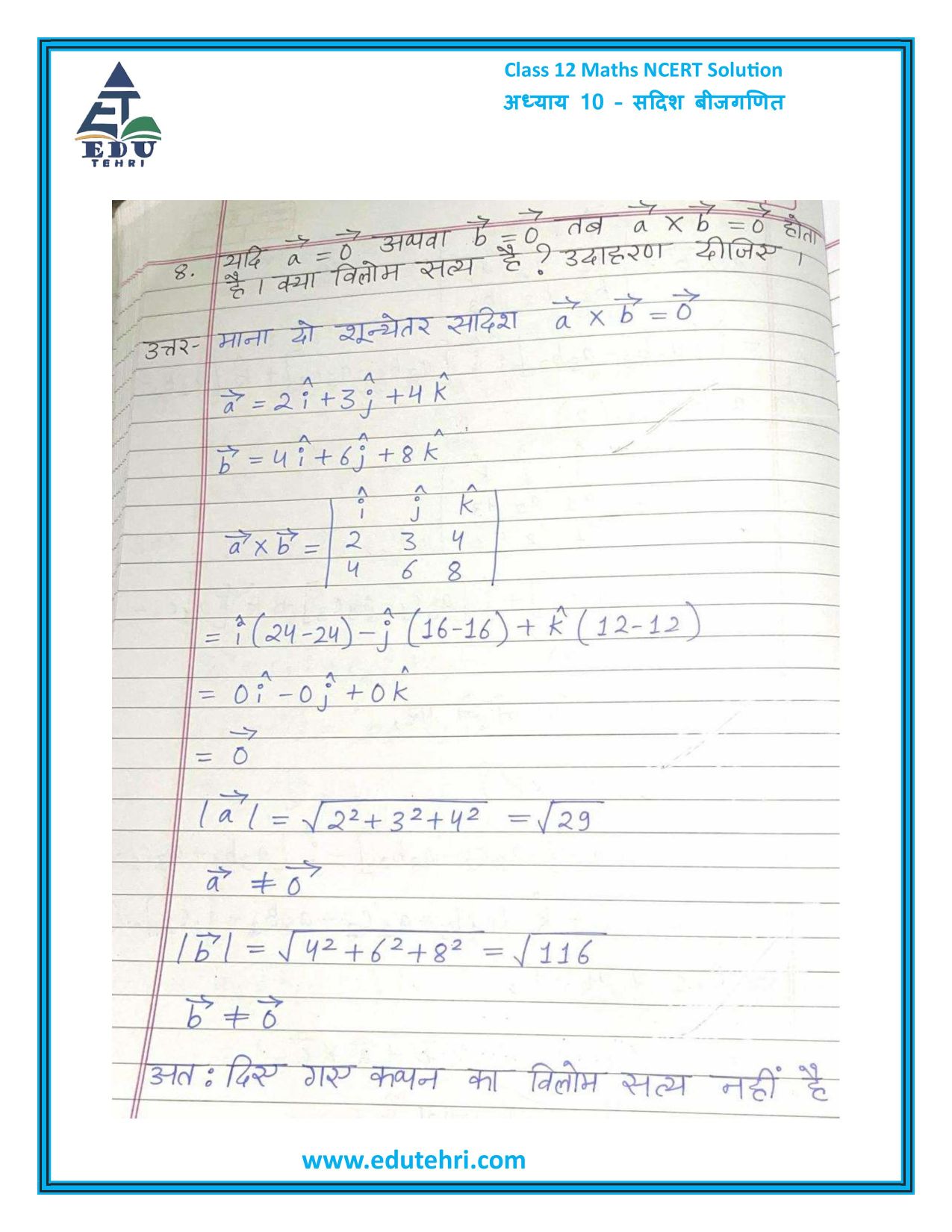
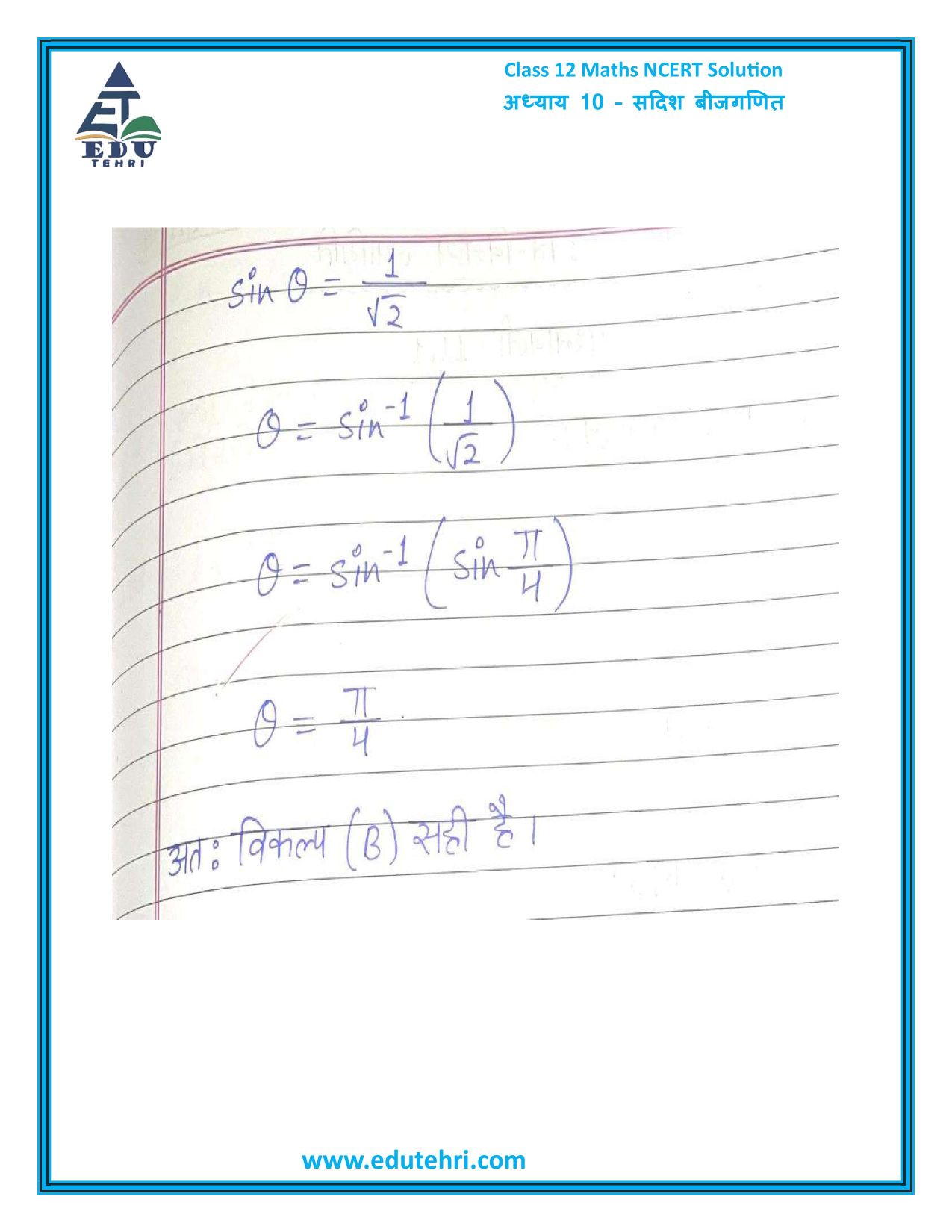
The vector product of two vectors is defined as:
\vec{a} \times \vec{b} = |\vec{a} || \vec{b} | \sin \theta \, \hat{n}
Where:
• θ = angle between vectors
• \hat{n} = unit vector perpendicular to both vectors
Properties of Cross Product
1. Result is a vector
2. Direction is given by right-hand thumb rule
3. If vectors are parallel, cross product = 0
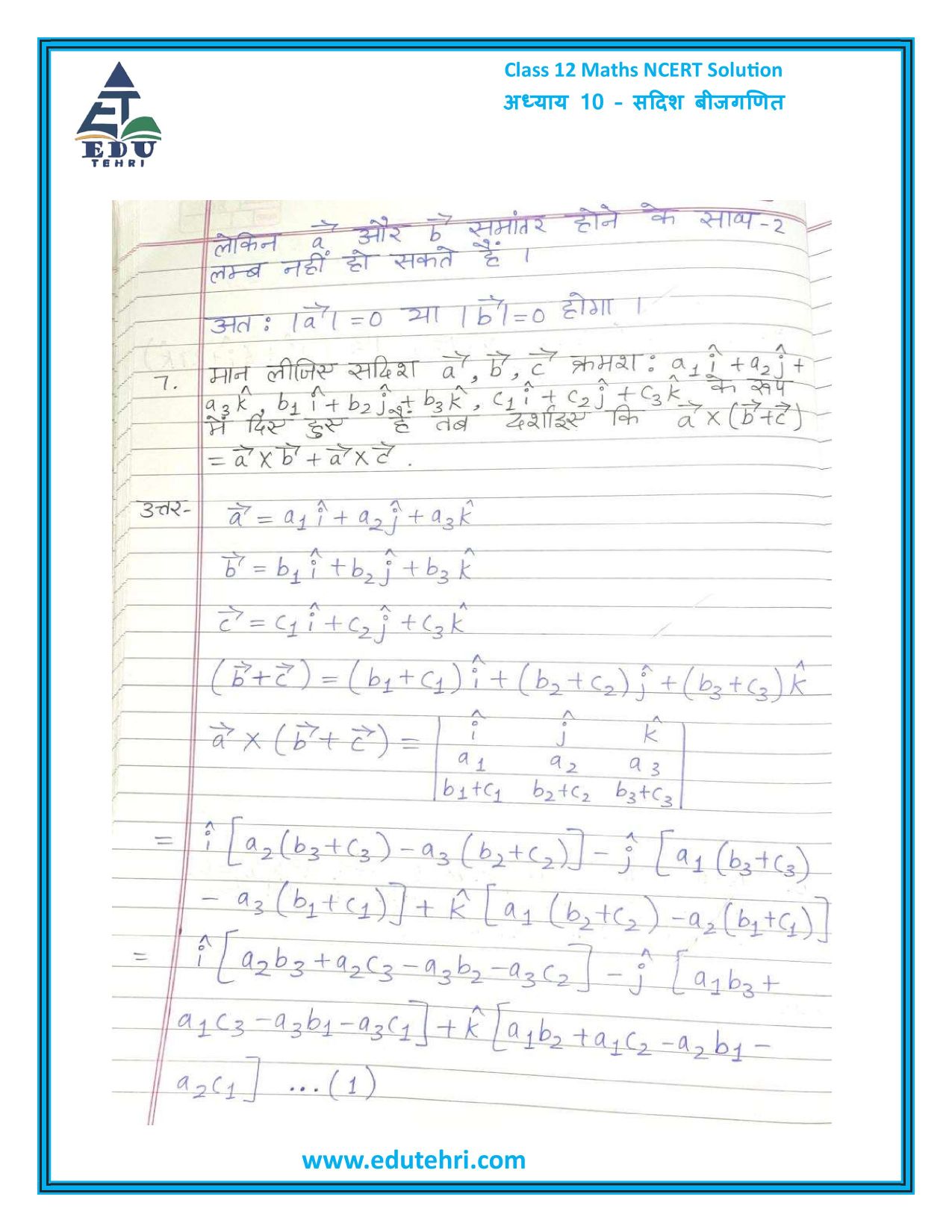
Cross Product in Determinant Form
\vec{a} \times \vec{b} =
\begin{vmatrix}
i & j & k \\
a_1 & a_2 & a_3 \\
b_1 & b_2 & b_3
\end{vmatrix}
This form is very important for exams.
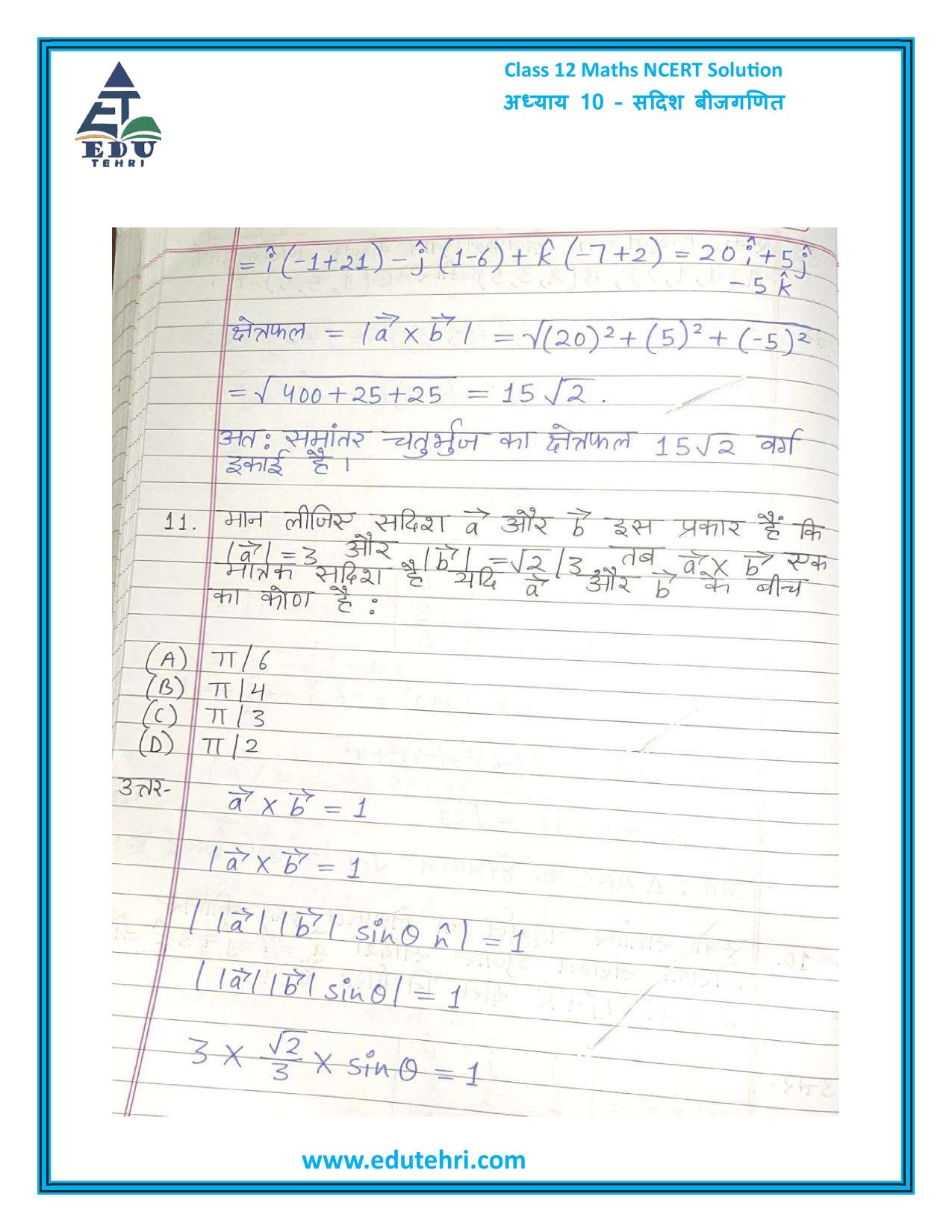
12. Applications of Cross Product
Used to find:
• Area of parallelogram
• Area of triangle
• Vector perpendicular to a plane
Area of triangle:
\text{Area} = \frac{1}{2} | \vec{a} \times \vec{b}|
Exercises in Chapter 10
NCERT Chapter 10 contains 4 exercises.
Exercise Details:
• Exercise 10.1 – Basic vector concepts
• Exercise 10.2 – Magnitude and direction
• Exercise 10.3 – Dot product
• Exercise 10.4 – Cross product
Exercises 10.3 and 10.4 are most important for boards.
Exam Weightage & Importance
• Usually 5–8 marks in board exams
• Often asked as long answer questions
• Forms base for 3D Geometry
Edu Tehri – Free PDFs & Handwritten Notes
Edu Tehri provides complete Chapter 10 support, including:
• Free NCERT solution PDFs
• Handwritten notes
• Formula sheets
• Board-oriented questions
• Step-by-step explanations
Key Features of Chapter 10
• Concept-based chapter
• Highly scoring
• Important for competitive exams
• Visual and formula-oriented
• Foundation for next chapter
Frequently Asked Questions
Q1. Why is Vector Algebra important in Class 12?
Because it is used in physics, engineering, and forms the base of 3D Geometry.
Q2. Is NCERT enough for Vector Algebra?
Yes, NCERT questions are fully sufficient for board exams.
Q3. Which topic is most important in this chapter?
Dot product and cross product are most important.
Q4. How can students score full marks?
By learning formulas, practicing NCERT exercises, and avoiding calculation mistakes.
Classs- 12th Mathematics NCERT Solutions All Chapters - Hand Written Notes | Free download PDF's | 2026-2027